Every student of history should locate and tour pertinent UO collections. To be a historian without close personal familiarity with libraries is like being a physicist or biologist without close personal familiarity with laboratories.
If you wish, hop directly to UO ELECTRONIC CATALOG (& other catalog services)
Here are some useful thoughts about "reading"
in the academic setting =
Hop to this [TXT], then come back here [ID].
And here is a table of contents guiding
you to eight rich UofO research/reading locations which you should know about =
KNIGHT Reserve Book Room
KNIGHT MAP Room
KNIGHT Reference Division with entry on Wikipedia
KNIGHT stacks
KNIGHT Information Technology Center
Jordan Schnitzer Museum of Art
Architecture & Allied Arts Library [W]
Jaqua Law School Library [W]
KNIGHT LIBRARY reserve book holdings
(accessed at the main checkout desk)
Access
any course reserve book room list.
You might want to print the list for this course, sorted BY AUTHOR.
Some films (movies) of use to the historian, are housed on the third floor of KNIGHT
THE UO MAP LIBRARY or MAP ROOM [MAP]
Here you will find several globes which will work very well for a little experiment. Look at Russia’s position and its bulk on any one of these largish globes. Lift the globe and position the southwestern Siberian city Novosibirsk in the center of your field of vision. Notice how much of the world land mass is located in the hemisphere before your eyes. Check the exact opposite hemisphere. That other side is largely Pacific Ocean.
Using your thumb and little finger as compass points stretching over the oval surface of your globe, measure some of the following distances =
Carry these manual compass stretches one at a time to Eugene OR ("transpose" these distances with your thumb and little finger as compass points) in order to see how far from Eugene you would have to go to equal those historical distances. Do the same for the distances among and between these European cities: (1) Moscow, (2) Berlin, (3) Paris, and (4) London.
Teach yourself how to sketch by hand the map or maps most essential to your work this term.
HIST 245 Click here to return to syllabus
HIST 303 Click here to return to syllabus
HIST 345 Click here to return to syllabus
HIST 346 Click here to return to syllabus for more MAP ROOM exercises
KNIGHT REFERENCE DIVISION [REF]
REF AE = Encyclopedias, particularly =
REF DK = The range of Russian historical reference
Dictionary of Literary Biography =
Check this University of Illinois GUIDE TO SOURCES ON RUSSIAN HISTORY AND HISTORIOGRAPHY
REF E-range = USA historical reference
The range of European and world historical reference =
REF D419... to D1051....| Encyclopedias and dictionaries of 20th-c. Europe
There are important reference guides beyond the first floor =
Raymond Pearson, Russia and Eastern Europe, 1789-1985: A Bibliographical Guide [Z2483.R83+1989]
STUDENT REVIEW=
[I]t's probably far from complete, [but] it's a quite helpful listing of materials relating to a wide number of topics -- from general histories to
materials relating to science, art, and culture, national minorities, the Tsarist government, and into the Soviet period. Most helpfully, for each topic
there seems to be a guide to primary source materials in English as well as all sorts of categorized secondary source citations. Glancing through
it, everything seems to be in English, too.
Materials on the Internet
For some suggestions about the internet as storehouse of information, try this Basket of Websites
The internet encyclopedia Wikipedia
is a handy reference work always available when you are working "on-line"
*--Here, as everywhere, but especially here, be cautious about what you find
*--Never cite Wikipedia in your journal or research work, on any topic, without comparing the Wikipedia account
with other reference or textbook sources, and/or SAC, and citing them together
*--What sort of editorial control does Wki exercise? What if there are serious disputes about
how an article ought to read? Here is an example of a Wki editorial dispute
[E-TXT].
Doesn't the editorial article make a false claim? It is linked to a whole bushel of blather on what the Wki
article on "Antiwar.com" should say. It is impossible to make clean good sense out of the
discussion. NB! active "citizen" editor Moore
*--Wikipedia article on "Reliability of Wikipedia"
*--Wikipedia article on the arguably most esteemed traditional "hard-copy" encyclopedia published in English,
Encyclopedia Britannica
*--Here is a thought-provoking SAC entry on Wikipedia
Archival guides
No attempt is made here to list a complete bibliography of archival guides, but one has been digitalized and is available on the web =
Grant, Steven A., and John H. Brown, The Russian Empire and Soviet Union: A Guide to Manuscripts and Archival Materials in the United States
KNIGHT Information Technology Center
For now, just find out where this facility is located,
on the lowest level of the library, on the far western extreme of the building.
We may have occasion, as a whole class, to view films in the studios of the Media Services Division
KNIGHT stacks
Take five-ten minutes to browse a Knight Library shelf range that contains publications relating to the history of one large territorial nation-state pertinent to our course. I do want you to get a visual sense of just how big our topic is, as seen in our fine but not really huge library. But you need not be overwhelmed. In fact, I would like to help you relax a bit about this miniature, five-ten minute physical imitation of "research". If you had to ponder these shelves at length, searching for titles that might help you as a researcher (perhaps later for a seminar paper or senior thesis, etc.), you could do it. But for now, sort the course reserve book list by call-number and notice how many of the titles on reserve cluster within one Library of Congress call-number range. That would be a good range to walk past. For one thing, there are second and third copies of some titles on our reserve book list still on the regular shelves and thus available to you for the longer check-out period.
DK = (Russia and the peoples of the Russian and Soviet empires). Calm yourself about the overwhelming number of Russian history books there, and about the fact that so many of them are in Russian. Our course is an introductory undergraduate survey. But at the next level, foreign language is to history as calculus is to physics. Relax, we're not trying to reach that next level just yet.
If you were to take the next step as historian, after taking courses like ours, you would need reading fluency in English and two to four foreign languages, one of them at the highest possible level of competence.
"Making" modern European history can be done with English alone, and that's what we will do. However, it is important to know that the next step above ours, in this undergraduate curriculum, is to master English, Russian, German and French.
Here are some other ranges in the Library of Congress system=
DA... (England and peoples of the British Isles)
DB... (Austria)
DC... (France)
DD... (Germany)
DH... & DJ... (Lowlands=Belgium, Netherlands)
DL... (Scandinavia=Norway, Sweden, Finland)
DP... (Spain)
DQ... (Switzerland)
DR... (Balkans:Serbia,Croatia, Bulgaria, etc.)
DS... (Asia--Central..., Near East)
DT... (Africa)
DU... (Austria and Pacific islands)
DX... (Romani [Gypsies])
These endless shelves seem overwhelming, and DK is just one of several concentration points of Russian culture and history in our library. You could check PG....
Then there is this gigantic alpha-range=
E = (The Americas, including USA)
UO JORDAN SCHNITZER MUSEUM OF ART [W]
(located just NE of Knight Library)
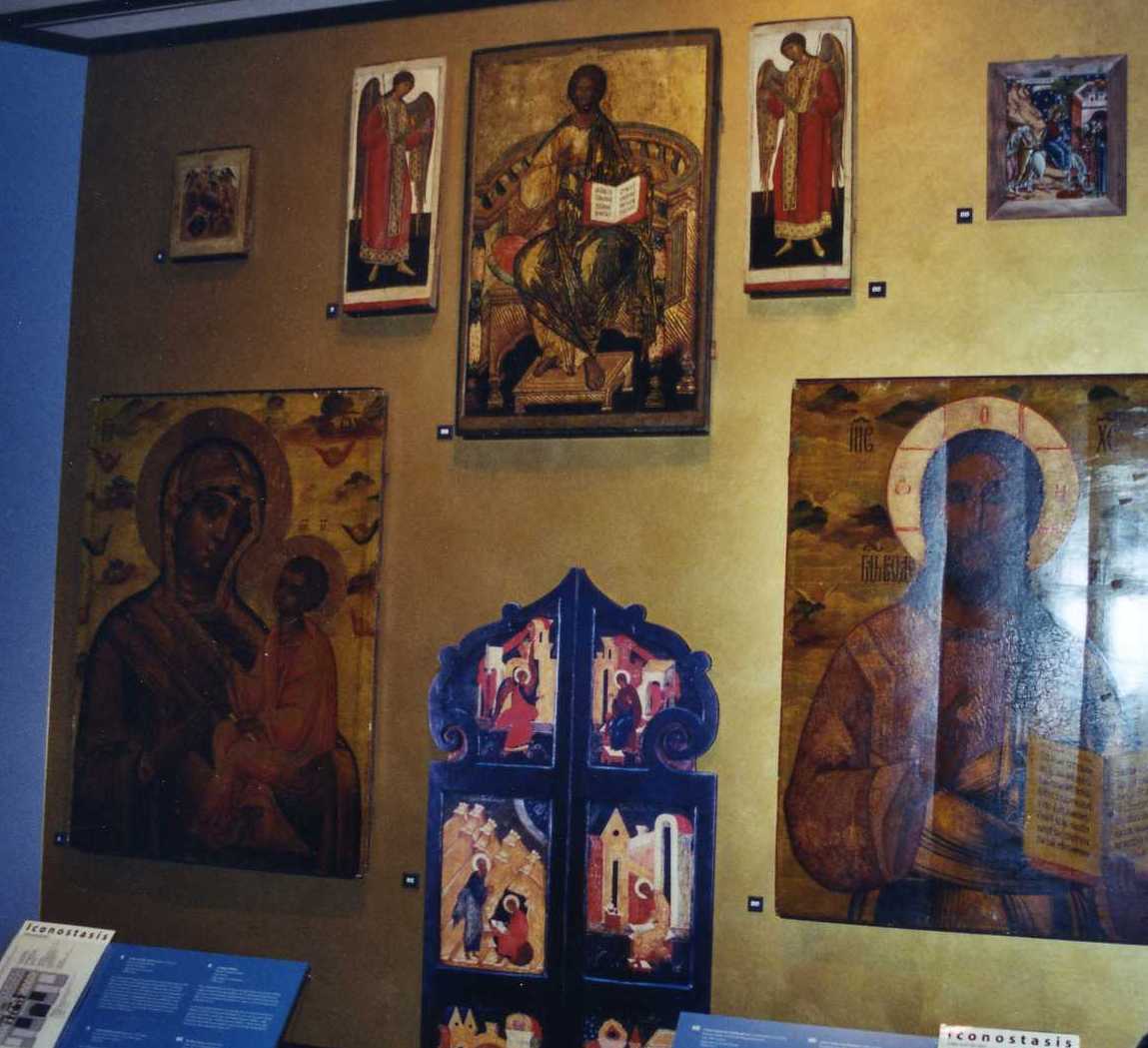
While walking from Knight Library to the Art and Architecture Library, drop in on the UO Art Museum. All historians of Russia should visit the Icon collection there. Here is a photo of the mock-up iconostasis as it was originally designed and built in the Museum =
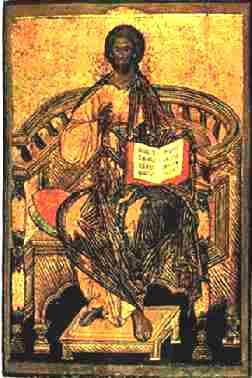
Here is a close-up of the the icon at the top center of the photo above =