
<>1983mr:Mikhail Gorbachev, as Secretary of the Central Committee [TsK] of the Communist Party in charge of agriculture, approved breaking up large kolkhoz enterprises into small autonomous groups [87no3:KIARS (A. Nove) | Boldin:175-86 | Miller:53-74]
<>1983ap:Siberia,
Novosibirsk | Tatiana Zaslavskaia issued a report which attacked "hypertrophy"
of the Soviet political-economy
*--She stressed the importance of making more room for public initiatives and
interests (civil society) in the processes of industrial production and exchange
[DSC:35-47]
*1983au03:WPo published Zaslavskaia
*1984:Survey published Zaslavskaia [DSC:35-47]
*--Zaslavskaia's reform writings translated and collected in A Voice of Reform
[review]
*--Soviet dissent seemed to come from high places, such as the powerful academic community of Novosibirsk
*1983: SAC editor's personal memoir of public lectures he delivered throughout this year on
Soviet dissent, "Thoughts on Dissent" [TXT]
\\
*--[W]
*1986se10:KIARS (Theen says Z's report was written in 1982)
<>1983je:USSR experimented with autonomous teams or brigades
in factories; wages in proportion to contribution
*--Foremen were given incentive to weed out goldbricks & drunkards = 7 of 39M workers targeted
*--Also autonomous worker brigades in agriculture, paid per harvest in many kolkhozes; private plots expanded
<>1983se01:Siberia, Sakhalin Isl. SW coast |
Soviet interceptor jets shot down [South] Korean Air Lines flight
with loss of 269 passengers and crew
*--The Korean airliner had deviated from its scheduled flight path and passed through sensitive
Kamchatka Peninsula and Sakhalin territories [W]
<>1983oc25:USA President Ronald Reagan sent the growing but recently inactive military into Grenada, a small Caribbean island just north of the Venezuelan coast (but still Grenada was a British Crown colony now being invaded by its USA ally) [ID]
<>1984:French extremist nationalist Jean-Marie Le Pen (leader of reactionary National Front) published Les Français d'abord, which expressed the severe anti-communism at the heart of European reactionary politics: The First Horseman of the Apocalypse: International Communism [P20:401]
<>1984fe:USSR | Konstantin Chernenko
became First Secretary of the Central Committee of the Communist Party [TsK]
upon the death of Yuri Andropov
*--Mikhail Gorbachev became Secretary in charge of cadres and the real actor [Kerblay,Grb |
Boldin:ch2] [LOOP on "cadres"]
*--In this year, enterprises within 7 ministries were decentralized; model for 1987:law
*1984:USSR government Planning Committee approved "Sibaral" [acronym SIB(eria)+ARAL Sea],
a plan for the diversion of Siberian rivers to the Aral and Caspian sea basins, a
bold environmental/engineering project
<>1984jy24:Soviet officials moved to impose censorship on pop-arts or commercial-culture music (even listing the rock groups whose music cannot be played in the USSR) [PS&C:143-5]
<>1985:Poland, Gdansk | Adam Michnik, Letters from Prison and Other Essays [excerpts, SFS:236-9]
<>1985mr10:USSR First Secretary of the Central Committee of the Communist Party [TsK] of the Soviet Union, Konstantin Chernenko, died [D&F:1-11]
<>1985ap23:USSR Central Committee plenum set whole series of events in motion =
<>1985my08:German Federal Republic President Richard von Weizsäcker addressed the problems of the Nazi past, A German Plea for Remembrance and Reconciliation [P20:427]
<>1985:USA Philadelphia police bombed restless neighborhood, expressing a distinctly modern amalgamation of police/militarism [The Guardian [ E-TXT]
<>1985de:Kazakhstan felt
intensification of anti-corruption campaign initiated earlier by Andropov. Kunaev
removed from post
*--Other Central-Asian republics took up the campaign, G. Aliev in Azerbaijan and
Eduard Sheverdnadze in Georgia, both of whom rose out of Andropov KGB
"patronage network" [Derluguian, "Rouge":19]
<>1986fe25:USSR Communist Party Congress #27 considered the bold plans laid out over the previous half year [Boldin:119-22 D&F:29-31 Medvedev, Time:1-37 Walker:38-101!]
<>1986mr09:MGW reported on Gorbachev speech about the "petty tutelage" officials exercised over the Soviet economy
<>1986mr01:
Gorbachev policy of glasnost formally introduced
[D&F:50-2, 133-4 | Melville:27-72 |
Boldin:ch5 | Steele:1-7]
*--On Soviet everyday life in these months [Walker:154-205]
*--On rise of civil society [Steele:1-17]
*--On search for historical identity [Walker:202-22]
<>1986ap26:Chernobyl
nuclear disaster focused world opinion on the dangers of nuclear power and
environmental degradation in the USSR and elsewhere [CVG:157-73
D&F:32-38 Medvedev, Time:37-57 Walker:223-45]
*--More about nuclear power and environmental concerns [Eisen:273-80]
\\
*--Murray Feshbach and Alfred Friendly, Jr.,
Ecocide in the
USSR
*--Donald Kelley on Environmental protection and conservation in Russia and USA,
Jamgotch,
Sectors
<>1986my:Moscow meeting of Soviet Filmakers' Union elected Elem Klimov (1933-2003) president in a tumultuous session
The city was ablaze up to the top of the sky. The river was also burning. It was night, bombs were exploding, and mothers were covering their children with whatever bedding they had, and then they would lie on top of them. Had I included everything I knew and shown the whole truth, even I could not have watched it. [Reported in 2003no04:Guardian obituary]
<>1986je19:Moscow Kremlin | Gorbachev met
with 20 or so writers
*--He asked their support of Perestroika, but he cautioned them
against vengeful attacks on past policies and personalities
*--Gorbachev hoped the USSR might peacefully just leave all that behind and greet a bright new day
<>1986jy27:MGW reported that a 17-page manifesto circulated, "To the Citizens of the USSR", issued in the name of a "Movement for Socialist Renewal" [1986au03:MGW published full English text of manifesto]
<>1986au:USSR government dropped Northern Rivers Project, perhaps averting environmental disaster, and perhaps responding to a growing environmental movement among Soviet intelligentsia and citizenry [1987je10:KIARS (Darrell Hammer)]
<>1986oc:ICELAND Reykjavik Summit held on short notice
<>1986de10:Komsomolskaia Pravda published letter-to-the-editor about
religion, written by world-famous poet Evgenyi Yevtushenko
*--The editors attached an official rebuttal [Melville:123-6]
*--Novels on religious themes published by Viktor Astaf'ev, Vasilii Bykov, Chingiz Aitmatov, etc [Melville:121-48]
*--This was a year of religious revival, opening era of glasnost in religion
<>1987:UNO World Commission on Environment and Development issued its first report, Our
Common Future [excerpts = PWT2:426-34]
*--UNO was entering the global environmental movement
<>1987ja27:Soviet President Mikhail Gorbachev speech to TsK Plenum. The meeting was delayed three times before Gorbachev got Communist Party Politbiuro support for his declaration of institutional or political reform [Medvedev,Time:77-108 IR9]
<>1987my07:Moscow meeting of Russian patriotic
society Pamiat' [memory] [D&F:63-5 IR9:302]
*--In this year, Pamiat' attracted nearly 1000 to
a rally in Dynamo Stadium [Hosking:10] GO 88fe26
<>1987:Russian émigré author, Vasilii Aksenov [Vassily Aksyonov] published his account of how he made his own adjustment or reconciliation to life in USA, In search of melancholy baby
<>1987je:Soviet TsK plenum took decision to embark on economic reforms, as a component of political/institutional reforms [DSC:69-82 | D&F:69-73 | IR9]
<>1987je:Roundtable
discussion on rock music and counterculture [TGG:154-68]
*--Re. Yurii Shevchuk [162-6. See bibliography p168 = E. Kanev Losoto, Aleksandr
Milovskii, E. Panov, Vasilii Pustov, I. Sidorov, M. Timasheva, A. Sokolianskii]
\\
*1987:NYT article on heavy metal rock in the USSR [TXT]
*2004:Michael Urban and Andrei Evdokimov explored the Russian pop-arts
scene and found deep cultural meanings and an intense popularity of "the Blues" imported from USA
[TXT]
*--Documentary films on the great US blues musician Robert Johnson =
FLM#1
FLM#2| Part two at 30 minutes plus, meet Son House and Rbt Johnson|
Then at 45 minutes plus, meeet Paul Butterfield Blues Band
FLM#3, CAN'T YOU HEAR THE WIND HOWL: THE LIFE AND MUSIC OF ROBERT JOHNSON
<>1987je:Tajikistan First Secretary revealed the
Kurgan-Tiube disturbance at the trial of a popular Islamic preacher, Sheikh Abdullah
Saidov, who sought to create an Islamic state along the lines of
Iran [Kerblay,Grb:63-4]
*--Zalygin announced that Glavlit will censor only international and security
issues in the periodic press [See Eisen:82-93 for
examples of the new censorship]
*--Novyi mir published poems by émigré Joseph Brodsky |
Glasnost allowed a new openness, but also a new freedom
of expression, within limits.....
\\
*--LOOP on Censorship
<>1987je02:Izvestiia
ran article about the nationalist voluntary society Pamiat'
and other Russian organizations of that type [Melville:250-4]
*--Russian nationalism stirred earlier in the Siberian newspaper Literaturnyi
Irkutsk [Melville:250-3]
<>1987jy:au; Ogonek interviewed Abel Aganbegyan [TGG:87-94]
<>1987jy15:Pravda ran
Gorbachev article which stated, "Society is made up of concrete forces: the working
class, the peasants, the intellectuals, each of which has its respective interests.
One cannot infuse dynamism into society or make it viable if one ignores the
interests of these social groups, and if these interests do not influence our
policy in return." [Kerblay,Grb:38]
*--Th. Remington called this "socialist
pluralism" [1988oc20:KIARS]
<>1987no:Gorbachev criticized the crimes of Stalin [D&F:74-5]
<>1987no:Auschwitz survivor and Nobel Laureate Elie Wiesel delivered address in the German Reichstag, Reflections of a Survivor [P20:429]
<>1987no11:Moscow City Committee of the KPS
dropped Boris Yeltsin, after a month of high controversy in which Yeltsin was
accused of "adventurism"
*--Lev Zaikov, a member of the Politbiuro, replaced him [D&F:75-9]
<>1987de:USA, Washington DC Summit | USSR/USA negotiations, with presidents Gorbachev and Reagan playing the central summit-style role in these negotiations, led to INF treaty, an agreement to dismantle a whole category of nuclear missiles. The Cold War was winding down
<>1988ja08:Gorbachev
said, "A magazine, a publishing house, or a newspaper is not a personal affair; it is
the affair of the Party." [Kerblay,Grb:57]
*--At the same time, Gorbachev admitted that there were factions in the
Communist Party. "Today more than ever before, it is clear that the battle of ideas,
the diversity of opinion, projects, experiences, and plans in every sphere of life without exception,
is the prerequisite of efficiency, vitality, and dynamism. Wherever this pluralism is excluded artificially,
by directives, stagnation is the inevitable outcome." [Kerblay,Grb:99]
<>1988fe01:Pravda article on Pamiat' and the journal Glasnost', edited by Grigoriants [TGG:143-53] Yes, glasnost had its limits
<>1988fe04:USSR Supreme Court overturned the 1938:purge trial of Nikolai Bukharin. He and 19 fellow victims were "rehabilitated" [Eisen:78 | 1988fe14:MGW]
<>1988fe14:MGW reported removal of Gosplan chief and candidate-member of the Politbiuro Nikolai Talyzin, as a result of the many economic failures = 6B rubles worth of goods rejected as substandard;13% of all manufacturing enterprises effectively bankrupt
<>1988fe17:Literaturnaia
gazeta article by Aleksandr Nikitin expressed growing resentment with "the
Gosplan and Gossnab bureaucrats [State Planning and State Procurement agencies],
who live untouchable in their comfortable apartments, concerned only with
holding on to their empires." [Kerblay, Grb:106]
*--Examples of bureaucracy [Eisen:79-82]
Economic reform threatened the interests of an ensconced
elite
<>1988fe18:MNe
article by Anatolii Butenko [Eisen:243-5] described Lenin's death
[ID] and the transition to
bureaucratic Stalinism
*--On this same day, Gorbachev speech warned about unrestrained and panicked
search for historical truth =
"The quest for truth is no grounds for hasty judgments, which can only lead to superficial
conclusions." [Kerblay,Grb:85]
<>1988fe26:Pamiat' society leader Dmitrii Vasil'ev interviewed [Eisen:34-37]
<>
1988mr:Moscow | M. Antonov criticized Aganbegyan [TGG:95-101]
*--In this year, Aganbegian published Economic Challenge [DSC:82-95]
<>1988mr13:Sovetskaia Rossiia article by Nina Andreeva, "I Cannot Go Against My Principles" [TGG:277-90 | Eisen:23-31 | DCE:29-2 | DSC:121-128 | IR9:302 | 88oc20:KIARS]
<>1988mr22:Izvestiia article on national independence movements [TGG:177-86]
<>1988ap06:Komsomolskaia Pravda article about the struggle to protect the environment in Nizhnyi Tagil [TGG:135-42]
<>1988ap14:USSR entered into a 4-power agreement to withdraw from Afghanistan on a 9-month schedule [D&F:101-2, 156-7 | Steele:163-74]
<>1988ap14:Pravda article by Aleksandr
Yakovlev on the Stalinist purge trials [ID]
*--Exposed weaknesses of Soviet law [Melville:151]
*--Opened era of glasnost in law [Melville:149-87] cf.87ja04
<>1988my09:Political group, Demokraticheskii soiuz [Democratic Union; DeS] met to organize a second party to participate in Soviet elections
<>1988my18:Russian journal Glasnost' [Openness or Transparency] suppressed by official censorship [D&F:106-8]
<>1988my:Moscow summit,
"featuring the unusual sight of a Soviet general secretary [Gorbachev] and an American
president [Reagan] strolling amiably through Red Square, greeting tourists and bouncing
babies in front of Lenin's tomb, while the respective military aides -- each
carrying the codes needed to launch nuclear missiles at each other's
territory -- stood discreetly in the background" [Gaddis
(1990:2nd ed.):336]
*--Cold War seemed increasingly senseless
<>1988je04:Zaslavskaia interview [TGG:313-20] Another [CVG:115-39]
<>1988je17:Andrei Sakharov explained the need for Perestroika, but acknowledged the obstacles put up by the bureaucratic class inside the Communist Party [TGG:321-]
<>1988je20:Politbiuro approved Gorbachev's combative, bold plan for a new constitution of the USSR and significant institutional reforms =
<>1988je28:jy01; Soviet Communist Party held its 19th Conference [KPS.Cnf#19], the first since 1941 [D&F:118-29! | Miller:109-113 | Medvedev,Time:181-253! | IR9]
<>1988su:USA historian Alfred Erich Senn witnessed growing anti-Soviet dissent movement and reported in Lithuania Awakening [P20:450]
<>1988jy05:Soviet resolution on glasnost, a central component of Gorbachev's perestroika [PS&C:156-9]
<>1988au31:Soviet Judge Valerii D. Zor'kin [Wki] and others discussed rule of law [Eisen:238-43]
<>1988se30:"September Revolution", a surprising defeat of Communist Party conservatives [D&F:137-40]
<>1988oc01:Gorbachev became president of the
Supreme Soviet and announced that the new constitution would be democratic
*1988oc03:WPo graphic on the institutional structure of new legislative body,
the People's Congress [NCng]
<>1988no14:KIARS, Andrei Sakharov expressed fear of fraud and deception in the People's Congress [NCng]
<>1988no23:Pravda interviewed B. Nazarov (head of the human rights department of VsS Juridical Institute) [Eisen:205-210, with more on human rights]
<> 1988no27:MNe#46 reported that the government disallowed 644 rallies or public demonstrations between 1988ja and 1988no
<>1988de07:New York City meeting of UNO, Gorbachev speech announced unilateral cuts of 500,000 from the Soviet army and broad pull-back of troops in Europe [TGG:329-52]
<>1988de17: Aleksandr Yakovlev on Perestroika and democracy [Eisen:131-3]
<>1988de31:Komsomolskaia Pravda interviewed Boris Yeltsin [Eisen:411-16]
<>1989:German
Federation government official and political leader (founder of the German Green
Party) Joschka Fischer described his party's environmental
and social ideals, The Alteration of Industrial Society [P20:386]
*--Environmental politics on the rise, expressing themselves with more vigor
than at any time since Harrison Brown's
pioneering work
<>1989ja:Russian economist Aleksei Arbatov criticized the Soviet military-industrial complex [TPP:221-32] Yurii Liubimov replied [233-40]
<>1989ja07:Russian President Boris Yeltsin interviewed [Eisen:416-20] More on Yeltsin [D&F:157?]
<>1989fe:USSR ended Afghanistan War, the origins of which had deep historical, imperialist roots
<>1989fe05:MNe interviewed Andrei Sakharov [Eisen:325-46, etc]
<>1989fe08:Soviet economist L. Abalkin interviewed [Eisen:146-54]
<>1989fe19:Yeltsin interview [Eisen:420-25]
<>1989fe20:Kiev street scene = Gorbachev meets and greets the people [Eisen:191-4]
<>1989mr09:Izvestviia debate on Perestroika intensified [Eisen:281-8]
<>1989mr21:Izvestiia article by Albert Plutnik stated, "The military super-department has for too long lived a life that is isolated, so to speak, from society"
<>1989mr26:Soviet elections sent delegates to the new People's Congress (NCng) [D&F:166-9 | Hosking:68-75 | Miller:114-26] GO my25 for first meeting
<>1989ap:Boris Yeltsin (w/John Morrison) completed text of his autobiography, Against the Grain =
The latest news is that rumors are going around Moscow that a coup is being planned for the next plenum [of the TsK], with the aim of dismissing Gorbachev from his post of General Secretary of the TsK of the CPSU, but leaving him as Chairman of the Congress of People's Deputies. I do not believe these rumors, but even if it actually happens, I shall fight for Gorbachev at the plenum. Yes, I shall fight for him--my perpetual opponent, the lover of half measures and half-steps. These, his preferred tactics, will also eventually be his downfall, unless of course he himself realizes his chief failing in time. But for the present, at least until the next [party] congress, at which new leaders may perhaps emerge, he is the only man who can stop the ultimate collapse of the party. Our right-wingers, unfortunately, don't understand that. They believe that by the old mechanical method of voting by a show of hands they will succeed in turning back the clock of history. The fact that these rumors circulate is, of course, symptomatic. Our huge country is balanced on a razor's edge, and nobody knows what will happen to it tomorrow. It is slightly easier for the readers of this book than for me. They will already know what is happening tomorrow, will know where I am and what has become of me. They will already know what has happened to the Soviet Union. And to all of us. (204) [DSC:171-193, excerpts]
<>1989ap01:Pravda criticized Yeltsin [Eisen:425-31]
<>1989ap25:Further purges of anti-reform Communist Party members [D&F:172-5]
<>1989my25:je09; Moscow the site of the first meeting of the new Soviet representative government, the People's Congress (NCng), which was the central institutional accomplishment of the Perestroika era
<>1989je03:je04; Beijing | Chinese People's Republic authorities sent tanks and infantry with automatic weapons against demonstrators gathered on Tiananmen Square
<>1989je04:Polish labor
union Solidarność [Solidarity] (nine years
after it was formed) victorious in parliamentary elections
*--With Polish wage-laborers taking the lead, Warsaw Pact and Mutual Economic Union [SEV] disintegration accelerated
<>1989jy11:+; Siberian miners went on strike [D&F:190-1 |
TPP:151-62]
*--Leningrad Izhora factory wage-laborers heard Gorbachev speech [TPP:293-312]
<>1989au:Stanislav Kondrashov criticized the Soviet
military-industrial complex [TPP:241-50]
*--Yurii Liubimov expressed official view [TPP:233-40]
<>1989au19:Poland | Tadeusz
Mazowiecki, a Solidarność member, became Premier
*1989au24:Mazowiecki addressed parliament [SFS:240-2]
<>1989se09:German
Democratic Republic Ministry for State Security [Stasi] took alarm at
growing number fleeing East Germany and issued Stasi Report on Motives for
Emigration [P20:447]
*--Warsaw Pact nations were feeling the sharp backlash of Gorbachev's perestroika
<>1989se19:20; TsK plenum
witnessed Gorbachev's successful political struggle to gain control of central organs of the Communist Party. Five
recalcitrant members were dismissed [D&F:200-1, 216]
*--The Communist Party however was splintered and weakened by this act, rather than mobilized for
new political life in the way Gorbachev's Perestroika required [TPP:69-76]
<>1989oc:Bulgaria, Sofia | Voluntary political
movement, Ekoglasnost zelena alternativa [Eco-glasnost Green Alternative] sponsored
an international conference on the environment
*--This movement contributed to the collapse of the Bulgarian Communist Party and state
*--Crystal Park demonstration led by Dimitrina Petrova, among others
*--Disorder among Warsaw Pact nations intensified,
to the applause of "The West", even when Western elites grew alarmed at
intensifying "New-World-Order" environmentalism
<>1989no:Novyi mir article by Boris Pinsker and Larisa Piiasheva measured success of economic reforms after 2 years [TPP:163-75]
<>1989no09:German
Democratic Republic ordered opening of Berlin Wall [SFS:255-9]
*--USSR reaction [D&F:205-8 | On USSR & E.Europe in
general, see Steele:174-88]
*--English journalist Timothy Garton Ash witnessed fall of the Berlin Wall [P20:453]
Garton Ash bibliography
<>1989no09:Bulgarian Interior Minister Petar Mladenov used the power of the Bulgarian Politbiuro, with USSR support, to remove Todor Zhivkov from power (held since 1954) and to initiate a Bulgarian Perestroika
<>1989no17:Czech protests boiled over and became a national demonstration against Soviet-style power
<>1989de:Malta Summit | USA President Bush and USSR President Gorbachev ended the Cold War?
<>1989de17:USA invasion of
Panama
The Cold War was over, but international chicanery
did not, as a result, come to an end
\\
*--Eytan Gilboa on the invasion of Panama [TXT]
<>1990fe04:USSR-wide street demonstrations for democracy
*--Moscow experiences 100K citizens rallying on the streets [D&F:232-3]
<>1990fe05:Soviet TsK meeting
heard Gorbachev proposal to abandon Communist Party monopoly on power
*1990fe07:Done [D&F:233-5]
*1990fe:Molodaia gvardiia article by Communist Party conservative Nina
Andreeva, "The Striving for Truth Has Not Yet Been Suppressed" [TPP:111-120]
*--Again, glasnost allowed everyone some chance to express themselves
<>1990mr:USSR-wide elections of provincial parliaments. Popular Front victories [Hosking:86-91]
<>1990mr02:Russian-nationalistic, "conservative" anti-reform manifesto signed by 74, then soon 300 [TPP:54-64]
<>1990mr11:Soviet President
Gorbachev urged passage of new law requiring democratic election of Supreme Soviet members
and officers, and it passed [D&F:244, 249-50]
*--On this same day, the Soviet Republic Lithuania declared itself an independent nation [Afdr,2:241-78]
*--President Vitautas Landsbergis was interviewed [TPP:34-40 |
D&F:217, 220-1, 241-3, 247-8, 252-5, 260-2, 263-4 | IR9:304]
*--Baltic republics neighboring on Lithuania followed the Lithuanian lead
*--Independence suffered from weak civil society [TPP:41-7]
*--Prospects for new Soviet Union Treaty darkened
\\
*--LOOP on "Eastern Baltic states"
<>1990mr15:Supreme Soviet elected Gorbachev President of the USSR [D&F:251-2 | Boldin:248-56 | IR9]
<>1990mr31:Russian pundit Aleksandr Shchel'kin described how the Soviet system pulverized civil society [TPP:11-7]
<>1990ap22:Izvestiia interviewed Stanislav Shatalin on the need for significant economic reform [TPP:203-10]
<>1990my16:je22; The Russian Federation's People's Congress declared Russia an independent republic, breaking from the USSR [D&F:264-6 IR9]
<>1990my27:USA Professor
Maurice Friedberg began account of his visit to Poland
in the aftermath of marketization and "Westernization" [P20:481]
*--Along with the remarkable "progressive" changes in Europe [for examples,
review previous year], once again
"rightist" or "reactionary politics" emerged, a new
variation on an older nation-statism with distinct police/military characteristics
\\
*--Luciano Cheles, et al., eds., The far right in
western and eastern Europe (1995)
<>1990my31:Izvestiia featured Aleksandr Yakovlev's appraisal of Perestroika accomplishments [TPP:320-5]
<>1990je08:Yeltsin declared Russian law took precedence in Russia over USSR law [D&F:274-6]
<>1990je12:USSR People's Congress [NCng] decided
to re-write the Soviet Constitution. A Constitutional Commission formed
*--At the same time, a Supreme Soviet Constitutional Commission formed, with O. Rumiantsev
the secretary and composer
*--Dueling constitution projects?
<>1990je16:Russian Orthodox Church Patriarch Aleksei II, Patriarch wrote political/religious tract, "Faith without Action is Dead" [TPP:48-53]
<>1990je18:Pravda article indicated that Yegor Ligachev supported the newly formed peasant union and opposed private ownership of agricultural land. He doubted the economic effectiveness of market reforms [TPP:326-31]
<>1990je20:je23; Moscow | Congress #1 of the Russian Communist Party heard Yegor Ligachev address [TPP:332-5]
<>1990je27:+; Soviet Communist Party Congress#28
witnessed "hard-liner" attack on Perestroika [D&F:280-1, 285-7]
[EG: Vladimir Kriuchkov (KGB) and Viktor Alksnis (applauded when he claimed the Baltic states
[Estonia, Latvia and Lithuania] were being "lost")] [Boldin:238-47 |
Steele:115-31 | Brumberg,RAP:56 | IR9:304]
*--Ligachev forced out of the Communist Party leadership
*1990jy:Aleksei Kiva and R.Safarov expressed their views [TPP:77-88]
*1990jy12:Yeltsin resigned from the
Communist Party [D&F:288-91]
\\
*--LOOP on "Eastern Baltic states"
<>1990jy06:NATO declared the
Cold War over, but engaged in vigorous planning for NATO expansion [D&F:281-3]
*--Igor Malashenko explained why it might be better for the USSR to pull back
strategically from Warsaw Pact posts in eastern Europe [TPP:251-61]
*--The 35-year-old Warsaw Pact was at
an end, while the 41-year-old NATO seemed to swell in
pride, self-confidence and ambition
<>1990jy11:Houston G-7 meeting discussed economic aid to the USSR [D&F:284]
*--Sergei Novikov on "Western" money, G-7, European investment in the Soviet economy [TPP:197-202]
<>1990au02:Iraq invaded and held Kuwait
\\
*--Bowker:39-49
<>1990se04:Soviet economist
Stanislav Shatalin, "Man, Freedom, and the Market (Outline of the Program for Changing over to the Market)"
[DSC:206-216]
<>1990se12:Soviet-German
treaty ended WW2 on the European front finally [D&F:301-3]
*1990se23:MGW. Nikolai Portugalov (Gorbachev's
adviser on German affairs) announced that USSR supported Germany as 6th
permanent member of the UNO Security Council
<>1990se23:MGW, Frankel on Iraq invasion of Kuwait emphasized how everyone had rushed to arm Saddam Hussein =
The bleak irony is that much of the technology and expertise that created [Iraq's huge arms industry] was bought by Iraq in the West, sometimes by deception but often with the silent acquiescence of Western governments. Sales continued even after Saddam's regime was accused of using chemical weapons against Iran & Iraq's own Kurdish citizens. Everyone, it seems, took a slice of the Iraqi arms pie. The Soviet Union, France, China, and Chile sold Baghdad much of its off-the-shelf weaponry. West Germany, France, Britain, the United States, Belgium, Austria, Switzerland & Brazil all sold the components, machines and tools -- much of the material with civilian as well as military application -- that are the building blocks of the modern Iraqi war machineBut that didn't keep Saddam's erstwhile military-industrial supporters from bringing the hammer down on him, once that suited them
<>1990se24:Supreme Soviet granted Gorbachev power to manage the Soviet economy by decree [D&F:304-7]
<>1990no07:Gorbachev announced new plan for government by decree
<>1990no13:Gorbachev faced 1100 disgruntled military officers
and defense officials [Brumberg,RAP:56. For some speeches, see 1990:CDP#42, #47:7-14]
*--Anatolyi Butenko defended the Soviet Cold War pullback, but those whose position and power depended on Cold War
military-industrial traditions opposed the pullback [TPP:262-70]
<>1990no24:Pravda published draft of the new Union Treaty [D&F:321-5 | Hazard, Beyond]
<>1990de17:Gorbachev
announced a tightening of central governmental controls. This seemed to all to
be a concession to Party conservative opponents of Perestroika
*--The following day, another kind of opponent, Boris Yeltsin, then the chairman
of the Russian republic's parliament, attacked Gorbachev's initiative as a "restoration of the Kremlin
dictate" [2001au14:MNe:15]
<>1990de20:Soviet government experienced big shakeup = Bessmertnykh
in MID; Boris Pugo (KGB Major Gen) and Boris Gromov (Colonel Gen army) in MVD
*--Sakharov died
*--Was Gorbachev turning toward his erstwhile conservative opponents? GO 91mr24
*--Soviet Foreign Minister Eduard Shevardnadze, one of Gorbachev's closest
allies, resigned in protest. "Dictatorship is coming. … No one knows what kind
of dictatorship this will be and who will come -- what kind of dictator,"
Shevardnadze warned in remarks to parliament [D&F:327-30 |
2001au14:MNe:15]
<>1990de22:Yugoslavia |
Croatian republican constitution introduced [SFS2:285-6]
*--Documents relating to origins of Yugoslav crisis [SFS2:273-88]
\\
*2017fe10:Reuters| "Croatian leaders tread softly in face of World War Two revisionism"
[E-TXT]
<>1991ja02:Lithuania, Vilnius | Communist Party headquarters and Latvian printing facilities and major editorial offices seized by Soviet Interior Ministry troops
<>1991ja11:Lithuania, Vilnius | Military attack
on TV center [D&F:336-45!]
*--Baltic independence movement in these weeks [Steele:189-213]
<>1991ja13:Lithuania, Vilnius | Soviet paratroopers stormed a regional television broadcast tower, despite protests by a few hundred people
<>1991ja16:ja17; Latvia, Riga | Soviet
paratroopers stormed Interior Ministry. Five people were shot dead. In Moscow,
thousands of demonstrators protested the violence, but Gorbachev
was unrepentant
*--The man behind the command to shoot was Interior Minister Boris Pugo, a
future member of the State Committee for an Emergency Situation that would try
to overthrow Gorbachev in August [2001au14:MNe:15]
<>1991ja16:Moscow Supreme
Soviet, "Ob organizatsii i merakh po obespecheniiu provedeniia
referenduma SSSR po voprosu o sokhranenii Soiuza Sovetskikh Sotsialisticheskih
Respublik" [about this, Afdr,2:395]
*--Soviet authorities sought to halt rapid disintegration of the Union of Soviet
Socialist Republics, in anticipation of a new Union Treaty
\\
*--LOOP on "Eastern Baltic states"
<>1991ja17:USA, British and other allied forces began the bombardment of Iraq in preparation for an invasion of Kuwait, occupied recently by Iraq
the president [George Bush I] showed that he could fight large-scale wars by committing hundreds of thousands of troops on his own say-so, that he could call up 200,000 reservists under authority granted him by various national security and mobilization acts, and if he so chose he could make the economy subservient to his and the military's will under the National Security Responsiveness executive order [ID]
<>1991fe03:MGW | USA Gulf War in Iraq forced
postponement of USA-USSR Summit
*--Gorbachev signed decree giving KGB & Foreign Ministry operatives the right to break into premises & seize property
*--He also strengthened police power on city streets in an effort to bring an end to rowdy demonstrations
*--Latvian protests for national independence grew in size and intensity
*--Shades of European imperialist past and the more modern police/militarism
<>1991fe06:After the
bloodshed in Latvia and Lithuania, six republics -- Latvia, Lithuania, Estonia,
Georgia, Armenia and Moldavia, now called Moldova -- said they would not
participate in Gorbachev's referendum on preserving the Soviet Union
*--The referendum was immensely significant for Gorbachev as a public legitimization of
his attempts to preserve the union and forge a new Union Treaty
*--The increasingly popular Yeltsin supported the
dissenters' position [2001au14:MNe:15]
<>1991fe17:MGW listed the "Influential hard-liners" in Gorbachev's USSR =
<>1991fe27:Belarus, Minsk | Gorbachev campaign speech at the beginning of a critical election tour, on the eve of nation-wide referendum on the new Union Treaty. Was Gorbachev ready for democracy? Did he know how to handle himself on the campaign trail? [TXT]
<>1991fe28:Gorbachev campaign speech said economic changes were essential for the future of the USSR, and that the military-industrial complex holds the USSR back. He warned that the rush for national-minority independence could be dangerous [TXT]
<>1991mr01:Gorbachev campaign speech dealt with dangers of extreme movement toward national independence. He stated outright that the past eighteen months have been a struggle for power. He touched also on the new Union Treaty and the threat posed by the Soviet military-industrial complex [voenno-promyshlennyi kompleks], left over from the Cold War [TXT]
<>1991mr02:Mogilev | Gorbachev campaign speech dealt with Chernobyl accident, which gave opening for a more general pairing of economic and political goals of Perestroika and the new Union Treaty [TXT]
<>1991mr09:Pravda and Izvestiia published
draft of new Union Treaty [Dogovor o soiuze suverennykh respublik (proekt)] [Afdr,2:230-8
| appendix contains many formal responses from USSR republics]
*--Yeltsin assaulted the new Union Treaty [D&F:346]
*--On nationalities in a federated republic [Steele:147-63]
<>1991mr17:Gorbachev's referendum on preserving the Soviet Union took place in the nine republics willing to participate [six republics -- Latvia, Lithuania, Estonia, Georgia, Armenia and Moldova -- opted out]
<>1991mr16:mr23; Yeltsin campaigning [TPP:313-19]
<>1991mr24:mr31; MNo reports by Liudmilla Saraskina, "Comforted by Lies", stated that some were losing faith in Gorbachev, but others (e.g., Anatolii Sobchak, Yegor Yakovlev, and Stanislav Shatalin) interpreted the previous three months as only a tactical shift
<>1991mr28:Soviet Prime Minister Valentin Pavlov ordered a three-week ban on public gatherings in Moscow, trying to prevent a rally in support of Yeltsin
<>1991ap23:Gorbachev, who reportedly supported the initial emergency plan, saw that the six recalcitrant republics were still restless = three of these in the Baltics (Estonia, Latvia, Lithuania), two in Transcaucasia (Georgia and Armenia), plus Moldavia
<>1991ap24:Novo-Ogareva Agreement (9+1) [new Union Treaty] signed [D&F:358-60 | DSC:235-43 | Miller:183-200]
<>1991jy11:Soviet Congress
of People's Deputies approved the general framework of the new Union Treaty
*--Throughout the month, Gorbachev was busy preparing for the first G-7 meeting
to which a Soviet leader was invited
*--At the same time he worked on the details of the new Union Treaty
*--Russian leader Yeltsin and Ukrainian leader Leonid Kravchuk called for
the agreement to give republics more independence [2001au14:MNe:15]
<>1991jy24:new Union Treaty
[D&F:376-7]
*--VSOV created a Constitutional Court to struggle against organized crime
[Steele:342-58] Yurii Boldyrev had positive view [353-8]
*--However, the power crisis mounted. Ministers within the VSOV were arrayed against
Soviet President Gorbachev [265-6]
<>1991jy25:Last Soviet
TsK Plenum approved new Communist Party Charter, backed by
Gorbachev
*--The Principle of Marxism-Leninism as state ideology, etc., was dropped in
favor of becoming "a party of social progress and democratic reforms, a party of
social justice and human values, a party of economic, political, and spiritual
freedom" [D&F:377-9 |
DSC:243-53]
*--For the past six years, Gorbachev nurtured the fine hope
that the Communist Party could renew itself and become the vanguard of Perestroika
*--Quite the opposite thing happened
<>1991au:USSR Siberia | A
small group of scientists and environmental lawyers from Oregon traveled to
southern Siberia to share ideas about conserving resources through scientific
research and grassroots environmental work
*--They made a video tape to show some
of the interactions of the exchange and describe some of the environmental
concerns in the area around Baikal Lake, the largest freshwater lake in the
world=
*--Logging Siberia [videorecording]. Producer/director, Sharon
Genasci [Portland, Or.] : Rainbow Film & Video Productions, c1992 [UO Library
VIDEOTAPE 01684]
*--Up-to-date information on Russian environmental issues can be found in the
web-journal Russian Environmental Digest: To subscribe, GO-TO
majordomo@teia.org. Elena Vassilieva
[Vasil'eva] of the
Trans-boundary Environmental Information Agency (TEIA) welcomes your
comments at
editor@teia.org
*--As so often over the preceding three
centuries, science was called upon to inform and guide human action
<>1991au04:Gorbachev set a
signing date of Aug. 20 for the first two signatories to the new Union Treaty,
Russia and Kazakhstan
*--He then left for a vacation at his luxurious dacha in the Crimean Black Sea resort town of Foros
*--The details of the Union Treaty were kept secret
*--However, about five days before the planned signing date, its text
was leaked to the press, causing outrage among hard-liners
*--Military-industrialists saw the Treaty as the definitive end to the Soviet Union and especially
to their immense powers at the levers of the massive central government's military-industrial
establishment [2001au14:MNe:15]
*--The new Union Treaty was, with the transformation of legislative institutions and
electoral processes, a central component of Perestroika
<>1991au11:MGW| Vasilii
Seliunin said the economic situation in Russia was "the sort of financial
situation that causes military overthrows in South America"
*--Russia must slash its military budget
*--Yavlinskii commented that to let Pavlov run the ministries
was like allowing a medic to run a hospital where all the patients have died
*--Yazov was making appearances at discussions of the new Union Treaty in order to
protect the interests of the military managerial elite
*--Yurii Ryzhov (VSOV delegate) said 80% of all machine building in Russia was part of the
military-industrial complex
\\
*--LOOP on "finance"
<>1991au17:KGB head Kriuchkov convened a secret meeting in Moscow of those who would soon form the State Committee for an Emergency Situation [2001au14:MNe:15]
<>1991au18:Representatives
of the State Committee for an Emergency Situation, or GKChP, went to
Gorbachev's vacation spa in Foros in an attempt to persuade him to abandon the
new Union Treaty and agree to impose a state of emergency
*--Gorbachev refused and the next day the coup plotters implement their plan
[2001au14:MNe:15]
*--The nearly one-year effort to institute a new Union Treaty
had failed
*--The unsuccessful coup came to be called "The Fools' Coup"
[W]
*--Boris Yeltsin played a leading and visible role in rallying opposition in Moscow
*--BBC correspondent Martin Sixsmith reported on the Moscow Coup
[E-TXT]
*--Владимир Познер: «Я уехал, потому что больше не было сил разочаровываться» (1991au:Coup remembered years later)
[E-TXT]
*2016au19 = 25 years on: Failed coup that ended the Soviet Union (PART 1) — RT News
[E-TXT]
*2016au = USA WDC Kennan Institute, Wilson Center views on the 91 Coup attempt [
E-TXT]
\\
*2016au19:Новая Газета| Загадки августа 91-го [E-TXT]
<>1991de08:Minsk Agreement. "Belovezhskoe soglashenie"
re. liquidation of the USSR [D&F:467-70 IR9]
*--Yeltsin (Russia), Leonid Kravchuk (Ukraine), Vladislav Shushkevich (Belarus) signed
*--In the place of the USSR, the Minsk Agreement created The Confederation of Independent States [CIS]
*--91de13:Five Asian republics joined CIS [D&F:471-2]
*--91de21:Alma-Ata Accords approved by Russia with VSOV confirmation
*--CIS was now Russia +10 republics | 25 million Russians, ex-citizens of the USSR, now lived
outside the borders of the Russian nation [D&F:473-6]
*--On concept of "Near abroad" [Lapidus.NEW:143-91]
*2016de13| Fifteen years after the event, Mikhail Gorbachev asserted that
treachery killed the USSR|
BBC News [E-TXT]
\\
*--LOOP on Gorbachev
<>1991de31:USSR dissolved into fifteen independent or semi-independent republics, seventy years after its official creation
<>1992fe07:Belgium,
Maastricht Treaty
signed by 12 European Foreign Affairs Ministers, creating the European Union [EU]
*--Official EU [W]
*--Western European Union [W] was a military
treaty organization closely integrated with the EU, but it languished in the
face of USA dominated NATO expansion
*1930:1997;
Website of documents on the history of general European integration
*--EU eastern expansion
[W]
*--Vienna Institute for International Economic Studies
[W]
*--The European Union [EU] was on the verge of creating a transnational constitutional structure
\\
*2017fe07:erotopics| "How the Maastricht Treaty has changed Europe"
[E-TXT]
*--LOOP on EU
<>1992au:USA Idaho |
Federal agencies, including the FBI, opened fire on the homestead of recluse,
Randy Weaver and his family, with deadly results
*--Weaver's wife and son, plus a Federal Agent, lost their lives
*--The episode has been taken up as a major cause by many organizations. Search
the WWW on the phrase "Ruby Ridge", to discover many, often flamboyant and
"extremist", sites, EG=[W], also =
[W with USA Department of
Justice investigation report]
[W with vulgar introduction to
1995je30:WSJ article by James Bovard on the investigation report]
[W with
angry chronology of events]
<>1992se06:North American Free Trade Agreement [NAFTA] [TXT]
<>1992 Fall:Chechnya,northern slope
of the Caucasus| Russian army moved into Chechnya against rebel separatists
\\
*--Bowker:67-83
*--Johanna Nichols, "Who are the Chechen?" [E-TXT]
<>1992de:USA, through the UNO, invaded Somalia (eastern Africa), a historical first for the UNO, a pre-emptive or preventative "humanitarian" invasion of a sovereign nation
<>1993:USA | Harvard University Professor Samuel P. Huntington joined the "new world order" discussion with The Clash of Civilizations? The Debate =
<>1993:Austrian
Freedom Party leader and government official Jörg Haider published his
right-wing political creed, Die Freiheit, die ich meine [Freedom as I See It] in
which he addressed the issue of Multi-Culturalism and Love of One's Country
[P20:404]
*--The powerful 20th-century innovation, statist radicalism, right-wing and left-wing, proved
an enduring legacy, despite the widely condemned excesses of the earlier part of the century
[ID] and the remarkable contemporary progress against it
in eastern Europe
<>1993fe26:NYC World Trade
Center the target of a terrorist bomb attack. Six died and one tower suffered
significant damage, but the attack failed
\\
[W]
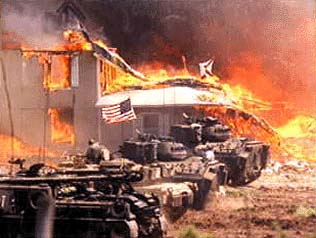
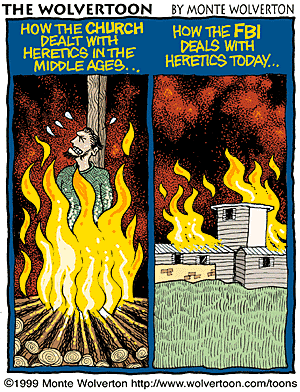
<>1993ap19:USA Attorney General ordered military attack on "Branch Davidian compound" in Waco TX
<>1993oc01:USA TV stations
carried commercial ad selling to Americans video cassettes of Russian children's
literature in cartoon form
*--Donald O'Connor was “host” of the infomercial and
also supplied the voice-over for the extravagant Russian folk-tale character,
Baba Yaga [ID]
*--O'Connor's pitch to American customers, American families, made four points =
<>1993oc03:oc04;
Russian President Boris Yeltsin ordered military attack on Parliament after he issued an
executive decree dissolving all Russian elected legislatures, including the
Moscow City Council
*--Website
devoted to the two-day "civil war" (Most of the links to
sub-sites [EG=pictures] are broken)
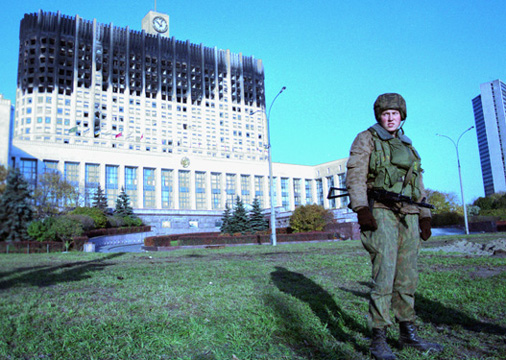
Russian Whitehouse after Yeltsin attack
[Websource broken]
*--Boris Kagarlitsky was an elected deputy to the City Council and kept a day-to-day account of events leading up to this drastic attack, Square Wheels: How Russian Democracy Got Derailed. He was then a member of the executive committee of the Russian Party of Labor, a socialist political party that opposed both the Communist and Yeltsin camps. Kagarlitsky is the author of several articles in Socialist Review (1991ap and je) and New Statesman (1989no10, 1991se06, 1993ap02, 1993de03). See also Nation (1889je05, 1993de06) and New Left Review (1993mr & ap). His most famous work is The Thinking Reed: Intellectuals and the Soviet State, from 1917 to the Present (1988) about the role of the "intelligentsia" in Russian political culture
<>1993de12:Russia, Moscow
| New Constitution ratified
*--The Russian constituion reminded many specialists of French tradition, with even
heavier emphasis on the executive/presidential branch of government, leaving legislative
and judicial branches in relatively weak relationship to the executive
*--President [chief justice] of the new Russian Supreme Court,
Valerii Zor'kin, opposed Yeltsin's policies and,
as a consequence, was demoted to status of judge, not to be restored to his leadership post
until 2003, during the time of President Vladimir Putin
*--The new "Yeltsin" Constitution divided Russia into 89 administrative divisions, running
in size and "weight" from the 21 republics, through 6 Territories, 49 regions, 2
"Federal Cities" (Moscow and St. Petersburg), 1 Autonomous Region, down to 10
autonomous areas [LIST]
\\
*--[W]
<>1994wi:Near Kandahar in southern Afghanistan, Taliban [Talib=student] movement arose against outrageous behavior of various Mujahedeen warlords, recently armed by USA
<>1994ja11:Russian Federal Assembly met [IR9] Two
houses =
*--Federal Council [FSOV] [speaker=Ivan Petrovich Rybkin (Agricultural Party)]
*--Duma [speaker=Vladimir Shumeiko]
<>1994se05:se13; International Conference on Population and Development deliberated on global environmental issues, with emphasis on population explosion [Excerpts from Conference report, with various "national" [nation-state] reactions = SWH:446-60]
<>1994se19:1995mr31;
Haiti invaded and occupied by USA-led force
*--USA State Department Analysis of the whole operation included lessons on "peace-keeping"
[E-TXT]
*1990s USA military budget equaled the combined total of the next 10 largest
military budgets in the world
*1992:2000; Over an 8-year period, the USA military budget grew from $260B/year to 300B/year,
by 2004, the military and homeland security budgets equaled $407B/year
*--The Cold-War era Soviet military-industrial complex failed miserably to sustain itself in the
post-Cold-War era [ID], but its USA cousin was doing very well under conditions of the "New World Order"
*--All signs were that the traces of more than two centuries
of European imperialism could still be sensed in the era of New World Order
<>1994no19:English Labour
Party leader Tony Blair
[ID] began to reshape his party in preparation for election victory in 1997.
He softened the left-liberal and strong European-style social-democratic tone of
the old party platform in order to remove reference to collective ownership of
means of production and to expand the constituency of the party beyond
wage-labor organizations (unions) [P20:397].
His party deposed the Conservatives of the Thatcher era, but bore the traces of
a certain push to the right during the era of Thatcher and USA President Reagan
*1995no02:NYR:34 summarized the role of Labour and socialist parties in European
politics over the previous 30 or so years =
Socialist parties came to power -- the British Labour Party from 1964 to 1979 (except for four years in the early 1970s) and the Social Democratic Party of [West] Germany in 1969. Sweden had had forty-four years of Socialist governments until 1976. Portugal's Socialist leader, Mario Soares, became Prime Minister in 1976, and his party went in and out of government coalitions for almost twenty years. Since 1974, the Italian Socialists have taken part in coalition governments or have headed the government. The French Socialists took over the government in 1981 and the Spanish Socialists in 1982
<>1995ja01:Switzerland,
Geneva | World Trade Organization [WTO] established. Membership = 134 countries
(as of 10 February 1999). Budget: 122 million Swiss francs for 1999. Secretariat
staff: 500. Head: Renato Ruggiero (director general)
\\
*--[W]
*--LOOP on "finance"
A telling graphic from the 1998 WTO website
<>1995ap19:USA OK.City in front of the Murrah Federal Building | Timothy McVeigh parked a rented Ryder truck with explosives. At 9:02 am Central Daylight Time (14:02 UTC), a massive explosion sheared away the entire north side of the building, killing 168 people
<>1995oc17:GKI (GOSKOMIMMUSHESTVO - the state committee for the management of state property) PUBLISHED IN ROSSISKAIA GAZETA THE RULES FOR IMPLEMENTING ITS SHARE MORTGAGE OR "LOANS FOR SHARES" PROGRAM
<>1995:Bosnia the site of USA led military attack
*--Reporter David Rieff published Slaughterhouse: Bosnia and the Failure of the West which was a harsh
criticism of Serbian (Yugoslav) and "Western" political leaders, based on first-hand observation
[
E-TXT excerpts | P20:474]
\\
*--Bowker:49-67
<>1995de17:Russian Federation elections to Duma
Leading Candidates
|
Name |
Party |
|
Abdulatipov,Ramazan G |
00 |
|
Aksiuchits, Viktor V |
26 |
|
Aleksei II, Patriarch of the Russian Orthodox Church |
00 |
|
Aliev,Geidar A |
00 |
|
Alksnis |
00 |
|
Anpilov,Viktor I |
36 |
|
Astaf'ev,Mikhail G |
00 |
|
Baburin, Sergei N |
30 |
|
Baturin, Yurii M |
00 |
|
Borovoi, Konstantin N |
39 |
|
Burbulis, Gennadii E |
00 |
|
Chernomyrdin, Viktor S |
17 |
|
Chubais, Anatolii B |
00 |
|
Dudaev,Dzhokhar M |
00 |
|
Fedorov,Boris G |
20 |
|
Fedorov,Sviatoslav N |
35 |
|
Fedulova, Alevtina V |
01 |
|
Filatov,Sergei A |
00 |
|
Gaidar, Egor T |
23 |
|
00 |
|
|
Govorukhin, Stanislav S |
26 |
|
Grachev,Pavel S |
00 |
|
Gromov,Boris V |
13 |
|
Kalachev,Konstantin E |
37 |
|
Khasbulatov,Ruslan I |
00 |
|
Klimantova, Galina I |
01 ZhR |
|
Kobelev,Viktor V |
02 |
|
Kovalev,Sergei A |
23 DVy |
|
Kriuchkov,Anatolii V |
36 |
|
Lakhova, Ekaterina F |
01 ZhR |
|
Lapshin, Mikhail I |
41 |
|
Lebed', Aleksandr I |
31 |
|
Ligachev,Egor K |
00 |
|
Lipitskii, Vasilii S |
29 |
|
Luk'ianov,Vladimir N |
40 |
|
Lukin, Vladimir P |
19 |
|
Luzhkov,Yurii M |
00 |
|
Lysenko, Nikolai N |
28 |
|
Medvedev,Roi A |
00 |
|
Mikhalkov,Nikita S |
17 NDR |
|
Nazarbaev,Nursultan N |
00 |
|
Nemtsov,Boris E |
00 |
|
Ovchinnikov,Konstantin N |
28 |
|
Panfilov,Anatolii A |
22 |
|
Pavlov,Nikolai A |
28 |
|
Popov,Gavriil K |
29 |
|
Primakov,Evgenii M |
00 |
|
Rumiantsev,Oleg G |
26 |
|
Rutskoi, Aleksandr V |
02 |
|
Rybkin, Ivan P |
38 |
|
Ryzhkov,Nikolai I |
30 |
|
Savitskii, Vitalii V |
42 |
|
Shakhrai, Sergei M |
24 |
|
Shatalin, Stanislav S |
13 MOt |
|
Shcherbakov,Vladimir I |
32 |
|
Sheinis, Viktor L |
00 |
|
Shevardnadze, Eduard A |
00 |
|
Shumeiko, Vladimir F |
00 |
|
Skokov,Yurii V |
31 KRO |
|
Sobchak, Anatolii A |
00 |
|
Stankevich, Sergei B |
00 |
|
Sterligov,Aleksandr N |
00 |
|
Tiul'kin, Viktor A |
36 |
|
Travkin, Nikolai I |
00 |
|
Vol'skii, Arkadii I |
32 |
|
Yakovlev,Aleksandr N |
00 |
|
Yakunin, Gleb P |
00 |
|
19 YBL |
|
|
Yeltsin, Boris |
00 |
|
Zatulin, Konstantin |
00 |
|
Zhirinovskii, Vladimir V |
33 |
|
Ziuganov,Gennadii A |
25 |
|
00 |
1995de17:Russia's Leading Political Parties
|
01 |
Zhenshchiny Rossii |
Women of Russian |
ZhR |
|
02 |
Sotsial-patrioticheskoe dvizhenie "Derzhava" |
Social-Patriotic Movement "Great Power" |
Derzhava |
|
13 |
Moe Otechestvo |
My Fatherland |
MOt |
|
17 |
Nash dom Rossiia |
Our Home is Russia |
NDR |
|
19 |
YaBLoka |
Apple |
YBL |
|
20 |
Vpered, Rossiia! |
Forward Russia |
VR! |
|
22 |
Ekologicheskaia partiia Rossii "Kedr" |
Ecological Party of Russia "Cedar" |
Kedr |
|
23 |
Demokraticheskii vybor Rossii & Ob"edinennye demokraty |
Democratic Choice of Russia & United Democrats |
DVy |
|
24 |
Partiia Rossiiskogo Edinstva i Soglasiia |
Party of Russian Unity and Accord |
EiS |
|
25 |
Kommunisticheskaia Partiia Rossiiskoi Federatsii |
Communist Party of the Russian Federation |
KPR |
|
26 |
BLOK STANISLAVA GOVORUKHINA |
Bloc of Stanislav Govorukhin |
BSG |
|
28 |
Natsional'no-respublikanskaia partiia Rossii |
National-Republican Party of Russia |
NRP |
|
29 |
Sotsial-demokraty |
Social-Democrats |
SDs |
|
30 |
Vlast'-Narodu |
Power to the People |
V-N |
|
31 |
Kongress russkikh obshchin |
Congress of Russian Communities |
KRO |
|
32 |
Profsoiuzy i promyshlenniki Rossii--Soiuz Truda |
Trades-union and Industrialists of Russia--Union of Labor |
PiP |
|
33 |
Liberal'no-demokraticheskaia partiia Rossii |
Liberal-Democratic Party of Russia |
LDP |
|
35 |
Partiia samoupravleniia trudiashchikhsia |
Party of Labor Self-government |
PST |
|
36 |
Kommunisty--Trudovaia Rossiia--Za Sovetskii Soiuz |
Communists--Labor Russia--For Soviet Union |
|
|
37 |
Partiia liubitelei piva |
Party of Beer Lovers |
|
|
38 |
Blok Ivana Rybkina |
Bloc of Ivan Rybkin |
|
|
39 |
Partiia ekonomicheskoi svobody |
Party of Economic Freedom |
PES |
|
40 |
Partiia "Narodnyi Soiuz" |
Party "Popular Union" |
NaS |
|
41 |
Agrarnaia partiia Rossii |
Agrarian Party of Russia |
AgP |
|
42 |
Khristiansko-Demokraticheskii Soiuz--Khristiane Rossii |
Christian-Democratic Union--Christians of Russia |
XDS |
<>1996:German
right-wing Neo-Nazi turned moderate youth welfare advocate, Ingo Hasselbach,
published English-language Ex Fuhrer: Memories of a Former Neo-Nazi with
a look Inside the Neo-Nazi Scene [P20:409]
*--The first decade of movement toward and consolidation of
German reunification had not been trouble free
<>1996:USA "neo-con"
think-tank -- The Institute for Advanced Strategic and Political Studies --
subjected Israel foreign policy to serious evaluation and made significant
supportive recommendations for change = "A Clean Break: A New Strategy for
Securing the Realm" [TXT]
*2000:2008; The authors of this study and their views came to have great
influence on US foreign policy toward Israel
and the wider world
\\
*2006se13:Ronald Bruce St.John posted on the website of the "liberal" Institute
for Policy Studies a description and critique of "A Clean Break"
[TXT]
*--LOOP on "AfroAsia"
<>1996:USA news reporter
Eleanor Randolph published her first-hand account
Waking the Tempests:
Ordinary Life in the New Russia
in which she described the results of capitalist "marketization" and
"privatization" of the old Soviet command economy [Excerpts =
P20:467]
*1999fe:GO
<>1996jy01:Johnson's Russia List (JRL, an email newsletter with wide-ranging and informative news and commentary on Russian politics and society) began to appear
<>1997my02:RTV | Tens of thousands of Russians marked the May Day holiday by marching outside the Kremlin calling for Boris Yeltsin's resignation
<>1997my05:RTV | A radical
Chechen guerrilla leader claimed to have masterminded two deadly bombings that
rocked southern Russia. Salman Raduev threatened to carry out terrorist
attacks before. He now claimed that the railway station bombings in Armavir and
Piatigorsk marked "a new phase of the Russian-Chechen war." He asserted that the
two Chechen women who were arrested in connection with the second bombing were
acting on his personal orders. Chechen leaders say they doubt whether the rebel
commander was behind the explosions
*--A demographic crisis loomed in Russia, according to a presidential advisory
commission. The death rate was on the rise, while the birth rate was dropping,
and the country's demographic indicators resembled those found in third world
countries. In 1995 Russia's death rate not only topped that of other European
countries and the United States, but was also higher than many Asian and African
countries. Experts said the roots of the problem can be found in the decline in
living standards and the collapse of Russia's health care system
*--Moscow reaffirmed its commitment to friendly ties with Tehran. Foreign
Minister Yevgeny Primakov sent a message to his Iranian counterpart, saying
bilateral relations will not be hampered by the West's criticism of Iran.
Iranian leaders said they would cease negotiations with the European Union [EU],
after a German court verdict blamed Iran's
leadership for the 1992 murders of four Kurds in Berlin
*--Former security chief and presidential hopeful Aleksander Lebed said he will
only have one person to beat in the next elections -- Moscow Mayor Yury Luzhkov.
Lebed rejected talk that his chief opponent could be young reformer Boris
Nemtsov, but public opinion polls showed the opposite. While Lebed topped the
list for strength of character, Nemtsov was number one when it came to
presidential qualities -- namely honesty and decency. Nemtsov had recently
joined the Yeltsin cabinet as first deputy prime minister and fuel and energy
chief
*--Russia began reform of its natural gas industry with a presidential reform
decree designed to control monopolies. Next steps will involve incorporation of
transport costs into the gas pricing system. Transport rates for both gas giant
Gazprom and independent suppliers were to be unified, and the rights to develop
gas fields will be opened through tenders. The government will also create
guidelines allowing gas suppliers access to Gazprom's transport network
\\
*--LOOP on EU
<>1997my06:RTV | The
long-awaited Russia-NATO draft charter was to be completed on this day. Russian
Foreign Minister Yevgeny Primakov, held talks with NATO Secretary-General Javier
Solana in Luxembourg. Primakov was hopeful that the last differences would be
smoothed out and the document ready for signing on May 27. He insisted Moscow
still opposes NATO plans to include eastern European members but still expects
the charter to ease some of Russia's security fears.
NATO
officials however were obdurate in their refusal to make any further concessions
*--Radical rebel leader Salman Raduev had reason to regret his boasts of
ordering deadly bomb blasts in southern Russia [ID]. A
Chechen presidential aide said that leaders in Grozny are fed up with Raduev's
declarations and had a warrant out for his arrest. However, he stressed that
Chechen leaders believe Russian special forces -- and not Raduev -- were behind
the attacks in Armavir and Piatigorsk. Raduev threatened
terrorist attacks on Russian targets several times in the past
<>1997fa:Russian President Yeltsin met with Japan Prime Minister Hashimoto to consolidate massive international agreements on natural gas and related energy issues
<>1997oc01:Russian Federation adopted new law "On Freedom of Conscience and on Religious Associations", which required official registration of all religious associations, including the Russian Orthodox Church, which was eventually registered as number one [E-TXT]
<>1998mr:Vatican Commission for Religious Relations with the Jews, We Remember: A Reflection on the "Shoah" [P20:431]
<>1998sp:French Commission for the Abolishment of Sexual Mutilations among African Immigrants in France: The Controversy over Female Circumcision [P20:425]
<>1998my02:NYT | Column by THOMAS L. FRIEDMAN, "Now a Word From X" [This is an opinion column based on a personal interview of George Frost Kennan whose anonymous 1947 article in the journal Foreign Affairs, signed "X" [ID], defined America's cold-war containment policy for 40 years
His voice is a bit frail now, but the mind, even at age 94, is as sharp as ever. So when I [Thomas Friedman] reached George Kennan by phone to get his reaction to the Senate's ratification of NATO expansion it was no surprise to find that the man who was the architect of America's successful containment of the Soviet Union and one of the great American statesmen of the 20th century was ready with an answer. [SAC editor has put Kennan's words in boldface.] "I think it is the beginning of a new cold war," said Mr. Kennan from his Princeton home. [...][Friedman continues in his own words = ]
I think the Russians will gradually react quite adversely and it will affect their policies. I think it is a tragic mistake. There was no reason for this whatsoever. No one was threatening anybody else. This expansion would make the Founding Fathers of this country turn over in their graves. We have signed up to protect a whole series of countries, even though we have neither the resources nor the intention to do so in any serious way. [NATO expansion] was simply a light-hearted action by a Senate that has no real interest in foreign affairs.
What bothers me is how superficial and ill informed the whole Senate debate was.
I was particularly bothered by the references to Russia as a country dying to attack Western Europe. Don't people understand? Our differences in the cold war were with the Soviet Communist regime. And now we are turning our backs on the very people who mounted the greatest bloodless revolution in history to remove that Soviet regime.
And Russia's democracy is as far advanced, if not farther, as any of these countries we've just signed up to defend from Russia....
It shows so little understanding of Russian history and Soviet history. Of course there is going to be a bad reaction from Russia, and then [the NATO expanders] will say that we always told you that is how the Russians are -- but this is just wrong.
One only wonders what future historians will say. If we are lucky they will say that NATO expansion to Poland, Hungary and the Czech Republic simply didn't matter, because the vacuum it was supposed to fill had already been filled, only the Clinton team couldn't see it. They will say that the forces of globalization integrating Europe, coupled with the new arms control agreements, proved to be so powerful that Russia, despite NATO expansion, moved ahead with democratization and Westernization, and was gradually drawn into a loosely unified Europe. If we are unlucky, they will say, as Mr. Kennan predicts, that NATO expansion set up a situation in which NATO now has to either expand all the way to Russia's border, triggering a new cold war, or stop expanding after these three new countries and create a new dividing line through Europe.
But there is one thing future historians will surely remark upon, and that is the utter poverty of imagination that characterized U.S. foreign policy in the late 1990's. They will note that one of the seminal events of this century took place between 1989 and 1992 -- the collapse of the Soviet Empire, which had the capability, imperial intentions and ideology to truly threaten the entire free world. Thanks to Western resolve and the courage of Russian democrats, that Soviet Empire collapsed without a shot, spawning a democratic Russia, setting free the former Soviet republics and leading to unprecedented arms control agreements with the U.S.
And what was America's response? It was to expand the NATO cold-war alliance against Russia and bring it closer to Russia's borders.
Yes, tell your children, and your children's children, that you lived in the age of Bill Clinton and William Cohen, the age of Madeleine Albright and Sandy Berger, the age of Trent Lott and Joe Lieberman, and you too were present at the creation of the post-cold-war order, when these foreign policy Titans put their heads together and produced . . . a mouse.
[We could suggest here that Friedman needed a stronger and more precise metaphor when he wrote "mouse" above. How about "pestilent rat"?]
We are in the age of midgets. The only good news is that we got here in one piece because there was another age -- one of great statesmen who had both imagination and courage.
As he said goodbye to me on the phone, Mr. Kennan added just one more thing: "This has been my life, and it pains me to see it so screwed up in the end."
The policy elite has thrashed it out in blue-ribbon panel reports, departmental memoranda and congressional hearings sufficiently arcane to discourage public scrutiny of the gap between the system's substantial costs and its uncertain benefits. Like NATO expansion in 1996, national missile defense is an elite-driven idea that will be "sold" rather than openly debated and explained to the public
<>1998my08:Russian Orthodox Church Patriarch Aleksei II met with Russian Federation President Boris Yeltsin in a joint commemoration of Easter and the anniversary of victory in WW2 [E-TXT]
<>1998my15:my17;
England, Birmingham summit of G7 officially became
G8 with addition of Russia as member (although the G7 continues to function along side the formal summits)
*--GO 1975no:France
<>1998jy12:jy17; Russian city Belgorod was the site of a huge combined ecclesiastical and secular conference on Mission of the Church = "Freedom of Conscience and Civil Society" [E-TXT]
<>1998jy20:Russian Orthodox Church Patriarch Aleksei II commemorated the 80th anniversary of the murder of the tsarist family [E-TXT]
<>1998au27: Vienna| Eurozine
founded as pan-European internet journal devoted to problems of political culture
*--Table of contents and chronology of
main moments in the history of the journal
<>1998se29:Russian Orthodox Church sponsored wide-ranging meeting of Christian religious and secular social organizations [E-TXT]
<>1998no20:Russian space module Zaria [Zarya, "dawn"] put in place as the core component of the most expensive construction project ever attempted by humankind = The International Space Station (ISS)[W]
<>1999mr25:Yugoslavia attacked by USA-led NATO air power
<>1999my26:Moscow Patriarchate of the Russian Orthodox Church endorsed priestly views on liberalism, traditionalism and moral values in the contemporary world [E-TXT]
<>1999au:USA Bank of New York exposed as the site of massive laundering of billions of dollars from Russia
<>1999no:Prague CZC the eastern European site of
a most significant meeting of the North Atlantic Treaty Organization [NATO] in years
Seven new members from the old USSR sphere of influence became members of this military alliance = Bulgaria, Estonia, Latvia,
Lithuania, Romania, Slovakia and Slovenia
*--NATO now counted 26 member nation-states
<>1999no23:de03; Seattle public
demonstrations protested WTO policies during international "Third
Ministerial Conference" [W]
[W]
[W]
\\
*--LOOP on "finance"
<>1999de31:Russian Federation President
Boris Yeltsin resigned, ending turbulent 12 years near the center of Soviet/Russian
politics
*--Yeltsin appointing Vladimir Putin as President pro temp and set a national presidential
election for 2000mr24
*1999de30:Nezavisimaia gazeta:4| Putin published his platform statement
[TXT]
\\
*--Richard Sakwa, Putin:
Russia's Choice (2004) argued that Putin must resolve four crucial
problems = (1) reform federal-regional relations (most dramatically represented
by the situation in Chechnya), (2) develop the economy and carry out further
economic reforms, (3) patch up foreign relations, (4) strengthen an independent
judiciary. Putin is popular because he appears to be the people's champion
against oligarchs, corrupt bureaucrats and provincial bureaucratic "bosses".
Centralization, followed by some form of "re-federalization" seems in the offing
*--Putin faced his greatest challenge in the year 2004
<>2000mr28:Russian Orthodox Church
Patriarch Aleksei II urged citizens of the Russian Federation to vote
*--It makes no difference, he said, which candidate a citizen chooses to support
*--The important thing is that citizens should get out and vote
*--The Church insisted that it had urged active citizenship since before the Soviet Revolution, during the time
of Soviet power, and in the contemporary era [E-TXT]
*--The leading figure on the ballot was Vladimir Putin, recently appointed President of the
Russian Federation and now running for that office for the first time
<>2000ap04:Moscow State University heard lecture by Russian Orthodox Church Metropolitan [Bishop] Kirill of Smolensk on the need for European unification [E-TXT]
<>2000my16:Japanese Premier and then the Japanese Emperor received an official Russian Orthodox Church delegation, led by Patriarch Aleksei II [E-TXT]
<>2000je14:Russian Orthodox Church sponsored symposium on church/state relations [E-TXT]
<>2000je21:Russian Orthodox Church Metropolitan Kirill of Smolensk published in the independent secular newspaper Argumenty i fakty a protest against an article there which exposed the excessive wealth and vigorous economic enterprise of the Russian Church [E-TXT]
<>2000jy17:Russian Orthodox Church sought to refute an article in Izvestiia which claimed that the Patriarch had taken steps to interfere in a matter of great ecological significance, the governments abolition of the 2-century-old central agency, now designated the Federal Forest Service [Rosleskhoz] [E-TXT]
<>2000au19:Russian Orthodox Church Patriarch Aleksei II consecrated the huge and lavish new Cathedral of Christ the Savior in Moscow [E-TXT]
<>2000oc:2005au; Official Church pronouncements [E-TXT in reverse chronological order]
<>2000no:The prominent journal Foreign Affairs ran a review article by Daniel Treisman with the following opening observations =
Pity the unpopular Russians. In July, Mexico elects its first president from outside the country's ruling party; The Economist magazine labels it a "real democracy." Russia elects a president from the political opposition in 1991, then holds no fewer than five competitive, generally free, national elections in the following years; The Economist calls it a "phony democracy." Colombia has a problem with organized crime, and Washington gives its government $1.3 billion to help fight the drug lords. Russia also has a problem with organized crime, and American politicians sternly lecture Moscow not to expect any more aid until it cleans up its act. An undercover U.S. operation finds several Mexican banks laundering drug money in the United States, and Washington apologizes to the Mexicans for conducting sting operations on their territory. An American bank allegedly launders money [ID] for Russian organized criminals, and a leading senator accuses the Russian government of being "the world's most virulent kleptocracy." When the Asian crisis scares investors away from the Brazilian market and the real collapses, commentators declare it a bump in the road. When the Asian crisis scares foreign investors away from the Russian market and the ruble collapses, commentators declare the crash proof of the failure of liberal economic reform in Russia. || That many Russians these days see a double standard in Western opinion toward their country is perhaps not altogether surprising
<>2000no15:NYC| UNO Convention against Transnational Organized Crime, including a Protocol to Prevent, Suppress and Punish Trafficking in Persons, Especially Women and Children [TXT], often called "The Palermo Protocol"
<>2001:San Diego CA | Jimmy Wales [ID] and associates created internet encyclopedia, Wikipedia
<>2001fe05=The Nation| "Florida’s ‘Disappeared Voters': Disfranchised by the GOP"
[E-TXT]
*--2001fe23:USA Department of State released its
report on human rights in Russia for the year 2000
<>2001se11:USA attacked by four groups of suicidal hijackers of commercial airliners
<>2002mr25:Pravda reported on efforts to consolidate the eighty-nine regions [W] that made up the Russian Federation [W]
<>2002ap06:ap07; USA TX Crawford ranch | President Bush and Prime Minister Tony Blair “summit” meeting arrived at a conditional agreement to invade Iraq, according to Los Angeles Times reporter John Daniszewski [2005my13:ERG]
perceptible shift in attitude. Bush wanted to remove Saddam, through military action, justified by the conjunction of terrorism and WMD [weapons of mass destruction]. But the intelligence and the facts were being fixed around the policy [boldface added by SAC editor].
If the political context were right, people would support regime change. The two key issues were whether the military plan worked and whether we had the political strategy to give the military plan the space to work.
In my view the CIA was not merely wrong in claiming that Saddam Hussein was “actively seeking” nuclear weapons. The evidence was sparse, fragmentary, thinly supported, inconclusive, and in crucial instances flatly contradicted; but Jervis avoids the implications of what is most obvious about this error -- its nature and its magnitude. The administration needed a scary intelligence estimate that would stand up long enough to persuade Congress to authorize war. This one did the job for three reasons: because the administration had created an atmosphere of crisis that Congress was too timid to challenge or resist; because the CIA put its authority on the line by claiming it had “high confidence” in its findings; and above all because the evidence was secret. To read the CIA's estimate now is shocking; nothing in the grab bag called for the haste to act insisted on by the President at the time.*2010au19:NYbooks, "CIA and WMD: Damning Evidence" [TXT], an effort to expose deception underlying the run up to the war in Iraq
But Jervis treats the CIA's “intelligence failure” as an honest mistake of the garden variety, an accumulation of shaky assumptions, small errors, and misreadings that led the agency astray. I cannot see why Jervis fails to connect the dots. Parsing the case does not require bales of subpoenaed evidence. The nature of the error (fluffing up the casus belli demanded by the White House) as well as the magnitude of the error (wrong in every particular) tell us what we need to know.
<>2002sp:BOMBmagazin#79. "Post-Soviet" writer Victor Pelevin interviewed. Notice the weave of post-Soviet Russian literature with global cultural influences
To look again at [H.G. Wells'] The War of the Worlds (1898, made into a USA movie in 1956, and frequently reproduced in the 1938oc20 radio version [ID]) is to be confronted with still bleaker truths: the eternal primacy of man’s will to power and the capacity throughout history for absolute inhumanity. In these pages there are to be found in abundance furious parallels between Wells’ reality, the domination, as he saw it, of half the globe by the British Empire. At moments, he exhibits a strange sympathy towards the extraterrestrial invaders:SAC would also add that the 1996 movie INDEPENDENCE DAY [Wki] portrayed an alien invasion of earth which could be an evasive effort to exorcise the bad conscience of USA, or simply to express sympathetic commiseration, in connection with the Euro-American invvasion of Native-Americans in the New World. The goal of the technically superior fictional aliens, like that of the historical Euro-Americans, was genocidal destruction of the targeted less-"advanced" earthlings. In the movie, however, the earthlings' native will to survive was sufficient defense against the superior invader. And an Afro-American is given an important role in that victorybefore we judge of them too harshly we must remember what ruthless and utter destruction our own species has wrought, not only upon animals, such as the vanished bison and the dodo, but upon its own inferior races. The Tasmanians, in spite of their human likeness, were entirely swept out of existence in a war of extermination waged by European immigrants, in the space of fifty years.The bloody excesses of Empire –- literally, for the Martians are, like their near-contemporary Count Dracula, sanguinary predators hungry for Englishmen -– are visited upon the nation itself, as first Surrey and then London are laid waste by the [Martian] tripods of destruction.
[...]
[A]lien-invasion narrative had become a cultural trope of considerable fluidity. That the aliens of the 1950s often stand for a fear of what was believed to be the insidious spread of communism has frequently been suggested [...]. [T]he extraterrestrials in Invasion of the Body Snatchers (1956) or Invaders from Mars (1953) may just as well have been intended to represent those McCarthyite forces that were manipulating the public into hysterical anti-communism....
<>2002oc16:WDC| Joint Congressional
resolution = Authorization for use of force against Iraq
[TXT],
a resolution taken under the influence of evidence carefully prepared by
Executive Branch (White House) [ID]
\\
*--Thomas Powers critique of this act [TXT],
in a review of Garry Wills, Bomb Power:
The Modern Presidency and the National Security State
<>2003mr19:USA invaded and occupied Iraq
In November 2002, after weeks of wrangling, the UN Security Council passed resolution 1441. It was designed to force Iraq to give up all weapons of mass destruction and threatening "serious consequences" if it did not comply. Iraq accepted the terms of the resolution and weapons inspections resumed.\\
In early February 2003, US Secretary of State Colin Powell told the UN that inspections were not achieving the disarmament of Iraq. The US and UK pressed for a new resolution authorizing military action against Iraq. France and Russia opposed this resolution, and threatened to veto it.
The resolution never came to a vote and early on 20 March, the US-led campaign to topple Iraqi Saddam Hussein began.
President George W Bush addressed the American nation and vowed to "disarm Iraq and to free its people".
The beginning of the campaign drew a barrage of criticism from world leaders, including those of France, Russia and China. There were also massive public demonstrations against the war in major cities across the globe.
The first aerial attack on Baghdad was on a much smaller scale than had been expected for the opening of the conflict. It was thought to have been mounted at short notice when US military planners spotted an opportunity to target five members of the Iraqi regime, including Saddam Hussein and his sons, Uday and Qusay.
Ground forces invaded from Kuwait, with UK troops moving to secure key southern towns and US forces moving on towards Baghdad. They did, though, meet pockets of resistance from Iraqi troops
<>2003oc01:Eugene Register Guard Guest
Viewpoint: Corporations need to put American interests first, by David Pokvitis
[TXT]
*--Pokvitis is a Springfield, Oregon, business owner and
director of a Chicago-based company, director of two other companies in Oregon
and on the board of advisers for the Small Business Development Center. To put
this opinion piece into a historical context even longer than the author
intended, consider the legacy of Adolf Berle's 1932
book and the even longer trends identified as the "managerial
revolution"]
*--In just these months, Russian business interests considered the lessons of
the US "progressive era" one century earlier [ID]
\\
*--LOOP on "finance"
<>2003oc25:Mikhail
Khodorkovskii, CEO of the greatest Russian petroleum corporation, YUKOS, was
arrested
\\
*--Richard Sakwa, The Quality
of Freedom: Khodorkovsky, Putin, and the Yukos Affair
*--Harvey Balzer [W]
described meaning of this event
<>2003no28:Christian Science Monitor column [TXT] assessed Mikhail Khodorkovskii
<>2003de17:Russia elections to the Russian Parliament returned representatives to the Russian Parliament from only four parties =
The Communist Party is the only distinctly oppositional party with any Parliamentary power, and it is increasingly marginalized and disorganized
Two other opposition parties failed to win any seats =
The American press was alarmed at having "only four parties", even in a USA electoral season when many in the press express alarm that the USA national election might have three rather than just two parties at work.
CIA Fact
book provided this more detailed account of elections to the two houses of
the bicameral legislative branch, the Federal Assembly [Federal'noe sobranie]
=
*--Upper Chamber = Federation Council [Sovet Federatsii] (178 seats; as
of July 2000, members appointed by the top executive and legislative officials
in each of the eighty-nine regions [W].
Members serve four-year terms)
*--Lower Chamber = State Duma [Gosudarstvennaia Duma] (450 seats; 225
seats elected by proportional representation from party lists winning at least
5% of the vote, and 225 seats from single-member constituencies; members are
elected by direct, democratic vote to serve four-year terms)
*--Election results = State Duma - percent of vote received by parties
clearing the 5% threshold entitling them to a proportional share of the 225
party list seats
--Column 1 = party; Column 2 = seats; Column 3 = percentage of vote
United Russia 222 37.1 CPRF [Communist Party of the Russian Federation] 53 12.7 LDPR 38 11.6 Motherland 37 9.1 People's Party 19 Yabloko 4 Union of Rightist Forces 2 Other 7 Independents 65 Repeat election required 3
<>2004ja30:USA National
Budged, by category, with President Bush's recommendation and final bill,
in billions of dollars =
|
Item |
Bush |
Final |
Etc |
|
Agriculture |
17.1 |
16.8 |
|
|
Commerce, Justice, State |
37.7 |
37.6 |
|
|
Defense |
371.8 |
368.2 |
|
|
Homeland Security |
28.4 |
29.2 |
|
|
Military Construction |
9.1 |
9.3 |
|
|
Foreign aid |
18.9 |
17.5 |
|
|
Interior |
19.6 |
19.5 |
|
|
Labor, Health &Human Serv, Ed |
138.0 |
139.0 |
|
|
Veterans, Housing & Urban Dev |
89.4 |
90.8 |
|
|
Total |
730.0 |
727.9 |
|
Fifteen-year growth of military budget (since end of Cold War)
<>2004mr29:Mikhail Khodorkovskii authored an article titled "Crisis of Russia's Liberalism" [TXT]
<>2004je11:Moscow the site of huge
labor rally, with Mikhail Shmakov, President of FNPR, in a leading role.
The protest showed the increasing importance of labor unions in post-Soviet Russia, and indicated
the importance of non-payment and under-payment of workers in the current struggle between Putin
and the "oligarchs" [W]
*--As the most explosive component of European "civil society" [ID], wage-labor continued
to influence events, as it had for a century and a half
*--Wage-labor was a critical consideration in
the years after the end of WW2
*--In the mobilization of east European civil society, wage labor
was a central element over the previous half century
<>2004au:USA | 9/11
Commission Report: Final Report of the National Commission on Terrorist Attacks
Upon the United States, Official Government Edition
[W]
*--Iraq Camp Bucca detention center gathered future leaders of ISIS
[theguardian]
<>2004se10:NYT (Seth Mydans) reported that Russian President Vladimir Putin was taking action to strengthen counter-terrorist forces in the Caucasus in the aftermath of the occupation of Middle School No. 1 in Beslan (North Ossetia)
<>2004se14:NYT
(Steven Lee Myers) reported on Putin's extensive plan for restructuring Russian
governing institutions in order to deal with mounting terrorism. Putin met in
special session with cabinet ministers and regional government leaders to share
his plan, "the most sweeping political overhaul - and his most striking single
step to consolidate power in Russia in more than a decade". [Here, NYT
referred to the 1993de12:plebiscite that approved
the current Russian constitution, the "Yeltsin Constitution"]
*--Putin's plan =
<>2004oc11:NYC, Columbia University hosted a wide-reaching series of policy-oriented scholarly papers about "Randolph Bourne's America" [W], three panels (unfortunatelly no longer online) =
<>2004oc12:Russian
"presidential" political party Edinaia Rossiia signed a partnership agreement
with "The Federation of Independent Trade Unions of Russia" [Federatsiia
nezavisimykh profsoiuzov Rossii (FNPR)] for cooperation in the State Duma
*--Party head (and speaker of house in the Duma) Boris Gryzlov
[W] and Federation President
Mikhail Shmakov announced the agreement
*--The leading concept was political unity and economic development without
forgetting the everyday life of the Russian working people
[TXT of 2000au10:Shmakov letter to Putin]
*--Putin's accomplishments were mixed after five years as
President of the Russian Federation
*--But Putin had plans for the future
<>2004de26:Indian Ocean earthquake sent towering
tsunami wave over thousands of miles of Asian coastline, causing thousands of
deaths and wide-spread destruction
*--Five indigenous tribes of the Indian archipelago of Andaman and Nicobar
islands apparently escaped major catastrophe. Large numbers of them were saved
because they read nature's sights, sounds and smells, paid heed to the movement
of wind, sea and birds, then fled the shores well before the waves hit. "They
can smell the wind. They can gauge the depth of the sea with the sound of their
oars." [Neelesh Misra, 2005ja05:AP dispatch]
<>2005ja13:NYR | Jonathan Raban
article, "The Truth about Terrorism", [TXT] on recent trends
in USA foreign policy, with reference to emerging new concepts
of war in the time of this "New World Order", now darkened over by terrorism
<>2005mr13:NYT published special Sunday section on official US government practice of "pre-packaged news"
<>2005ap24:Kim Murphy
review of Oksana Robski's fictional but fact-based account of how Russia's "new
rich" or "new Russians", the super-capitalist or savage-capitalists [dikie
kapitalisty] live [TXT]
*--Convergence?
<>2005my09:USA| The Huntington Post, which was founded by Arianna Huffington [ID], now began internet publication, adding a powerful and informative voice to growing USA journalistic dissent
<>2005my29:je01;
European Union website described two national votes against ratification of the
EU "Constitutional Treaty" in the following way = "The people of France [and...the
Netherlands...] choose to say no to the ratification of the Constitutional Treaty"
*--EU decided to observe a year (or two) of deliberation or reflection before
the move toward ratification was resumed
\\
*--Jan Zielonka, Europe as Empire:
The Nature of the Enlarged European Union, argues that the EU has been an immense foreign
policy success, creating an order to do things in a manner that, to some degree, resembles
the old Holy Roman Empire, or Hapsburg Monarchy, especially as it evolved into the Austro-Hungarian Empire
[ID]. Many would find that prospect alarming rather
than reassuring, but the possibilities of multilateralism among various regions embraced loosely
in a union of some sort must be explored, said Zielonka
*--An assessment of EU [TXT]
*--LOOP on EU
<>2006mr:John J. Mearsheimer
and Stephen M. Walt published "The Israel Lobby and U.S. Foreign Policy"
[Original TXT]
*--A revised text was published in the next month in the
London Review of Books. That text opened =
For the past several decades, and especially since the Six-Day War in 1967, the centrepiece of US Mideast policy has been its relationship with Israel. The combination of unwavering support for Israel and the related effort to spread "democracy" throughout the region has inflamed Arab and Islamic opinion and jeopardised not only US security but that of much of the rest of the world. This situation has no equal in American political history. Why has the US been willing to set aside its own security and that of many of its allies in order to advance the interests of another state? One might assume that the bond between the two countries was based on shared strategic interests or compelling moral imperatives, but neither explanation can account for the remarkable level of material and diplomatic support that the US provides.
Instead, the thrust of US policy in the region derives almost entirely from domestic politics, and especially the activities of the "Israel Lobby". Other special-interest groups have managed to skew foreign policy, but no lobby has managed to divert it as far from what the national interest would suggest, while simultaneously convincing Americans that US interests and those of the other country -- in this case, Israel -- are essentially identical.
<>2006je21:The Guardian | English conservative Peregrine Worsthorne [ID] said =
Of course it made sense in John Stuart Mill's day [ID] to replace hereditary aristocracy, of which there was too much, with a system of careers open to talent, of which there was too little. But surely anybody looking at the subject with an open mind should be able to see that today, 200 years later, there is something quite other to worry about; and the new problem, which is getting worse all the time, is the deeply unattractive and unimpressive nature of an exclusively self-made meritocratic ruling class: a ruling class made up of men and women exceptionally gifted only in the horrible rat-race arts of elbowing their way to the top. Aristocracy may have its faults but meritocracy, which is what in practice a meritocratic system produces, is proving even worse -- which is possibly why the public seems so eager to welcome the return of the English gentleman in the shape of David Cameron [ID]. [Boldface added by SAC editor to suggest Worsthone's rhetorical emphasis and coloration of argument]Is "The West" ready for a return of something like aristocracy?
<>2006oc07:Moscow | Anna Politkovskaia, journalist
with Novaia gazeta, was gunned down in front of her apartment building
*--She was a widely-regarded critic of the Putin administration's anti-liberal policies
*--Her diary has been translated and published as
A Russian Diary:
A Journalist's Final Account of Life, Corruption and Death in Putin's Russia
\\
*2016oc07:Novaia gazeta| "This Week Marks the 10th Anniversary of Anna Politkovskaya’s Murder"
[E-TXT]
*2016oc05[The Guardian| "The murder that killed free media in Russia"
[E-TXT]
*--LOOP on Censorship
<>2006oc17:USA
WDC | President George W. Bush signed the "Military
Commissions Act"
[ID]. The
act suspended habeas corpus in connection with the "war on terror"
*--Terrorism was now a feature of international and domestic politics, a feature
of reciprocal international military relationships between states and domestic
police relationships within states, a new accent on military/police interface at
home and abroad
*--Terrorism LOOP since 1993
*--But terrorism has a far longer pedigree. Over the previous
century and a half, terrorism had became a common feature of war and revolution
\\
*2016mr23:RT Op-Edge| "Blow up Brussels; you are a ‘terrorist.’ Blow up Moscow; you are an ‘insurgent.’"
[E-TXT]
<>2006de15:USA Department of Defense issued its
Counterinsurgency Manual FM-3-24 [W TXT]
*--In this year the US Army issued Lawrence Yates' study "The US Military's Experience in Stability
Operations, 1789-2005" [W TXT]
*--These two publications indicated explicit redefinition of the military's
mission or role, more clearly expanding it from the traditional battlefield to
the day-by-day occupation and management of troubled political/social
environments, for example, in Iran, but by no means explicitly restricted
to troubled political/social environments abroad
<>2007fe02:USA,Eugene OR| Viacheslav Nikonov spoke on "Russia and Russian Foreign Policy after Putin: an Insider's Look at 2007-2008 Elections in Russia"
<>2007:NYC | Richard Rhodes published his Arsenals of Folly: The Making of the Nuclear Arms Race which concluded = "Threat inflation was crucial to maintaining the defense budgets of the Cold War"
<>2007mr15:my11; Polish right-wing and pro-NATO government of President Lech Kaczyński and Prime Minister Jarosław Kaczyński (twin brothers) pushed through a law of "lustration" which would purge from public life those who refused to sign a declaration that they never served as secret police agents during the years of Communist rule
<>2007ap14:ap15; Petersburg, Russia (Reuters article by Denis Pinchuk) | Riot police wielding batons beat, kicked and chased anti-Kremlin protesters through the heart of St. Petersburg on Sunday, a day after Russian authorities snuffed out a similar rally in Moscow. [The Reuters article continues (SAC editor has bulleted the article's paragraphs) =]
DETENTIONS
*--As in the Cold-War decade, 1962-1972 [ID], so also toward the second decade of the 21st century, dissent began to shape global politics
<>2007jy14:Russian President Vladimir Putin responded to USA/NATO plan to deploy a missile shield in eastern Europe (Poland and Czech Republic)
Critics of the United States' handling of relations with Russia have warned that the Bush administration has been creating an environment in which the Putin government, emboldened by a flood of oil dollars and seeking to re-establish its status in the world, could pick and choose among its treaty obligations. [...] Under Bush, the United States pulled out of the Anti-Ballistic Missile Treaty [Wki] so it could pursue the goal of a global anti-missile shield, the exact effort that has so angered Putin and his inner circle.
<>2007:Table = TWO AFFLUENT SOCIETIES: USA and Norway
|
USA |
Category
(GNP=Gross National Product) |
Norway |
|
$37,624 |
Spending Power per capita |
$37,108 |
|
04.1% |
Military Spending as % of GNP |
01.9% |
|
15.0% |
Health Spending as % of GNP |
10.0% |
|
26.0% |
All Taxes as % if GNP |
43.0% |
|
1824 |
Hours Worked per Year |
1363 |
|
17.0% |
Children in Poverty as % of Population |
03.0% |
|
765 |
Private Vehicles per 1000 Persons |
494 |
|
12.0% |
Foreign-Born Residents as % of Population |
09.0% |
|
0.41 |
Index of Income Distribution. The lower the number, the more equal the incomes |
0.26 |
Table based on 2007oc11:NYR:31 which cites United Nations Statistic Yearbook, CIA World Factbook, OECD
Revenue Statistics. Income Distribution
<>2007:European philosopher and political-economist Andre' Gorz
[ID] made a distinction between what he called
"real economy" and "finance industry" ["The Exit from Capitalism", reprinted
in Ecologica] =
<>2007de21:Bill Moyer's Journal
[ID] interviewed Benjamin
Barber [Wki] about his latest book
Consumed: How Markets Corrupt Children...
[W]
\\
[W]
*--LOOP on "finance"
<>2008fe17:Serbian province of Kosovo declared its independence on basis of agreements reached among a set of west European and North American powers
<>2008je12:USA Supreme court struck down key provision of the Military Commissions Act
<>2008au07:Georgia, a candidate for membership
in NATO, attacked South Ossetia [Osetiia], provoking Russian military response
*--Russian Federation troops moved into Georgia from the autonomous regions of South Ossetia and Abkhaziia
*--Russia routed the USA-trained and equipped Georgian military and humiliated the US ally, Georgian President Saakashvili
\\
*--An excellent analysis of the conflict with good maps, putting matters in the
essential international context of events over the previous two decades = [W]
<>2008oc09:MOSCOW [Associated Press] Russian Prime Minister Vladimir Putin said in a presentation to the Russian Communist Party that the financial crisis has irreparably damaged the image of the USA as the leader of the free world and the global economy
<>2009ja05:Moscow Bureau official of the Carnegie Endowment for International Peace, Lilia Shevtsova, offered her views on recent Russian diplomatic initiatives [TXT NB! the old-fashioned-feeling use of the term "West"]
<>2009my07:Czech Republic, Prague| European Union "Summit" gathering formally initiated its Eastern Partnership Community [EaP] project, designed for certain recently created east European nation-states, all erstwhile Soviet republics
The Eastern Partnership (EaP) is a European Union [EUn] initiative directed at six countries of Eastern Europe and the South Caucasus: Armenia, Azerbaijan, Belarus, Georgia, Moldova and Ukraine. The EaP was launched by 27 EU member states and the six partner countries [above].... The initiative aims at tightening the relationship between the EU and the Eastern partners by deepening their political co-operation and economic integration [SAC editor has introduced boldface script]
<>2009se14:Russia city Yaroslavl was site of international "Yaroslavl Forum"| Dmitrii Medvedev delivered a major address on the world system emerging out of recent global financial crisis [TXT]
<>2010ap02:TLS| Marc Vernon review of four recent books on atheism, positioning them within the ongoing debate over religion, secularism and atheism that has agitated modern thinking with new force over the previous decade or so =
Despite the recent intensification of debate between atheists and religious believers, the result still seems to be stalemate. Protagonists can readily identify their opponent's weak spots, and so delight their supporters. At the same time, both sides can fall back on their best arguments. [... They have] created, or recovered, a perfect sport. No one can win in the game called 'God': everyone can land blows. [8]But Vernon suggests that the players in the game called "God" (especially, he emphasizes, the atheists) have forgotten Coleridge's Aids to Reflection, Aphorism IX = "In Wonder all Philosophy began; in Wonder it ends: and Admiration fill up the interspace. But the first Wonder is the offspring of Ignorance: the last is the parent of Adoration"
<>2010ap29:NYR:18-19| European historian (?New World Order historian?) Tony Judt, "Ill Fares the Land", presented 6 complex but stunning graphs ("figures") to illustrate the actual position of the USA in the more developed world. NB! In the graphs that follow, none of the huge mainland Asian or Central and South American nations are included (Russia, India, China, Mexico, Brazil, Argentina, Chile), nor is Africa =
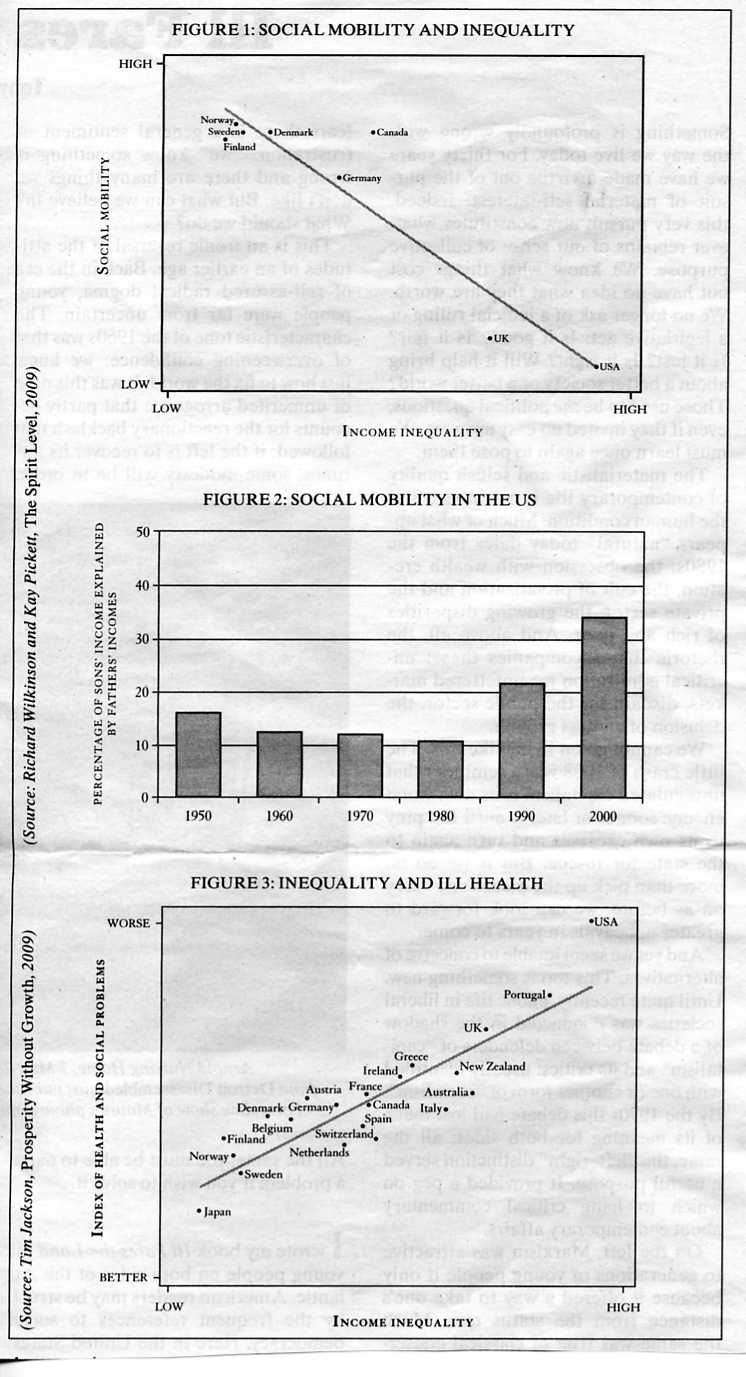
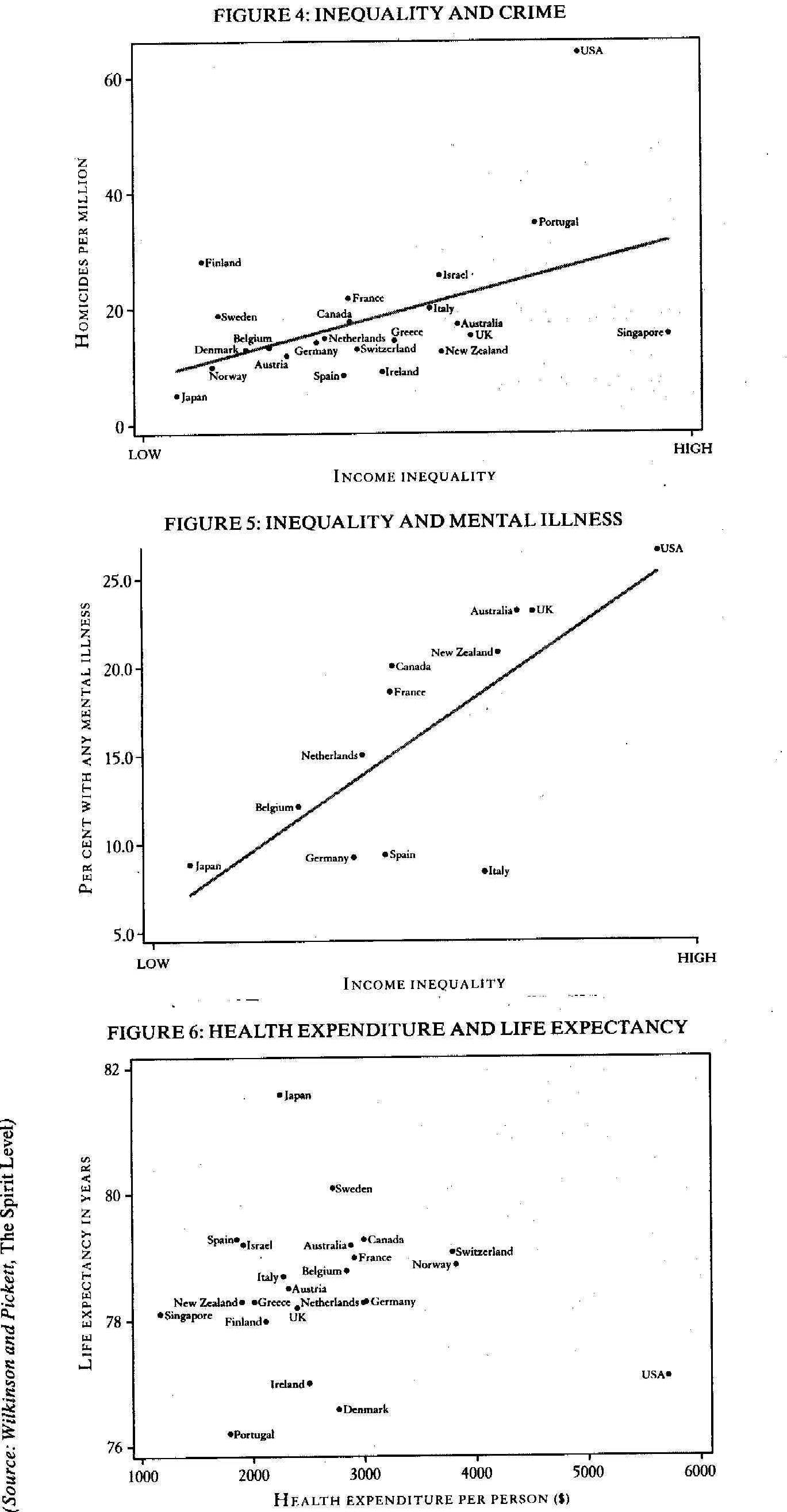
*--CF=2007:Table
CF= Annually renewed ranking of global "Legatum Financial Prosperity Index" (less sophisticated than
graphs above but globally more expansive) [E-TXT]
\\
*--LOOP on "finance"
<>2011wi:Arab-speaking world and beyond swept by
waves of unrest. Protests convulsed half a dozen countries across AfroAsia [Based on NYT rpt~]
*--Tunisia | The suicide of a street vendor led to a revolt that ousted that country's autocratic ruler
*--Egypt | Less than a month later, President Mubarak was driven from the office he claimed as his own for
three decades, and strikes over long-suppressed grievances continued there
*2011fe16:Bahrain | Tens of thousands of people turned out to challenge the monarchy
*--Yemen | Street battles intensified
*--Iran | Demonstrator's funeral turned into a brief tug of war between the government and its opponents
*--Libya | Pockets of dissent broke out from under heavy police control
Throughout "the Arab Spring" of 2010-2011 readers of commercial-culture journalism in USA noticed emphasis on the
wondrous progressive power of "social media" [F/] and on the heroic popular unrest among the people of the Arab world
But attitudes about vigorous political dissent depend so much on "whose ox is gored" =
Some USA readers noticed that the sense of heroism or emphasis on the positive role of anti-establishment "social media"
in the story above was altogether absent in the same media outlets' stories about the wave of popular unrest that swept
across the USA at the same time, with the rise of the "Tea Party" and "Occupy Wall Street" demonstrations
[EG#1 | EG#2]
*--In addition, public mass-media in "The West" noticed vigorous international
military intervention into these ostensibly domestic AfroAsian uprisings
*--Over the previous century and a half, AfroAsia had become a distinct
global hot spot, and as the 21st century unfolded it continued to be so
\\
*2009ap13:NYT| Paul Krugman, "Tea Parties Forever" [E-TXT]
*2016: eurotopics.net| Report lambasts Cameron's Libya intervention
[E-TXT]
*2017mr02:theguardian| Mubarak acquitted in final ruling on Egypt's Arab spring deaths
[E-TXT]
<>2011oc15:NYT (a
USA "newspaper of record" [W-ID]) |
NYC the scene of massive public protest against Wall Street corruption. "In Private,
Wall St. Bankers Dismiss Protesters as Unsophisticated", by Nelson D. Schwartz and Eric Dash|
An article which sought to summarize the way bankers and other financial managers characterized
USA public protests after citizens "occupied Wall Street" in September and as these protests
spread throughout the USA and seemed to mesh with global citizens' movements against remote,
oppressive and indifferent elites =
Publicly, bankers say they understand the anger at Wall Street -- but believe they are misunderstood by the protesters camped on their doorstep. But when they speak privately, it is often a different story.
"Most people view it as a ragtag group looking for sex, drugs and rock'n'roll," said one top hedge fund manager.
"It's not a middle-class uprising", adds another veteran bank executive. "It's fringe groups. It's people who have the time to do this."
As the Occupy Wall Street demonstrations have grown and spread to other cities, an open question is: Do the bankers get it? Their different worldview speaks volumes about the wide chasms that have opened over who is to blame for the continuing economic malaise and what is best for the country.
Some on Wall Street viewed the protesters with disdain, and a degree of caution, as hundreds marched through the financial district on Friday. Others say they feel their pain, but are befuddled about what they are supposed to do to ease it. A few even feel personally attacked, and say the Occupy Wall Street protesters who have been in Zuccotti Park for weeks are just bitter about their own economic fate and looking for an easy target. If anything, they say, people should show some gratitude.
"Who do you think pays the taxes?" said one longtime money manager. "Financial services are one of the last things we do in this country and do it well. Let's embrace it. If you want to keep having jobs outsourced, keep attacking financial services. This is just disgruntled people."
He added that he was disappointed that members of Congress from New York, especially Senator Charles E. Schumer and Senator Kirsten Gillibrand, had not come out swinging for an industry that donates heavily to their campaigns. "They need to understand who their constituency is", he said. [IE= The "constituency" of the USA Congress was ensconced bankers, not mobilized citizens]
Generally, bankers dismiss the protesters as gullible and unsophisticated. Not many are willing to say this out loud, for fear of drawing public ire -- or the masses to their doorsteps. "Anybody who dismisses them publicly is putting a bull's-eye on their back", the hedge fund manager said.
John Paulson, the hedge fund titan who made billions in the financial crisis by betting against the subprime mortgage market, has been the exception. His Upper East Side home was picketed by demonstrators earlier this week, but Mr. Paulson offered a full-throated defense of the Street, even going so far as to defend the tiny sliver of top earners attacked by the Occupy Wall Street protesters -- whose signs refer to themselves as "the other 99 percent".
RELATED NYT TXT =
"The top 1 percent of New Yorkers pay over 40 percent of all income taxes, providing huge benefits to everyone in our city and state", he said in a statement. "Paulson and Company and its employees have paid hundreds of millions in New York City and New York State taxes in recent years and have created over 100 high-paying jobs in New York City since its formation."
The messages coming from the protesters are by no means in accord. They have myriad grievances, though many see Wall Street as the most powerful symbol of the income inequality and "economic injustice" they are railing against. There is ample indignation over banks being bailed out while their customers are being foreclosed upon, and over banks handing out hefty bonus checks and severance packages so soon after the crisis erupted.
Similarly, executives keep getting generous payouts when they leave. Just last week, Bank of America disclosed it was paying a total of $11 million in severance to two executives forced out in a management reshuffle, Sallie Krawcheck and Joe Price, even as the company said it would begin laying off roughly 30,000 employees over the next few years.
"Wall Street continues to underestimate the degree of anger among citizens and voters", said Douglas J. Elliott, a former investment banker who is now a fellow at the Brookings Institution. For the most part, bankers say that they see the protests as a reaction to the high unemployment and slow growth that has plagued the American economy since the recession and the financial crisis of 2008. Despite all the placards and chants plainly indicating otherwise, some bankers suggest that deep down, the protesters are not really all that mad at them.
"I don't think we see ourselves as the target", said Steve Bartlett, president of the Financial Services Roundtable, which represents the nation's biggest banks and insurers in Washington. "I think they're protesting about the economy. What's lost is that the financial services sector has to be well capitalized and well financed for the economy to recover."
Jamie Dimon, the chief executive of JPMorgan Chase, typifies the conflicting messages coming from Wall Street. In a conference call with reporters after third-quarter earnings were announced Thursday, he struck a sympathetic note. "I do vaguely remember the First Amendment that it is legal to demonstrate and it is completely fine", he said. "You should listen and not just have a knee-jerk reaction."
But in a later conference call with analysts, Mr. Dimon's remarks were more offhand when asked about the protests and the negative perception of his industry. "Most of our clients like us", he said. Besides, changing the industry's image now is a tall order, he told the analysts, before adding, "If you have any great ideas on the phone you guys can write them up and send them to me. We'll take them into consideration". Without a coherent message, the crowds will ultimately thin out, Wall Street types [??"types"] insist -- especially when the weather turns colder. They see the protesters as an entertaining sideshow, little more than flash mobs of slackers, seeking to lock arms with Kanye West or get a whiff of the antiestablishment politics that defined their parents' generation.
"There is a view that it will be a lot of sound and fury signifying nothing", said one financial industry official.
MORE FROM NYTIMES.COM =
Most bankers were far more concerned this week about the business impact of the new Volcker Rule restrictions on speculative trading than they were about the demonstrations, this official added.
A smaller group of bank executives are taking the protests more seriously. They see them as a sign of the growing economic divide in this country -- and are even monitoring the latest developments on Twitter. While peaceful so far, the demonstrations at Bank of America, Chase and Wells Fargo branches from San Francisco to Peoria are eerily similar to those routinely seen at Citibank outposts in Athens, Hong Kong, and in other overseas markets. Some believe it could be years before the swarms of protesters end their marches on bank branches.
A few outspoken members of the financial industry have broken ranks with their more skeptical brethren to say they understand a bit of the outrage of the Occupy Wall Street crowd.
"When I tell people I went down to research the protests, they're shocked, they literally laugh", said Michael Mayo, a veteran bank analyst at Crédit Agricole Securities. "It's just not a location they frequent."
Citigroup's chief executive, Vikram S. Pandit, even said he would be happy to talk with the protesters any time they wanted to drop by. Mr. Pandit, onstage Wednesday at a Fortune magazine conference, said that the protesters' "sentiments were completely understandable".
"I would also corroborate that trust has been broken between financial institutions and the citizens of the U.S., and that it's Wall Street's job to reach out to Main Street and rebuild that trust", Mr. Pandit said. The protesters should hold Citi and others "accountable for practicing responsible finance", he said, "and keep asking us about how we're doing".
\\
*2016se17 = Five Years Later, Occupy Gets Its Moment - POLITICO Magazine [E-TXT]
*2017ja06:The Guardian| "Want to be part of the next wave of activism? Move to rural America" [EG=Occupy organizer moves to rural Oregon] [E-TXT]
*--LOOP on "finance"
<>2011de10:SRAS Newsletter offered excited eye-witness report on Moscow events
<>2011de11:Moscow| Reuters dispatch addressed remarkable public protest against fraudulent elections in Russia, a more vigorous public reaction to fraudulent election practices than experienced in any other European or North American nation (CF=2000:USA election which failed and led to US Supreme Court appointment of George W. Bush)
MOSCOW (Reuters) President Dmitry Medvedev ordered an investigation Sunday into allegations of fraud in Russia's parliamentary election, one day after tens of thousands of protesters demanded it be annulled and rerun.
Medvedev responded on his Facebook site to the protesters' complaints that the December 4 election was slanted to favor of his and Prime Minister Vladimir Putin's United Russia party, but did not mention their calls for an end to Putin's rule.
"I do not agree with any slogans or statements made at the rallies. Nevertheless, instructions have been given by me to check all information from polling stations regarding compliance with the legislation on elections," Medvedev said in a post on the social media site.
"Citizens of Russia have freedom of speech and freedom of assembly. People have a right to express the position that they did yesterday. It all took place within the framework of the law," he added.
His statement was a sign that the Russian leadership feels under pressure after the biggest opposition protests since Putin rose to power in 1999. The protesters themselves used social media to organize their rallies.
In a further sign of recognition that the people's mood has changed after years of tight political control by Putin, city authorities across Russia allowed Saturday's protests to go ahead and riot police hardly intervened.
State television and other Russian channels also broadcast footage of a huge protest in Moscow, breaking a policy of showing almost no negative coverage of the authorities.
But Medvedev had already indicated before the protests that he would call an inquiry, and a statement from Putin's spokesman, Dmitry Peskov, gave no indication that the prime minister was about to make big concessions to the protesters.
"We respect the point of view of the protesters, we are hearing what is being said, and we will continue to listen to them," Peskov said in a statement released late Saturday.
That is unlikely to appease protesters who issued a list of demands at the Moscow rally, which police said was attended by 25,000 people and the organizers said attracted up to 150,000.
PROTESTERS LIST THEIR DEMANDS
The demands included much more than just an investigation in the conduct of the election, which international monitors and the United States said was slanted to help United Russia secure a majority in the State Duma lower house.
The protesters demanded a rerun of the election, the sacking of Central Election Commission chief Vladimir Churov and the release of people they define as political prisoners. The organizers also called for a new day of protests on December 24.
"I am happy. December 10, 2011 will go down in history as the day the country's civic virtue and civil society was revived. After 10 years of hibernation, Moscow and all Russia woke up," Boris Nemtsov, an opposition leader, wrote in his blog.
"The main reason why it was such a big success is that a feeling of self-esteem has awakened in us and we have all got so fed up with Putin's and Medvedev's lies, theft and cynicism that we cannot tolerate it any longer ... Together we will win!"
It may not be that simple. The opposition has long been divided, most mainstream parties have little or no role in the rallies and keeping them up across the world's largest country is hard at the best of times but especially in winter.
Most Russian political experts say Putin, the former KGB spy who has dominated the world's largest energy producer [Russia] for 12 years, is in little immediate danger of being toppled, despite anger over widespread corruption and the gap between rich and poor.
But they say the 59-year-old leader's authority has been damaged and may gradually wane after he returns as president in an election next March that he is still expected to win.
Although opinion polls show he is Russia's most popular politician, the protests indicate how deep feelings are over the December 4 election. The biggest were in Moscow and St Petersburg, the two biggest cities and the main centers of Russia's middle class, but smaller rallies took place across the country.
TOUGH TASK AHEAD
"Putin has a formidable task. He has lost Moscow and St Petersburg, crucial cities where everything usually starts," said political analyst and author Liliya Shevtsova. "He looks out of touch."
Putin, as president for eight years until 2008 and as prime minister since then, built up a strongman image by restoring order after the chaos in the decade after the Soviet Union's collapse in 1991. But he no longer seems invincible.
He could release the state's purse strings to satisfy the financial demands of some critics but many of the protesters in Moscow are middle-class people demanding more fundamental changes, including relaxing the political system he controls.
His charges last week that the United States encouraged the protesters and financed them provoked scorn on the Internet.
Answering calls to protests on social media sites, a huge crowd gathered in Moscow's Bolotnaya Square Saturday, many carrying white carnations as a symbol of protest. Some waved pictures of Putin and Medvedev saying: "Guys, it's time to go."
Felix, 68, a retired military officer who declined to give his surname, said in Moscow he wanted Putin out, but had no hope this could be accomplished through elections. "There is no way to change those in power within the electoral system they have set up, so we need to use other methods," he said.
(Reporting by Timothy Heritage and John Bowker; Editing by David Stamp)
\\
*--Wki
*--These events described as a "Revolutionary Situation", borrowing a more than 100-year-ild Leninist historiographic concept [ID] [E-TXT]
<>2011de12:Moscow|
Reuters dispatch|
Steve Gutterman, "Two Putin-era Russians seek liberal mantle"|
Russia's former finance chief and one of its richest tycoons put themselves forward as candidates to unite liberal and
middle-class voters who vented frustration with Vladimir Putin's political dominance by taking to the streets in protest.
Alexei Kudrin [W.ID], a longtime Putin ally forced out as
finance minister in September [2011], said he wanted to help create a liberal party to fill a void exposed by
Russia's December 4 parliamentary vote, which set off mass protests over alleged fraud.
Billionaire Mikhail Prokhorov [W.ID], a metals
magnate who owns the New Jersey Nets basketball team, separately announced he would run in the March presidential
vote which he expected would return Putin to the Kremlin after four years as prime minister.
Both men cast themselves as potential leaders of liberal forces that have struggled to gain political
representation, but analysts and opposition politicians raised questions about their motives and
their independence from Putin and the Kremlin.
Tens of thousands of Russians protested on Saturday over the December 4 parliamentary election they
said was rigged in favour of United Russia, the party Putin has used as an instrument of his rule.
Kudrin said the election, in which voters sharply reduced United Russia's majority in the State
Duma lower house of parliament, had shown the "dire" need for a strong liberal alternative.
"Today one can say that the demand for the creation of such a structure is so high that it will
certainly begin to be created," Kudrin, 51, said in the interview published by the
financial daily Vedomosti.
"The process of the consolidation of liberal and democratic forces will now go forward. I am
absolutely certain of this, and I myself am ready to support this," Kudrin said, adding that
it was too early to talk about a potential leader.
MIDDLE CLASS
Putin's plan to return to the presidency and make Medvedev prime minister, unveiled in
September [2011], deepened feelings of many Russians that the future had been decided without
their input. The Duma election increased a feeling of disenfranchisement.
Many protesters in the diverse crowds across Russia on Saturday were drawn from a new middle
class of moderately wealthy professionals who are unhappy with a tightly controlled
political system dominated by a single man.
Prokhorov, 46, described himself as a "defender of middle-class interests". He told a
news conference he was "ready to be an integrator" of Russia's liberal, democratically minded opposition.
Both Prokhorov and Kudrin are relatively new to electoral politics and are fresh
from public breaks with the Kremlin.
Kudrin had been finance minister since 2000, the year Putin was first elected
president, until he was forced out in September after criticizing President Dmitry
Medvedev for lavish military spending plans. [LOOP on "finance"]
Prokhorov, long seen as more of a playboy than a politician, briefly headed Right
Cause, widely seen as a pocket party controlled by the Kremlin to win liberal support.
But he quit, also in September, after a spat with Kremlin political strategist Vladislav
Surkov, influential deputy head of the presidential administration.
Neither Kudrin nor Prokhorov attended the protests on Saturday, which could scupper
their chances of winning the support of opposition leaders who led the demonstrations.
Boris Nemtsov [W.ID], a longtime Putin foe whose
political party was denied registration by the Justice Ministry this year, barring it from the parliamentary vote,
said he believed Prokhorov's candidacy was engineered by the Kremlin.
"This is a 100 percent Putin-inspired project," he told Reuters.
A liberal party led by Kudrin, who rejected a Kremlin request to lead Right Cause earlier
this year, could offer a way for Putin to channel discontent and reduce the threat posed
by the biggest opposition protests since he came to power in 1999.
"Of course the Kremlin wants to retain control and channel the energy that spilled out
into the street on Saturday into a project that will be not be completely unpredictable," said
Maria Lipman, political analyst at the Carnegie Moscow Center.
But she said whether or not Kudrin was acting in concert with Putin and the Kremlin, the
election and the protests had loosened the government's grip on politics.
"The political monopoly that the Kremlin has got used to will gradually wash away, and
even agreements with the Kremlin will not mean unconditional loyalty or Kremlin control
over the political process," she said.
KUDRIN CRITICISES UNITED RUSSIA
Kudrin's ties to Putin leave questions about his ability to play a key role in any new
political force, particularly after the protests on Saturday featured frequent chants
of "Russia without Putin" and "Down with Putin".
Opposition leaders have vowed to hold big new protests on December 24, hoping to increase pressure
on Putin as the March 4 presidential vote approaches. Polls show Putin is Russia's most popular
politician, but his approval ratings have fallen.
Kudrin avoided strong criticism of Putin in the interview, saying he had done a good job
softening the blow from the global financial crisis on Russia, and blaming United Russia
for the lack of progress in fighting corruption and other problems.
But he warned that the legitimacy of the presidential election would be undermined if
the authorities ignore the allegations of fraud in the parliamentary vote.
Kudrin called for a recount "in certain polling districts and even regions" and said
the Kremlin should consider dismissing the head of the Central Election Commission, Vladimir
Churov, which is one of the protesters' other demands.
"If this is not done, the next elections will be conducted in a slipshod manner," he
said. "Ignoring obvious violations places the objectivity of these elections in doubt."
Medvedev said on his Facebook site on Sunday that he had ordered an investigation into
the electoral fraud allegations, but neither he nor Putin has given any indication
they will accede to the protesters' demands for a new election.
Russian Prosecutor General Yuri Chaika said on Monday that he saw no grounds for
a recount or a new vote. [Remember the same judicial move in USA against recount
in the 2000 presidential election.]
Up to 5,000 mostly young pro-Kremlin activists turned out for a rally in a central
Moscow square on Monday, Russia's Constitution Day.
Police and state television said the demonstration drew 25,000, the same as the
police crowd estimate for Saturday's protest in Moscow.
(Additional reporting by Alexei Anishchuk, Nastassia Astrasehuskaya and Elizabeth Piper; Editing by Alistair Lyon)
\\
*--The Other Russia [E-TXT]
*2016au25:BBC News| Protesting in Putin's Russia [E-TXT]
*2017fe11:BBC News| Russia court questions jailing of peaceful activist Ildar Dadin
[E-TXT]
<>2012fe26: Moscow, on the rim of Sparrow Hills, looking down on Moskva River|
One of the finest of the increasingly global pop-arts "flashmobs" strutted its stuff
[YouTube#1 | YouTube#2]
\\
*--The long century-old (maybe endless) history of dissent
continued to rock complacent world-wide "establishments", even with pop-arts public "demonstrations"
*--LOOP on nearly two centuries of pop-arts comes down to this for now
<>2012mr:FoA| NATO "victory" in Libya
[E-TXT]
<>2013fe12:The Guardian| An outstanding English visual presentation of
what a certain system of textual analysis says about the "educational level" attained by USA Presidential
"state of the union" addresses since 1790| "The state of our [USA] union is ... dumber"
[E-TXT]
<>2014ap24:NYR:68-9| George Soros
[W-ID] interview = "The Future of Europe, from Iran to Ukraine"
[SOURCE]
Schmitz (the interviewer): What do you think of Vladimir Putin's recent policies with respect to Ukraine, Crimea, and Europe?<>2013fa+: Ukrainian domestic and international crisis broke out and stretched on for years
Soros: Now you are coming to the crux of the matter. Russia is emerging as a big geopolitical player, and the European Union needs to realize that it has a resurgent rival on its east. Russia badly needs Europe as a partner, but Putin is positioning it as a rival. There are significant political forces within the Russian regime that are critical of Putin's policy on that score.
Schmitz: Can you be more specific?
Soros: The important thing to remember is that Putin is leading from a position of weakness. He was quite popular in Russia because he restored some order out of the chaos. The new order is not all that different from the old one, but the fact that it is open to the outside world is a definite improvement, an important element in its stability. But then the prearranged switch with Dmitry Medvedev from prime minister to president deeply upset the people. Putin felt existentially threatened by the protest movement. He became repressive at home and aggressive abroad.
That is when Russia started shipping armaments to the Assad regime in Syria on a massive scale and helped turn the tide against the rebels. The gamble paid off because of the preoccupation of the Western powers -- the United States and the EU -- with their internal problems. Barack Obama wanted to retaliate against Syria's use of chemical weapons. He asked for congressional approval and was about to be rebuffed when Putin came to the rescue and persuaded Assad to voluntarily surrender his chemical weapons.
That was a resounding diplomatic victory for him. Yet the spontaneous uprising of the Ukrainian people must have taught Putin that his dream of reconstituting what is left of the Russian Empire is unattainable. He is now facing a choice between persevering or changing course and becoming more cooperative abroad and less repressive at home. His current course has already proved to be self-defeating, but he appears to be persevering.
[After decades abuilding, the EU was experiencing "mission creep" at a time of internal disorder and in close association with a very different organization, NATO
*--For its part NATO continued well into its seventh decade to shape world events, strengthening ever closer institutional ties with the ostensibly civilian/economic federation, the expansive but increasingly dysfunctional EU]
Schmitz: Is Russia a credible threat to Europe if its economy is as weak as you say?
Soros: The oligarchs who control much of the Russian economy don't have any confidence in the regime. They send their children and money abroad. That is what makes the economy so weak. Even with oil over $100 a barrel, which is the minimum Russia needs to balance its budget, it is not growing. Putin turned aggressive out of weakness. He is acting in self-defense. He has no scruples, he can be ruthless, but he is a judo expert, not a sadist -- so the economic weakness and the aggressive behavior are entirely self-consistent.
Schmitz: How should Europe respond to it?
Soros: It needs to be more united, especially in response to Russian aggression in Ukraine. Putin prides himself on being a geopolitical realist. He respects strength and is emboldened by weakness. Yet there is no need to be permanently adversarial. Notwithstanding the current situation in Ukraine, the European Union and Russia are in many ways complementary; they both need each other. There is plenty of room for Russia to play a constructive role in the world, exactly because both Europe and the United States are so preoccupied with their internal problems.
[If you wish, GO to beginning of the nearly 1200-year LOOP on Ukraine]
Schmitz: How does that translate into practice, particularly in the Middle East?
Soros: It has totally transformed the geopolitical situation. I have some specific ideas on this subject, but it is very complicated. I can't possibly explain it in full because there are too many countries involved and they are all interconnected.
Schmitz: Give it a try.
Soros: I should start with a general observation. There are a growing number of unresolved political crises in the world. That is a symptom of a breakdown in global governance. We have a very rudimentary system in place. Basically, there is only one international institution of hard power: the UN Security Council. [Soros might have done better if he said "transnational" above so as to distinguished UNO from NATO which otherwise seems to contradict "only one".] If the five permanent [UNO Security Council] members agree, they can impose their will on any part of the world. But there are many sovereign states with armies; and there are failed states that are unable to protect their monopoly over the use of lethal force or hard power.
The cold war was a stable system. The two superpowers were stalemated by the threat of mutually assured destruction, and they had to restrain their satellites. So wars were fought mainly at the edges. After the collapse of the Soviet Union, there was a brief moment when the United States emerged as the undisputed leader of the world. But it abused its power. Under the influence of the neocons, who argued that the United States should use its power to impose its will on the world, President George W. Bush declared "war on terror" and invaded Iraq under false pretenses.
That was a tragic misinterpretation of the proper role of hegemonic or imperial power. It is the power of attraction -- soft power -- that ensures the stability of empires. Hard power may be needed for conquest and self-protection, but the hegemon must look after the interests of those who depend on it in order to secure their allegiance instead of promoting only its own interests. The United States did that very well after World War II, when it established the United Nations and embarked on the Marshall Plan. But President Bush forgot that lesson and destroyed American supremacy in no time. The neocons' dream of a "new American century" lasted less than ten years. President Obama then brought American policy back to reality. His record in foreign policy is better than generally recognized. He accepted the tremendous loss of power and influence and tried to "lead from behind." In any case, he is more preoccupied with domestic than foreign policy. In that respect America is in the same position as Europe, although for different reasons. People are inward-looking and tired of war. This has created a power vacuum, which has allowed conflicts to fester unresolved all over the world.
Recently, Russia has moved into this power vacuum, trying to reassert itself as a geopolitical player. That was a bold maneuver, inspired by Putin's internal weakness, and it has paid off in Syria because of the weakness of the West. Russia could do what the Western powers couldn't: persuade Assad to "voluntarily" surrender his chemical weapons. That has radically changed the geopolitical landscape. Suddenly, the prospect of a solution has emerged for the three major unresolved conflicts in the Middle East -- Palestine, Iran, and Syria -- when one would have least expected it.
[Start LOOP on "Putin" at beginning]
The Syrian crisis is by far the worst, especially in humanitarian consequences. Russia's entry as a major supplier of arms, coupled with Hezbollah's entry as a supplier of troops, has turned the tables in favor of Assad. The fighting can be brought to an end only by a political settlement imposed and guaranteed by the international community. Without it, the two sides will continue to fight indefinitely with the help of their outside supporters. But a political settlement will take months or years to negotiate. In the meantime, Assad is following a deliberate policy of denying food and destroying the medical system as a way of subduing the civilian population. "Starve or surrender" is his motto
\\
*--LOOP on "Syria" since 1918
“The Vatican is not part of any bloc or international alliance. ... It attaches more importance to the interests of its faithful than to the games of the major powers. Catholicism does not see human rights, nationalism and democracy as a fundamental basis but gives them theological interpretations. This is why the pope is free to meet dictators, to visit isolated states and to take action in politically complex situations. Using its diplomacy the free Vatican can lend a helping hand in international negotiations. ... It is unacceptable to accuse the pope of naivety or of currying favor with Russia for meeting the Patriarch in Havana. The pope knows what he is doing and his actions are not influenced by the tensions between Russia and the West.”
“The Russian aggression of which the American Defense Secretary speaks is cheap propaganda on the part of those who want nothing but a new Cold War. They need a bogeyman in the East to unite the US while disciplining the states of Western Europe, as well as some in the East. Because even in the former Soviet satellite states, which are today in the throes of democratic change, not everyone is happy about a stronger American military presence in Europe. That's why Russia must be depicted as the enemy and a danger to the 'Free World' -- and to world peace in general.”
<>2016mr09:Независимая
газета| "Патриарх Кирилл предложил создать единый список литературы для
российских школ"| [E-TXT]
*2016je02:Независимая газета| "Константинопольский патриархат
удовлетворил пожелания РПЦ по поводу Всеправославного собора" [E-TXT]
*2016je13:Guardian| "Russia will not attend historic meeting of world's
Orthodox churches" [E-TXT]
*2016oc19:Независимая газета| В состав Общественной палаты вошли
представители духовенства [E-TXT]
*--Since the evaporation of the USSR in 1992, the status of
the Russian Orthodox Church has made Russia -- when considered from a purely
official and institutional point of view -- the most Christian European state.
Why might we take such a comparison with a pinch of salt?
<>2016je26: The Guardian| "Russia passes 'Big
Brother' anti-terror laws" [E-TXT]
*--"Yaroslava Law (in Russian) [TXT]
<>2016jy04:Новая Газета| "Могут повторить" [re."deplorable"
right-wing candidates for election to the State Duma of the Russian Federation]
[E-TXT]
<>2016au19:The Insider|
Консерватизм, Сталин, православие! Кто стал новым министром образования? [E-TXT]
*2016au19:RT| Russian Communications Ministry mulls total control over
Russian sector of the web [E-TXT]
*2016no02:Novaia gazeta| "Крипто-облако для Яровой. Почему попытки цензуры в Сети обречены оставаться на шаг позади
прогресса" [E-TXT]
\\
LOOP on Censorship
<>2016se19: eurotopics.net| "Why is Putin's
political party, Russia United, so successful in the current elections to the
Russian legislature" [E-TXT]
<>2016oc07:WPo| Masha
Gessen| "Five myths about Russia" [
E-TXT]
<>2016de23:NYT| "President Gorbachev’s Last Phone Call"
[E-TXT]
\\
*--LOOP on "Gorbachev"
<>2016de27:Независимая газета| "Явлинский:
Россия движется по пути, которого нет" [E-TXT]
*2016de27:Независимая газета| "Лидер 'Яблока' считает, что постепенно кризис отрезвит людей"
[E-TXT]
*2016de28:Независимая газета| "Явлинский: Фальсификации это не игры, а государственное преступление
с целью узурпации власти" [E-TXT]
*--Yavlinskii and political party Yabloko, official website (in Russian)
\\
*--LOOP on "Yavlinskii"
<>2017fe24:The Guardian| "Multiple news outlets denied access to White House press briefing"
[E-TXT]
\\
*2017fe22|New Republic| "The D.C. Think Tank [ID] Behind Donald Trump"
[E-TXT]
*2017fe22:The Nation| "Are We Witnessing a Coup Operation Against the Trump White House?"
[E-TXT]
*2017fe22:The Nation| Cohen, Steven. "Why We Must Oppose the Kremlin-Baiting Against Trump"
[E-TXT]
*2017mr11:The Guardian| "Death, Truth, Propaganda, Alternative-facts
gripped world" [
E-TXT]
*2017mr15:rfer..org| Crimean Journalist (Mikola Semena) Risks Jail By Refusing To Follow Kremlin Line
[E-TXT]
\\
*--LOOP on Censorship for now hops back to begin the more than
three-and-one-half century-long legacy of institutionalized censorship
<>2017mr06:New Yorker on Trump, Putin
and the New Cold War [E-TXT]
<>2017mr08:The
Nation| Cohen,S, The ‘Fog of Suspicion’ and of Worsening Cold War
[E-TXT]
<>2017mr10:RT News| "US hosts anti-ISIS meeting of 68 nations,
fails to invite Russia, Iran" [E-TXT]
<>2017mr26:Russia experienced an unexpected
nation-wide day of vigorous public demonstrations against "corruption" among national official
*2017mr20 (6 days before demonstrations broke out):Johnson's Russia List|
"Moscow authorities believe their rejection of Navalny’s requested anti-corruption rally final"
[E-TXT]
*2017mr26 = Up to 8,000 people taking part in unauthorized rally in central Moscow — police
[E-TXT]
*2017mr26 = Hundreds detained at unsanctioned opposition rally in central Moscow (VIDEOS, PHOTOS) — RT News
[E-TXT]
*2017mr26 = Thousands take to streets in opposition rallies across Russia (VIDEOS, PHOTOS) — RT News
[E-TXT]
*2017mr26 = Акцию протеста во Владивостоке разогнали силовики, задержав около 40 человек / Независимая газета
[E-TXT]
*2017mr26 = Митинг сторонников Навального в Красноярске обошелся без провокаций / Независимая газета
[E-TXT]
*2017mr26 = Митинг против коррупции собрал в Новосибирске 2 тыс. участников / Независимая газета
[E-TXT]
*2017mr26 = В Омске сторонников Навального глушили джазовой музыкой / Независимая газета
[E-TXT]
*2017mr26 = Участникам несанкционированной акции в Москве грозят аресты и штрафы / Независимая газета
[E-TXT]
*2017mr26 = В Москве начали задерживать участников несогласованной акции / Независимая газета
[E-TXT]
*2017mr26 = Источник: Число задержанных в Москве участников несогласованной акции превысило 500 человек / Независимая газета
[E-TXT]
*2017mr26 = Угроза взрыва в Москве: из бизнес-центра на юге эвакуированы 300 человек / Независимая газета
[E-TXT]
*2017mr26 = Навальному грозит штраф или административный арест / Независимая газета
[E-TXT]
*2017mr26 = Возбуждено уголовное дело по факту тяжелой травмы полицейского во время оппозиционной акции в Москве / Независимая газета
[E-TXT]
*2017mr26 = Russia protests: Opposition leader Navalny arrested - BBC News
[E-TXT]
*2017mr26:Protesters Gather in 99 Cities Across Russia; Top Putin Critic Is Arrested - NYTimes.com
[E-TXT]
*2017mr27 = Kremlin airs its views on 'mass protests' in Russia
[E-TXT]
*2017mr27 = Kremlin evaluating activism of Russian protests’ participants
[E-TXT]
*2017mr27 = Госдеп США осудил задержание участников акций протеста в РФ / Независимая газета
[E-TXT]
*2017mr27 = Кремль не считает нужным реагировать на призывы ЕС и ОБСЕ освободить задержанных / Независимая газета
[E-TXT]
*2017mr27 = Песков: Информирование о протестных акциях по ТВ не ограничивалось / Независимая газета
[E-TXT]
*2017mr27 = Навальный арестован на 15 суток за сопротивление полиции / Независимая газета
[E-TXT]
*2017mr27 = Навальный в суде признал себя организатором акции в Москве, но назвал ее законной / Независимая газета
[E-TXT]
*2017mr27:Навальный и «непоротое поколение» - Фонтанка.Ру
[E-TXT]
*2017mr28 = Федотов подверг критике организаторов несогласованных акций / Независимая газета
[E-TXT]
*2017mr28 = СМИ: Росгвардию оснастят комплексами воздушного наблюдения для контроля за массовыми акциями / Независимая газета
[E-TXT]
*2017mr28 = Посольство Великобритании выясняет детали задержания британца в ходе протестных акций в Москве / Независимая газета
[E-TXT]
*2017mr28 = МВД: Полицейским перед акцией 26 марта давали установку свести задержания к минимуму / Независимая газета
[E-TXT]
*2017mr28 = Кремль учитывает и анализирует гражданскую позицию участников акций протеста, сообщил Песков / Независимая газета
[E-TXT]
*2017mr28:Владивосток, Казань, Петербург и еще 10 городов. Как проходили воскресные митинги против коррупции в регионах
[E-TXT]
*2017mr29:Новая газета| Parents and offspring tell about official repression after Sunday's meeting
[E-TXT]
*2017mr29 = Moscow slams West’s reaction to Russian protests as part of long-planned campaign
[E-TXT]
*2017mr29 = Russia's new protest generation | Al Jazeera
[E-TXT]
*2017mr30:«Мы фаталисты-практики». Что происходит в ФБК после акции 26 марта — интервью с автором расследования Георгием Албуровым
[E-TXT]
*2017mr31 = Прокуратура предостерегла москвичей от участия в несогласованной акции 2 апреля / Независимая газета
[E-TXT]
*2017mr31 = Московская полиция предостерегает от участия в несанкционированной акции 2 апреля / Независимая газета
[E-TXT]
*2017mr31 = Russia blocks access to Internet pages promoting new Moscow protest | Reuters
[E-TXT]
*2017mr31 = В выходные в Москве закроют вестибюли пяти станций метро / Независимая газета
[E-TXT]
*2017ap01 = Investigative Committee opens criminal proceedings on calls for mass disorders in Moscow
[E-TXT]
*2017ap01 = Песков: Протесты в Москве были незаконными, это стало причиной арестов / Независимая газета
[E-TXT]
*2017ap01 = Следователи возбудили уголовное дело о призывах к массовым беспорядкам в Москве / Независимая газета
[E-TXT]
*2017ap01:Кто организовал митинг 2 апреля? С акцией протеста, которую анонимы планируют на Красной площади, все не так
[E-TXT]
*2017ap01:Страна не примет команду: «Сидеть!» Будет ли сценарий ответа власти на
мобилизацию оппозиции умеренным — или «ястребы» победят?
[E-TXT]
*2017ap01 = Следователи возбудили уголовное дело о призывах к массовым беспорядкам в Москве /
Независимая газета [E-TXT]
*2017ap01 = Песков: Протесты в Москве были незаконными, это стало причиной арестов / Независимая газета
[E-TXT]
Return to top
Return (back 1500 or so years) to the earliest SAC page
|
|
|
|
|
|
|
|
|
|
|