
- GO TO most recent SAC chronology
- BC 510:BC 44; ROME, from Republic to Empire, interspersed with Classical
Greek chronology, an introduction to the concept of "usable past"
- ---(SAC coverage of Russian and World History actually begins here = )
- 453:988; BYZANTINE STEPPE FRONTIER
- 576:966; Khazars vied for dominance in the Pontic Steppe [LOOP on "Khazar"]
- 632:1018; Beginnings of medieval Bulgarian tsardom [LOOP on "Bulgar" NB! distinction from "Bolgar"]
- 632je:1029; Beginnings of fast-expanding Islamic Arabic Empire [LOOP on "Arab"
or "Islam"]
- 789: Frankish king Charlemagne launched religious/military "crusade" against NE Slavs
- 839+: Warrior merchants (popularly called "Vikings") plied the seas and rivers of
Europe and western Eurasia
- 862:980; Beginnings of Russian history, establishment of Kievan Rus'
- 863: Byzantine Patriarch Photius sent out diplomatic/religious mission
to West Slavs [LOOP on "Cyril"]
- 962:973; German King Otto I laid the foundations for
"the Holy Roman Empire" [LOOP on "German"]
- 980:1223; KIEVAN RUS, from grandeur, through decline, to utter destruction
- 1029:Seljuk Turks irrupted into Persian and Arabic territories
- 1066:Normans conquered the English Island
- 1223:1328; THE GOLDEN HORDE (Zolotaia Orda, the regime
that administered Mongol [Tatar] dominion)
- 1252:1570; NOVGOROD, THE HANSEATIC LEAGUE, and SUBORDINATION TO MOSCOW [LOOP]
- 1328:1462; MUSCOVITE RUSSIA phase 1 = Agent & Enemy of Golden Horde
- 1462:1533; Phase 2 =
Independence & Grandeur: Ivan III "the Great"
- 1533:1587; Phase 3 =
IVAN IV "THE TERRIBLE"
- 1587:1612no19; Phase 4 = TIME OF TROUBLES
- 1612no19:1652; Phase 5 =
ZEMSKII SOBOR and LAW CODE
- 1652:1682; Phase 6 =
RASKOL [Schism] and NATIONAL CRISIS
- 1648: The Peace of Westphalia brought an end to the devastating middle-Europe-wide Thirty Year War
(1618-1648)
- Next SAC
- Guide to SAC
- KIMBALL FILES HOME PAGE
<>BC 800,000 (approximately)| Proto-humans -- not yet properly designated "Homo
sapiens" but "Homo erectus" -- had the ability to sail in open seas. Early-early humanity crossed large
stretches of water (12 miles or more), probably on bamboo rafts, to reach the Indonesian island
Flores. Archaeologist Mike Morwood at University of New England in Armidale, Australia, has studied and dated stone tools found on Flores. This
evidence vastly expands the earlier presumptions about human culture, particularly human capabilities on the open seas. Earlier it was presumed
that the first such adventures were across the waters between modern-day Indonesia and Australia, 40-60,000 years ago [1998:Nature].
*--775,000 years later (approximately) something like agricultural civilization arose, the beginning of a period for which
surviving records allow something like what we conventionally call "history"
*700-595 BC: "European" history comes into good focus beginning with classical Greece and Rome
\\
*2016au29:The Guardian| "The Anthropocene epoch: Scientists declare dawn of human-influenced [contemporary global] age"
[E-TXT]
*2017au17:The Guardian| "'Rivers of bones': rituals of life, death and hunting in the American west", a description of
pre-historic hunter/gatherer culture in what we call "North America" |
[E-TXT]
*2018no01: New Republic | "Paleo Politics: What Made Prehistoric Hunter-Gatherers Give Up Freedom for Civilization"
[E-TXT]
Before we get down to the central purpose of SAC, IE=Russia in a global setting, let's look at
A brief but instructive outline history of classical Greece and Rome
with emphasis on the instructive fate of the Roman Republic
[you might want to GOOGLE some of these briefly outlined features of classical Greek history to get more detail] =
<>BC 700:595; Classical Greece, Athens| Eupatrid oligarchy
- BC 594:509; Classical Greece, Athens| Solon and tyranny
- BC 508:491; Classical Greece, Athens| Foundation of democracy
<>BC 510:390; Roman aristocratic republic lasted 120 years
- In these early years what would eventually be known as "The Twelve Tables" served as a powerful "constitutional"
foundation of Roman law E-TXT
- At the end of this first epoch, Rome was captured and burned by Gauls. Stoic old Roman senators were
massacred as they sat in their homes
- Through the final century of the Roman aristocratic republic, to the
east, Classical Greece flourished =
- BC 490:479; Classical Greece, Athens| Persian Wars
- BC 478:462; Classical Greece, Athens| Delian League and postwar building
- BC 461:430; Classical Greece, Athens| High empire and struggle for Greek hegemony
- BC 429:416; Classical Greece, Athens| Peloponnesian War phase #1: Stalemate
- BC 415:404; Classical Greece, Athens| Peloponnesian War phase #2: Crisis
- BC 403:379; Classical Greece, Athens| Post-Peloponnesian War
<> BC 390:270; Roman Republic, over the next 120 years, recovered and was transformed as it established
its authority over the surrounding "frontier"
- Rome finally had administrative, military and economic control over the whole Italian
peninsula, but at the same time its civilization was overwhelmed
- Roman culture was "Hellenized" from the East by Greek thinkers, artists craftsmen.
Should we call this "Easternization" of Rome?
- BC 378:355; Classical Greece, Athens| Naval Confederation and Social War, financial crisis
- BC 354:322; Classical Greece, Athens| Confronting Macedonia on NE
frontiers, economic prosperity
- BC 321:146; Classical Greece, Athens| Macedonian and Roman domination
ended the years of greatest Athenian geo-political grandeur
<>BC 270:120; Roman Republic's final grand epoch lasted 150 years
- The power of the Roman metropol expanded beyond Italy to Spain, North Africa (Carthage), the Balkan Peninsula (Macedonia), and into
the lands of its cultural tutors, the Greeks
- This happened in a series of three "Punic Wars" [ID} against
Carthage and campaigns into regions washed by the eastern Mediterranean Sea
- Roman constitution and imperial expansion were described by Greek-born historian Polybius
[ID]. He emphasized the "mixed" quality of
the Roman state and extolled the positive virtues of balanced and solidly institutionalized government. Three powers "checked
and thwarted one another" =
(1) Consuls (military leaders),
(2) Senators (civilian elites) and
(3) Tribunes (elected representatives of the people, the Plebeians or "Plebs")
- In Polybius' view, these three powers prevented any one faction from dominating public
life in the republic. In his ideal model, the result was "mutual interdependency of all the three". Polybius had reason
to be nervous about trends that threatened "mutual interdependency" in his own time =
- Unprecedented wealth poured in as imperialist tribute and booty were collected from subdued peoples
- Slavery expanded
- Independent small holdings (farms) declined
- The power of a Senatorial oligarchy was increasingly unchecked
- The force of "The Twelve Tables" faded with the decline of the republic
- The Twelve Tables were put aside as empire came to replace republic
- Orator, author and Censor Cato (the Elder) [ID] resisted
loss of old "Roman virtues" and objected to excessive luxuries and intensified cultural "Easternization", but Cato ended by
learning Greek himself
<>BC 133:Roman Tribune Tiberius Gracchus [ID]
launched political campaign to restore balance to Roman political life
- He worked against insiders who privatized (expropriated) vast public
lands, impoverished the masses, and threatened to dominate the republic
- A group of Senators killed Tiberius
<>BC 123: Roman Tribune Gaius Gracchus [ID]
took up his brother's cause, trying to expand citizenship beyond the city Rome and broaden public participation
- Gaius stabilized grain prices and weakened Senatorial power
- Gaius' enemies attacked and massacred his supporters
- Gaius asked a faithful servant to kill him so as to avoid being taken himself
- His reforms were scuttled
- Senatorial power was restored
<>BC 116:108; Rise and fall and rise again of Consul then censor Gaius Licinius Geta,
a democratically oriented associate of the Gracchi who struggled against insider elite power and corruption
in the name of the Roman "people"
\\
*2016:|>Zelinskii,FF|_Римская республика
*2009: T.P. Wiseman, _Remembering the Roman People: Essays on Late-Republic Politics and Literature
<>BC 102:86;
Roman army, now a professional rather than
a citizen's force, defeated Germanic invaders and came to dominate Roman
political life
- The army propelling their successful, ambitious and popular commander Marius [ID]
onto center stage
- Equites [ID]
[Equestrian order, the non-Senatorial commercial elite] grew in wealth and power, cashing in on military aggression
- Insider bankers, money-lenders, government "procurement" contractors, executives
in corporations [societates] became very wealthy, while general prosperity languished
- Equites fortunes were increasingly tied to military imperialism, as was the economic misery of the wider population
- Military dictatorship replaced civilian rule at the end of this 16 year period
- BC 86:82; Marius assumed power and massacred his enemies
<>BC 82:79; Rome soon ruled by a second military
dictator, Sulla [Sylla] [ID],
a bitter rival of Marius but with much the same meaning for the republic
- Sulla introduced "proscriptions" [enemy lists] and authorized anyone to kill those on
the lists
- The price of political "checking and thwarting" [ID] was going up
- The ethos of the battlefield was now applied to social and political life
- The Roman republic was
doomed. The myth and many of the forms survived, but the spirit was near death
- Senatorial power was restored after Sulla's harsh dictatorship, while
"people-power", institutionally nested in the Tribunes, continued to decline
- The next phase of "Easternization" began to supplant the first phase
- Astrology, magic and other Asian religious or mystery cults were
replacing sober Greek trends of thought
<>BC 70:30; Rome gripped in ruinous 40-year civil war
- All factions were at one another's throats, seeking to destroy one another rather
than "check and thwart" [ID]
- In the last century of the republic the Equites fell into commercial alliance with
the growing ambition of the
army and promoted mounting indebtedness among Romans and ruthless exploitation of the provinces
- Working together, the commercial and military elites undermined the venerable republic
- The Republic was falling apart, but it was a period of cultural brilliance, "The Age of Cicero"
- Roman civilization produced Lucretius [ID],
Catullus [ID],
young Virgil [ID] and the great writer, orator and politician,
Cicero[ID]
\\
*--Robert Harris projects a large, complex and very now-oriented three-volume historical novel about the life and times
of Cicero. Imperium and Lustrum are the first two volumes. Cicero is less a hero and more an
actual, recognizable, 21st-century-type of person, excessively talented, seriously compromised, and up to his hips in
that contradictory and sordid but inescapable world called politics
*--Mary Beard's SPQR: A History of Ancient Rome deals with the Senate and people of Rome (that's the
meaning of the Latin abbreviation SPQR) with the purpose of explaining the fall of the Roman Republic, beginning with
the BC 63:Catiline conspiracy
*2016de19:NYT| "How Republics End" [
E-TXT]
*--A Don’s Life: Roman history and the dangers of nostalgia [
E-TXT]
<>BC 48:44; Rome fell under the personal autocratic military dictatorship of Julius Caesar
- Caesar returned with his armies from successful imperial wars of aggression against Germanic "barbarians" in
north-central and western Europe
- Caesar took power, but was soon assassinated
- Brutal struggle among dictatorial factions followed (some of them Senatorial
and elitist, some of them democratic and just plain despotic)
- Cicero learned the futility of what he
called contra arma verbis [words against weapons]
- When Cicero criticized Marcus Antonius in the public forum, he was chased down in the woods and
beheaded by three clumsy sword strokes
- Antonius put Cicero's head and severed writing hand on display at the
public forum where something approaching free speech reigned for centuries
- Antonius thought to teach a lesson to those
who would express views contrary to militarist powers, those who dared to
confront contra arma verbis
- The price of political "checking and thwarting" [ID] now
approached its highest level
- Four centuries of mixed republican life was now at an end
- No more "mutual interdependency" of major social and political factions
- No more authentic give-and-take for the public good, defined in social or civilian terms
- Politics were now blood sport or, more apropos, war
- Factions conspired with one another for complete annihilation of opponents
- These were the virtues of a highly successful new imperialistic Roman era
- 1979:Just this contradictory mixture of Roman success and Roman militaristic
dominance & violence was parodied in the movie MONTY PYTHON'S LIFE OF BRIAN
[E-TXT =
transcript of scene in which provincial rebels tried but failed to compose
a list of complaints in a manifesto against Roman Imperial rule]
- What followed the decline of the Roman Republic was increased levels of
militaristic autocracy and Imperial dictatorship, vicious insanities and
extreme depravity of governmental and public life
- It continued to work for a long-long while, four centuries, and it benefited well-to-do Romans
- *0365jy21:Tunisia | Roman coastal city inundated by giant tsunami | "Major Roman ruins discovered underwater in Tunisia"
[E-TXT]
- But it put the wider population into a bound relationship to power, and it destroyed all but the myth of
Roman virtue, even as it built big cities, good roads, and sumptuous hot baths. [MAP]
- Fifth century AD:The Empire in the west finally destroyed itself when Germanic peoples on the northern frontiers of the Empire --
erstwhile subjects, acolytes, trainees and servitors of Rome -- turned against their benefactors and captured the great world city Rome
- The Roman Empire in the east, Byzantium [GO], survived yet a thousand more years,
until 1453 when Constantinople fell to Eurasian Turkish invaders [ID]
- Then came the Ottoman Turkish "time at bat", five centuries of Islamic Empire rose on these foundations [ID]
\\
*2016de02:The Washington Post| "Five myths about the decline and fall of Rome"
[
E-TXT] Consider the variety of "historiographies" that the author of the E-TXT dismisses as "myths"
or that he uses to expose the "myths". Take an hour to read the
comments of E-TXT readers. These are frequently silly and wrong, but mixed in with the silly comments are
the sophisticated comments, just about the most sophisticated of the scores of such collections of
comment I read through the year or so of the 2016 presidential campaign. Notice the frequency of
commentators praise for the E-TXT,
mixed with critical analysis of it. Notice the
search for ways to understand the distant past by means of contemporary
events, but also notice the search for ways to understand contemporary
events by means of the distant past.
---- WE HOP FORWARD NOW TO THE TIME OF BYZANTIUM,
BEGINNING WITH THE NICAEAN COUNCIL =
<>0325:Nicaean Council (First Ecumenical Council
of the Christian Church)
- This "ecumenical" or "universal" council -- inclusive of all Christian churches, then concentrated in
SW-Asia ("Near-East" or "Middle-East"), north & NE-Africa, and southern Europe [MAP] --
set itself the task of defining "Christianity", building on the record of Jesus Christ's ministry and the vast
administrative/spiritual accomplishments of the Apostle Paul
- Christianity was at this time a hodge-podge of diverse and often
contradictory movements and beliefs. Uniformity had to be imposed
- This was the institutional and theological beginnings of "Christendom"
- What was earlier a persecuted sect and vague cultish faith was becoming an important component of
Roman Imperial rule and Roman ideology
- The Nicaean Council dealt with Arianism [ID#1 |
ID#2], a popular doctrine taught by Arius, a priest in
Alexandria (Egypt)
- Arius taught that Jesus Christ was neither God nor man but was a particular creation
of God, something of a demigod
- Orthodox doctrine preferred to describe Jesus as a sacred and mystical combination of God and man
- Arianism was declared a heresy but lingered on, still lingers in the ranks of world-wide Christians
- "The Nicaean Creed" [ID] became the official summary
of what Christianity was all about
We believe in one God, the Father Almighty, maker of all things visible and
invisible; and in one Lord Jesus Christ, the Son of God, the only-begotten of
his Father, of the substance of the Father, God of God, Light of Light, very God
of very God, begotten. By whom all things were made, both which be in heaven and
in earth. Who for us men and for our salvation came down and was incarnate and was made
man. He suffered and the third day he rose again, and ascended into
heaven. And he shall come again to judge both the quick and the dead.
And [we believe] in the Holy Ghost. And whosoever shall say that
there was a time when the Son of God was not, or that before he was begotten
he was not, or that he was made of things that were not, or that he is of
a different substance or essence [from the Father] or that he is a
creature, or subject to change or conversion -- all that so say, the
Catholic and Apostolic Church anathematizes them [excommunicates, curses and
completely condemns them].
- This council also created the first three Patriarchal Sees (central
administrative "thrones" of the universal Christian church) =
- Alexandria (near the mouth of the Nile in Egypt)
- Antioch (in modern-day Turkey)
- Rome
- Fordham University website presents main substance of
all seven of the great ecumenical councils of the expanding Christian Church
- 0330:Constantinople was founded and named the
co-capital of the Roman Empire
- The recently converted Christian Emperor Constantine named the new
capital Constantinopolis, after himself, and he shifted his administration there
- The Roman Empire now sported an official ideology = Christianity
- Emperor Constantine was much influenced by heretical Arianism
- Nonetheless, Constantine's new Roman imperial capital became an official Patriarchal See, the fourth
- 0398:Constantinople | John Chrysostom became Patriarch of the Eastern Orthodox Church [Eastern Church website
W#1]
- Constantinople now eclipsed Rome as the central Patriarchal See and brought the other two patriarchal
thrones, Alexandria and Antioch, under its authority
- 0451:Jerusalem was designated the fifth Patriarchal See of the Universal Christian Church
- The city Rome slumped into rustic disintegration, but the Roman Empire lived on another 1000
years, centered in the magnificent Eurasian capital city Constantinople
- Christianization was a centrally important moment of "Easternization" of "The West"
- The highest level institutional administrative structure of the Christian
Church remained unchanged for more than a millennium, until =
- 1521:In central Europe, the Protestant Reformation (Revolution?)
- 1598:Seven centures after Russian Christianization, the Moscow Metropolitan became
the Moscow Patriarch
, the sixth Patriarch -- the last officially
designated Patriarch -- of the frequently splintering universal Christian Church
\\
*2012:Peter Brown, Through the Eye of a Needle: Wealth, the Fall of Rome, and the Making of Christianity in the West, 350-550 AD
[2012=noUO]
*2012oc11:NYR:43-5|>Wills,Garry review of Brown = "It is a privilege to live in an age
that could produce such a masterpiece of the historical literature" (45)
*500:1500; One thousand years of growth of the Eastern Orthodox Church prior to elevation of Russian Patriarch summarized
[E-TXT]
*2018oc15=The unified "ecumenical" Christendom experienced constant fractures, from the outset until
very recently. For example, 18oc15:RT World News, "Biggest split in modern Orthodox history: Russian
Orthodox Church breaks ties with Constantinople"
[E-TXT]
*--7-hop LOOP on "Protestant Reformation"
*--LOOP on "Church"
<>0453:988;
BYZANTINE STEPPE FRONTIER
- 0453:Hun commander Attila died [W
summarizes his remarkable semi-mythic warrior-nomad campaigns. Concentrate on "Eastern Roman Empire" and
"In the West", up to his death. Contemplate Attila's wide geographical implications as shown on the two maps]
- Pontic Steppes [the vast feather-grass plains north and east of the lower Danube R.
and the Black Sea] entered another in a long series of disordered epochs or simple flux,
sometimes a gentle milling of peoples and sometimes forceful movement of violent nomadic warriors
- We know very little about these early epochs in the history of the Pontic Steppes and of Eurasia
- The famous Enlightenment historian Edward Gibbon, in _The_Decline and Fall of the Roman Empire,
described these epochs as eras of "obscure calamities"
- We can, however, familiarize ourselves with the geography of Eurasia [ggr |
MAP]
- In this extended period of wandering peoples, the western capital of the Roman Empire (Rome) fell,
while Constantinople, the Eastern capital of that empire since the year 330 [ID],
survived another thousand years, until 1453
- The Eastern Roman Empire is known as the Byzantine Empire
[W]
\\
*--Wki entry on Attila refers regularly to Byzantium and its people as Rome and Romans
Contemporary aerial photo of Constantinople
[called Istanbul in the Turkic epoch]
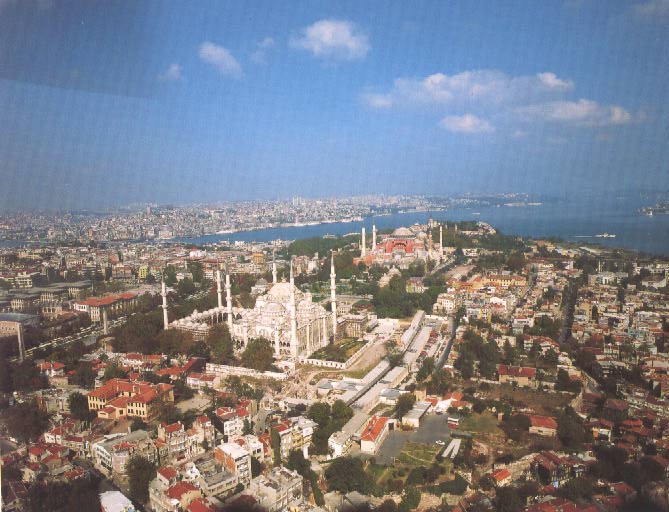
The Blue Mosque (foreground) and St.Sophia Cathedral (background)
in contemporary Istanbul [Constantinople]
[Source: website#2 above]
St.Sophia [Hagia Sophia] Cathedral was the intellectual-cultural center of Christian life in the
Constantinople epoch (now a museum)
[Read Russian Chronicle account of the powerful
architectural impression made by Hagia Sophia]
Blue Mosque is the spiritual center of Islamic life in the
post-1453 epoch
Pick up LOOP on Islam from the beginning
- In the confused centuries up to the 800s, Slavic peoples lived originally as
village-based farming folk along the Pomeranian shores of the Baltic Sea [the name
"Pomerania" comes from a Slavic expression for "at the seashore", po more]
- Under pressure from migrating Germanic or Gothic peoples, these Slavs shifted eastward and southward
along the Eastern slopes of the Carpathian Mountains out into the cold Valdai savannahs [mixed
woods and prairies where the Volga, Dnepr, western Dvina, and Volkhov rivers rise], into the woodsy
farm lands of present-day northern European Russia [MAP].
- Slavs and other peoples migrated in response to the pressures of
something like a demographic Rubic's Cube. As one people or "tribe" moved,
others moved perforce and/or were absorbed. The movements of Gothic peoples, both
Visigoths [West Goths] and Ostrogoths [East Goths] were a powerful cause of demographic
flux
- Among these migrating peoples were the Alany
[ID]
- Slavs shifted eastward and southward in rhythm with the interrelated pan-European
and Pontic Steppe flux, a phenomenon German antiquarians call Volkerwanderungen, the wandering of peoples
Three distinct Slavic language groups emerged from this process
MAP
of three contemporary Slavic language groups
- West Slavic villagers settled down in territories roughly equivalent to where
modern-day Lithuanians, Poles,
Czechs, and
Slovaks live
- East Slavs settled where today we find Belarusians, Ukrainians
and Russians
- South Slavic peoples, in the centuries prior to the
9th, found themselves extruded into the boiling cauldron of demographic change
in the lower Danube valley, along the vital defensive frontier of Byzantium,
northwest of Constantinople. These Slavs were pressured in all directions, but
the most important force was the first great epoch of Turkic expansion into eastern Europe =
- South Slavs drifted even further southwest, under the
command of Hunnic chieftains or Bulgar boyars
- Turkic military commanders/leaders came to be named with the Slavic word boyar [warrior]
- In the two centuries up to about 700, the south Slavic villagers in the lower Danube
valley "Slavicized" their Turkic boyars
- They filled the countryside of what is modern-day Bulgaria, and founded a powerful
Christian Bulgarian tsardom [W (brief
popular histories)] and [MAP]
- Turkic peoples under boyar leadership who did not move south and west into the Danube valley, who held to the wild eastern Steppes, were
split off from the Danube Bulgars
- Khazar expansion pushed these Turkic peoples northward up the Volga valley to the lands
around the city Kazan [map] where they formed a significant Islamic
or Muslim Bolgar khanate
- NB! In SAC Bolgar is spelled with an "o" to distinguish Volga Bolgars from Danube Bulgars
- Similar movements were under way in the Balkan Peninsula, "Yugoslavia" and Greece
- Hundreds of years after the Bulgar/Bolgar migrations, a second epoch
of Turkic expansion poured out of the Altai highlands
- Eurasia in outline [MAP]
- In a process of remarkable cultural syncretism, West, East and South Slavic peoples filled
the countryside from the eastern Baltic to the Adriatic and Black sea coasts
- These Slavic villagers were the rural platform over which generations of warrior nomadic peoples passed
- These various warrior nomads sometimes recruiting Slavs into their service
- In the reverse direction these various warrior nomads, these Turkic
elites, were often absorbed into the cultures of the recruited Slavs
- To the south of all this flux, the Byzantine Empire evolved a subtle and complex military
and commercial network of "diplomatic" relations
- Byzantine "foreign policy" was designed to protect it from the destructive potential of
nomadic instability, and to profit from it
- Byzantium was forced to play with fire
- The very phrase "Byzantine diplomacy" has taken on a very unjust negative
colloquial meaning = desperately complex and disgustingly "devious"
- But the stakes were high, and diplomatic skill was key to Byzantine success
- The diplomatic strategies of the Byzantine Empire shaped
the modern world in eastern Europe
- The Obolensky term for the expansive world of Eastern Orthodox Christendom is on
the mark = "Byzantine Commonwealth"
\\
*--Obolensky=1-3, 42-61
*--[TXT = A summary history of Byzantium]
*--YouTube history of Byzantium
*2001:| Paul M. Barford, _The_early Slavs: Culture and society in early medieval Eastern Europe [DJK27.B365+2]
*2005:| Bryan Ward-Perkins, _The_Fall of Rome and the End of Civilization [DG311.W33]
*2005:| Julia M. H. Smith, _Europe After Rome: A New Cultural History, 500-1000 [D121.S67]
<>0494:Rome| Pope Gelasius's "Letter" on spiritual and temporal power
outlined the "two-swords" concept of western Christendom [E-TXT]
- "Two swords" asserted a degree of separation of church and state in the world administered
by the Patriarch in Rome [the Pope]
- No such separation of church and state was experienced in the world of the Byzantine Church
- Eastern Orthodox Christian institutional traditions differed from those of Rome
("the western patriarchate" of the universal Christian Church) precisely in the
definition of church/state relations
- The Byzantine Emperor and his Eastern Orthodox Church existed in a generally
tight relationship of unity or "symphony"
- One of the most dramatic demonstrations of the "Western" aberration occurred in 1076
\\
*--LOOP on "Church"
<>0540:Balkan Peninsula settled by Bulgarian Kutrigurs and Slavs
<>0550c:Byzantine Empire| Procopius of Caesarea
described Slavs [VSB,1=7]
*--0550c:Gothic Jordanes
"Origin and Deeds of the Goths" [E-TXT]
| On Slavs [VSB,1=7-8]
<>0576:Turkomen of Central-Asia turned against Byzantium,
forcing the Empire to pull back to more proximate positions in the northern Caucasus and Crimea
- Byzantium regrouped to protect itself from Avars, then Khazars out on the Pontic
Steppes [map]
- 0581:John of Ephesus described attacks by Slavs in the Balkans [Obolensky:51]
- Over the next century, Avars and Slavs settled north and south of the Danube
- 0600c:Byzantine Empire| Basileus [Emperor] Mauricius described Slavs [VSB,1=8-9]
- 0626jy29:au07; Constantinople under combined Avar and Slavic siege, but
the attackers failed to
breach the great defensive walls around the city
- The dynamic Pontic Steppe region was but one geophysical source of threat to Byzantium
<>0632:651; Turkish Bulgar khans,
Kovrat and Kubrat, created independent Bulgar khanate along watersheds flowing
from the north into the Danube
*--The Danube Bulgars accepted Christianity from Constantinople and thus served
as a Byzantine client state, sometimes restive but clearly part of the "commonwealth"
<>0632je:Islamic Prophet Muhammad
died, marking the beginning of a most dramatic cultural/political explosion, the spread of the
Muslim or Islamic Arabic Empire [W]
- The first epoch of Islamic Arabic expansion was called the "Umayyad Caliphate"
[W-ID]
- The accomplishments of this first century and a half have much the same relationship to historical
Islamic identity as the great Roman Empire (west and east) has to western and eastern European historical
identity -- a dream or a nightmare of original grandeur. "It's where we came from. It's our roots"
- Note how this
moving
MAP illustrates the stunning rapid growth of the Arabic Empire, 15 expansive
moments in the first two decades after Muhammad's death
\\
*--Tom Holland on origins of Islam [YouTube]
*2016: Aljazeera, "The Caliph"
[E-TXT]
*--Pavlidis,6
*--Fred Donner, Muhammad and the Believers: At the Origins of Islam
[E-TXT rvw with extensive links relating to the first century
of Islamic consolidation and expansion]
*--Barnaby Rogerson|_The_Heirs of the Prophet Muhammad: The Two Paths to Islam (2006)
accounts how the Arabic empire spread rapidly. However, two of Muhammad's heirs became
symbolic patrons of two warring factions. These two factions continued over the following 13 centuries to
split Islam into fatally hostile camps = Muhammad's son-in-law Ali inspired the Shiah;
Muhammad's wife Aisha the Sunni
*--LOOP on Islam
<>0674:678; Byzantine capital city Constantinople
besieged by Arabs
*--At this point, however, Islamic Arab power was turned away and diverted elsewhere
\\
*--LOOP on Islam
<>0680:681; Constantinople Council
(Sixth Ecumenical [universal] Council of the universal Christian Church)
<>0689:Bulgar khan Asparukh
[W] moved with his
people over the Danube to the south
*--The Bulgars thus breached one of the most important Roman/Byzantine defensive lines
against nomadic incursion from "The East"
*--Byzantine power concluded that Bulgars now had to be co-opted into further close alliance or crushed
*--But these Bulgars were strong enough to gain significant independent
status and to sustain it over the next three centuries
\\
*--Obolensky=13, 63-4
<>0695:Dnepr River delta city Kherson, a key trading port in the
Crimean area, was under the khagan [khan, kagan, kahan; ruling monarch] of Khazaria
*--Soon Byzantium achieved joint authority with them
<>0710:1185; Japan, Ezo [Hokkaido]|
Historical sources of the Nara (710-794) and Heian (794-1185) periods describe
how, over these 400 years, northern Honshu Island was still occupied by
"barbarians" who once inhabited large areas of what is today called Japan
*--The Japanese people pushed the aboriginal people north
*--The Chinese characters,
adopted by the Japanese as they because literate, named these northern areas and can be read as Ezo, Ebisu or Emishi
*--"Ezo" denoted proto-Caucasoid "barbarians" who, many years later, in the Meiji period (late 19th c.),
were called Ainu
*--The Ainu are a people with a complex and obscure history
[Wiki | KEJ,2=238]
<>0711:712; Spain conquered by Arabic forces erupting
out of the global region "AfroAsia" (a neologism employed by SAC [ID] )
<>0717:718; Constantinople under siege by Arabs
again but received significant support from Bulgar khan Tervel and his warriors [boyars]
*--Orthodox Christian Bulgaria became an increasingly important power west of
Orthodox Byzantium, east of German Catholic power, south and east of Judaic Khazar
as well as Islamic power
\\
*--Obolensky:61-68
<>0718:732; France under Arabic invasion
*--Frankish king Charles Martel stopped Arabic advance in what is today the
French/Spanish border area [MAP]
<>0737:Lower Volga territories of Khazar
authority [W] subject to Arabic attack, but without any long-term success
- Soon Khazars held the middle-Dnepr city Kiev
- Khazar khaganate became the dominant power throughout the European Steppes north of Byzantine and Arabic power
- Khagan Bulan accepted Judaism
- Khazars were not ethnically "Jewish", but over the next century the Old-Testament faith and ritual spread
among the Khazar elite. Judaism became something like an official religion
- The displacement of local shamanistic religions by one or another of the "great" religions of the
book (Christianity, Islam, Judaism or Buddhism) was a standard feature of Steppe history
- The "great" religions of the book contributed powerful cultural prestige to ambitious Steppe rulers
- Frequently it meant a transition from oral culture to written civilization for these peoples
- For the Khazars Judaism functioned as a counterpoise to Byzantine Orthodox
Christianity and Arabic Islam. It gave them "distinction"
<>0750:The Muslim world split = Sunni and Shiah branches of the
Islamic faith
*--Sunni khalif [Caliph or "khalif"] established in Damascus [capital of modern-day Syria] GO 763
<>0754:Constantinople| Church Council condemned the worship of
images (icons) [W]
*--Attack on icons was called "iconoclasm" [TXT]
*--The Church called the last great Ecumenical Council to deal with this crisis
*--LOOP on "Church"
<>0763:Baghdad founded [capital of modern-day Iraq],
"capital" of the Shiah khalif (Caliph) and his Arab Abbasid dynasty
- Baghdad was a new Babylon, master of the "fertile crescent" between the two
legendary rivers, Tigris and Euphrates [Mesopotamia = Greek-based expression, meaning "between the rivers"]
- The strength of Abbasid armies came from the Central Asian Steppes
- Afghans trained in Buddhist traditions were the core of Abbasid administration, these the folk who sponsored
construction of the Bamiyan Buddha [W#1 |
W#2 |W#3]
- The great ruler Haroun al-Rashid was the central character in the famous stories, "The Arabian Nights"
\\
*--Pavlidis,7
<>0777:Iberian Peninsula
[ID] holdings of Arabs attacked by
Frankish King Karl without success
- North of Iberia, in an area that would in modern times be called "France", Germanic king Karl consolidated
his predecessor's authority over folks later called "French"
- "French" is a distortion of the Germanic name "Frank" with its core meaning "free", a meaning never completely lost
- Growing closeness with the western Patriarch (Pope) in Rome encouraged Frankish
King Karl to think of himself as a possible new Caesar of a reviving Roman Empire
- This required freeing the Iberian holdings of the old Rome [contemporary Spain, Portugal, etc.] from Islamic cultural,
political, and economic control
- King Karl's campaign represented an early adumbration of "Western"-sponsored, religiously intensive "crusades"
of "liberation" projected outward from the metropols of Christendom against perceived threats (Arabic expansion) but also
against vulnerable targets of opportunity (the Slavic peoples of NE Europe [ID])
- Great epic poem commemorated tragic heroism of Frankish commander Roland against the "infidels", the
expanding Arabic Muslim (Islamic) power of the Moors [W]
- Eurasia [MAP]
- We are seeing that, at least since 330 [ID], "Rome" and "Roman" ceased in
world-historical parlance to mean simply a specific "city" on the Italian peninsula or "of or pertaining to citizens of
that city"
- These two expressions were blending with an expanding dream (or nightmare) of global or universal ("ecumenical")
power, secular as well as religious
- In the same way, "Caesar" ceased to be simply a family name and became a more generally applicable
European institutional designation for absolute, autocratic, imperial power =
- tsar in Russian
- Kaiser in German
- kaiser-i-rum [Roman Caesar] in Turkish (after Islamic Ottoman Turks brought down the
Eastern Roman Empire in Constantinople in 1453 [ID])
\\
*--LOOP on Islam
<>0787:Nicaea| Seventh Ecumenical Council restored worship
of icons, on the initiative of Byzantine Empress Irene
<>0789:Baltic Sea, southeastern Pomeranian shores | Slavs
(largely what would later be known as Poles) and Esti
[Estonians] subdued by Frankish King Karl
- Karl's campaign was inspired by more than a little bit of the crusader or proselytizing
spirit, bringing Christianity to the pagans of NE Europe
- 0800:814; In the direct aftermath of this original "crusade", Germanic speaking
King Karl became Karlus Magnus (Charles the Great; better known later by the French translation "Charlemagne")
- The Western Patriarch of the Universal Christian Church in Rome (the Pope) crowned him Emperor
- The western half of the great Roman Empire was reviving itself under the leadership of the Pope and in league
with the heirs of the very nomadic invaders who earlier destroyed it
- Einhard's "Life of Charlemagne" [TXT]
- MAP of the Frankish Empire [my thanks to Gwenael Henry, who signs her email "Gwen Free",
for this map, substituted here for a faulty map that suggested incorrectly that Gwenael's proud Bretons were subdued by Charlemagne]
- King Karl's achievements and ambitions, however, were followed by decline of the Frankish Empire
and a setback to the dreams of "Western" restoration
- Charlemagne and the Pope at first pretended to imperial authority over the whole Empire (east and west,
Constantinople and Rome)
- Actuality soon prevailed =
- By 812, Emperor Constantine's nearly 500-year-old division of the old Roman Empire into east and
west [ID] was once again recognized back in the now rusticated city Rome
- Then more than a century later, the western imperial idea experienced a Quixotic revival
as the Holy Roman Empire under German King Otto I
- But from the 9th to the 16th century, Byzantium continued to
be the main heir to the Roman Imperial tradition, contested in this inheritance less by Rome and
"The West" than by new waves of Turkic warriors from the east [EG]
- 1937:As WW2 loomed, English author Rebecca West traveled through the Balkan territories of the old Byzantine
Commonwealth and wrote a lengthy and still-inspiring travelogue
which drew together the medieval history of the region with dark pre-WW2 20th-century events
\\
*--Obolensky
*--Albert Brackmann, "The Beginnings of the National State in Medieval Europe and the Norman Monarchies",
Medieval Germany,2=281-99 [DD126.B35] (an example of how narrow nationalist history found some
compatibility with Nazism. See Gasiorowski below)
*1955:Speculum#30:550-60Z| J. Gasiorowski, "The conquest Theory of the Genesis of the Polish State".
CF=Brackmann above
*2017au15: New Republic| "Racism, Medievalism, and the White Supremacists of Charlottesville [VA, USA]" |
[E-TXT]
<>0803:831; Bulgar khans Krum and Omurtag ruled
in an epoch of great ethnic and religious diversity in Bulgaria
<>0827:843; Sicily and southern Italy conquered
by Arabic forces
<>0839:German
source Annales Bertiniani [W] reported on
warrior merchants who passed through German-speaking territories on their way to and from western Eurasian markets
- This company called themselves collectively "Rhos"
- At this time they lived in the northern regions of modern-day Russia, probably around the fortress city Novgorod
- They were commanded by a "chacanus" [probably the German source's effort in Latin to capture what they heard from the boatmen =
- "Chacanus" most likely was their Latin rendition of the common Pontic-Steppe Asian political term for commander/leader, "khan"]
- Chacanus is not a likely Latin rendition of any Scandinavian term
- These "Rhos" said they were originally, some time back, from the Baltic shores of the lower Scandinavian peninsula
- But in their new homeland, these Rhos were variously called Rus' or Variagi
or Dany [?Danes] [VSB,1=11]
- 846:Arabic source, Ibn-Khurdadhbih, described Rus' merchants and their fabulous
routes [W]
- He identified these intrepid warrior merchants as "a kind of Slav", suggesting that
by the middle of the 9th century these "Viking" boats contained some sort of mixture of
Scandinavian/Slavic crews and possibly occasionally captains of mixed enthicity
[VSB,1=9 | RRH,1=63-4]
- We can reasonably assume that from their first appearance on the historical scene, these Rus'
were an ethnic mix [KRR=14-21]
- They have collectively come to be known as Vikings or Norsemen, but these terms may not
always attach to a pure ethnic group
- In other areas of Europe, other warrior merchant companies, originally from the Baltic shores of the
Scandinavian peninsula and near-by islands [EG=Gotland], were beginning to make their appearance [EG]
- Ironically here in the 21st century, multi-national NATO has made the island Gotland a front-edge menacing strong point
against feared Russian attack on "The West"
[
E-TXT]
\\
*--Viking routes [MAP] suggest that warrior
merchants, not unlike the Rus' encircled all of Europe, along seacoasts in the north, west
and south, and over river passages in the east
*--History of Sweden: Viking Age [E-TXT] In essence, this
history of Sweden simply "shanghais" the history of Rus to serve Swedish history
*--Jones
*2017je29:BBC, "The first European settlement in the New World"
[E-TXT]
*--YouTube explores reasons for 15th c. disappearance
of Norsemen from Greenland
<>0852:First dated entry in Laurentian text of the Russian Chronicle
(written long after this year) [CPC:58 |
KRR=9-11]
- CPC:59-205 covers origins of Russian history from
852 to 1116]
- For account of who wrote the chronicles and when, see CPC:3-50
\\
*--Nora Chadwick, _The_Beginnings of Russian History: An Inquiry into Sources [DK70.A2c5]
*--LOOP on "Chronicle"
<>0852:Bulgarian khan Boris I
[W] played Germans off
against Byzantium in order to protect Bulgarian independence
<>0855c:Constantinople University the center of a
Byzantine intellectual/spiritual renaissance
- Patriarch Photius of Constantinople dispatched missionary/diplomatic ambassador to Arabs
- For this most delicate and significant purpose, Photius
chose scholar and future apostle to Slavs Constantine [Kiril or Cyril]
- In these years in Baghdad the great Arabic university, The House of
Wisdom, was coming into its full maturity
- 1258:Eventually, 400 years later, The House of Wisdom and its world's largest library was destroyed
by attacking Mongols
\\
*--Pavlidis,8
*--LOOP on early history of the "university"
*--LOOP on Islam
<>0859:First dated entry in the
Russian Nikonian Chronicle
- The Nikonian Chronicle was written long after this year but with significant association
of Russian history with the great contemporary golden age of Byzantium) [ZNC,1:15]
- ZNC,1 covers approximately 270 years, 867-1130s
- ZNC,2 covers about a century, 1132-1240 (decline of Kievan Rus')
- ZNC,3 covers about 140 years, 1241-1381 (Mongol dominance)
- ZNC,4 covers about 40 years 1382-1425 (Moscow consolidated power)
- ZNC,5 covers about a century 1425-1520 (Muscovite grandeur, Ivan III "the Great")
\\
*--Thomas Noonan wrote a review of the translated Nikonian Chronicle, a "Historiographical" review
[E-TXT]
that is especially useful for the student of early Russian history, with attention to the dangers posed by our inescapable reliance
on chronicles, and especially with attention to the strengths and weaknesses of the contemporary translator's historical introduction
<>0860:Byzantium|
Patriarch of Constantinople Photius now sent scholar-monk Constantine [Kiril] on
mission to Khazars
<>0862:980; Beginnings of Russian history
Origins of Kievan Rus'
<>0862:Slavs and Finns by this time paid tribute to "Viking" warrior-merchants
- These "Vikings" were sometimes called "Norsemen" in western Europe
and "Variagi" [Varangians], "Dany" [Danes], and Rus' in eastern Europe
- In this year around the fortress city Novgorod, Slavic farming people "invited" Varangian Prince Rurik to
rule, described in Chronicle [TXT]
[Also in CPC:59-60 |
Jones:244-6 |
ZNC,1=16 |
KRR=11 |
RRH,1=11-12]
- Rurik and two brothers considered Novgorod, Beloozero and Izborsk reliable
strong points along a secure "route of the Rus' " to the Bolgars on the
middle Volga and beyond them to the trading centers of Arabia and Asia
- Soon they found portages to the upper drainage of the Dnepr river in the Valdai Hills and
moved straight south toward Constantinople, via Kiev
- Viking routes [
MAP#1 | MAP#2] |
How does MAP#1 compare with MAP#2? This is a "historiographical" question]
- Viking ship [pix] provided swift transport and ample room for freight
as these warrior-merchant Rus' plied their routes
\\
*--[Viking ship video] Pressed for time?
Begin video at ca. 20th minute and run to the 27th minute
*1981:| Omeljan Pritsak, _The_Origin of Rus' [DK73.P7] This is the most hyper-scholarly
exploration of the question
*--Vernadsky,2=1-18 offers a general assessment of early Russian history
*--Jones
*--Joseph L. Wieczynski, _The_Russian Frontier: The Impact of Borderlands upon the Course of Early Russian History [DK18.7.W53]
*1920: Annual Report of the American Historical Association=163-71; reprinted in HRR,1=121-7|
Michael Rostovtzeff, "The Origin of the Russian State on the Dnieper"
*1922:| Michael Rostovtzeff, _Iranians and Greeks in South Russia
*1930:| S. Runciman, History of the First Bulgarian Empire
*1936:| Aleksandr A. Vasiliev, The Goths in the Crimea
*1947:RRe#7:96-110| Nicholas V. Riasanovsky, "The Norman Theory and
the Origin of the Russian State"| A UO undergraduate's reworked history-department senior thesis
*1954:| Henryk Paszkiewicz, The Origin of Russia. The Polish view
*1955:Speculum#28:324-44| Alexander S. Vucinich, "The First Russian State:
An Appraisal of the Soviet Theory"| A "historiographical" essay, reprinted in Black.REWRITING:123-42 [DK38.B5]
*2017se12:The Guardian, "Does New DNA Evidence Prove that there were Female Viking Warlords?"
[
E-TXT]
*2018se12:The Guardian, "Viking ship burial discovered in Norway just 50cm underground"
[E-TXT
*--LOOP on Islam
*--LOOP on "Chronicle"
<>0863+:Moravian (Czech)
lands [W] | Prince Rastislav and
other Slavic princes asked Byzantine Emperor Michael III to send "bishop and teachers" of the Christian
faith, to preach in native Slavic language [Chronicle TXT]
- Byzantine Patriarch Photius dispatched Cyril and his brother Methodius (Kiril i Mefodii) to the
Slavic lands of Prince Rastislav [sometimes written "Rostislav"] [VSB,1=12-13]
- The two missionary brothers, emissaries both of the Byzantine Orthodox Church and the
Emperor, were from Salonica and native speakers of "Slavonic". They were well
suited to bring the Eastern Orthodox liturgy to the Slavs
- They were already experienced emissaries [EG#1 | EG#2]
- Cyril devised for the Slavs an alphabet called the Glagolitic, supplanted soon by the
Greek-based alphabet, named the "Cyrillic" in honor of the scholar-diplomat-monk
- For examples of Glagolitic and Cyrillic alphabets, see Obolensky=136-53
and HML, which is a "duo-page" edition, Russian-English
- Check this replica of the oldest surviving use of the Cyrillic alphabet, then hop back here
- The Byzantine Emperor and Patriarch Photius had
good reason to respond favorably to Rastislav's request =
- First was the desire to forestall the efforts of the Western Patriarch
(the Pope) to extend his church into these territories
- Second was the need to restore some sort of security against growing threats from the Bulgarians
and Rus'
- Third was to strengthen their hand against the Khazars
- The missions of Cyril combined diplomatic with religious purposes
in a critical era of European history
- Very soon Bulgaria and the Rus' entered into the
picture of Byzantine religious or Church diplomacy
\\
*--Paragraph on Cyril and Methodius [TXT]
*--Imre Boba, _Nomads, Northmen and Slavs: Eastern Europe in the Ninth Century [DR39.B6]
*--Dimitri Obolensky, _Byzantium and the Slavs, ch.9 and/or ch.10 [df541.o25]
*--C. A. Macartney, _The_Magyars in the Ninth Century
*--LOOP on "Church"
<>0865se:Bulgarian khan Boris baptized by Byzantine missionaries,
but continued to court Rome
*--Squeezed between the two remains of the great Roman Empire, West and East, Bulgaria had to be
cunning. And there was yet a third force at work here =
*--Following Boris' baptism, Turkic boyars within Bulgaria itself were reluctant to give up their customary pagan beliefs.
Old Bulgar military elites led a stubborn pagan reaction
\\
Obolensky:84-94
<>0866:Byzantium | Varangians or Rus' recently
launched their first attack on Constantinople, led by Viking warrior-merchants Askold and Dir
- 1420:MAP of Constantinople
- The attack was described in the Chronicle [TXT]
- On the way down the Dnepr River to the Black Sea and then on to Byzantium, Askold and Dir
took the vital strong-point Kiev from the Khazars
- The attack on Constantinople came perilously close to success and shook the Byzantine sense of security along
its northern frontiers. Patriarch Photius left a description [VSB,1=11]
- Now, within five years of Askold and Dir's attack, Photius described how some of these warrior
merchants, these Rus' and their Slavic crews, abandoned their pagan
faith(s) and became Christian [VSB,1=11-12]
//
*--LOOP on "Chronicle"
<>0867:1056; Byzantium's 189-year "Golden Age",
the "Macedonian Epoch" in the history of the Roman Empire, now centered at the margins of "Europe" and "Asia"
(stretching chronologically over approximately the next six SAC screens)
\\
*--Summary [TXT]
*--Pavlidis,10
<>0867:886; Byzantine Emperor Basil I (Vasilii)
the Macedonian reigned almost 20 years at opening of the "Golden Age" [ZNC,1=14,20]
<>0867:869; Rome in St.Peter's Cathedral | Byzantine
scholar/diplomatic and priest, Cyril celebrated mass in Slavonic language (troubling western church
officials accustomed to the mass in Latin -- GO 879)
<>0874:Byzantine treaty with Rus' in which an Orthodox archbishop was
posted in Kiev
<>0879:Patriarch of Rome (Pope John VIII) issued Bull against
use of Slavonic language in Christian liturgy
- Catholic/German and Orthodox/Slavonic factions entered a stormy period, and Cyril served as
a "lightning rod", here at the end of his historical quarter-century mission
- The "oecumenical" [universal] Christian Church was in the grip of a serious
crisis. Western Catholicism and Eastern Orthodoxy were splitting apart
- One of the seismic historical "hotspots" in this struggle, Croatia, came under secure authority of Rome
in league with medieval German "imperial" power
\\
*--LOOP on "Church"
<>0880:912; Kiev became headquarters
of Varangian Prince Oleg, down from Novgorod after he defeated and killed Askold and Dir
- Thus Kiev was solidly linked to the system of princely rule in Varangian city-fortresses
- Oleg ruled in Kiev for 32 years [CPC:60-71 | ZNC,1=29-49]
- Oleg's move down from Novgorod was an important sign that Rus' power felt increasingly secure in relationship
to the unstable Pontic Steppes
- Novgorod remained one of the cities in the emerging system of
Kievan mestnichestvo [ID], but it became something of a backwater for almost two centuries
- Kievan Rus' taking shape, moving closer to and aiding Byzantium in its efforts
to "pacify" the Pontic Steppes
- Kievan and Byzantine interests were mutually served in the struggle against Khazar power,
and both were vexed by Pecheneg marauders
\\
*--Vernadsky,2=22-28
*1959:| Boris Grekov, _Kiev Rus [DK71.G713] (Several editions of old original Soviet history of Kievan Rus')
*1965:| Boris A. Rybakov, _Early Centuries of Russian History [DK71.R9313] One of the best Soviet historians of early Russia
*1989:| Boris A. Rybakov, _Kievan Rus [DK80.R913]
*--LOOP on "Chronicle"
??Integrate GLOS/CMH from here on in SAC
<>0895:959; For six decades, Pecheneg
marauders careened out of the Pontic Steppes along the lower Danube drainages, pressuring Magyars [Hungarians] westward and northward
- Magyar horsemen in their turn ravaged Bulgaria and moved northwestward into Slavic
Moravian [Czech] lands, eventually clashing there with German (Catholic) power
- Magyars finally settled in lands which included territory now known as Hungary
\\
*--Obolensky=153-63
<>0903:913; Ibn-Rusta on Rus' [VSB,1=9-10]
<>0911se02:Constantinople | Byzantine Empire
signed Commercial treaty with Russia (after Rus' Prince Oleg's raids
launched near the end of his long reign)
- Chronicle TXT [Other
locations = VSB,1=20-1| WAL,1=41-4 | RRH,1=15-18]
- Scandinavian names were still characteristic of these warrior-merchants
- Varangians and Slavs, as well as other
ethnic groups were clearly working, doing business, fighting, and living (breeding) together as Rus'
- In the following year, Oleg died. The Russian Chronicle perpetuated a great mythic tale about this
event [TXT]
\\
*--Obolensky=184-7
*--LOOP on "Chronicle"
<>0912:945; Kievan Prince Igor's
reign (33 years!) [ZNC,1=49-52]
- Notice how "Ingvar" was now Igor; his wife "Helgi" now Olga
- Their son was given the hyper-Slavic name Sviatoslav [suggesting
something like "sacred glory"]
- These erstwhile Scandinavian princes were now melted into a "Russia" best thought of
as a mélange of "East Slavic" peoples (proto-Russian,
proto-Ukrainian, proto-Belarussian, undifferentiated by modern
"national consciousness" and probably not much different in language or culture)
- Over a century, very likely, they become thoroughly intermixed with
Viking warrior genes and Finnish genes of the northern hunter-gatherer folks
they lived among for eons
- This cultural assimilation that made up the Rus' can be compared and
contrasted with the English experience under Norman rule [ID]
- It was a long process, but agrarian Slavic tribal populations took to
the warrior-commercial ways of Scandinavian Varangians
- And those Scandinavians, for their part, were by now thoroughly absorbed into the culture
of native Slavic peoples whom they originally menaced and dominated
- Over the previous century or more, the Rus' had by degrees been
largely "Slavicized"
- In Kiev (the old Khazar stronghold) assimilation was at
a rapid rate in the time of Prince Igor
- 913:Northwest shores of the Caspian Sea| Khazar and Bolgar forces clashed
with a Russian expedition
\\
*--Vernadsky,2=28-58. Vernadsky insisted on
the "Eurasian" qualities of Russia
<>0917au19:Bulgarian tsar
Semeon [ID] defeated Byzantine army, built
vast Bulgarian Christian tsardom
*--0927:Treaty with Byzantium ratified Bulgarian gains
Remember why we represent the descendants of these early nomadic Turks with two names, "Bulgars" and
"Bolgars" [ID] =
- Bulgars split from main body of Turkish nomads and went south into the Danube frontier and
formed a settled Christian kingdom, Bulgaria
- Bolgars split from main body of Turkish nomads and went north into the
middle-Volga frontier and formed a settled Islamic kingdom =
<>0921:922; Bolgar
chieftain Almis,
whose domain spread along the left bank of the Volga River, below the confluence with the Kama River, sent
a diplomatic mission to Muktadir, khalif (Islamic Caliph) in Baghdad [ID]
- Muktadir responded to Almis' expressed interest in closer ties
- He sent a diplomatic mission which included Ibn Fadlan [sometimes "Ibn-Fahdlan"]
[W-ID]
- The Arabic mission found the pagan Bolgar leader and his wife ill. They soon recovered, and they concluded
that this was caused by the power of the Islamic faith
- Then there followed some new victories over the Khazars, and other enticements =
- sophisticated and attractive Arabic notions of rule by khan
- including development of crafts and agricultural skills
- state revenue from a tax in horses, skins, etc.
- plus tribute of 10% of all trade carried out by Bolgar subjects
- All these things seemed to recommend Islam to the Bolgars
- Bolgar khan Almis and his wife found sufficient reason to reject paganism, to
accept the Islamic faith, and to go on pilgrimage to Mecca, traveling through Baghdad
- The strong fortress city named Bolgar in the middle-Volga valley administered a system of fortress
strong-points spreading eastward across the southwestern Siberian Steppes
- Ibn Fadlan and other Arabic sources mention "Sivara" [?Siberia]
- Ibn Fadlan was also on mission to Khazaria
- While on this important and complex mission along the Volga River,
Ibn Fadlan met and described the Rus'
- The most famous paragraphs from his account deal with the funeral of a Rus' commander
- FIND "chieftains die" in this E-TXT
and read to the end of the translated text
- Be forewarned = This is a gruesome bit of first-hand information on the ways of the Rus'
- Excerpts from Ibn Fadlan [VSB,1=11 | Jones=164 and 425 |
DMR2=11-16]
- Many Arab sources described the pagan Rus' and Slavs
\\
*--Viking Fire Funeral (Up Helly Aa) [YouTube]
*--Ship on Fire! Viking Up Helly Aa festival heats up in Scotland
[YouTube]
*--LOOP on Islam
<>0941:Constantinople attacked by Prince Igor, but Greek fire repulsed
the Rus'
<>0944:Byzantium | Prince Igor's treaty
w/Constantinople in the last year of his long reign
[CPC:72-3 | VSB,1=21-2]
<>0945:962; Kievan Grand Princess Olga reigned
(17 years) [CPC:78-84 | ZNC,1=54-63 | DMR2:30-4 |
DMR3:22-5 | RRH,1=18-21 | ZMR2:54-8]
- She was the wife of Prince Igor [ID] who had been treacherously slain
- The Russian Chronicles reveled over the way she took her revenge [TXT]
- In these years, among the Kievan elite, pagan culture
and Christian civilization clashed under pressure from competing Byzantine
Orthodoxy and German Catholicism
- Kievan Rus' was assuming a critical role in the northern
frontiers of the Byzantine "commonwealth"
*--LOOP on "Chronicle"
<>0950s:Bulgaria | Bogomil
"heresy" flourished (religious views unacceptable to conventional Christian theologians)
- Followers of the Slavic priest Bogomil combined Gnostic [W]
concepts of salvation through knowledge [gnosis = knowledge] with Manichaean doctrines of struggle between evil and goodness
- Third century Persian [Iranian] visionary Mani long ago revived traditions of Zoroastrianism
[W], which continued to influence Christian churches
- The Bogomils were intensely "Slavic-minded" [maybe we would say "nationalistic" in our time] and
therefore both anti-Turkic and anti-Byzantine, and far from friendly to Rome
- Their Bulgarian home has been the eye of a great and enduring 1000-year European historical storm
between East and West
\\
*2017ap06:BBC | "The obscure religion that shaped the West (Zoroastrianism)"
[E-TXT]
*--Obolensky=119-27
*--LOOP on "Church"
<>0956:Baghdad | Arabian scholar Masudi on
Slavs [VSB,1=10-11]
- 1000:Arabic description of the city Baghdad [W]
- 2003mr21:A thousand years later, palatial Baghdad neighborhoods (described in the first paragraph of the document
just above) were put under the spell of US "shock and awe" [pix]
- Baghdad one month later = Satellite image [pix]
<>0957:Byzantium | Kievan Grand Princess Olga traveled with
a large diplomatic delegation to Constantinople and Emperor Constantine Porphyrogenitus
- Olga was baptized (probably for the second time) [Chronicle account in RRC2,1=6]
- Constantine Porphyrogenitus described the Rus' in _De_administrando imperio [DF593.C6613| English
translation plus original Greek| Excerpts = VSB,1=23-4 | DMR2:27-9 |
DMR3=19-21 | RRH,1=64-6]
- In his account, Constantine gave Slavonic and "Russian" [i.e., Scandinavian] names to the Dnepr
rapids, indicating that both languages were in use among the Kievan Rus'
\\
*--Alan Kimball, "Olga and Anna and Christianization of Rus' " [TXT]
*--Obolensky=164-201, especially 181-201
(Byzantine diplomacy in the Steppes) and 189-91 (Kiev in particular)
*--LOOP on "Chronicle"
<>0961:German King Otto sent Catholic missionaries to Kievan
Princess Olga
- 0962:973; Otto became "the Great" as he sought to restore and even
expand Charlemagne's grand regime of 150 years earlier [ID]
- Otto, too, associated his rule with the Patriarch of Rome (the Pope)
- For the next 800 years a German dominated imperial power was sometimes a fiction or
pretense but was given the flattering designation "Holy Roman Empire"
- It loomed on the western borders of the Orthodox "Byzantine Commonwealth",
in eastern Europe, in the Balkan Peninsula and Russia
- West and South Slavs (Poles, Czechs, Slovaks,
Croats, etc.) came under German Catholic rule
- Kievan Princess Olga was unruffled. She played German Catholics off against
Byzantine Orthodox Greeks
- As a result, the pagan culture of Kievan Rus' found itself
between a rock and a hard place as Ol'ga's 17-year reign entered its last year
-
Prince and Princess, husband and wife, Igor and Ol'ga together reigned for a
half-century
\\
*2004wi:SlR#63,4:771-93| Francis Butler, "A Woman of
Words: Pagan Ol'ga in the Mirror of Germanic Europe"
<>0962:972; Kievan Prince Sviatoslav [ZNC,1=57-71 |
DMR2:34-8 | DMR3:26-30 | ZMR2:58-65 | ZMR1:59-65]
- 0966:969; Sviatoslav campaigned against and destroyed the Khazar
khaganate, for over three centuries a powerful force in the Pontic Steppes
- Sviatoslav's campaign possibly coordinated with Byzantine invasion of Arabic
Syria, suggesting close Byzantine/Russian diplomatic relations
- 0967:971; Sviatoslav invaded Bolgar lands
- 0968:969; Kiev besieged by Pechenegs, who
thus served Byzantine interests by providing counter-balance to the growing
power of Byzantium's ambitious ally, Kiev
- Here we see an example of what Europeans came mendaciously to call "Byzantine diplomacy"
- 0971:Constantinople | Sviatoslav and Byzantine Emperor Johannes Tsimiskes signed treaty
- Sviatoslav traveled in "a kind of Scythian boat" to meet the Emperor
- He manned an oar like the other Rus'
- He was blue-eyed and wore a bushy moustache
- He shaved his head, except for a lock on one side of his head, a sign of his nobility
- He wore one golden ear-ring with two pearls and a ruby set between them
- He, like all the Rus', wore white garments, but his were cleaner than the
rest. [As described by Leo Diaconus in Jones:261-2]
- 0972: Pechenegs ambushed and killed Prince Sviatoslav at the Dnepr rapids,
ending his 10-year reign
- The Pechenegs fabricated a cup from
his skull and drank from it [ZMR2:62-5 | DMR3:56-7]
\\
*1961de:SEER#40:44-57| A. D. Stokes, "The Background and
Chronology of the Balkan Campaigns of Svyatoslav Igorevich"
*1962je:SEER#40:466-96| A. D. Stokes, "The Balkan Campaigns of Svyatoslav Igorevich"
*--Vernadsky,2=42-48
*--Tamara T. Rice, _The_Scythians [DK34.S4R5]
<>0980:1223;KIEVAN RUS
FROM PEAK THROUGH DECLINE
<>0976:1025; Byzantine Emperor Basil
II reigned 49 years (jointly with his brother Constantine VIII)
*--1018:Byzantine Emperor Basil's successful campaigns (aided on and off by Kiev) devastated
Bulgaria. Basil was dubbed "The Bulgar Slayer"
<>0980:1015; Kievan Grand Prince Vladimir reigned
(35 years!)
- At the beginning of his reign Prince Vladimir sponsored a vigorous pagan revival
- Vladimir seemed to be reversing trends of the previous two decades =
- Noble interest in Christianity grew steadily followed his grandmother Olga's conversion [ID]
- Grandson Vladimir now created pagan pantheon on the great hill overlooking the Dnepr and Podol inlets near his palace
- [pix showing ruins with inscription =
Otsiuda poshla russkaia zemlia (From here sprang forth the land of Rus)]. Photo by Sasha Kashirin
- Vladimir erected a large monument to the Slavic god of stormy heavens, Perun, the Russian version of the Scandinavian god "Thor"
- Some pagan statuary from this period, thanks to Sasha Kashirin = [pix#1 |
pix#2]
- But Vladimir's destiny lay elsewhere =
- 0986:Kievan prince Vladimir received delegations representing the religions of four other powerful
rulers [RRH,1=27-8] =
- Bolgars and their Islamic faith
- Germans and their Catholicism
- Khazars and their Judaic beliefs
- Byzantium and its Orthodox Christianity
- Then Vladimir sent out his own emissaries to make enquiries [RRH,1=29-32]
- 0988:989; Kiev Prince Vladimir sent 6000 Rus' to help Byzantine Emperor Basil II and
demanded in return Basil's sister Anna's hand in marriage
- Basil promised because he needed Kievan help = Constantinople was threatened by rebel general Bardas Phocas
from the eastern region of the Anatolian Peninsula (often called "Asia Minor" --
MAP)
- Prince Vladimir captured Kherson in the Crimea, perhaps because Basil balked on his promise
- Kiev was now the major power north of Constantinople
- Negotiations continued, resulting in Vladimir's diplomatic decision to be baptized a
Christian and to declare the Orthodox Church official in his realm
- Christianization described in Excerpt from Chronicle TXT |
Full TXT [Other locations
= CPC=110-19 | ZNC,1=74-122 |
KRR:63-71 | VSB,1=25-6 |
DMR2:38-44 | DMR3:30-5 |
ZMR1:65-71 | ZMR2:43-83 | WAL,1=65-71]
- Vladimir, who was earlier the great champion of pagan revival among the Rus', had the great wooden
statue of Perun pulled down and cast into the Dnepr River
- Not so far down river Perun came ashore, exciting the religious imagination of Kievan pagans, seeing
in this the return of their great god [Chronicle TXT description]
- An Orthodox monastery, Vydubichi [lxt#1 |
lxt#2], had to be built on this spot in order to preempt
the pagan desire to make this their new holy place
- Vladimir promulgated a law protecting the interests of the newly established Russian Orthodox Church and
defining its independence from interference. Does this law suggest separation of church and state?
[W] [VSB,1=39]
- Russian/Byzantine relations were now very close, now both diplomatically and
institutionally =
- Kievan Rus' mirrored Byzantine "symphonia" in the relationship of Church to State
- 2016je07:Fontanka| В КПРФ предлагают отменить празднование Дня России 12 июня
[E-TXT]
- 2016no03:Независимая газета| "Путин примет участие в открытии памятника князю Владимиру"
[E-TXT]
- 2017mr19:Независимая газета| В Киеве памятник князю Владимиру
облили краской [E-TXT]
\\
*--Kimball, "Olga and Anna & Christianization of Rus' " [E-TXT]
*--Vernadsky,2=56-74 on Vladimir and Christianization
*--Florovsky and Nikolai Andreev debate about paganism in TDU
*--Florovsky,5:2-9 [includes Father Georges Florovsky's critique of paganism]
*--Vernadsky,2=48-56 on Russian paganism
*2018au10: The Economist| "Neo-paganism offers something old and something new - Reviving pre-Christian religions"
[E-TXT]
*2018oc30: WPo| "Russian neopagans move their faith from the fringes"
[E-TXT]
*--Florovsky, "The Problem of Old Russian Culture" [TDU with full discussion=125-166]
*--Obolensky=134-153, 191-201
*----------------. "Russia's Byzantine Heritage" in RRC1:201-15
[also in CSH and HRR]
*----------------. _Byzantium and the Slavs [DK67.5.B95 O26]
*--Boris A. Rybakov, et al., _Christianity and Russia [BR932 .K4813]
*--Henrik Birnbaum, ed., CSS#12 (1984)
*--George P. Fedotov, _Russian Religious Mind (1946, reprint 1960 [BX485 .F4] )
*--Eve Levin, _Sex and Society in the World of the Orthodox Slavs, 900-1700 [HQ18 .E852 L48]
*--Konrad Alexander, _Old Russia and Byzantium: The Byzantine and Oriental Origins of Russian Culture [PG3002.K6]
*--Georg Ostrogorsky, _History of the Byzantine State [DF552.5 .o813]
*--I. Shevchenko, "Byzantine Cultural Influences". In Black.REWRITING:143-91 [DK38 .B5]
*---------------------, "Byzantine Source of Muscovite political ideas" [CSH]
*--Aleksandr A. Vasiliev, _History of the Byzantine Empire [DF552 .V3]
*--Internet slide show presents elementary and sometimes all-too-cute summary of early Russian
history [W]
*--Albert Leong, ed.,_The_Millennium: Christianity and Russia (A.D. 988-1988) [BR932. M54]
*2017au29:BBC News | Paganism is 'second most popular' faith in south-west England
[E-TXT]
||
*--LOOP on "Chronicle"
*--LOOP on Islam
<>0987:1697; New World, Central
America, Mexico, Yucatan, for 700 years the site of a great Mayan civilization
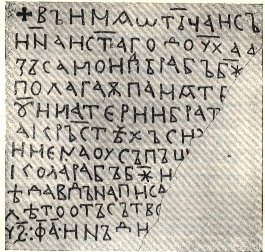
<>0993:Bulgarian Tsar Samuel
[W] had commemorative tablet inscribed to the memory
of his family
This table is the earliest surviving document in the "Cyrillic" alphabet
*--1018:Byzantine Emperor Basil's successful campaigns (aided on and off by Kiev) devastated Bulgaria.
Basil was dubbed "The Bulgar Slayer"
*--The first great epoch of Bulgaria was at its end
*--For the next several centuries, Bulgaria was tossed about in what we might call
"the Balkan maelstrom", the result of the grinding of the two great intersecting historical-seismic fault lines,
east/west and north/south
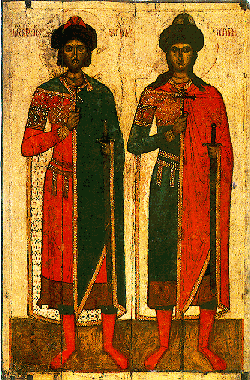
<>1015:Martyrdom of Boris and Gleb the most
traumatic moment in a series of internecine struggles among Rus' princes [DMR3:47-56]
- These two peaceable brothers were victims of the increasingly frequent and violent disputes that broke
out over right of succession up and down the hierarchy of Kievan princely cities
[CPC=126-30 | ZNC,1=123-8 | KRR:22-5 |
ZMR1:87-91 | ZMR2=101-5]
- The hierarchical political system, known as mestnichestvo, established
the rank of ruling princes and their city-states
- Mestnichestvo evolved over the 150 years since the "invitation to
the Rus'" [ID]
- The system was venerable but always prone to instability
- Ambitious and impatient princes frequently tried to "cut into the
line" ahead of turn, at a level or into a "place" [mesto] which their seniority
or "mestnichestvo" rank did not qualify them
- Boris and Gleb were sons of Prince Vladimir and one of his wives, maybe
Byzantine Princess Anna. They occupied a position of high esteem among native
Russians elevated to Christian sainthood =
Icon depicted martyred saints Boris and Gleb
\\
*--LOOP on "Church"
<>1018:Pechenegs described by German
missionary among them as omnium paganorum crudelissimi
- The Chronicles lamented the constant Pecheneg threat to Kiev [DMR3:56-7]
- But the pagan Pechenegs were at the end of their 15 decades of
fame
- The Polovtsy briefly but famously replaced them as Steppe-bred menace
- And then a fresh wave of warrior nomads washed over the Pontic Steppes and left an imprint on the
course of history that remains strong to this day
- The Turks were coming =
\\
*--Obolensky=180
*--LOOP on "Chronicle"
<>1029:Out of Turkmen/Bukhara Steppes, Seljuk Turks
(a Tatar people out of the Altai region of modern-day Mongolia) irrupted
into Arab/Persian [Iranian] world
<>1036:1054; Kievan Prince Yaroslav Vladimirovich, known
as Yaroslav Mudryi [the Wise], reigned (18 years)
[CPC=136-42 | ZNC,1=129-51 | VSB,1=26-7 |
ZMR2:71-3]
\\
*--Vernadsky,2=79-83
<>1035:Kiev Cathedral of St. Sophia built
<>1037:Kiev became the Metropolitan See (throne
or headquarters of the Russian Orthodox Church)
- The office "Metropolitan" was the Byzantine equivalent of the "Bishop" in the Roman church
- Prince Yaroslav Mudryi issued statute in support of the Kievan Orthodox Church
[VSB,1=39-40 | DMR2:51-4 | DMR3:41-5]
- 1037:1118; Three generations of Kievan scholar-monks composed the original and most
substantial primary source on early Russian history, "The Tale of Times Gone By" [Povest' vremennykh let] more
often simply The Russian Primary Chronicle [Nachal'naia letopis']
[E-TXT (Thanks to Melody Charles for this URL)]
\\
*--LOOP on "Chronicle"
*--LOOP on "Church"
<>1050s:Viking saga of Harald Hardradi and Viking runes [KRR=11-13]
<>1051:Kievan Princess Mariia (Yaroslav Mudryi's daughter) married French
King Henry I
- The Russian princess signed the nuptial documents twice, once in Cyrillic script and once in Latin
- The French monarch scrawled his illiterate "X"
\\
*1000:1100; A great epoch in the history of the Kievan City-State [KRR=30-38]
*1000:1400; Women of Novgorod [KRR=54-60]
<>1051:Kiev-Pechersk Lavra [Great Kievan Cave Monastery] founded
[ZMR2=105-16 | Official Pechersk website]
Latterday celebration of Christmas liturgy at
Pechersk
A concert
of Pechersk Bells (tenor bell melody sounds only in last 45 seconds)
Computerized cartoon tour of monastery grounds (Russian narrative)
- Ilarion [Hilarion], 1st Russian Metropolitan (Bishop) of Orthodox Church, delivered "Sermon on Law
and Grace" [ZMR1:79-81 | ZMR2:85-8]
- Ilarion also delivered a "Eulogy of Prince Vladimir and Prince Yaroslav" [VSB,1=27-8 |
DMR3:45-7 | WAL,1=45-8]
- "Lives of the Saints" became major religious but also esthetic expressions of Kievan
civilization
- EG= Feodosii's life of Nestor and sermon "On Patience and Love" [FTS=11-49 |
ZMR2=116-34] and
- Life of Feodosii [KRR:67-71]
- 170 years after the Kiev-Pechersk Lavra was founded, the greatest Kievan cultural masterpiece was completed
there, "The Paterik" [ID]
- Even as the political system of princely cities in hierarchical relationship to Kiev deteriorated and on
the very eve of Mongol invasion, the Russian Orthodox Church stood at the center
of Kievan high culture ["civilization"]
\\
*--Hubert Faenson, _Early Russian Architecture [NA5681.F3313]
*2017my02: The Moscow Times | "Russia's Ancestral Architecture" [
E-TXT]
*2017my30: Novaya gazeta | In connection with the intense nationalistic crisis involving Ukraine and Russia
(2013+), debates rage about what is Ukrainian and what is Russian in the medieval period and thereafter, especially
in this era of high-civilization in Kiev in the time of Yaroslav Mudryi (see Princess Mariia above). One of the
finer Russian newspapers, Novaia gazeta, here makes the strong and plausible argument that in these pre-modern
years there was neither a "Russia" nor a "Ukraine" [E-TXT]
*--LOOP on "Church"
<>1054:1073; First Russian law code, Pravda Russkaia
[E-TXT#1 |
E-TXT#2]
*--Some printed excerpts = VML:26-56 | KRR:26-9 |
RRC2,1=24-5 | VSB,1=35-6,36-8 | DMR2:44-50 |
DMR3:36-41 | WAL,1=45-8 | RRH,1=43-6]
*--The law code of Yaroslav Mudryi [E-TXT |
Excerpts = KRR:50-4]
<>1054:1237; Kievan political disorder (over 180 years!)
[ZNC,1=151-255 and ZNC,2=Whole volume |
KRR:24-6 | VSB,1=29-30 | DMR2:55-63]
- Feudal disintegration of Kiev
. Earlier it was
- A reasonably coherent hierarchical association of princely city-states
- A confederation held together by what is called "mestnichestvo"
- Functioning in beneficial client or vassal relationship to Byzantium
- Now Kiev was becoming a fragmented network of feudal principalities
- At the same time, ties with Byzantium were weakening
-
Kievan Rus' at the end of Yaroslav Mudryi's reign and the beginning of
disorder [MAP]
\\
*--LOOP on "feudalism"
<>1054:Great Schism of Byzantine
Eastern Orthodox and Western Catholic churches
- Christendom now clearly split into two big blocs, "East" and "West" as
Rome drifted away from its Eurasian matrix
- A serious cultural "fault line" ran through the Balkan peninsula
all the way north to the Baltic shores
- Slavic national groups became divided along confessional lines
- EG= "South-Slavic" [Yugoslav] peoples =
- Croats became Catholic
- Serbs became Orthodox
- Further north, Catholic Poles found themselves on the western edge of the fault line and Orthodox Russia
on the eastern
- Slavic peoples between these two (EG=Belarusians and Ukrainians) scrambled for
balance between religiously-inspired clashing forces
- 1521:A half millennium later, a second great schism further doomed the universalist
dream of ecumenical "Christendom" =
- The Protestant Reformation [LOOP] spread in north-western Europe and
severely damaged the power of the Patriarch in Rome (Pope)
- The big gathering concept "Christendom" would now give way to the big gathering concept "Europe"
- And both would be increasingly subordinated to the gathering power of multiple monarchical nation-states
- In "The West", the Christian Church was slipping away from the centers of imperial or monarchical power
- But the Church held on in south and eastern Europe for some time longer
- Nonetheless, the 189-year Byzantine "Macedonian Epoch", the Golden Age, was coming to a close
\\
*2016fe12:Reuters| "Millennium after split, pope and Russian church to meet in Cuba"
[E-TXT]
*--LOOP on "Church"
<>1063: Novgorod Metropolitan [Bishop] Luka Zhidiata gave
instructions to brethren [WAL,1=55-5]
<>1066:England taken under power of Norman King William
"the Conqueror", scion of a powerful Norseman or Viking tribe [ID]
- In the 900s, Normans sailed in from Scandinavian homeports and settled on the Atlantic coast of
modern-day France (Normandy) [W]
- They were now a long-assimilated French-speaking feudal dukedom but
retained much of the Viking taste for projecting power across the waters
- 1061:1091; Sicily taken by Normans
- In the decades after conquest of the English Island, the Frenchified Normans in turn Frenchified the vanquished Germanic Anglo-Saxon
elites there and laid the foundations for the evolution of a hybrid Romance/Germanic language today called "English"
\\
*--Vikings in Normandy "Allthemeds" documentary (pt1 does the job)
[YouTube]
*--YouTube history of the "English" language
*--Hugh M. Thomas, _The_English and the Normans: Ethnic Hostility, Assimilation and Identity, 1066-c1220
[E-TXT]
*--LOOP on "feudalism"
<>1067:Kievan Rus'| Out on the Eurasian steppes,
Polovtsian raids began [DMR2=64-72 | DMR3=59-64]
- Polovtsy were fierce nomadic warriors. Of Turkic-Altaic origins, they were also known as Cumans, Kumany, and Kipchaki
- Their appearance on the Pontic Steppes destabilized the region, reaching
all the way to Novgorod, and contributed to the decline of Kiev [CrNVG:5]
- Polovtsy were a continuation of the sort of Pontic disorder previously presented
by Pechenegs
- A larger Turkish onslaught scattered the Polovtsy before them, pushing them out of the
way and northward across the Pontic Steppes
- For Kiev, the Polovtsy were a premonition of the Golden Horde two centuries later
\\
*1868:Eight-hundred years after the Polovtsian era, Russian chemist, physician and composer, Aleksandr Borodin,
wrote "Polovtsian Dances" for his opera PRINCE IGOR [YouTube]
<>1071au19:Armenian frontier battle between Byzantium and
Seljuk Turks at Manzikert
- The Manzikert battle reflected the same larger processes of demographic instability suggested just above
- Alp Arslan led the Seljuk cavalry armies to easy victory. They humiliated Byzantium
- Seljuk Turks were by this time confident they were the heirs of the great Arabic empire of Muhammad
- Not only that. They can also be thought of as precursors to the Mongol invasions a century and a half later
[ID]
- Now settled on the Anatolian peninsula, they also frequently thought of themselves as inheritors
of the Byzantine Empire
- Seljuk Turks employed the Turkish expression "Rum" [Rome] to describe
their new Anatolian possessions
\\
*--Two paragraph TXT on the significance of this
<>1076fe22:Rome | Pope Gregory VII deposed Holy
Roman Emperor Henry IV [TXT]
*--This was a great symbolic moment in the history of church/state relations in regions under
the authority of the Roman Church
*1087:Pope Gregory VII issued Dictatus papae [E-TXT],
showing that the Patriarch of Rome was going to fight to hold his grip on power in "The West" for as long as possible
*--The chosen method was to enforce the separation of the power of the Church from the power of the Prince
<>1095no27:France, at Clermont | Pope Urban II
delivered a sermon [TXT] which appealed
for a western European Crusade to save the Holy Land from infidel Turks (and anyone else
who got in the way or offered possibility of booty)
- 1095:1204; Over a century, Catholic lands launched four great crusades into eastern Mediterranean
territories and even into northeastern Europe in an increasingly disfocused aggressive mission. The Crusades
were epochal examples of "mission creep" [ID]
- Europe and the Mediterranean world in the time of the
crusades [MAP]
- 1097:1150; Crusade#1 | Near Eastern Holy Lands occupied for a half century by
west European Crusaders, aristocratic adventurers seeking plunder wherever they could find it
- Increasingly crusaders, largely recruited out of central and northern Europe, lent their
sacrificial energies to causes controlled and manipulated by sordid and opportunistic "business"
interests of various Italian merchant city-states
- The actions of Crusaders eventually lost contact with both the western Catholic Church and
its fledgling western Empire
- 1146:Crusade#2 [ID]
- 1189:Crusade#3
- 1200:1204; Crusade#4 (the Fourth Crusade)
[Wki] did nothing to liberate the Holy Land, but
had especially dolorous consequences for eastern Europe =
- First-hand account of crusade#4 [E-TXT]
- "The West" turned its aggressive energies against Constantinople and nearly destroyed the great city
- Byzantium entered into decline, never fully recovering from assaults from "The West"
- 1212:Crusade#5 (usually unnumbered but often called the "Children's Crusade") was tragic and foolish
- 1291: Syria finally liberated itself from Crusader occupation
- A summary account of the full series of "crusades" extends into the 1400s [Wki]
- The crusades echoed on down the years beyond the 1400s =
- Toward the end of the crusading era outlined above, in the early 1200s, Teutonic Knights
began to move northward into the pagan or heathen frontiers of eastern Europe
- Teutonic Knights were a military/religious order that had, since the third crusade, settled in the Holy Lands
- Now they spread into the lands of Germanic (Prussian) and Slavic (Polish) farming
people along the south-eastern Baltic coast
- Beginning as allies of German-speaking Austrian Holy Roman imperial monarchy,
Teutonic Knights took advantage of the disordered lines of authority within that empire and soon secured a
certain independence from Vienna
- They shifted allegiance directly back to their Church superior, the Pope
- Teutonic impact on the regional economy was mixed
- Looking backwards toward old medieval practices, they bound local villagers in an unusually harsh
version of serfdom
- Looking forward toward the early modern European world, they encouraged development of relatively
independent market-city economies [GO Hanse]
- Teutonic Knights spawned and were closely allied with a similar order =
- The Livonian Order was made up of Catholic warrior monks who pushed further
east of Teutonic territories [ID]
- Like the Teutonic Knights, they enserfed the rural, indigenous Estonian and Latvian peoples
- This was long before Russian serfdom was codified
- Unlike the Teutonic Knights, the Livonian Order did not foster market-city independence in their territories
- Together, Livonian and Teutonic Knights brought constant military
pressure to bear on pagan Lithuanians
- This was the last big moment in the nearly half millennium-long
Christian/pagan confrontation among the Slavs
- NB! this crusade against pagan Slavs was not a "Christian/infidel" confrontation as down south in the Holy Lands
- Together, Teutonic Knights and the Livonian Order
could be called militarist "Westernizers"
- These invading warriors settled and introduced a hyper-feudal/aristocratic order to eastern Europe
- That order insisted on sharp, almost "racial" distinctions between those nobles who ruled
and those commoners who worked for those who ruled
- That order hyper-inflated the importance of spurious categorical
distinctions based on secondary differences such as mother tongue and tribal background
- That order held that the simple fact of birth in superior families made
one permanently and inalterably due certain titles, privileges and
exemptions [exceptions from general rules]
- In eastern Europe, titles, privileges and exemptions had not been previously
so prominently distributed according to birth
- For central and eastern Europe, the crusades represented a historic sea-change
- 1180s:Bulgaria in the time of tsar Kaloyan
[ID] offers a good but
little-known example of that sea-change. And the buffeting continued for
Bulgaria
- Despite this slow east/west sea-change (tide came in, tide went out), "The East" had still two powerful challenges for "The West" before
the tables were turned altogether =
(1) The Golden Horde in the 13th and 14th centuries, and
(2) The Seljuk and Ottoman Turks in the 15th and 16th centuries
- 2013au (about 1000 years after the Crusades got underway): Newspaper account
of a 13th-c crusader document reflected the tensions of early 21st-c struggle with the wide-spread Islamic
terrorist Jihad aimed at "The West"
- The article described how a 13th-c French Dominican priest, Humbert of Romans, composed a guide for church
officials on ways to convince Christian nobles and villagers to go on crusade to fight "infidels" who had conquered
remote Christian Holy Lands
[E-TXT]
\\
*--Paul M. Cobb|_The_Race for Paradise: An Islamic History of the Crusades
*2016de07: Al Jazeera | "Shock: The First Crusade and the Conquest of Jerusalem"
[E-TXT]
*2016de14: Al Jazeera | "Revival: The Muslim Response to the Crusades"
[E-TXT]
*--Pavlidis,12
*--LOOP on "Church"
<>1097:Kievan princes assembled to define for each his
"portion" [udel] of the unraveling Kievan princely hierarchy
- In Kievan Rus' a system of feudal authority was evolving among princely rulers =
- Various princes now acknowledged the liege lord superiority of a "grand prince" [velikii kniaz']
- Each vassal prince nonetheless retained his own subordinate udel
- As mestnichestvo crumbled, so did that political system that SAC calls "contract princes"
- A "feudal" order evolved in Kievan Rus' which was not unlike that found in most regions
of medieval Christendom [Europe]
- In the late 11th-c, in far SW Rus', signs of
unraveling Kievan order were clearly visible (IE=to those who could still see (this a jocular reference to
the fact that Prince Vasilko was blinded in an internecine struggle for power there) [ZMR1:73-6]
- Vasilko's SW Russian domain was located in the right-bank Dnepr River region of modern-day Ukraine
- Vasilko's domain was comprised of Halych [Galich or Galicia], plus Volyn or Volhynia
[W.ID]
- On its western and southern frontiers, this domain bordered on
territories of Hungarian (Magyar) and Romanian peoples
- Paradzhanov's FLM portrayed customary everyday life in these
eastern Slavic frontier hill settlements
- 1100:Kievan princes again conferred among themselves in the hopes of easing fractiousness
- Kievan prince Vsevolod and his son Vladimir were active partners in the evolution of this
informal inter-princely assembly
\\
*--Vernadsky,2=173-214 on Kievan administration and
governance| 214-241 on federated relationship of Kievan thrones
*--LOOP on "feudalism"
<>1103:Kievan princes from various princely city-states yet again
(for the third time) conferred in what seemed almost an emerging pattern, every three years
- But this time Russian princes gathered in order to address "foreign policy", the defense of their combined
borders from nomadic encroachment, particularly that of the Polovtsy
- These important gatherings acknowledged an abiding usefulness of the unraveling old princely
hierarchy [mestnichestvo]
- Mestnichestvo appeared now to be reforming itself in the face of new external challenges
- These efforts hinted at some sort of deliberative assembly of interested princely "stake-holders"
- 1111:Salnitsa| Vladimir Vsevolodovich [Vladimir son of Vsevolod] commanded a Russian victory over
the Polovtsy
<>1108c:From Constantinople to the Holy Land, a pilgrimage of South Russian Abbot
Daniel [E-TXT
| WAL,1=56-62]
<>1113:1125; Kievan Prince Vladimir
Vsevolodovich, better known as Vladimir "Monomakh", reigned 12 years [ZNC,1=235-48 |
VSB,1=32-3 | DMR2:73-80]
- 1097:1113; As seen above, Prince Vladimir was for more than a decade an
active partner on the throne beside his father, Kievan prince Vsevolod
- Vladimir shaped the destiny of Kievan Rus' (as far as any prince can do such
a thing) for a combined total of 27 years
- Letter to Oleg Sviatoslavich [CPC:216-18]
- His Prayer [CPC:218-19]
- 1113:1118; Kiev | Monk Nestor
[ID] gave final form to his
version of the Russian historical chronology
- This text came to be known as the "Nestorian" Chronicle
[CPC:3-23 | RRC2,1=1-11 |
DMR2:3-10,17-26,etc]
- No physical specimen of the Chronicle produced earlier than 1377 [ID]
has survived [ZMR1:43-76]
- First dated entry was the year 852 [ID]
- Kiev was in a state of near constant military conflict in the time of Vladimir Monomakh
- Kiev was at war on three remote fronts =
- Finnish lands of Livonia
- On the middle Volga in Bolgar territories
- In left-bank Danube valleys near the Black Sea coast
- Monomakh's Testament describes 83 major military campaigns
- Vladimir Monomakh thought of himself in terms defined by the emerging feudal European
concept of "the good prince" =
- He sought to rule in close harmony with the Church and to promote its Christian ideals
- But at the same time he involved himself in the detailed everyday life of his people
- He left an interesting Testament [CPC:206-15 | ZMR2:92-100 |
DMR3:65-72 | CPC:206-15 | WAL,1=50-6]
- He described himself =
I fell from my horse many times, fractured my skull twice, and injured my arms and legs in my youth. I was
reckless with my life and did not spare my head. Making war or on the hunt, night or day,
hot or cold, I worked just as my servant worked, and gave myself no rest. Without relying
on stewards and agents, I did whatever had to be done. I dealt with all problems that
arose in my household. On the hunt, I posted the hunters, and I looked after the stables,
the falcons, and the hawks. I did not allow the powerful lords to abuse the poor peasant
or the unfortunate widow. And I myself managed ecclesiastical matters and Church
service.
Did he really do all those things? We cannot be sure.
But we can be sure that he thought that the good prince would do all those things
- The years of Vladimir Monomakh, however, were but a momentary relief in a long
period of Kievan decline, a century before the Mongol invasions
\\
*--LOOP on "feudalism"
<>1136:Novgorod Veche [deliberative assembly of
urban elites] elected princes [VSB,1=34-5,62-3]
- The Novgorod veche expelled Prince Vsevolod from Novgorod and composed laws
about merchant enterprise [VSB,1=69,74-5]
- The veche might have been the original local institution of public deliberation
among Slavic tribal people, even before and certainly after the invitation to the Rus' [ID]
- The veche, as institution of urban self-administration, might also derive from the old Scandinavian
institution "Ting" or "Thing" [W-ID]
- The word veche, however, was clearly derived from the old-Russian
or east-Slavic verb "to speak" [veshchati]
- Similarly the English word "parliament" derived from the old-French word "to speak"
[parler]
- However "original" the institution, there is no historical record of the veche prior to 1016
- There is no documenary record of the institution anywhere but in Novgorod until 1068:Kiev
- The veche was thereafter active in many Kievan cities in the 12th century
- The veche was called into session by the sounding of a bell on the town square
- Often "veche" is translated as "urban assembly" in VSB,
KRR and elsewhere
- 1128:1193; Chronicles described life in Novgorod [ZMR2:78-83 |
RRH,1=54-8]
- Bishops were elected
- Princes were moved around to suit desires of Novgorodians
- Or in order to fill vacant positions in the hierarchy of urban thrones that made up the old Kievan
system of princely mestnichestvo
- Was mestnichestvo falling apart everywhere in Kievan Rus', except in Novgorod? Three questions =
- Did the veche strengthen the original concept of "contract princes"?
- Did a newly active Novgorod veche in one sense reinforce but in another neutralize mestnichestvo?
- Did the veche provide something like a medieval variation on the idea of "checks and balances"?
- Answers are not easy, but we can say this = Veche authority grew as the larger Kievan system of
princely mestnichestvo weakened in the 11th century [EG]
- In Novgorod the veche became an even more elaborate instrument of local deliberation and even self-regulation
- It branched out into the various districts [kontsy] of the city
- It positioned its authority over the Church
- It positioned its authority against that of the prince
- 1136:Novgorod Cathedral of St. Sophia received charter from Novgorod prince Sviatoslav (princely power was still
significant) [W]
- 1156:Novgorod veche elected Archbishop (significant "investiture"
authority [ID] held by
veche) [VSB,1=70] Illustrated [KRR:36]
- The questions are difficult. What was the relationship of the veche
to Church institutions and to mestnichestvo (especially its election
of princes)
- Everyday life in medieval Novgorod [DMR3=119-32]
- Women in Novgorod [KRR:54-9]
- Novgorod life documented in birchbark charters etc EG
- Consider another example of very local and ancient Russian "public" deliberation =
Village assembly [mirskoi skhod]
\\
*--Mikhail N. Tikhomirov, _Drevnerusskie goroda [DK71.T52] Translated as The Towns of
Ancient Rus| ((Summit| Tikhomirov wrote much on Novgorod))
*--V. Sergeevich, Veche i kniaz': Sovetniki kniazia| Vol. 2 of _Drevnosti russkogo prava
*--M. W. Thompson, ed., _Novgorod the Great: Excavations [DK651.N506T4]
*2016fe12:Независимая газета, "Археологи раскопали самую старую русскую вилку"
[E-TXT]
<>1139:1169; Kiev | Over this 30-year period,
seventeen different princes occupied the unstable Kievan throne [ZNC,2=11-140]
- Among those who held that throne on and off was the vigorous prince Yurii Dolgorukii [Big-Reach
or Longlegs]
- Son of Vladimir Monomakh [ID], Yurii did not inherit the Kievan throne at the
death of his father
- Rather he became prince of Rostov Velikii [map]
and Suzdal (1125-1157, 32 years), southeast of Novgorod and south of the Volga River basin
- Three times he extended his "big-reach" to hold the Kievan throne, but his destiny was up north in those
two smaller fortress cities
- Yurii's main efforts were in the direction of expanding the commercial life of his northern princely
territories
- He had little luck extending his power in the direction of Novgorod, but he did orient his
two cities in strategic directions =
- Rostov Velikii interfaced Germanic economies to the west
- Suzdal interfaced the Bolgar economy to the east
- From the middle-Volga territories east of Suzdal in these years Bolgar wheat was a significant import item in Suzdal
- Yurii invited Islamic Bolgars to colonize open areas along the eastern edge of his realm
- He employed Bolgar masons and master builders to construct churches
- Yurii founded several other market/fortress cities, EG=
- Pereslavl-Zalesskii [W]
- Moscow (first mentioned in Chronicles in 1147)
- Independence of the north gave sign of the internal decay of Kievan civilization
- Life was becoming unsettled in the southern Pontic Steppes, much as it was before prince Oleg
[ID]
- Life was quickening in the north in and around the original Russian city Novgorod
\\
*--LOOP on Islam
*--LOOP on "Chronicle"
<>1147jy24:jy28; Damascus attacked by Second Crusade, then
abandoned, a debacle for Catholic Crusaders
<>1150c:Kiril of Turov "Sermon on the First Sunday after Easter"
[ZMR2:90-2 | WAL,1=62-5 | ZMR1:83-6]
*--Popular apocryphal text which circulated in these years, about the Holy Virgin's descent into
Hell [WAL,1=96-100]
<>1169: Vladimir-Suzdal (two linked fortress cities) |
Local feudal Prince Andrei Bogoliubskii [Beloved of God] led attack from this remote northern principality
and sacked distant Kiev [ZNC,2=140-2]
- Bogoliubskii was the son and political heir of Yurii Dolgorukii [just above]
- Now victorious, Bogoliubskii showed no interest in assuming the devalued Kievan position
- He stayed in Vladimir-Suzdal
- Vladimir [W] is located about 600 miles
northeast of Kiev (120 miles east-northeast of modern-day Moscow)
- Be alert to the fact that the city might be confused with the personal given name "Vladimir"
- In the middle of the 12th century, still a half century before the Golden Horde invaded Russian lands,
Bogoliubskii's disinterest in the Kievan throne was a sure sign of Kievan decline
- The shift of power northward to Vladimir and Suzdal was also a sign of mounting
insecurity in relationship to those Pontic Steppes that stretch away to the Kievan south and east
- The stirring of Polovtsy and Seljuk Turks was a premonition
of coming Mongol [Golden Horde] assaults a half century later
- Kievan Rus' was nearing the end of its time as an independent system of city-states
- And yet another reason the prince of Vladimir-Suzdal might wish to stay in Vladimir-Suzdal
was the growing importance of ties with the Islamic Bolgar khanate on the middle Volga (Andrei's wife was a Bolgar)
- And there was also the growing vitality of certain northern European German states along the Baltic coast
- The old Kievan seniority system known as mestnichestvo [hierarchy of
princely cities] was breaking down
Visit northeastern fortress cities in the Vladimir-Suzdal area, a string of cities
called "The Golden Ring"
For some excellent photos, F/Kliazma/ and F/Suzdal/ on this [W]
Suzdal, the Church of the Putting on of Vestments, 1688
[source]
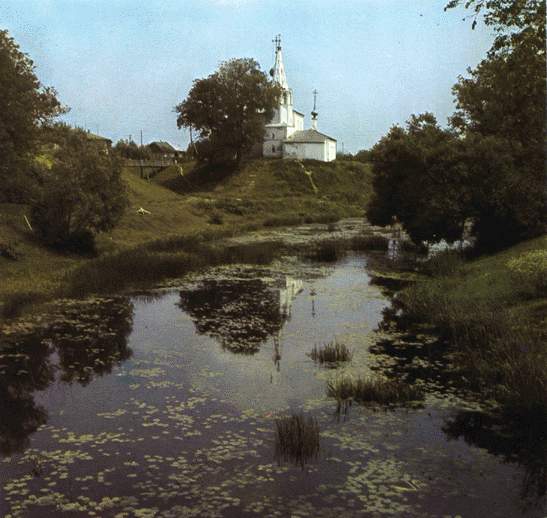
<>1174:Vladimir-Suzdal Prince Bogoliubskii
was assassinated [ZNC,2=157-61 | DMR3:72-5]
<>1185:Novgorod-severskii (NW of Kiev) Prince
Igor Sviatoslavich's lamentable campaign against Polovtsy out on the increasingly disorderly Pontic
Steppes [ZNC,2=186-9 | WAL,1=71-80]
- A great epic poem described the tragic Polovtsian adventure of Igor =
Slovo o polku Igoreve [PG3300.S6E5]
It has been translated often =
"Song of Igor's Campaign" (translated by Vladimir Nabokov)
"The Song of Prince Igor: Russia's Great Medieval Epic" (translated and edited by UO graduate Robert Mann)
"Tale of the Host of Igor" [Excerpts in DMR2:81-96 | DMR3:77-92 |
RRH,1=22-23 | ZMR1=139f]
\\
*1952:Speculum#27:43-66| Roman Jacobson, "The Puzzles of Igor's Campaign on the 150th Anniversary of
its First Edition"
*--Robert Mann, _Lances Sing: A Study of the Igor Tale [PG3300.S6M35]
<>1187:SW Rus (Galich-Volhynia in right-bank Dnepr River region)
racked by disturbances and princely feuds [VSB,1=44]
*--Notice that this is more than 20 years before the Golden Horde came on the scene
*--Kievan Rus' was falling apart, BUT
*--Something new and strong was developing in the north =
<>1190:Novgorod treaty w/German city [VSB,1=69-70]
*1193:Novgorod elected Archbishop of its Russian Orthodox Church [VSB,1=70]
<>1204:Constantinople captured and sacked
by Crusaders from western Europe (first successful attack on the city by sea)
- Enrico Dandolo (1192:1205; Doge of Venice) co-opted the crusade for his own
economic purposes
- Whatever there might have been of religious or idealistic motive in crusader hearts, the action
was in essence this-worldly and acquisitive
- The crusaders became sailors and soldiers for projection of the Doge's wide-ranging
ambitions [Wki]
- 1113:The crusades had become simple acts of western aggression against eastern rivals, national
armies enlisted in the "market-economic" interests of the Doge and his close associates
- The Doge was then a pioneer both in the evolution of market economics and statist
mercantilism [ID]
- We should bear in mind that the full history of "capitalism" generally combines these two
trends, despite the little blink of historical time and in that globally limited place where
Adam Smith's ideas [ID] prevailed
- Byzantium was weakened beyond recovery
\\
*--Four paragraph TXT summarizes impact of crusades on Byzantium
*--Fascinating computer science analysis of the way the Doge of Venice was elected
[E-TXT]
<>1206:Altai plateau, near Lake Baikal | Mongol
tribesmen gathered in kurultai [assembly] to "elect" Chinggis [Genghis] as khan
- 1200c:Eurasian continent on the eve of Chinggis
[MAP]
- 1207:1225; Over an 18-year period, up to his last two years of life, Chinggis expanded Mongol power =
MAP
- In a sequence of eight moments,
this moving MAP more or less accurately illustrates the first 88 years of Mongol expansion throughout Eurasia =
*--Moment #1 = 1206: Origins
Read through the next few SAC entries for the Mongol story through 1228-1230 (moments #1 through #5
on the moving MAP abv)
*--Moment #2 = 1219:Moves eastward and conquers China
*--Moment #3 = 1223:Moves southwestward and establishes "Golden Horde"
*--Moment #4 = 1227:Moves against Persian Empire
*--Moment #5 = 1237: Moves with new
decisiveness against Kievan Rus'
*--Moment #6 = 1259: Moves against Baghdad and Damascas
*--Moment #7 = 1279: Kublai-khan
*--Moment #8 = 1294: Disintegration
- The city Karakorum was the dynastic and administrative headquarters
("capital" or metropol) of Chinggis' emerging Eurasian Mongol empire
- Chinggis dictated the Great Yasa a comprehensive constitution-type guide
or law code for commanders but also for administrative officials and subjects of his empire
- The Yasa served as a divine mandate with practical advice about how to rule the whole world
- The Yasa was communicated by direct heavenly inspiration from Tengri
[ID] to Chinggis-khan
- Here is a source on the Yasa with extensive translation of text =
*1938de:Harvard Journal of Asiatic Studies #3:337-60| George Vernadsky, "The Scope and Content
of Chinggis Khan's Yasa" [E-TXT |
Excerpt = VSB,1=47-8]
- Another primary source = _The_bejeweled summary of the origin of khans (1967)
- And another = Secret History of the Mongols: A Mongolian Epic Chronicle of the Thirteenth Century,
Igor Rachewiltz, ed. (2006, 2vv) [E-TXT]
\\
*--Narrative extension of SAC chronology on Golden Horde [TXT]
*--Narrative extension on Early English "parliament" [TXT] for comparison
of Yasa rule with a contemporary far-NW-European parliament
*--Per Inge Oestmoen's curious contemporary website, with his
description and conspectus of the Great Yasa [E-TXT],
based largely on George Vernadsky (abv)
*--Vernadsky,3
*--Ruth Dunnell, Chinggis Khan: World Conqueror
*--May.MONGOL
*--Stanley Stewart wrote very fine modern-day travel accounts which describe these times and this place
[EG]
*--LOOP on "Chronicle"
<>1211:1216; Mongols invaded China, expanding
their power eastward
- This was moment #2 of 8 on the Moving MAP of Mongol expansion in Eurasia [ID]
- Over the next century or so, Chinggis-khan and his heirs projected their unstoppable cavalry
armies, developed sophisticated urban siege technologies, and established their remarkably stable
tribute-gathering political authority in the east (China) and south (Islamic lands of
Central-Asia, eventually even into India) [MAP]
<>1215:Runnymede, England | Rebel barons forced King John
to accept the Magna Carta as law of the land
*--Perhaps, in the world-historical setting, the critical generalizable "chapter" is #39
[E-TXT,
with extensive commentary]
*--The full significance of ch#39 was not fully realized until the middle of the 17h-century
[CF=habeas corpus ad subjiciendum]
<>1220:Bukhara [modern-day Uzbekistan] fell to Mongols
under Chinggis-khan as he moved westward
- Two centers of Mongol power formed out of this process =
- Ilkhanate [Khorezm or Khwarezm] in Persian territories [Iran] south and east of the Caspian Sea
[W-ID with satellite image of depleted Aral Sea]
- The Golden Horde out on the Pontic Steppes, the
vast prairies north and east of the Black Sea, Caspian Sea and Aral Sea coasts
- The Mongols now commanded China and the heartland of Eurasia (and the globe?) [MAP]
- Creation of these two new western centers of Mongol power was moment #3 of 8 on the Moving MAP of Mongol expansion in Eurasia [ID]
\\
*--On the origins of the Uzbek and Kazakh peoples [W]
*--LOOP on Islam
<>1220c:Kiev-Pechersk Lavra|
_The Paterik of the Kievan Caves Monastery [BX596.K513 | A 1989 translation of
Kievo-Pecherskii paterik] Covers the years 1073 to 1156 (summary of text = xviii-xx) | Excerpt ZMR1:92f |
ZMR2=134f]
- On the eve of its destruction at the hands of the Mongols, Kievan Russia was in one sense already
in decline, as a result of internal developments, but it was still capable of great cultural achievements,
such as the epic poem "Slovo o polku Igoreve" [ID] and the Paterik
- 1220c:A subject's plea to Prince Yaroslav Vsevolodovich revealed much about
high secular culture in these years of Kievan decline [DMR3:93-7]
- For nearly four centuries, the city Kiev held a strong position on the
northwestern edge of the Pontic Steppes
- Russian power was dominant throughout the region and, for the first time, the challenge of
stability out on the Pontic Steppes was successfully met
- In the late 10th and 11th centuries, Kiev was one of the
greatest cultural and political centers of Christendom, that huge and complex geo-cultural
space which has been called "Europe" in later and more secular times
- But now the 350-year epoch known as Kievan Rus' was over,
and the relative stability of the Pontic Steppes was fully and violently overturned
<>1223:1462; Kievan Rus' was
put to rest in the 240-year-long Era of Mongol dominion|
- Mongol power exploded suddenly on the Eurasian world [ID]
- Over nearly two and one half centuries Russian lands were subjected to 48 destructive Mongol invasions
and 90 violent civil wars
- This was a continuation of moment #3 of 8 on the Moving MAP of Mongol expansion throughout
Eurasia [ID], and it constitutes Phase #1 of Mongol dominion over the Russian periphery
(the Golden Horde ruling out of their metropol Sarai) =
- 1236:1328; Phase #1 of THE GOLDEN HORDE in Russia = Mongol [Tatar] overlordship in nearly
the whole territory of old Kievan Rus' [ZNC,3]
- 1328:1462; Phase #2 of THE GOLDEN HORDE in Russia = A century and a half
in which grand princes of the new-comer Russian princely city Moscow [ID] were ambitious
subordinates and agents of -- but eventually competitors with -- the Golden Horde
- Phase #2 of THE GOLDEN HORDE in Russia thus can divided into two different periods
- Through moments #3 to #8 in the larger story of Mongol expansion in Eurasia [ID],
the princely city Moscow arose on the historical scene and played the part of subordinate and agent
- Then, over a century of decline of the Golden Horde, Moscow played the role of competitor
\\
*--CHR,1=127-57 (covers the years 1246-1359)
<>1223:Kalka River | Mongols defeated Russian forces in first
probing attack, then backed away, only to return in even greater force 13 years later, in 1236
- Beginnings of the dominance of the Golden Horde ("Mongol Yoke", "Tatar" rule)
[ZNC,2=285-90 | VSB,1=45-6 |
ZMR2=193-211 | RRH,1=75-80]
- This invasion also brought an end to the century and a half of the Polovtsy
as an independent force on the Pontic Steppes [MAP]
- The term "Golden Horde" [Zlataia or Zolotaia Orda] came into wide
usage from the Russian description of the Mongol khanate that destroyed Kievan Rus'.
SAC follows Russian usage, though it must be recognized that this usage exaggerates the
organizational unity of Mongol power as it projected itself into European Russia and
throughout the "Middle-East"
- The Golden Horde could also be called the Kipchak khanate or Djuchi-ulus (the
patrimony of Djuchi [Jochi], oldest of four sons of Chinggis-khan, each of whom received
in inheritance a patrimonial portion (an ulus) of Chinggis's "empire")
- The many greater and lesser khanates that multiplied after Chinggis' death were
vulnerable to factional splits from the very beginning
- With time Mongol power was subject to disintegration rather than unification
- The late 20th and early 21st centuries used the expression "war lords" to describe these sorts of
militarized institutional networks
- But we do not need to exaggerate the looseness of regional Mongol institutional life simply in order
to avoid exaggerating unity
\\
*--John Fennell, _The Crisis of Medieval Russia, 1200-1304 [DK90.F44]
*--Vernadsky,3 | Also see Vernadsky on the impact of the Mongols
on Russian history, in RRC1,1(14) and RRC2,1(15)
*--Soviet era historian's review of Vernadsky = E-TXT
*--Charles J. Halperin, _Russia and the Golden Horde: The Mongol Impact on Medieval Russian History [DK90.H28],
NB! Halperin's concept of historical "silence" [KRR:104-7]
*--Donald Ostrowski, _Muscovy and the Mongols...[DK90.O86], pp. 36-63 on significant institutional influences;
pp. 85-107 refutes "Oriental" interpretation
*--Aleksandr Presniakov, _The_Formation of the Great Russian State [DK90.P713], pp. 1-29
*--Leo de Hartog, _Russia and the Mongol Yoke [DK90.H35]
*--Charles J. Halperin, The Tatar Yoke (1986) [DK90.H29]
*--Dmitrii Pokotilov, _History of the Eastern Mongols [DS793.M7 p5713]
*--Valentin Riasanovskii, _Fundamental Principles of Mongol Law [K.R481]
*--Paul Steeves summarizes the main historiographical approaches to the question of the Mongols and
Russia = E-TXT
\\
*--LOOP on "Chronicle"
<>1225:East Persia Khorezm [Iran] wrecked
by Mongol invasion
- Mongol Ilkhanate established in its place. This was Chinggis khan's last great achievement
- *1227:Deaths of Chinggis-khan and his oldest son Djuchi
- Ugedei [Ogedei] succeeded Chinggis as Great Khan in Karakorum
- Batu succeeded his father Djuchi as khan of the Golden Horde
- Rivalries among the successors to Chinggis-khan intensified
- This was moment #4 of 8 on the Moving MAP of Mongol expansion throughout Eurasia [ID]
\\
*2017jy17:BBC | Why Genghis Khan’s tomb can’t be found
[E-TXT]
<>1228:1230; Novgorod city disturbance
[ZNC,2=290-1 | VSB,1=71]
- The Golden Horde devoured prominent southern cities of once-grand Kievan Rus'
- But Novgorod in its remote northern region went about its business
- Not counting the consolidation in eastern Europe of Mongol power itself, the rise of medieval Novgorod can be called
the first great geo-political result of Mongol rule in Old Rus' [KRR=99-101 (from the NVG.Xrn)]
- Novgorod everyday life documented in birchbark documents [KRR=71-2 and 129-30 |
RRH,1=54]
- Novgorod elected Archbishop of Orthodox Church [VSB,1=70-1]
- 1230:1241; Galicia [Galich, Halych], the remote "right-bank Dnepr River" region
[ID], in disorder
- MAP of area around Galich, including Kievan RUS in this era [MAP]
\\
*--LOOP on "Novgorod"
<>1229:Roman
Patriarch [aka Pope] Gregory IX launched Inquisition
[ID]
\\
*--James Reston,Jr., review of 2012 effort to link history of Inquisition
with the contemporary world [TXT]
- The Papal Inquisition expanded on growing trend of formal assault on dissent in "The West"
- 1209:1229; Languedoc (southwestern France) for 20 years was riven by the "Albigensian Crusade"
[ID]
- Now it was time for the Catholic Church to launch a legal and theological "clean up" (purge)
\\
*--LOOP on Church
<>1231:1243; Azerbaijan and Armenia fell to Golden Horde
<>1236:Volga River, below the confluence with the Kama River |
Bolgar administrative capital taken by Mongol chieftain Chinggis-khan's great general Subutai at the head of the new Golden
Horde [ZNC,2=307-8]
- The Horde was under the supreme command of Batu who sent Subutai northward from SW Rus' and Bulgarian
[ID] territories
- Volga Bolgars were absorbed into Batu's Golden Horde, but Bolgar urban government and social structure survived
- Bolgar Muslim culture influenced pagan Mongols who were increasingly inclined to accept the Islamic faith
- This process of absorption and assimilation had already been witnessed many times out on the Eurasian Steppes
- Ambitious rulers shifted from local paganism to one or another of the "religions of the book" (Islam,
Catholicism, Orthodoxy, Buddhism, Confucianism, Judaism...)
- This can technically be described as a perceived status upgrade from provincial culture to universal civilization
- The reach of culture had to be made as vast as the reach of military/political power
- Just as with Chinggis-khan's "decimal" organization of his armies, so also with acceptance of a "religion of the book",
empires require "de-tribalization" of many diverse peoples, joining them together in new non-natal sodalities
- In the Kazan region, the Bolgar prince got Yarlyk [charter from the Golden Horde, a "license" to
exercise designated authority subordinate to the Mongol khan]
- Bolgar prince functioned more nearly as an agent of Mongol
power than would the Moscow princes later [ID]
\\
*--LOOP on Islam
<>1237:Russian city Riazan destroyed by Batu's Horde
[ZNC,2=308-17 | DMR2=107-13 |
DMR3=146-9 | KRR:99-101 |
VSB,1=44-5 | ZMR1=176-85]
- Kievan Rus' under full-scale assault by the Golden Horde [MAP]
- Russian prince paid tribute to Mongol masters [VSB,1=49-50]
- "Discourse Concerning the Ruin of Rus Land" [DMR3:97-9]
- This was moment #5 of 8 on the Moving MAP of Mongol expansion throughout Eurasia [ID]
<>1240:1255; Golden Horde
was under the command of Batu, now elected khan
- The grandson of the great Chinggis-khan was now his successor, but only in the Dzhuchi-ulus
(commonly called the "Golden Horde")
- Batu in the Dzhuchi-ulus was nominally subordinate to Moengke-khan and two subsequent
great khans in Karakorum [ZNC,2=319-23]
<>1240de:Kiev captured by Golden Horde [DMR3:151-2]
<>1240:1243; Aleksandr Nevskii defeated Swedes
in a series of battles
*--"A Biography of prince Alexander Nevskii" [ZNC,3=1-39 | ZMR2:224-42 |
DMR3:99-105]
\\
*--LOOP on "Chronicle"
<>1243je26:Central Anatolia [central Turkey today] |
Seljuk Turks defeated by Golden Horde
<>1246:Pope in Rome sent Ambassador Carpini [ID] to
the Mongolian Great Khan in Karakorum
<>1247:Vladimir (city) grand prince Yaroslav
Vsevolodovich died
*--A letter of appeal to him from Daniel, a member of his druzhina [closest military servitors,
retinue] [DMR3:93-7 | WAL=100-4]
<>1240s:Sarai, in the lower Volga valley|
A great "nomad" metropolis was founded by Batu-khan as administrative center and headquarters of
the Golden Horde
- Some argue that Mongol color symbolism took yellow or gold to mean "the center", and that was what created the
term "Golden Horde"
- The original Sarai-Batu was on the right bank of the Volga River just north of modern-day Astrakhan
- In the later 13th c., Sarai-Batu was moved -- as only a nomad metropol might be -- northward to just downstream from
modern-day Volgograd and called Sarai-Berke [W-ID with MAP]
- This tent and pavilion urban center grew in size and importance
- Sarai-Berke included more permanent stone structures, EG=several suburban neighborhoods with caravan rest points
[caravan-sarai (ID)]
- Visitors reported that it took a half day to ride by horse from one outskirt to the other [BrE,56:399]
- Tradesmen whose ethnicities originated in three different continents sojourned in Sarai
- Sarai served as a central point for caravan routes along the fabled "Silk Road",
from Africa to China, northward to the Mongol metropol Karakorum, and southward to
Persia [Iran] and India [W-ID and MAP,
7 paragraphs]
- 500 years after the Arabic invasions [ID], Sarai became a linchpin in the evolution of AFroAsia
- 1253:1255; French King Louis IX sent Catholic Friar Willem van Ruysbroeck [Rubruck (ID)]
to Karakorum and Sarai
- MAP of Rubruck's route
\\
*--Thomas T. Allsen, _Mongol Imperialism: The Policies of the Grand Qun Möngke in China, Russia, and
the Islamic Lands [DS22.3.A45]
*--Thomas T. Allsen, _Culture and Conquest in Mongol Eurasia
<>1250:SW Rus' | Galician prince Daniel and
his brother had to learn to deal with the Golden Horde
[VSB,1=51-2 | DMR3=171-4]
*--After a century and a half of growing internal disorder in SW Rus',
Galich-Volhyn area came under Mongol power and found itself isolated from old Kievan networks and
vulnerable to influence of German Holy Roman Empire
<>1252:1263; Novgorod
and Vladimir [city] prince Aleksandr Nevskii reigned 11 vital years in the
early phase of Mongol dominance over the territories of old Rus' south of Novgorod
*--The_Chronicle of Novgorod, 1016-1471
[E-TXT (Thanks to Melody Charles for this URL) |
Excerpts = VSB,1=64-5 | DMR2=137-50 | ZMR1=162f |
RRH,1=88-90]
\\
*1938:Historial film directed by Sergei Eisenstein, ALEKSANDR NEVSKII
*--Aleksandr Presniakov, _The_Formation of the Great Russian State [DK90.P713], pp. 60-98 on
Vladimir city in the 13th century
\\
*--LOOP on "Novgorod" and on "Chronicle"
<>1257:1266; Golden Horde |
Berke-khan [Berkh-khan] issued an early decree on free trade [VSB,1=48-9]
- Berke-khan made Islam the "official" religion of the Horde
- A familiar pattern is observable here at the outer NW edges of Mongol power -- the move from local
spiritualism into one of the "religions of the book"
- Mongol-Turk syncretism (cultural and institutional combination, melding together of diverse cultural strains)
- 1258:Baghdad sacked by Golden Horde as Berke turned his swift armies
southward against the Turks
- 1260:Damascus taken by Golden Horde, but the Mongols stopped north of Jerusalem and backed off
- This was moment #6 of 8 on the Moving MAP of Mongol expansion throughout Eurasia [ID]
- 1260c:1360c; For about a century, Anatolian Near-East ["Asia Minor"] experienced a significant
easing of Mongol power
\\
*--Pavlidis,13
*--LOOP on Islam
<>1261:Russian Chronicles mention Sarai,
headquarters of the Golden Horde, for the first time in connection with the establishment there of a Russian
Orthodox diocese, following agreements reached between Novgorod prince Aleksandr Nevskii and Berke-khan
- Novgorod flourishing as Mongol dominance destroyed old Kievan hierarchy of cities
- This was probably the most important legacy of Novgorod prince Aleksandr Nevskii's 22-year career
- 1264 or 1265: Novgorod treaty with Tver helped consolidate regional power in relative independence from the
dominance of the Golden Horde [W#1 |
KRR:84-5]
\\
*--LOOP on "Novgorod"
<>1267au01:Kievan Metropolitan of
Orthodox Church received favorable Yarlyk from new Mengu-Temir-khan
[DMR3=175-6] [VSB,1=49 dates this 1308]
*--Russia drifted out of its Byzantine orbit as the Golden Horde consolidated its grip
on the Eurasian Steppe and as Novgorod developed ties with the newly independent commercial city-states of the
Baltic and North-Sea regions =
*--LOOP on "Chronicle"
*--LOOP on "Church"
<>1270:Novgorod treaty with Hanse (pronounced
and sometimes spelled "Hansa"; later formally the Hanseatic League)
[DMR2=132-7 | DMR3=114-19]
- Some moments and documents (with MAP) in the history of the Hanseatic League [TXT]
- Novgorod also maintained treaty relationship w/ its prince [ZNC,3:46-9 | VSB,1=65-6]
- Novgorod Charter described aspects of its urban independence from traditional
Kievan ways in the years after the Mongol invasion [RRH,1=47-54]
- Eurasia [MAP]
\\
*--LOOP on "Novgorod"
*--LOOP on "Chronicle"
<>1274:Naples [Italy] | Thomas Aquinas
died [ID], having brought the new "Western" Christian philosophy
and theology -- called "scholasticism" -- to its highest perfection. The Catholic Church later sainted him.
He capped a marvelous century of theological speculation =
- 1109:Anselm, "the father of scholasticism", died [ID].
He devoted himself to proving faith by reason, by employing the powerful rationalist or logical tools of inquiry
- 1142:Peter Abelard died [ID]. He sought to identify
and address the chief logical contradictions in Christian faith
- These "Western" achievements would not have been possible if it were not for a serious dose of "Easternization"
- Arabic scholars provided the Western Church Aristotelian texts, preserved until this time only in the Islamic world
- New translations and new discoveries of Aristotle's writings ushered in a new era of Catholic religious philosophical speculation
- Old, settled Ecumenical decisions came under wide-ranging and speculative contemplation, discussion and debate
- And Muslim philosophers on their own influenced this process =
- Translations of the Islamic philosopher Ibn Rushd were read widely in "The West" [ID]
- In the Latin cultural sphere, Ibn Rushd was known as Averroës (1128-1196). He was born in what we call "Spain"
- Two Islamic-Aristotelian principles were influential in "The West" =
- "Averroism" preached "double truth", allowing room for both faith and reason
- Here the immortal soul and universal worldly vitality (the anima mundi
[Wki] ) are the same
- This principle can undermine the notion of distinct human individuality
- And it insists that what is true in the light of faith may be untrue in the eyes of reason, and vice versa
- This principle can undermine both intellectual and spiritual absolutism
- 100 years after Averroës, in the realm of the Papal authority, struggles between faith and reason gripped theologians
- Duns Scotus (1265c-1308) stood for faith [ID]
- William of Occam (1287-1349c) stood for reason [ID]
- "Eastern" Islamic civilization presented a formidable spiritual/philosophical challenge to traditional "Western" medieval Christianity
- For its part, the Eastern Orthodox Church, in Russia and elsewhere, reacted
negatively to scholasticism and was little affected by it
- We need always to remind ourselves that Christianization of Europe, when it got into high gear 1000 years before this
time [EG], was itself a massively significant instance of "Easternization" of "The West"
\\
*2018ap12: The New Republic | "How Islam Shaped the Enlightenment"
[E-TXT]
*--A harsh-minded mid-twentieth-century "modern" source [CDE(1940):1586] had this to say = "The 15th-century
scholasticism was at best a sorry thing, and it produced in its contemporaries, especially in Italy and France, a great
detestation for the whole system...". CDE continued in re. Francis Bacon=
His "ignorance of scholasticism almost surpassed his dislike for it"
*--LOOP on "Church"
*--LOOP on Islam
<>1274 and 1281:Mongols under Kublai-khan twice failed in
effort to invade Japan
*--Heavy storms at sea contributed to the rescue of Japan from the overwhelming Mongol power
*--These came to be called "divine winds" [kamikaze]
*--The implausibility of success in such a venture, plus Japanese preparedness, were perhaps more decisive factors
<>1275:Lithuania
the target of attack by allied Russian and Mongol forces, but the Golden Horde
backed away from their furthest incursions into the Baltic river drainages
- Growth of Lithuanian power and eventual union with Poland can be
designated the third great geo-political result of Mongol rule in Old Rus'
- 1275:Vladimir (city) | Death of Abbot Serapion, author
of sermons "on the Merciless Heathens" [which interpreted the Mongol assault as punishment for Russian
sins] and "on Omens"[ZMR2:243-6| ZMR1=199-204| WAL=104-6]
- This was moment #7 of 8 on the Moving MAP of Mongol expansion throughout Eurasia [ID]
<>1290:1312; Golden Horde| Tokhta-khan
ruled in a time of renewed invasion of Russian lands
- But this was also a time of serious disintegration of the Golden Horde
- And it was also a time of growing conflict with one of the more long-enduring splinter hordes,
the Crimean Tatars
- 1290s:Marco Polo, who claimed to travel to China along the legendary "Silk
Road" [W-ID], reported on Russia (cold
and much drinking) [VSB,1=52]
- Silk Road in the era of Marco Polo [W]
and the great empire of the Golden Horde and the perhaps even greater empire of China under Mongol rule (Yuan Dynasty)
[MAP]
- This was the final moment #8 of 8 on the Moving MAP of Mongol expansion throughout Eurasia [ID]
\\
*--Wki on Marco Polo controversy = Did he really go to the
Mongol capital of China, and were his descriptions really based on first-hand observations?
<>1300:Vladimir (city) became the Metropolitan See of the
Russian Church
*--Kiev was essentially cut loose and declined
\\
*--LOOP on "Church"
<>1303:1325; Moscow prince Yurii III
- Orthodox Christian Yurii married Islamic Mongol bride, sister of the khan of the Golden Horde
- Nuptial diplomacy as an element of power politics need not get "hung up" on religious differences.
Yurii's Mongol bride, of course, became Christian
- Unlike the Bolgars under Mongol domination [ID], the Moscow Yarlyk
retained for them the right to strike their own coins
- Mongols never considered Moscow a part of their Dzhuchi-ulus. Moscow was a tribute-paying satellite power
- Moscow had not been of much significance from the time of the founding
one and a half centuries earlier [ID] until now
- Now, after Kievan disintegration and Mongol destruction, two very different urban strongholds,
representing two very different medieval "Russias", rose in power and prominence =
First Novgorod and then Moscow
- The rise of Moscow can be called the fourth great geo-political
result of Mongol rule in Old Rus'
- 1300:1553; Over two centuries of Muscovite Russian expansion
[MAP]
\\
*--LOOP on "Novgorod"
*2017au16: RT News | "Russian medieval history may ‘influence’ new book – Game of Thrones author George RR Martin"
[E-TXT]
<>1312:1357; Forty-five years,
the last successful efforts to restore disintegrating Golden Horde
- Uzbek-khan (-1342), followed by Djanibek-khan (-1357) restored power of Djuchi-ulus and expanded territory of control
- 1325:1349; Tangier-born North African Ibn-Battuta
[ID] left fabulous dictated memoirs of his extensive travels throughout
the Islamic world
- For nearly three decades, Battuta was "on the road" in northern Africa, Egyptian territories of the Mamluk
Empire, Arabia, Byzantium, the "Middle-East", into the Mongol Empire, China and the Philippines
- He wrote at length about his travels [E-TXT |
Excerpted TXT]
<>1313:Vladimir Metropolitan of the
Orthodox Church Peter received Yarlyk from Uzbek-khan [KRR=101-2]
\\
*--LOOP on "Church"
<>1313:1326; Uzbek-khan
spread Islamic faith, which the Golden Horde first encountered in a serious way years
earlier among the Bolgar people of the middle-Volga [ID]
*--LOOP on Islam
<>1316:1341; Lithuanian
grand prince Gedimin [Gediminas] extended his authority east and south into the partial vacuum created by the
strategic withdrawal of the Golden Horde
*--Lithuanian grand prince Gedimin took the old city Kiev
<>1320s:Central America, Mexico, north of
the Mayan city-states | Nomadic Aztecs settled
and began to build great new urban center, their "capital", Tenochtitlan [site of Mexico City]
*--The second great New World civilization grew, but no wheel, no iron,
and a famously ferocious religion
<>1327:Tver rebelled against Golden Horde
[ZNC,3=124-6 | DMR2=151-2 |
DMR3=179-82]
\\
*--Aleksandr Presniakov, _The_Formation of the Great Russian State [DK90.P713], pp. 98-121
on medieval city-state Tver
<>1328:1462; Phase#2 of the Golden Horde
This was also Phase#1 of MUSCOVITE RUSSIA
=
- Moscow princes grew in power. Like Tver (above) Moscow too grew in ambition
- For more than one century, Moscow was both enemy and agent of the Golden Horde
- Now Moscow exerted itself for independence from Mongol rule
- Moscow also extended its dominance over neighboring Russian centers -- still frequently with Mongol help
- Muscovites came to call this process "re-gathering the Russian lands" [ZNC,5]
- 1328:1341; Moscow prince Ivan Danilovich ruled 14 years as Ivan I Kalita
[Ivan the First, aka Ivan Moneybag]
- Ivan Kalita was the first Muscovite prince to be called "grand prince" [velikii kniaz']
[ZNC,3=127-47 | DMR2=153-8 | DMR3=190-5]
- The Golden Horde sponsored the coronation of Ivan I
- Ivan Kalita ruled in a time of transformation in the relationship of the Golden Horde to Russian lands
- No longer would special administrative envoys of the khan [baskaki] rule in Russia
- Now the khan allowed princes like Ivan Kalita to function as ally or agent of the khan
- The khan sent advisory envoys [posoly] to his agents out there in the provinces
- He bound these agents into close personal contact, as demonstrated by Ivan's nine journeys to Sarai
- Also, Russian princely sons were frequently confined to Sarai as something like hostages or insurance
against malpractice among provincial princely agents
- In this new role, the Muscovite grand prince and the khan of the Golden Horde thrived together
- And they thrived only so long as the grand prince was not yet in position to shed Mongol authority
- Ivan I used the power gained through closeness to the Horde to expand his authority
over neighboring Russian princely cities
- Ivan I stripped local elites of their positions and power, and substituted his own servitors
- For example, in Dolgorukii's [ID] old power base, Rostov
Velikii [MAP], a prominent boyar family (one young member of which was the
future St. Sergius) was forced to flee from Radonezh to escape expanding Muscovite power
- The Official church hagiography, "Life of St. Sergius", tells this story in unexpected and explicit detail
[TXT]
- Moscow began the process of "re-gathering Russian lands" in earnest
- Russia in the time of Ivan I Kalita [MAP]
- Moscow flourished, but did not altogether free itself from Mongol dominion for another century,
not until the reign of Ivan III
- Whatever else the era of Mongol dominance meant for Russia, it was essentially this = The Kievan
trend toward recognizable medieval feudal princely power and possession was brought to an end
- Illustrations of medieval Moscow, the Kremlin [W]
- Moscow architectural sites [W]
- Other Medieval Russian cities, "The Golden Ring"
[W]
\\
*--Aleksandr Presniakov, _The_Formation of the Great Russian State [DK90.P713], pp. 121-138
on Moscow in the time of Ivan I Kalita
*2016:MVA|>Gorskii,A.A.|Москва и орда
*--LOOP on "Chronicle"
*--LOOP on "feudalism"
<>1328:Moscow became Metropolitan See of
Orthodox Church, relocated from Vladimir (city)
- This event can be said to mark the end of Vladimir (city) feudal grandeur (since 1169)
- and the rise of Moscow from among the Russian cities under the direct dominion of the Golden Horde
- Moscow worked to protect itself from, but also to benefit from, the Golden Horde and the Byzantine Empire
\\
*--John Meyendorff, _Byzantium and the Rise of Russia [DK67.5.B95 m4]
*--LOOP on "feudalism"
<>1337:Trinity-Saint Sergius
Monastery [Troitse-Sergieva Lavra] founded
*--This great fortress monastery became a central institution of the Muscovite Orthodox Church
\\
*--St. Sergius-Trinity Lavra [VIDEOTAPE+05219]
*--LOOP on "Church"
<>1339c:Moscow | Testament of Ivan I [HTP=182-7 |
VSB,1=53-4 | DMR3=195-8]
<>1341:1353; Moscow grand prince Semyon Ivanovich Gordyi [the
proud] ruled after his father's death and was confirmed by the Golden Horde
- Semyon sojourned with family five times in Sarai
- 1347:Byzantine Emperor Kantakouzenos replied to an inquiry from Semyon Gordyi
about the nature of the institution "emperor" [basileus], indicating
two possible meanings =
- Semyon lost touch with Byzantium and needed a refresher course in "Roman" institutional practice
to guide his own assumption of a new status, and
- the Mongol khan of the Golden Horde had for decades been the only model
for the new status assumed by the grand princes of Moscow
<>1347:Novgorod granted independence to commercial/fortress
city Pskov, though Pskov church remained subordinate to Novgorod
*1342:1359; Novgorod city disturbances [VSB,1=72]
\\
*--LOOP on "Novgorod"
<>1353:Moscow grand prince Semyon's Testament
[HTP=189-92] Semyon was taken by the black death
*1348:1350; The Black Death spread westward through the Mediterranean Sea coastal ports, northward to England and
the lowlands, then in a big circle back eastward through the Baltic Sea along Hanseatic League
trade routes to Novgorod and then to Moscow under the Golden Horde
<>1353:1359; Moscow grand prince
Ivan II the Meek or Krasnyi [Red]
*--His Testament [HTP=195-202]
<>1354:Ottoman Turkish power
crossed the straits just south of the Byzantine imperial capital city Constantinople
- Ottoman forces entered Europe for the first time, moving westward over
the next few years all the way to Kosovo (in "Yugoslavia")
- In many ways, Ottoman power was an evolved Mongol power
- Ottoman Turks pushed resolutely into certain SE European territories
that the Mongols never managed to hold for long
- Ottomans absorbed under their administration significant territories that
the Mongols did not hold at all
- Ottoman power crushed the medieval sovereignty of territories
today called Hungary, Serbia, and the once great feudal state
Bulgaria
- Byzantium would not fall to the Ottoman Turks for one
more century, but the handwriting was on the wall....
\\
Two paragraphs of TXT describe Ottoman Turkish expansion
into south-eastern Europe
*--LOOP on "feudalism"
<>1354:1368; Moscow | Russian Orthodox Church
Metropolitan Aleksei was a powerful supporter of Muscovite throne and the actual ruler in Dmitrii's youth [See below]
\\
*--LOOP on "Church"
<>1355:1389; Moscow grand prince Dmitrii Ivanovich [after 1380
dubbed Donskoi] ruled for 34 years [ZNC,3=185-305]
- The dramatic developments in Dmitrii's time =
- Russia in the time of Dmitrii Donskoi [MAP]
\\
*--CHR.1=158-87
*--LOOP on "Chronicle"
<>1357no:Moscow | Metropolitan of the Russian
Orthodox Church, Aleksei. received favorable Yarlyk from Berdibek-khan of
the Golden Horde [DMR3=176-7]
\\
*--CHR.1:338-59
*--LOOP on "Moscow"
+--LOOP on "Church"
<>1357:1380; Twenty-three years in which 25 khans ruled in Sarai
*--Khorezm [Khwarezm-shakh, Khiva; centered on modern-Day Iran and Uzbekistan
(W-ID) ] splintered and fell away from control by Sarai
[YouTube#1
music & architectural sites |
YouTube#2
(in Russian and directed at potential tourists) ]
*--Poland-Lithuania projected its increasingly vigorous metropol powers into
western territories of Sarai, the lower Dnepr basin
periphery
<>1359:Novgorod elected Archbishop [VSB,1=71]
- These years witnessed increasing projection of waxing metropol power -- Poland, Novgorod and
Moscow -- moving into newly vulnerable peripheries caused by weakened Mongol power (see year 1357 above) =
- Novgorod merchants consolidated their control over the Bolgar city Zhukotin
- This was a sign of eastward expansion of Novgorod's commercial empire and of constant interchange with Golden Horde
- 1361:Bolgar territories spawned Mongol pretenders to the throne of the Golden Horde
- After a series of executions, Khidei became khan. Bulaktemir briefly ruled Bolgar land
<>1367:Germanic trade center Köln [Cologne] hosted Confederation
of the Hanseatic League
- 1370:Denmark. Stralsund Treaty with King Waldemar IV opened great century in the life of the Hanseatic League
- About seventy Baltic coastal cities and several inland markets were linking themselves
into some sort of regional market
- The Hanse represented a trade "institution" very much out of
line with old imperial or newer medieval institutions
- Novgorod was now the eastern anchor of the Hanseatic League (as London was the western)
- There on that eastern edge of the League, Novgorod opened to the great Asian markets along the
Silk Road
- Novgorod entered its most glorious "Era of Gosudar Novgorod velikii" [Lord Novgorod
the Great] [W]
- 1371:Novgorod settled a treaty with its prince [VSB,1=66-7]
- Delicate diplomatic relations with the Horde, the hallmark of Aleksandr Nevskii's reign,
had now become tense competition
- Russian power now sometimes challenged the Golden Horde
- 1374:1375; Novgorodians plundered the great tent-city on the lower Volga, Sarai, capital of
the Golden Horde [BrE,56:399]
- 1384:1388; (and again in 1418) All was not well, however. Popular
disturbances rocked Novgorod [VSB,1=72-3]
- 1380:1500s; Economic developments in the Baltic world of the Hanseatic League
paralleled those somehow more famous developments in the Mediterranean world [ID]
\\
*--Charles Halperin on Novgorod [E-TXT]
*--Henrik Birnbaum, _Lord Novgorod the Great: Essays in the History and Culture of a Medieval City-State
[DK651.N506 b5], pp. 40-54 covers the political history of this remarkable city-state; pp. 82-100 covers the
institutions of city-state rule
*--Henrik Birnbaum, _Novgorod in Focus, pp. 153-166 deal with Novgorod & the Hanse
<>1367:Moscow stone Kremlin began
<>1368:1372; Lithuania attacked Moscow frequently
<>1368:Moscow treaty w/Tver [VSB,1=54-5]
<>1375:Moscow | First testament
of Dmitrii Donskoi [HTP:204-6]
<>1377:Lithuanian grand prince Wladislaw Jagiello [Jagellon]
created a great Polish/Lithuanian dynasty
<>1377:Suzdal | Lavrentian edition
of the Chronicles
*--The Hypatian monastery ("Ipaty" [pix] in
Kostroma, about 80 miles east-northeast of Yaroslavl [map])
issued its edition of the Chronicles around this time
*--The Hypatian edition of the Chronicles covered Russian history from the year 852
<>1380se08:Kulikovo battle, south of Moscow near the Don River, prince
Dmitrii ("Donskoi") defeated Mamai-khan of the Golden Horde
[ZNC,3:264-305 | VSB,1=55-6 | DMR2=165-8]
- The Kulikovo victory was unusual and was taken as a sign of a new Russian independence from the Golden Horde, BUT =
- That same year, Tokhtamysh defeated Mamai-khan on the Kalka River banks, THEN =
- 1382:The warriors of Mamai's successor, Tokhtamysh-khan (1380-1395)
burned Moscow [ZNC,4:2-12 | VSB,1=56-7]
- The Golden Horde was still a force to be reckoned with
- Nonetheless, an epic poem commemorated the great Kulikovo battle, "Zadonshchina" by Sofony of Riazan
[ZMR2:211-23 | ZMR1=186f | DMR3:202-9 | WAL=106-11]
- "Hagiographic" biography of prince Dmitrii appeared [ZMR2:315-22 | DMR3=198-202]
- Four decades later, "The Life of St.Sergius" described how exemplary monk
Sergius of Radonezh inspired Moscow victory [TXT]
\\
*--LOOP on "Chronicle"
<>1380:1500s; Venice [on the northwestern-most shore of
the Adriatic Sea in modern-day Italy], a commercial city-state, defeated its arch-rival, the city-state Genoa, and assumed
dominance over Mediterranean trade
- The power of Venice was rooted in the successful exploitation of European crusader zeal a century
and a half earlier
- Now, defeat of Genoa marked the beginning of a commercial transformation that signaled the rise of market
economics at odds with medieval tradition
- Along Mediterranean shores a cultural transformation, traditionally labeled "Renaissance", accompanied
economic transformation
- Mediterranean developments have always drawn more attention than similar developments up north in the
Baltic/North-Sea Europe = The rise of the Hanseatic League
- There are important differences =
- Venice was an independent city-state, itself a center of trade and for centuries
invulnerable to growing authority of European centralized national monarchies
- The Hanse was a loose federation port towns, vulnerable to the expanding
claims of waxing centralized national monarchies
- The fate of Novgorod illustrates the vulnerability of Hanse cities
<>1385:Poland-Lithuania in Krewo Union
- This was a personal union based on the fact that Lithuanian grand prince Jagellon accepted Catholic
Christianity and pledged to adhere to its Church
- Jagellon married the Polish Queen Jadwiga, and thus became also King of Poland [background,
see VSB,1=89-96]
- The West Slavic peoples along SE Baltic shores [po more], after nearly a thousand years
subordinated to various outside authorities, now become a great independent medieval monarchical state, united under
the authority of the Catholic King of Poland
- Reaching south into the Pontic Steppes to the northwestern shores of the Black Sea, the Jagellon dynasty soon
ruled in Romanian-speaking Moldavia, Wallachia, and Bessarabia
- Poland and Lithuania [together or independently, they are now joined in one SAC LOOP] made strenuous effort to
consolidate their united authority in vulnerable, remote and newly acquired territories via significant
charters to regional and urban centers [EG]
- Urban charters in Poland-Lithuania granted limited but, in these times and places, unusual
powers of self-regulation [VSB,1=89-110]
\\
*--A brief online history of Poland [E-TXT]
*--Oswald Backus, "Problem of Unity..." in TDU:275-95, with discussion:296-319
*--LOOP on "Church"
<>1386:Moscow prince Dmitrii Donskoi's second
testament [HTP:208-17 | VSB,1=57-8]
*--Compare with simple freeholder's last will [KRR=130-1]
<>1389:Dmitrii Donskoi's last will and testament illustrated effort
of Moscow prince to escape the tradition of "partible inheritance" among Russian landowning nobles
- Partible inheritance was a system in which estates were divided among all male heirs, thus fragmenting and depleating them
-
- Dmitrii Donskoi established, at least for the grand princely inheritance, a tradition
of primogeniture (in which the estate went intact to the eldest son)
- Notice also the presumptions here of the rights of women in such inheritances [KRR:87-90]
- Russian history, like many other "national" histories, was on occasion shaped by grand and powerful
women [EG= Olga (ID), Anna (ID), and Marfa Posadnitsa (ID)]
- Dmitrii Donskoi's will opens a window into the everyday life of women in medieval Rus'
<>1389:1425; Moscow grand prince Vasilii I reigned for
36 years
- Tokhtamysh-khan put Vasilii I on the throne. Elites in Suzdal [W]
and in Bolgar opposed this action, but without success
- Russia in the time of Vasilii I [MAP]
- The Golden Horde in the time of Vasilii I
[MAP]
\\
*2007:Astrakhan| N.E. Vedeneeva, Vasilii I Dmitrievich - Velikii kniaz` Moskovskii (1389 - 1425): Monografiia
<>1389:Moscow to Constantinople | Metropolitan Pimin's
journey [DMR2=158-62 | DMR3:209-13]
*--First-hand accounts written by _Russian Travelers to Constantinople in the Fourteenth and Fifteenth Centuries
[DR729.M34] help us test the degree of Muscovite isolation from its Byzantine roots in the era of the Golden Horde (CF=1393)
<>1392:1430; Poland-Lithuania ruled for 38 years by Witowt in
the years of greatest Polish-Lithuanian power and extent
<>1393:Moscow grand prince Vasilii I reflected
how far Russia had drifted out from under authority of Constantinople when he ordered Russian churches
not to bother saying prayers for the Byzantine emperor ["basileus" in Greek; "tsar" in Russian] (CF=1389 above)
- Getting wind of this, the Patriarch in Constantinople wrote to Vasilii =
"It is inconceivable for a Christian to have a church and not have the tsar, for the state and
the church are closely united, and it would be impossible to separate
them one from the other" [Miliukov, Religion and the Church in Russia=18]
- Evidence suggests that the Russian Orthodox Church on certain occasions offered prayers for the khan of the Golden Horde
- Yes, the khan was an Islamic "infidel", but his power still was "tsar-like" and had its source,
like all looming monarchical authority, in the mysterious ways of God
- Thus Mongol khans were worthy of the sorts of prayers reserved in earlier times for Byzantine emperors
- Moscow took inspiration from two great imperial models, Roman and Mongol
- Historians often claim that Russian drift from Byzantium, from its European roots, from "The West", was another of the
significant consequences of Mongol rule
- However, the question of "Russian isolation" is very much more complicated than that
\\
*--Historian Michael Cherniavsky, "Khan or Basileus" [CSH, esp. pp.68-9] suggests that Russian
Church observances had for many years substituted the khan of the Golden Horde for the Byzantine Emperor in its prayers
for the protection of power [Basileus]
*--LOOP on Islam
*--LOOP on "Church"
<>1395:Golden Horde capital city Sarai burned to the ground
when Tamerlane (Timur the Lame) defeated and seized the throne from Tokhtamysh-khan
*1389:The Golden Horde in Sarai in the years before Tamerlane's devastating attack
[Wki]
- Over the next several years, Tamerlane turned attention away from Kievan Rus' and other
northern regions where the Golden Horde ruled
- Tamerlane turned southward toward distant lands ruled by Ottoman Turks, another warrior folk
who had recently come aflooding down from the Altai highlands
- For over a century Mongol power had neglected these southerly territories under Ottoman authority, but not now =
- 1400oc:Tamerlane-khan sacked Aleppo
- 1401:1402; Tamerlane began an eventually successful siege of Jerusalem as he moved into lands ruled by Ottoman Turks
- 1401fe:mr; Tamerlane sacked Damascus
- 1401se:Tamerlane sacked Baghdad. The first 700 years in the history of this great city foretold
the next 700
- 1402jy20:At Ankara, Tamerlane defeated and briefly stymied the expansive Ottoman Turks
- Tamerlane for a time checked rapid Ottoman Turkish expansion in the south, but not without cost
to his position in the north =
- Northern Slavic peoples' sought independence (especially in Poland-Lithuania, Moscow, and Novgorod)
- At the same time, conflicts arose among these northern Slavic peoples (much as we see conflict among the Turko-Tatar peoples)
- Back up north, ambitions and independence as well as disorder grew with Mongol neglect when Tamerlane
and the Golden Horde looked southward
<>1395:Novgorod [?]. Death of Spiridon Stroganov,
wealthy trader, grower, and miner in the most distant north-eastern Novgorod markets of the Hanseatic League
- The Stroganov family became especially rooted in the region of Arkhangel'sk and the Northern Dvina
River in the White Sea drainage
- In that remote region, they operated in relative independence from Novgorod authority
- They formed a Stroganov family dynasty in close relationship to the Golden Horde and Bolgar authorities
- As the family drifted away from Novgorod, it fell into the orbit of expanding Muscovite power, EG=
- 1397:Moscow grand prince Vasilii I gave Charter (exercising a Mongol-like power to issue
yarlyks) to those very same Northern Dvina lands at the extreme northeastern edge of the Novgorod commercial empire
where the Stroganovs made their fortune [VML:57-60]
- 1396 or 1397: Way back in the other direction from the remote eastern Dvina lands -- the western edge of the
Novgorod commercial empire (which was the eastern edge of Poland-Lithuania) -- the fortified trade city Pskov, which
was a close ally of Novgorod, governed itself under a Judicial Charter
[E-TXT]
- See sections 3 & 4 of the Charter to learn something of the workings of the veche
- The text that survives is a 1467 revision of the Pskov Judicial Charter
- Compare veche administration in Novgorod with 1338:German city
administration [TXT]
\\
*--LOOP on "Novgorod"
<>1399:Kazan Mongols ("Kazan Tatars") sometimes
fled to Russian lands for sanctuary as they sought to escape internecine struggles within the splintering Golden
Horde
- Still, the Golden Horde could inflict defeats on its competitors, EG=Lithuania
- Over the next few years, Mongol Makhmet-khan and his brother Kichim-khan founded the Kazan Tatar fortress
- They invited those disaffected with the Golden Horde, Astrakhan Tatars, Azov Tatars,
and Crimean Tatars to join them
- They created the Kazan khanate [tsardom] on territories of the Bolgars and Mordvins
[ID]
- The new Kazan khanate [ID] was not like the Golden Horde
because the Kazan khan was restrained in power by an aristocracy [BrE,26:907]
- Heritable titles were biki and murz
- A tsar ruled at top, surrounded by guards, ulany, the servitor element in the Kazan state
- The bikim and murz elected the tsar and restrained him
- They received salary from the state
- The clergy or holy men were very significant = seid was head of the Muslim
clergy and had political administrative significance, extending even to diplomacy
- The growing power of the Islamic Kazan khanate brought it into conflict with Moscow
Prince Vasilii I who sent his military against Kichim-khan but was defeated
- With Tamerlane's attentions turned southward, the empire of the Golden Horde frayed at the edges
- The disintegration of the Golden Horde into several widely scattered and independent khanates, such as
the Kazan Tatar khanate, can be considered the fifth and final great
geo-political result of Mongol rule in Old Rus'
\\
*--LOOP on Islam
<>1403:Czech lands, Prague | At Karel University
(Univerzita Karlova, Universitas Carolina or Charles University [W])
German professors launched attack on publications of English reforming Oxford University priest
John Wycliffe (1384:England, death [W])
- Professor Wycliffe was popular with Czech professors, especially with Jan Hus and his associates
- It is of some significance and interest to notice the rising competition and conflict between two
institutional worlds = Papal throne and university [CF=hst.txn II.A]
- Spiritual as well as political unity of the Church in "The West" was breaking up,
and Slavic Czechs, led by Jan Hus and his associates, kept up the pressure
\\
*--LOOP on "Church" and early history of the university
<>1406:Moscow grand prince Vasilii I''s first
testament [HTP:219-24]
<>1409:Prince Edigei of the Golden Horde dispatched
letter to Vasilii I advised him strongly to consult "the old men" about how Moscow should behave in relationship
to the Horde =
It would be well for you ... to observe the ancient customs, and then you will live safely
and rule in your domain. Whenever you suffer any harm, either from Russian princes or
from Lithuania, each year you send complaints to us against them, and
you ask us for charters of protection from them, and you give us no respite on this account....
- In other words, Moscow relied on the Golden Horde as an ally
against its enemies, but it failed to live up to its end of the bargain
- Edigei
complained about the following perceived abuses =
- Traitorous Mongol servitors of the Golden Horde ("children of Tokhtamysh") sought asylum
in Moscow [EG]
- Vasilii showed disrespect toward Mongol envoys and merchants sent to Moscow
- Moscow tried to exercise its authority in certain towns under Mongol dominion
- Vasilii's failed to visit Sarai (to see the khan "with your own eyes") or
send boyars or sons to pay homage to the khan, and
- Vasilii failed to pay yasak [tribute, a primitive form of taxation exacted by Golden
Horde. The yasak was the standard source of revenue collected from subordinate peoples, usually
those with whom a license agreement (Yarlyk) was arranged. The Yarlyk was the main non-military, non-punitive instrument of control,
a licensing authority exercised by the Golden Horde over Russian administrative affairs since
the early years of the conquest
- Edigei explained that these failures of Vasilii I justified him
in his decision to attack Moscow [VSB,1=113 | DMR3=182-3]
- So we see that the question of Russian isolation is not simply one of drift away
from "The West". We also see drift from Byzantium and the Golden Horde
<>1409ja18:Czech lands, Prague |
Karel (Charles) University's "four nations" structure overturned by King Václav IV [a clumsy western European version of
this name is often met = "Wenceslas", as in a popular Christmas carol]
- The "four nations" structure gave German professors three votes and Czech professors only one
vote in academic affairs. Now Czechs were three, Germans one
- So the German professors and students all returned to German lands and founded Leipzig University
- From their new base of operations, these vengeful exiled professors spread word over
Germany about Czech heresy
- Thus they elevated academic/nationalistic politics to the level of religious doctrinal dispute
- Jan Hus eventually became new Czech Rector at Karel University and led the expanding
struggle for radical reform of the Catholic Church
- Lured to Germany under false promise of immunity from western European Church officials, Hus was arrested,
jailed and tortured
- 1414:1417; Council of Constance declared Hussite movement heretical
- 1415jy06:Jan Hus was burned at the stake [W#1 |
W-lxt]
- Rebellion followed in Czech lands [Dvornik=189-99]
- 1431:Council of Basel (an important act in the ongoing drama of efforts at East/West
unification) and the continuing Hussite movement agitated European Christian Churches
\\
*--LOOP on "Church"
*--LOOP on early history of universities
<>1410:Tannenberg battle | Lithuania defeated Teutonic
Knights
*--The zealous and holy two-century-long
Teutonic military mission was now broken
*--But these German-speaking elites continued to have powerful influence on
southeast Baltic (northwest Russian) culture and civilization
*--Over the next century, Poland-Lithuania acquired Belarus, much of what is today
called Ukraine, and certain Russian cities and lands
*--Poland-Lithuania was becoming one of the vastest European monarchies of all times
<>1417:Moscow grand prince Vasilii I's second testament [HTP:226-34]
<>1417:1418; Trinity-Saint Sergius Monastery
flourished at the height of Vasilii I's reign [pix |
1965:pix of pilgrims] [W]
- An increasingly independent and vigorous Russian Orthodox Church evolved [VSB,1=121-5]
- The evolution of a distinct Russian civilization and culture received encouragement from three different sources =
- Disorder in the western European Church [EG]
- Decline of Byzantine power and authority [EG]
- Weakening of Mongol dominance [EG]
- YouTube "slide show" = Mature
Russian Orthodox church architecture and iconography with Orthodox liturgy as sound track
- 2012ja06:Moscow Cathedral of Christ the Savior | Celebration of Christmas Liturgy
[YouTube]
Two great figures deserve a place in general European Church history,
in the history of Christendom in general =
(1) The "Life of St. Sergius of Radonezh" [TXT],
composed by Monk Epifanii Premudryi [Epiphanius the Most Wise],
became one of the most popular "lives of the saints" in the Russian tradition [ZMR2:262-90]
- The uncomplex spirituality of St. Sergius was not lost in a peasant wood-cut chapbook [liubok] illustration of the
majestic Trinity-Saint Sergius Monastery =
- At first glance, the huge monastery was displayed in all its glory [pix]
- But notice the unobtrusive miniature of Sergii [Sergius] & fellow monks at their original, primitive hermitage on the hillside to
the right and above all the majesty [detail]]
- Sergii's "Life" described how he inspired 1380 defeat of Golden Horde [ID]
- Sergii died in 1392 (2-plus decades before Epifanii composed his "Life")
- Epifanii wrote other "Lives" [FTS:50-84 | RRC2,1=119-27 |
ZMR1:206-36]
- Sergii was a major figure in the 400-year tradition of "lives of the saints"
- Apocryphal literature was also popular. EG= a legend about King Solomon [WAL=114-5]
(2) 1430:Death of Andrei Rublev,
the greatest Russian icon "writer" [painter]
Rublev's Old Testament Trinity =
(View detaeil in Olga's Gallery)
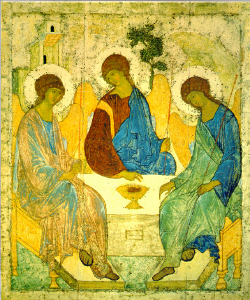
- Icons in a Russian Orthodox Church are arrayed in regular patterns on a tall partition called
"iconostasis", located behind the altar, with the "golden gate" at its center. Priests pass through the gate at
the center of the iconostasis to perform the most sacred and mysterious elements
of the liturgy [pix |
pix | pix |
pix]
- Icons were arrayed on all walls -- floor to high vaults, from the altar at
the front to choir at the back of the nave -- and around all columns
[pix |
pix]
\\
*--Essays on Muscovite culture in the era of the Golden Horde
[E-TXT]
*--Vasilii Kliuchevskii, "St. Sergius", in HRR,1
*--Nicholas Zernov, _Russians and Their Church [281.947+Z54 -- old Dewey Decimal call-number]
*----------, St. Sergius, Builder of Russia [NoUO]
*--Kimball essay on select scenes in the great Tarkovskii movie ANDREI RUBLEV
*--Viktor Lazarev, ed., _Early Russian Icons [N7956.U5]
*--Arthur Voyce, _The_Art and Architecture of Medieval Russia [N6983.V6]
*--Moscow | Tretiakov Gallery, which holds the Rublev "Trinity"
[W]
*--LOOP on "Church"
<>1423:Moscow grand prince Vasilii I's third testament [HTP:236-40]
*--Vasilii I's long reign ended two years later
<>1425:1462; Moscow grand prince Vasilii II Temnyi [Basil the Blind] reigned
on and off for 37 years
- The Golden Horde was fragmenting through these years. New "Tatar" khanates appeared | EG=
- 1425+:Siberian Tatar khanates [Sibirskie tatary]
- 1438+: Nogai Tatar and Kazan Tatar khanates
- 1443:Crimean Tatar khanate
- 1460s:Kazakh Tatar, Uzbek Tatar, and Astrakhan Tatar khanates
- Yet Vasilii II was defeated, captured and held by the Golden Horde who extracted secret promises
from him
- These promises most likely were in connection with the Horde's need of Vasilii's help against the splintering factions
- In return, the Horde helped destroy Vasilii's relatives who competed for the Moscow throne (it was in that
violent competition that Vasilii was blinded)
- The Horde protected him as grand prince. Vasilii II had great success against
rival Russian princes and their domains
- Luka Stroganov ransomed, or helped ransom, Vasilii from captivity
by the Golden Horde
- Stroganovs fell into Moscow orbit as Novgorod came increasingly under pressure from Moscow
- Russia in the time of Vasilii II [MAP]
\\
*--Alan Kimball, portion of essay on Stroganov family dealing with their "frontier"
phase [TXT]
*--LOOP on "Novgorod"
<>1431:Moscow had great military success against Bolgars.
Earlier independent, then under Mongol rule, the Bolgars now were brought fully under
Russian rule
<>1431jy25:1445; [Switzerland] Council of
Basel [W] worked for fourteen years without success
to pull the disintegrated European Christian Church together, to pull western European factions together
and to reunite Eastern and Western Churches
- Serious splits in the Catholic Church revealed themselves
- At the same time an independent Conciliar Movement
[ID]
gained in strength, challenging the unprecedented authority claimed by
the Patriarch in Rome (The Pope)
- This movement, asserted the superior authority of the whole church assembled in general council of high officials
- The Council, rather than a single Pope, should rule the Church
- 1439:1446; most intense seven years of renewed effort to reunite Eastern
and Western churches (Orthodox/Catholic churches)
- Russian Orthodox Church rejected reunion and declared itself autocephalous (independent of Constantinople
and the general east/west ecumenical movement)
- Russian Metropolitan Isidor protested the position against union taken by his Russian Orthodox superiors
- Isidor went into exile in Rome [VSB,1=126-8 | RRH,1=99-101]
- Back home in Moscow, Russian Orthodox church authorities independently elected their Metropolitan with
no participation of wider Orthodox church officials
- Reunion of a single, universal Christian Church failed
- Main reason = Centralized European monarchical states grew in stature and self-assurance
of their sovereign power
- These waxing political metropols resisted external authority and domestic independence
- Nation-state sovereignty prevailed over "Christendom"
as earlier administered by an "ecumenical" Church [ID]
- Further disintegration followed =
- Hussitism was still an issue (after more than forty years of
suppression), adding its radically independent weight to the centrifugal motions of the
moderately independent Conciliar Movement
- The seeds were being sown for the Protestant Reformation in the next century
<>1436jy16:Novgorod treaty w/ Hanseatic
League [VSB,1=76-7]
<>1438:Moscow the target of a siege mounted by Kazan
"tsar" Ulumakhmet | MAP
of Kazan Khanate and surrounding lands
- 1440s:Golden Horde continued to splinter. Crimean Tatar and Kazan Tatar hordes more
often acted independently
- 1445je06:Suzdal was the target of Kazan "tsar" Mamotyak attack
- 1452:Moscow grand prince Vasilii II refused to pay further tribute to
the Golden Horde
- Bashkirs out on the windy steppes paid yasak to various stronger, surrounding hordes,
EG=Kazan Tatars, Sibir, and Astrakhan
- Other Bashkirs who lived in the highlands of the Urals remained more independent of Tatar power
- Novgorod conducted a lively trade with the Bashkirs, and thus it was
increasingly a rival to Tatar power in this Steppe frontier
- Belaia River was a good route to Asia and Central-Asia, but Kama River was a frontier
- Mordvin territories were ruled by their own prince
\\
*--LOOP on "Novgorod"
<>1447:1492; Lithuania under Polish King
Kazimierz [Casimir] IV [VSB,1=96-9]
<>1453my29:Constantinople fell to Mehmet II's
cannons. Ottoman Turks victorious [TXT]
- After more than 1000 years meeting the challenge of the
great Steppe frontier, the Byzantine Empire was overwhelmed
- A Slavic convert to Islam and participant in the Turkish capture of Constantinople, Nestor-Iskandr, described
the event [DMR3:214-20]
- Ottoman Turkish power established itself in Constantinople [which the Turks pronounced Istanbul], converted
many features of the old Byzantine imperial power to its own purposes, and became the dominant
center, the "metropol", of south-eastern European and near-eastern (Central Asian) life for the next
four-plus centuries, until 1919
- In one sense the fall of Constantinople can be taken as the utter end of the great "Roman Empire"
- A millennium earlier, Rome was dismembered of its original western region and re-centered itself in Constantinople
- Now it was gone altogether
- Or was it?
- In another sense, Ottoman victory can well be considered a further evolution of that
great Roman Empire
- Wasn't it Arabic-Islamic high culture, rather than medieval European culture, that preserved for
the world the legacy of ancient Greece and Rome [EG]?
- Now the institutional legacy of Rome might be said to be sustained best under the authority of
non-European, non-Christian peoples
- Comparison of the west European Holy Roman Empire [ID] with the Byzantine
and Ottoman empires is relevant to this point
- What difference does ethnicity and religion make in the story of "Rome"?
- They spoke Latin in multi-ethnic territories under Rome
- They spoke Greek in multi-ethnic territories under Constantinople. Elites there called
themselves "Romaion" (Greek for "Roman")
- They spoke Turkish (written in Arabic alphabet) in the multi-ethnic territories under Istanbul (as Constantinople was
officially renamed after WW1)
- In the greatest era of Byzantine power, Macedonian Emperors ruled [ID]
- Byzantine territories were now ruled by invading outsiders
- But how different was Turkish intrusion from Constantine's own earlier intrusion into the Greek colonial
city Byzantion a millennium before [ID]
- How different was Turkish intrusion from the west European seizure of the city 250 years earlier [ID]?
- These victorious Turks adhered to the doctrines of yet another world religion, Islam
- And they placed no particular value on the roots of that empire in the actual city Rome
- But we might forget that the Roman empire centered in Rome was aggressively
anti-Christian until the Eastern branch of the Empire in the year 330 adopted
Christianity as a sort of official ideology [ID]
- The "world-historical" role of the Ottoman Empire was to be in certain ways
the same as Rome
- Just as Obolensky described the Byzantine Commonwealth [ID], a future historian might
compose a study of the "Ottoman Commonwealth"
- [*2012:In our time, Hungarian right-wing political activists harkened back to the "Turkish" roots of Hungarian identity]
- Much like the earlier "Roman Empire", Ottoman Turkish power became a decisive presence in the "Mediterranean World"
(defined by Fernand Braudel to include the Black Sea and all appurtenant shores and passages along the western and central
stretches of the Silk Road) and a powerful influence on the evolution of modern European history,
east and west [BMM=110]
- More on the underlying AfroAsian geography of these questions [TXT]
- We could use a clear and less "Eurocentric" and more globally oriented exploration of the ways the
Turkish "world-historical" role was the same as, and the ways it was different from, the Roman/Byzantine role
- It is in this way that Ottomans can be said to partake of two great imperial legacies = Rome and
the Golden Horde
- *--LOOP on "Turk" from 1243 back to this 1453 entry
- Wiki on Turkish and Mongol "origins myth"]
- The Ottoman Empire did take up as its own a large part of the Byzantine institutional and geopolitical heritage
- And it did this on the basis of successes in SE Europe which were more enduring, even more
stable, than anything Byzantium or the Golden Horde ever achieved
- Of course, such successes are never permanent
- Nor are such successes absolute
- Don't ignore the significance of the 1492 expulsion of Islamic "Moors" from what we call
Spain only a few decades after Ottoman victory at Constantinople [ID]
- Another point to ponder = While Ottomans wielded great power in the lives of southern Slavs, they never managed
to do so in the life of Russia
- Ottoman power, as inheritor of Byzantine power, never managed their own version of that
pre-Mongol Russian/Byzantine closeness
- On the contrary, long term animosity between the Ottoman Empire and Russia largely shaped world history
over the next four-plus centuries, and may reverberate in our own time
- In the contest with Ottoman power, Muscovite Russia also carried
on the legacies of both Roman and Mongol empires
- The Eastern Orthodox Church had since the year 330 become something like the institutional guardian of imperial
"ideology" in east Rome [ID]
- But the Byzantine Church was now without its emperor
- Furthermore, after more than a millennium, Christendom was flying apart
[EG#1 | EG#2]
- Increasingly, Moscow saw itself in the role of holy and secular defense of universal Christendom
and its empire, the inheritor of that Byzantine patriarchal/imperial function
- Thus the Russian Orthodox Church now had strong motive to suppress the memory of the Mongol legacy
and of the "khans", to exalt the memory of the Orthodox and Imperial past, and to throw its support behind the ambitions of
the Muscovite "tsar" [Slavic form of the expression "Caesar"]
- Ottoman Turks clearly inherited some part of the Byzantine and Mongol legacy and mixed
them in their own way, while Muscovite Russians inherited and mixed them in different ways
- Between Ottoman and Russian claims to the Mongol and Byzantine inheritance there was a large area of
territorial overlap where the two "heirs" disputed the other's claims
- So Ottoman-Russian relations were therefore to be a history of conflict that showed only brief signs of
abating in the 19th-c [EG]
- These were two Eurasian heirs to an awesome Eurasian dual legacy. Their wax and wane were closely linked over the next four-plus
centuries
- So also was linked their nearly simultaneous destruction in the early 20th
century [ID]
- But that's far down the line
- Growing Russian power and the Ottoman Turk Empire had yet nearly five centuries to go before they failed
- In the unfolding of the Russian/Ottoman contest, a third inheritor of the Roman legacy,
the so-called Holy Roman Empire, played a tertiary role
- In view of the larger macro-historical situation, the question of Russian isolation from "The West"
is utterly misconceived
\\
*--The Rise of the Turks and the Ottoman Empire [W]
*--LOOP on Islam
<>1456:Moscow drove wedge between Novgorod upper class
(who leaned toward Lithuania) and lower class (who leaned toward Moscow)
- Vasilii II defeated Novgorod and forged treaty which held until 1471au11
- The treaty restricted authority of the veche
- Now the signature of the Moscow grand prince was required on all Novgorod charters
- This treaty later allowed Ivan III to claim Novgorod as part of his personal patrimonial feudal possession,
his personal udel, otchina or votchina
\\
*--Vernadsky,4
*--LOOP on "feudalism"
<>1458c:Novgorod. St. Michael, Fool in Christ, died [ZMR1:247-57]
\\
*--LOOP on "Novgorod"
<>1461:Moscow grand prince Vasilii II's testament [HTP:242-66]
*--His 37-year reign was nearing its end
*--The 300-year rise of grand-princely city-state Moscow now culminated
in the emergence of tsarist Muscovite Russia, a national monarchy =
<>1462:1533; MUSCOVITE RUSSIA, phase #2 -- The 7-decade
era of Ivan III "the Great" and his son Vasilii III
*--Ivan was co-ruler since 1449, meaning 56 years in power)
- Muscovite Russia became fully independent of the Golden Horde and in line to claim the
mantle of Byzantine imperial authority, though Ivan's power did not stretch beyond RUS'
- Moscow Kremlin pix | Terem throne [pix#1 |
pix#2
- 1462:1505; Ivan III the Great, 1st tsar (remember, tsar = Slavic version of "Caesar" or "Kaiser")
- As a consequence of the fall of Byzantium, Muscovite grand-princely
authority took on new significance
- Some major features of this epoch =
- Russia in the time of Ivan III [MAP]
\\
*--Vernadsky,4 deals with the crucial epoch of Ivan III and Vasilii III
*--Crummey
*--Aleksandr Presniakov, _Tsardom of Muscovy [DK100.P7413]
*--Gustave Alef, _Origins of Muscovite Autocracy [DK102.A43]
*------. _Rulers and Nobles in 15th-century Muscovy [DK601.2.A68]
*--Nikolai Andreev, _Studies in Muscovy [DK100.A7]
*--Samuel H. Baron, _Muscovite Russia: Collected Essays [DK70.A2 b35]
*--John Fennell, _Ivan the Great of Moscow [DK106.F4]
*--Nancy Kollman, _Kinship and Politics [DK62.K57]
*--Henryk Paszkiewicz, _The Rise of Moscow's Power [DK90.P37]
*2017je15: Независимая газета | "В скиту Свято-Тихоновой пустыни установлен первый в России
памятник Иоанну III" [E-TXT#1 |
E-TXT#2]
<>1463:1468; Russian serfdom spread as
some of the earliest official restrictions were placed on peasant
movement [DMR2=168-9 | DMR3:221-2]
*--Ivan III handed down a decree which expanded earlier decrees limiting peasant movement from one landlord to another
*--Now villagers could move only after harvest, in a two week period surrounding St. George's
Day (no26) [VSB,1=123-4]
*--Peasants continued, however, to flee the evolving system of serfdom
<>1466:1474; Russia to India, and back | Russian merchant-trader Afanasii Nikitin described
his enterprise abroad [ZMR2:333-53 | WAL=111-13]
<>1467:Pskov reissued
its earlier Judicial Charter [W]
which revealed some workings of the veche [VSB,1=83-4 | VML:61-82 |
VML=18-20 describes the veche | Vernadsky translates "veche" as "city assembly", and sometimes veche is
translated as "people's assembly" or "urban assembly"]
<>1468:Belaya River | Tsar Ivan III attacked Bashkirs, an
episodic event = Nothing like this again for almost a century
<>1470:Novgorod treaty w/Polish King Kazimierz [Casimir] IV
*--Novgorod sought to counter-balance the power of Moscow [VSB,1=77-8]
*--Novgorod minstrel's immunity charter gives some insight into everyday life [KRR=131-3.
On everyday life throughout post-Mongol Russia:127-45; illustrated]
<>1471:1474; Moscow defeated Novgorod and its remarkable female
mayor, Marfa Posadnitsa [Novgorod Chronicle in RRC2,1=44-6 | KRR:91-9 |
VSB,1=78-81 | DMR2=170-84 | DMR3:222-36 (with MAP)]
*--Hypertext LOOP on "Chronicle" ends here | Hop to first of this 6-century long LOOP, but you might find
later chronicle entries of interest or use
- 1471:Novgorod city charters [KRR=109-14 | RRC2,1=29-46 |
VML:83-92 | VSB,1=67-8]
- 1471au11:Novgorod-Moscow treaty [VSB,1=80]
repeated most of the terms of the 1456 treaty
- This treaty severed ties with Lithuania
- It recognized Novgorod as otchina [or votchina, heritable patrimonial
possession] of the Moscow grand prince
- The commercial city-state with its governing veche was no match for the centralized princely tsardom of Moscow
- Moscow absorbed Novgorod, something the Golden Horde never managed to do
- This was thus a major moment in the "re-gathering of Russian lands". But it was more =
- Moscow seized from Novgorod the eastward tending trade initiative and thus =
- Moscow positioned itself to inherit the Golden Horde's Asian sphere of influence
\\
*--Henrik Birnbaum, _Novgorod in Focus [DK651.N506B573], pp. 166-181 deal with the meaning of Novgorod's defeat
*--Vernadsky,4:27-67
*--LOOP on "Novgorod"
<>1472:Muscovite tsar Ivan III married Zoe Paleologus,
niece of the last Byzantine Emperor, now living in Italian exile
- In the tradition of "nuptial diplomacy", Russia's claim to the Byzantine inheritance was strengthened
- Also Zoe solidified Russian ties with Renaissance Italy [GO 1476fa]
- 1474:1478; Italian architect Aristotle Fioravanti was commissioned by Ivan III to design and build
the first great cathedral in the Moscow Kremlin, Uspenskii sobor [Cathedral of the Assumption (or Dormition)]
- Fioravanti carefully studied Russian architectural traditions in Novgorod, Vladimir and Pskov
- Uspenskii sobor [pix] became the primary tsarist church, the site of
coronations, victory services, weddings and funerals of Russian monarchs until Peter I moved the capital to St.Petersburg
- 1472:Sarai| Russian warriors from Viatka looted
the capital of the Golden Horde during the absence of the khan
- 1474:Golden Horde sent hundreds of merchants and diplomats on mission to Moscow [Halperin:81]
- 1474:1507; Moscow treaties with Crimean Tatars demonstrated that Moscow need no
longer acknowledge a unified Golden Horde
- How confused is the issue of
Russian isolation!
<>1476fa:Venice ambassador Ambrosio Contarini
was sent to Persia in an unsuccessful effort to rally support against Ottoman Turks
- Contarini acted on the perception that Ottoman Turkey and Persia were natural competitors, even though both were Islamic in their
imperial doctrine
- Contarini's premonition about this, however, was premature by a quarter of a century =
- 1501:Persia made a shocking break with Sunni Islam and shifted to Shia Islamic faith
- But, in any event, Contarini's main concern was that the fall of Byzantium and the establishment
of the vigorous Sunni Ottoman Turkish authority throughout the eastern Mediterranean world cut Venice off from
the source of its prosperity and power. He sought allies to this cause wherever he could find them
- On his way home from Persia [Iran], Contarini
circled through Moscow where he met with Ivan III
- They discussed the shared Russian and Venetian interest in thwarting Ottoman power
- Ivan's wife [above] had been brought up in Italy
- Italian-Russian relations were especially close in these years
- Contarini left an interesting account of wintertime travel in sani
[enclosed sleds] and of daily life in Moscow [DMR2=184-90 | DMR3:237-43]
- Victories of the Ottoman Empire brought an end
to the nearly 300-year epoch of Venetian city-state political and economic power,
but they gave rise to ambitions and fears among neighboring states
- Like all waxing European monarchical powers, Russia poised herself to play the role of great imperial nation
- Contarini thought it might be possible for the waning city Venice to
provoke the waxing national monarchy "Muscovy" to do its bidding
- Russia had become a flourishing European culture and a thriving Eurasian power
- The days of powerful and independent city-states were over
- Contarini's mission was perhaps doomed from the outset
- This was the beginning of the monarchical nation-state era, and in this regard Russia was way
out front of most European kingdoms
\\
*--Pavlidis,14
<>1478:Novgorod veche bell was cut down and shipped to Moscow, later
to be melted down and caste into a cannon
- With the abolition of the Novgorod veche, the long history of early Russian urban self-government or
self-administration was at its end
- Novgorod defeat at the hands of tsar Ivan III of Moscow not only had profound implications for Russian institutional
history but for social history as well =
- Over the next six years (especially 1480:1484), 150 Novgorod boyars were
executed and their property confiscated
- Independent churchmen were arrested
- The top layer of Novgorod society was skimmed off =
- 8000 prominent families were deported
- They were offered land in the Moscow area if they agreed to serve the Moscow tsar
- In their places back in Novgorod, Ivan III settled his own servitor gentry, a pomeshchik aristocracy [officially
designated place-holding service nobles, officially rewarded with titles and properties]
- The 300-year era of patrimonial (heritable) votchinnik aristocracy was coming to an end
- But fundamental social transformations take time
- In truth, the rule of the Golden Horde long ago undermined votchinnik independence
- Mongol insistence on complete subordination of all to the khan had its effect on old aristocratic social norms
- This sort of tsarist power was one of the important Muscovite Russian inheritances from the era of the Tatar
Yoke
- But votchinniki survived
- Now this recognizable European-style elite feudal social formation (aristocracy or nobility) entered a long
epoch of terminal decline
- And the agent of this decline would be the power of the Muscovite tsar
- Over the next two centuries, the medieval Russian secular elite was split into two tiers,
the first under constant pressure and the second expanding =
- Votchinniki, i.e., "patrimonial nobles" with heritable possessions (landed estates),
privileges, exemptions and presumed duties
- Votchinniki were a noble by birthright
- Their titles and possessions were a direct inheritance from a father or, rarely, some other close family member
- Their titles and possessions were traditionally unmediated by any official appointment or approval
- Pomeshchiki, i.e., "servitor nobles" with assigned possessions (landed estates), privileges, exemptions
and very explicit duties
- Pomeshchiki depended for their titles, properties, privileges,
exemptions, etc., on the good will and continued support of their princely masters
- They were assigned pomest'e [landed estate, held on condition of service to the tsarist state]
- This was a social innovation, not new to Ivan III's time, but brought to first full fruition under his authority
- The servitor gentry [pomeshchik] was very different from the old patrimonial aristocrat [votchinnik]
- It must also be noted that the pomeshchik had to earn this distinction in the eyes of
the princely master, and held it only so long as his service satisfied the princely master
- In the 15th century, the power and independence
of the old votchinniki elite (for that matter of the whole social structure)
was a natural target for the increasingly centralized tsarist authority
- The 1649 Law Code described pomeshchik [TXT]
and votchinnik [TXT], and in that order
- Muscovite grand-princely power applied constant pressure to shift votchina aristocracy
into a service-bound pomest'e [territorially assigned] aristocracy, and to blur the
distinctions in the ranks of this two-tiered feudal elite
- In reaction to this, many Russian votchinniki left Russian service
to enter service in other "nations", most notably in Lithuania and Poland [EG]
- It seems a bit odd that the institution of "Boyar Duma" achieved something like solid
institutional expression at this time and under these conditions
- Russian aristocratic elites grasped onto this institution to protect their interests in the face of tsarist inroads
- The tsar, in his turn, was not yet in a position to rule in total independence from the
old families
- He met irregularly with the Boyar Duma for advice and support of his policies
- The tsar convened the Boyar Duma; it did not convene itself
- Its members were divided into several different categories = boyars, okol'nich'i, duma gentry, and duma d'iaki
- The Boyar Duma represented a certain institutional compensation to the old
votchina elites of Moscow
- Boyar Duma eased votchinniki through a time in which they were losing authentic political and social independence and power
- It would be still two centuries before authentic votchina independence was fully undermined
- Nonetheless, Russia was the first and the most irreversibly successful among
emerging European centralized "national" monarchies to neutralize independent aristocracies
\\
*--LOOP on "Novgorod" but only after giving some interpretive thought to the historical relationship
between the geo-political fate of Novgorod and the political-social fate of votchina aristocrats
*--RRC1(6) or RRC2(6) (George Vernadsky and L.V. Cherepnin
debate issue of whether there was a "Russian Feudalism")
*--Nancy Kollmann, _Kinship and Politics: The Making of the Muscovite Political System, 1345-1547 [DK62.K57]
*--LOOP on "feudalism"
<>1480:Russian tsar in Moscow,
Ivan III, renounced authority of Golden Horde when he rejected Akhmat-khan's effort to
extract further tribute [VSB,1=113-16 |
DMR2=191-3 | DMR3=184-6]
*--Moscow had grown strong, yes, but the Golden Horde had also grown weak
*--Sarai, the encampment of the Golden Horde that served as something like a "capital" or "metropol", was
taken and plundered by Voevoda [Muscovite frontier military governor] Nozdrevatyi
*--This was the utter end of
nearly two and one half centuries of Golden Horde dominion over Russia
<>1482:Crimean Tatars,
one of the offshoots from the earlier united
Golden Horde, sacked Kiev,
harassed Poland-Lithuania
*--Over the next two centuries, a four-way contest for ascendancy evolved in the old Pontic Steppes, involving
- Catholic Poland-Lithuania
- Crimean Tatars, acting as ally of the Islamic
Ottoman Empire
- Orthodox Moscow, in uneasy association with emerging
- Cossack communities along the Dnepr and Don river drainages
\\
*--LOOP on Islam
<>1485:Tver prince Michael went over
to Lithuania [VSB,1=116] as Moscow seized the city-state
and continued the "re-gathering of Russian lands"
\\
*--Oswald P. Backus, Motives of West Russian Nobles in Deserting Lithuania for Moscow, 1377-1514 [noUO]
<>1487:1489; Novgorod's 50 richest merchants were deported
*--Eventually 10 thousand middle class burghers were moved from Novgorod to Moscow lands
*--In these years Ivan III approved a Novgorod Judicial
Charter [W]. Compare
this urban charter with the earlier Pskov Judicial Charter
*--LOOP on Novgorod
<>1487my18:Moscow defeated Kazan Tatars.
Mohamed-Amin became vassal khan
*--Russian frontier or imperialist expansion to the south and east now picked up momentum
<>1488:Beloozero city charter [VSB,1=116-8]
<>1489au16:Viatka taken by Moscow and all prominent figures
sent under guard to Moscow
*--Tsar Ivan III granted to some of these prominent Viatka figures pomest'ia [landed estates held
by pomeshchiki nobles] so long as they rendered state service to the Moscow tsar
*--Others were executed
<>1490au: Nogai Horde murzy [princes]
sent embassy to Moscow offering tsar Ivan III alliance in a struggle against "Ahmad's sons", i.e.,
the remains of the Golden Horde
- Russian frontier or imperialist ambition now looked beyond "re-gathering Russian lands"
- Russians gazed down the Volga watershed past the Kazan Tatars and toward
the heart of the old Golden Horde's territories on the shores of the Caspian Sea
- At the same time western European monarchies (most notably those of Spain, Portugal and England)
"discovered" great overseas opportunities
- Overseas opportunities eventually devalued control over the old overland Silk Road,
but that trade route remained still important
- Scan the next 30 years to get a sense of what it meant when trans-oceanic projection of power became a human possibility =
<>1492:Spanish-sponsored explorer Columbus "sailed the ocean blue",
making landing on Caribbean Sea islands of the New World [MAP]
- 1493:1527; Peru, Cuzco | Far inland and high in the Andes mountains, the third
great indigenous New World civilization, the Incas
[Emperor's], reached its apex under Emperor Huayna [sometimes Huayra] Capac
- Back in the "old world", Spain drove out Jews and the Islamic Moors
(left over from days of Arabic greatness [ID] )
- Beginnings of European trans-oceanic exploration and expansion (projection of
military, administrative and economic power) over the face of the whole globe =
[Moving MAP]
<>1492:Polish King Kazimierz died.
His two sons ruled Poland-Lithuania
- When tsar Ivan III's daughter, Elena, married Lithuanian prince Aleksandr, Ivan began to call
himself "tsar i Gosudar vseia Rusi" [tsar and Lord of all the Russias] and his ambitions looked
south as well as west
- Flexing his autocratic powers as conflict with Poland intensified, Ivan III squeezed elite aristocrats
and lowly village laborers =
- In the midst of this complex foreign entanglement and domestic squeeze,
Russian votchinniki [patrimonial aristocrats] fled from Muscovite tsarist power
to Poland-Lithuania
- At the other end of the social and economic spectrum, peasant villagers, increasingly pressured into
condition of serfdom, fled to freedom in the south and east
- Some villagers who fled south and east in the lower Dnepr, Don and Volga watersheds acquired the name "Cossack"
- Cossacks picked up their name from Steppe nomads, the Kazakhi, whom they met out on the vast Eurasian prairie
- Fleeing Russian peasant villagers slightly mispronounced the local name kazakhi as kazaki
- We further distort the name in English as "Cossacks"
- These novel, Orthodox, warrior-farmer Cossack communities grew strong in the wild Steppes
- They were becoming a thorn in everyone's side, whether Moscow, Poland, Lithuania, or Crimean Tatars
- These folks fled from Moscow, but Moscow still had one advantage in dealing with Cossacks =
- For Cossacks, Orthodox Christianity was the central element of self-identification
- Cossacks did not ask recruits into their communities about their ethnicity or "nationality" or mother-tongue
- They asked, "How do you cross yourself?"
- In Muscovy, domestic and "international" as well as political and religious issues braided together
\\
*--Vernadsky,4:220-33 and 249-69
*--Robert M. Croskey, _Muscovite Diplomatic Practice in the Reign of Ivan III [DK102.C76]
*2016:MVA|>Akunin,Boria|Между Азией и Европой : история Российского государства : от Ивана III
до Бориса Годунова
*--LOOP on Islam
<>1494:Novgorod ties
w/Hanse ended. Moscow authorities seized some Hanse merchants
<>1497:Moscow | Sudebnik [Law Code]
of tsar Ivan III [Horace W. Dewey, ed., _Muscovite Judicial Texts, 1488-1556:9-21|
Excerpts = VSB,1=118-9 | DMR3:243-58| HRR,1]
- 1957:Speculum#32| Dewey, ed. "The White Lake Charter: A Medieval Russian Administrative Statute"
- Ann M. Kleimola, _Justice in Medieval Russia: Muscovite Charters (pravye gramoty) of the Fifteenth and
Sixteenth Centuries [KM.K63j1975]
- "Kormlenie" charter ["tax farming" license] (example) [VSB,1=119-20]
- Other Muscovite charters [KRR=114-7]
\\
*--Daniel Kaiser, Growth of the Law in Medieval Russia
*--J. M. Feldbrugge, Law in Medieval Russia
[E-TXT]
<>1500:1503; Moscow defeated Livonian
Order, though the Order lingered on for a half-century
- Over the previous three centuries, the original crusading Livonian Order settled down in Slavic lands
- The Livonian Order concentrated its power in urban centers = Riga, Tallinn, and Tartu [the modern-day Latvian
name of a town originally founded by Russians as Yur'ev, later called by a German name Dorpat or Derpt]
- The Livonian Order smothered the urban commercialism fostered earlier by the Hanseatic League
- It imposed harsh forms of feudal baronial authority over the full agricultural and commercial life of these regions
- With the defeat of the Livonian Order, Russia came into this inheritance
- For example, Riga, still the major Latvian city, had been a significant member of the Hanseatic League
- But everywhere these independent commercial cities were in decline as centralized monarchies extended their power
- In this regard, Muscovite tsardom moved in harmony with general European trends, only it moved far more vigorously =
- Increasingly in the 15th and 16th centuries, centralized monarchical
power was in the process of forming European "nation-states", from west to east, from England to Russia
- A new and very "modern" janus-faced notion of political "sovereignty"
[W-ID] played a key role in this process
- New territorial nation-states looked outward for sovereign independence in their international
relations and inward, within "borders", for the same independence in domestic politics
- 1516: The oldest continuously observed national "border" was
marked [ID])
LOOKING OUTWARD = INTERNATIONAL POLITICAL SOVEREIGNTY. These new centralized monarchical
nation-states rejected the idea that their increasingly vigorous national sovereignty could be properly
checked by any other sovereign nation-state. Reaching even further, these new nation-states rejected
larger "transnational" political arrangements and limitations. World-wide, different varieties of
Christian churches and increasingly splintering denominations flourished with a new and disorderly
abundance [EG#1 | EG#2]. But the old ecumenical dream of
Christian universalism, the very concept of "Christendom", was in all practical actuality dead in
"The West". Church independence and regional autonomy within feudal territories came under criticism
and control. The loosely constituted Holy Roman Empire under the rule of German-speaking
peoples unraveled even further. As one wag put it, the Holy Roman Empire was neither holy, nor Roman,
nor Empire. The larger drift of history doomed the dream of a unified Europe-wide Christendom on the
institutional model of the old empire
LOOKING INWARD = DOMESTIC POLITICAL SOVEREIGNTY. These new nation-states did not tolerate independent provincial
aristocracies, or any form of feudal regionalism or even semi-independence from the throne. The domestic "periphery"
was being made dependent on the national monarchical "metropol". The new monarchies worked against free and wide-ranging
regional association of cities outside the limits of monarchical practice and authority. Centralizing monarchical
nation-states struggled on all fronts against clerical, patrimonial aristocratic and urban independence from "national
authority". Urban commercial culture, for the moment, declined. Nationalistic monarchial social orders and economies
formed up. For these reasons, the two-century history of the Hanseatic League was coming to an end
- The two faces of emerging "sovereignty", in a sense, marked the end both of the classical Greco-Roman and
the medieval phases of west European history
- West Europeans were at the dawn of the modern era, but much was old and familiar =
- Traditional feudal hierarchies lingered, from princes and priests down to villagers
- The great monarchies still draped themselves in the robes of "divine right"
- But much was new. Two significant examples =
- Service and landowning nobility, as well as laboring commoners, were falling increasingly
under close monarchical authority
- In this age of European exploration, discovery and colonization, national economies were
increasingly both "globalized" in the wider world and "localized" in the
hands of small mercantilist oligarchies of insider elites concentrated
in "national" capitals, in royal metropols [ID]
- Thus we see the central contradiction built into the new European concepts of sovereignty =
Outward projection of "nation-state sovereignty" meant imperialist encroachment on "sovereignty" in
targeted regions at the peripheries
- And, looking far ahead in time, we can see more clearly the vital significance of the
emerging modern political idea of federalism
- Federalism can be thought of as "distributive sovereignty"
[EG (one paragraph)] =
- In relationship to strengthening central authority, populations and regions established
for themselves, or pulled back toward themselves, certain elements of sovereignty commandeered or
threatened by centralized monarchical authority
- In the in the 16th-c, centralized national monarchical phase
of history approached its apex, most sharply in Russia but in other areas of Europe as well
- In Russia, this process long ago expressed itself in the rise of bound aristocratic
servitors [ID] and very belatedly in the rise of bound village laborers (serfs)
- Serfdom in Russia expanded on practices found among Germanic landowning nobilities (the infamous "Baltic Barons") who
dominated this region since the arrival of Livonian and Teutonic crusading orders in the 13th century
- The spread of serfdom to Russia from the territories of the holy Germanic knights might be
called a form of "Westernization" of Russia (if that term were ever allowed to have a negative connotation)
- Ironically, serfdom in central and west European domestic agricultural/administrative life was
coming to an end as Russian serfdom flourished in the 16th century. Europe shifted its attentions to the profits available out
in the increasingly "globalized" slave-worked plantations of the several "new worlds"
- Russia developed its particular variation on the general European pattern of centralized "national" monarchy,
and it did so ahead of all other European monarchies
- In the interest of interpretive consistency on this sort of comparative analysis, we might be tempted to label
Russia "advanced" and western Europe "backward"
- How silly such a comparative perspective seems when applied to trends we do not like
- The views and actions of Russian tsarist advisers (largely clerical scribes and Church
officials) cast further doubt on the notion of "Russian isolation"
- Still we have to acknowledge and come to terms with a seemingly contradictory fact about Russia =
- This most centralized of all the centralizing European "national" monarchies was in an unusually favorable position
among late medieval European states to entertain vastly inspiring notions of transnational imperial power
- In just these years, Russia came alive with its own version of the oldest pan-European imperial dream = the
universal Christian Empire [ID]
- On the whole, nonetheless, the next century and a half in Russia and the rest of Europe, north and south,
east and west, was less "imperial" than it was "nation-statist"
- As we enter this era, we must develop an alert sensitivity to the confusions associated with two sets of words =
(1) "Nation" and "national". The original Latin connotation of
these words was cultural, signifying something like "those born
together, within a shared ethnic environment". Language ("mother
tongue") was a powerful sign of "national" identity and unity. What we
see emerging in the 16th century was a new political-institutional
connotation of these words, signifying something like "those ruled or
governed or administered within a defined sovereign territorial state".
In this SAC LOOP on "national", the term "national" often appears in quotation marks in order to
emphasize this important shift from ethnic, cultural and shared-language connotations to centralized
political connotations. Dominant ruling elites might share common ethnic, cultural and language
traditions, but increasingly many under the authority of territorial "nation"-states did not. This was
the beginning of the great era of centralized "national" monarchies but also
of outwardly projected and expansive nation-state power beyond the limits of "national" cultural
uniformity. So the second set of words that require alert sensitivity are the following =
(2) "Empire" and "imperialism". The old Roman or Mongol empires, and their two most important
heirs, the more recent Ottoman and the rising Russian empires, were at base very different from this
newly-rising imperialism of certain sovereign
European nation-states. The new imperialism might be thought "better" or "more progressive" or "more
beneficent" than the old imperialism, but that is doubtful. More important = That is not
the question. The important historical point is this = They are structurally and behaviorally different
[ID some features of this difference]
\\
*2012:Tulsa Law Review#48,2 [E-TXT =]
|>Ackerman,John Wolfe| "Why Political Theology Again? Reviewing Paul W. Kahn, Political Theology:
Four New Chapters on the Concept of Sovereignty and Sacred Violence: Torture, Terror, and Sovereignty"
[E-TXT of Kahn's book]
*--LOOP on "feudalism"
<>1502:Crimean Tatars defeated
the Golden Horde and finally destroyed Sarai
*--The powerful influence of nomadic Mongol warriors on world history had still one more great moment,
but the powerful Golden Horde would soon be but a legacy to which significantly less powerful
Tatar khanates aspired. But also Ottoman Turks and tsarist Russians
<>1502:Central America [Honduras] the site of Columbus'
first mainland disembarkation in the New World
<>1503:Moscow | Russian Orthodox Church Council
declared victory of Josephites [followers of Joseph of Volokolamsk and called "Possessors"],
a victory over followers of Nil Sorskii [The Trans-Volga Elders, called in this controversy the
"Non-possessors"] [FTS:85-133]
- Like other European monarchists of the day [EG], Josephites were concerned about
the need to unite and strengthen Church and state in Russia for the challenges and opportunities that lay ahead
- And also as everywhere in the Christian world, there were those, not unlike the Trans-Volga Elders, who were
ready to protest the expansively wealthy and managerial Church
- Judaizers [zhidovstvuiushchie] were declared to be heretics at this time [VSB,1=154-5]
- BSE3 says this = The late 15th century witnessed a fresh upsurge
of the [?"the"?] heresy movement in Russia
- It was centered, as before, in Novgorod [NB! possible ties between theological and geo-political competition]
- losif Volotskii identified the founder of this form of heresy as a certain "Jew Skharia"
[W-ID] who arrived in Novgorod
in 1471 from Lithuania [IE= Iosif identified Skharia and his religious trend as an alien outsider force]
- Volotskii called the heretics themselves by the mouth-full expression zhivodomudrstvuiushchie
("Judaic-philosophizers")
- Without foundation, he imputed to them adherence to Judaism
- Prerevolutionary historical literature employed the somewhat simplified designation zhidovstvuiushchie
("Judaizers") to describe the Novgorod and Moscow heretics of the late 15th and early 16th century
- This designation was rejected by Soviet historians in favor of the following home-baked interpretation=
- The main contingent of these heretics was comprised of Novgorodian townspeople under the leadership of
local Orthodox clergymen of lower rank. The movement's ideologists were the priests Denis and Aleksei
- Just like the strigol'niki ["shearers", those who sought to sever the growing wealth of the Church
from what they took to be the central mission of the Church = celebration of the liturgy], the Novgorod heretics [those
deceptively labeled "Judaizers"] disavowed the hierarchy and rites of the [official statist] Church
- Iconoclastic sentiments [ID] were in evidence, and some held anti-Trinitarian views, subjecting
the fundamental Orthodox [?fundamental Christian?] tenet of the Trinity to criticism based on rationalist
premises [More on "rationalist" trends in late medieval European Christianity]
- By the early 1500s, all Novogord Church property was
confiscated by Moscow tsar Ivan III
- Now we are down to the nitty-gritty of this conflict
- Tsar Ivan distributed this valuable commodity to his pomeshchik army officers
- The Josephites approved of their powerful tsar, but they wanted to prevent such confiscations taking place in
territories of Muscovite Church authority
- The statist-oriented Josephites did not operate in Russian
isolation from general European trends toward national-monarchical dominance
\\
*--Florovsky,5:9-26
*--CHR.1:351-3
<>1504:Moscow tsar Ivan III wrote his testament [HTP:268-98 |
VSB,1=120-1]
<>1505:1533; Moscow tsar Vasilii III inherited
from his father, Ivan III [ID], a domain of ca. 55,000 sq. miles [the state of Oregon
equals 97,000 sq. miles]
*--Vasilii's father had himself inherited ca. 15,000 sq. miles, thus Russia had grown four-fold by the end of
Ivan III's reign [MAP]
*--And it continued to expand =
<>1510:Pskov taken by Moscow [VSB,1=84-5]
Over next years, Pskov brought thoroughly into Muscovite sphere of control
<>1514:Smolensk annexed by Moscow [VSB,1=131]
*--In that same year, feeling pressure from Moscow as it seized these western Russian towns, Poland-Lithuania granted Kiev the right
to govern itself by the Magdeburg Law [W]
*--Moscow, as it "re-gathered Russian lands", was increasingly successful against Poland-Lithuania
<>1516:English statesman and thinker, Thomas More,
published a Latin-language description of an imaginary ideal state, Utopia (1551:English version published)
- Utopia [Nowhere] = the world gained a new literary genre and a new word
- Thomas More was a powerful official and prolific writer in a most troubled time =
- The English monarchy expanded its authority over British life like never before
- More refused to follow his King Henry VIII away from the Roman Church in directions defined in the Act of Supremacy
- The Act of Supremacy seized the English Catholic Church
- It "nationalized" the Church, removing it from the authority of the Pope in Rome and Catholic clerical
administrators in England
- With the monarch in charge, the English Church now became an "Anglican" rather than an ecumenical or
universal ("catholic") church
- 1535:Thomas More was beheaded on a charge of treason
- He was later sainted by the Catholic Church but also knighted by the English monarchy
<>1517:and again in 1526:Holy Roman Empire ambassador
Sigismund von Herberstein resided in Moscow
*1557:Herberstein wrote _Description of Moscow and Muscovy [Excerpts: VSB,1=156-8 |
DMR2=194-208 | DMR3:261-75]
<>1517:Ottoman Empire, Istanbul | Selim I took title khalif (Caliph)
*1512:1574; Ottoman Turks were entering their golden age
\\
*--Summary of a great Ottoman epoch [W]
*--On Selim the Grim [W]
*--The wonders of the Ottoman capital city (metropol) Istanbul from the time of Sultan Selim I
to early years of architect Sinan [W-ID]
*--Pavlidis,15
<>1519:Central America, Mexico | Hernán Cortéz
conquered indigenous New World territories for Spain, destroying Aztec civilization
<>1520,1566; Ottoman Turkish Sultan Suleiman I ("the Magnificent")
ruled forty-four years [W-ID]
- These were years of great Ottoman Turkish cultural flourish
- These were also years of significant enhancement of Ottoman power
- To the east, against Persia [Iran]
- To the shores of the eastern Mediterranean
- 1540s and 1550s:Close Ottoman diplomatic alliance with France against the Holy Roman Empire
- Into the territories of modern-day Hungary
- And generally along the eastern marches of Austrian imperial authority (accented by
an Ottoman Turkish siege of Vienna)
- [MAP]
\\
*--The Caucasus -- lands of Georgians, Armenians and Azery -- were a constant temptation for Turks and Persians
[W]
*--Morgan on Persian Shah Ismail [W]
<>1520s:Russian Orthodox Church leader, the influential monk Filofei, wrote
letter to tsar Vasilii III which offered a doctrinal historical analysis that amounted to a recommended state "ideology"
- Filofei described Moscow as "Third Rome" = "Two Romes have fallen. The third still stands.
There will be no fourth." [VSB,1=155-6 | DMR3:259-60 |
ZMR1:265-74 | BL&T=171 | RRH,1=103]
- The doctrine of "Third Rome" cannot be considered an expression of Russian isolation from
western Europe (reified so often as "The West" [LOOP])
- On the contrary, Filofei's central concern was that west Europe had isolated itself, from its own millennial traditions
- Filofei was concerned about the collapse of ancient ecumenical or universal Christendom
- Part naive, part cunning, he believed Russia was called to set all this right
- See also the Novgorod "Tale of White Cowl" [ZMR2:323-32]
- Russian power needed a supplementary doctrine to guide its foreign relations
- The earlier Muscovite doctrine of "re-gathering Russian lands"
was too limited and had by now approached its plausible limit
- Russian power now reached further than it had ever before reached =
- Actual (rather than idealized) "Christian civilization", east and west, projected a new vision of power
and economic ambition
- Russia in particular faced new challenges in view of the rise of vibrant mercantilist
competitors in expanding regional and world markets [ID] =
- Venice [ID]
- Ottoman Turks in the region of the old Silk Road trade routes
- the Muscovy Company [an English imperialist adventure]
- Centralized national monarchies, such as England and other Atlantic seaboard monarchies,
moved overseas with their mercantilist corporations
- Russia moved across the sea-like southern and eastern Steppes
- This was the beginning of the era of eruptive European frontier and imperialist
expansion [MAP]
- The misconceived question of Russian isolation, rooted in the experience
of Mongol dominance, need engage us only one more time
\\
*1953:Speculum#28:84-101 (reprint in CSH) |
D. Stremooukhoff, "Moscow the Third Rome: Sources of the Doctrine"
*2016:MVA|>Abramov,Dmitrii, and Kliment'ev,Dementii| Новый и Третий Рим : византийские мотивы России
*--W. K. Medlin, Moscow and East Rome [noUO]
<>1521:German priest Martin Luther
was excommunicated for his anti-Rome preaching and activism
- Over one century earlier Czech spiritual leader, Jan Hus, and the Hussite movement clearly
adumbrated the Protestant Reformation [LOOP]
- As the Protestant Reformation intensified, it provoked the second profound doctrinal
split in European civilization
- In the time of Luther, this second profound split might crudely be thought of as between
the "North" and the "South" of western Europe
- Ireland and Poland now joined Yugoslavia as
European spots of hot religious contention
- The two splits worked together to place Catholic Poland and Lithuania
in a position of doubled doctrinal conflict =
- "West" (Catholic powers) vs. "East" (Orthodox Russia)
- "South" (Catholic powers, especially the "Holy Roman Empire")
vs. "North" Protestant states Sweden and Prussia)
- The only partially "integrated" Germanic Holy Roman Empire was "disintegrating"
along religious lines
- More broadly, the Universal Christian Church and the larger concept of "Christendom" was
disintegrating in actual fact
- Only a dwindling number of still ambitious and optimistic ecumenical-minded Christian Church activist-officials
had their hands on -- or were close to -- state power [EG]
- But all around, Christianity as trans-national state ideology was splitting into "nationalized" units
- 1525:Yet a third sort of split became evident in northern German-speaking areas gripped by the
trauma of Reformation = peasants (villagers) vs. their feudal lords
- Protestant villagers were known to affirm, "No priest, no prince"
- Thomas Müntzer [W-ID] became the central figure
in this futile effort to extend religious/institutional Reformation [txn level II.a]
into broader political, social and economic Reformation [txn level II.B, III and IV]
\\
*2017de12: New Republic | "The Luther Legend" [E-TXT]
*--Watch "5 Differences Between Orthodoxy and Evangelicalism"
[YouTube]
*--Blickle.REV
*--LOOP on Protestant Reformation
*--LOOP on "feudalism"
<>1523:Moscow tsar Vasilii III's testamentary writ [HTP:300-303]
<>1525:Moscow | Russian Orthodox Church Council declared
Maksim Grek [Maximus the Greek (ID)] a heretic
- Trained in Italy and dedicated to the revival of Eastern Orthodox Christianity, Maksim deplored the Russian
drift from Greek Patriarchal control
- He was appalled by the errors that had come into the Russian liturgy in the many years of Muscovite isolation
under Mongol dominion
- But the Russian Josephites, after a quarter-century struggle with their monastic opponents, were in
a position to silence criticism such as that from Maksim the Greek
- Josephites were ready now to defend their comfortable national
traditions and new-found favor in the tsarist court
<>1525:New World, Central America | Spanish conquistador Cortéz
established Captain-generalcy of Guatemala
<>1526:India fell under Mongol rule
*--Babei founded the Mogul dynasty in Hindustan. Delhi became the center or metropol
*--This was the last great accomplishment of the three-century-long Mongol dominion over Eurasia
<>1527:1535; New World, Central America,
Mexico, Yucatan | Mayan civilization the target of Spanish conquistador Francisco de Montejo the elder
*--He failed in two military campaigns
*--Twentieth-century experience in this area
<>1527:Italian City-state Florence | Ambassador and
political theorist, Niccolo Machiavelli died
- Machiavelli was the author of an epochal study in political power,
"The Prince" [E-TXT], and other seminal works
- He has been called the creator of "political science". He was the first influential popularizer of the
modern concept of politics. He is the stormy petrel of "modernism"
- He was unflinching in his emphasis on the immediate and practical side of political life
- He explicitly refused to subordinate politics to any traditional moral or religious dicta
- He insisted that politics is an independent science, with its own "laws"
- He seemed cynical about "value politics"
- He did, however, concede a place for decorous or we might say opportunistic and mendacious observation
of conventional moral and religious views
- He is too frequently associated only with these cynical possibilities
- His affection for princely authority, for tough-guy leadership, is unsettling
- But he needs also to be acknowledged as a liberator of humanity from =
- Abstract valorization of power or
- Elevation of politics beyond everyday actualities and into various abstract or super celestial realms
- He brought it all down into the give-and-take of actual human exchange and interaction in the public sphere
- He wanted us all to understand the deepest and troubling implications of the old Aristotelian assertion that "humans are political animals"
- Without politics, humans are just animals
- In this sense, Machiavelli was the utter opposite of anarchists and of others
who presume that politics can only corrupt
- In his view, politics make humanity what it is, and it is a good thing that it does so
- For better and for worse, politics force all humans to shape their experience as best they can
- Politics are evil but they are necessary, even unavoidable, in human communities
- Politics force individuals to acknowledge those inevitable moments when other humans ("leaders") shape the experience of large populations
- All this made Machiavelli a favorite target of scorn
- The adjective, "Machiavellian", in casual conversation, almost always carries negative implication
- It almost always implies manipulative and centralized "princely" political rule over subjects
- However, look at J.G.A. Pocock's book listed below for a very important corrective to these standard views
- We need to know that Machiavelli exerted wide influence and frequently won at least secret admiration
- Humans have a hard time believing that they are in essence political animals
- But humans also find it nearly impossible to deny it in the heat of practical everyday life
- Someone once asked and answered, "What is the first thing all true Machiavellian politicians
will do? They will deny that they are Machiavellian politicians"
- Machiavelli observed that a cloak of righteousness is frequently draped over human action
- But righteousness is seldom the central motive of human action
- Political leaders (and citizens or subjects under the power or authority of political leaders) must
always be aware of that
- That awareness is the essential first step toward mature political life
- Machiavelli felt that open recognition of that seemingly depressing fact was the first step toward
protecting a place for authentic ethical behavior in actual adult public life
- At a deeper and even more "seditious" level, Machiavelli dislodged a widely shared philosophical
axiom = The presumption that all genuine values are compatible with one another
- 1971no07:NYR| English historian of thought
Isaiah Berlin explained the novelty of Machiavelli this way =
- He presumed "that ends equally ultimate, equally sacred, may contradict each other"
- "[E]ntire systems of value may come into collision without possibility of rational arbitration"
- And all this is so "not merely in exceptional circumstances ... but (this was surely new) as
part of the normal human situation" [SAC editor's boldface]
- Over the years Machiavelli has not earned his reputation because he is tough and extreme, he
earned it because he is complex and inescapable
\\
*--J. G. A. Pocock, _The_Machiavellian Moment: Florentine Political Thought and the Atlantic Republican Tradition
[E-TXT = 1st 80 pp.]
*1981mr:JMH#53,1| J.G.A. Pocock, "The Machiavellian Moment Revisited"
[E-TXT]
*2016no30:TLS| William J. Connell, "Machiavelli’s Utopia" [E-TXT]
(("The solid discoveries here are that Machiavelli was not the lonely writer he is so often imagined as being;
that he belonged to a network of writers who were contributing to a shared discussion of princes and statecraft;
and that Erasmus and More, in the years before the Lutheran break, were being read in ways that were more radical
than is generally thought – and than they themselves would wish to be thought after the Reformation took off"))
<>1528:Spanish Imperial explorer and administrator, Cabeza de Vaca,
published an amazing account of his near decade lost on expedition through New World territories now named Florida.
Texas. New Mexico, and, probably, Arizona [E-TXT]
<>1529:Lithuania law [VSB,1=98-100
| City law=100-110]
<>1529se:Vienna, the very capital of "The Holy Roman
Empire", was for the first time put under Ottoman Turkish siege
*1547:Holy Roman Empire conceded Hungary to Suleiman the Magnificent
<>1533:1587; MUSCOVITE RUSSIA, phase #3
-- The era of IVAN IV "THE TERRIBLE"
- 1300:1533; Russia [MAP]
- 1533:1598; Russia [MAP]
- 1533:1584; Ivan IV Groznyi [Awesome, Terrible] (born 1530; actual reign at age 17, from 1547)
- 1533:1547; Boyar [heads of old noble families, court advisers] contested with
one another and with the royal family for ascendancy in Muscovy [VSB,1=132-3]
- 1538: Ivan's mother Elena died and seven years of fierce internecine struggle
followed. Ivan himself related the torment of these insecure years of struggle
[Fennell,Correspondence:69-81. Fennell's footnotes help explain the fault-lines between
old-boyar patrimonial princes and the new "service people" created around the tsarist throne]
- Ivan later described his impression of these terrible early years [DMR3:276-85]
- The great moments in Ivan's reign can be summarized =
- First Zemskii sobor
- Stoglav Assembly
- Final defeat of Kazan Tatars
- Relations with England
- Livonian Wars
- Oprichnina and struggle with Russian boyar elites
- Novgorod crushed
- Ivan killed his son & heir...
- ...which contributed to "dynastic crisis"
\\
*--Isabel de Madariaga, Ivan the Terrible [DK106.D4]. Madariaga claims to look at Ivan
"in Moscow and looking out over the walls of the Kremlin towards the rest of Europe, and not
looking in -- and down -- into Russia, over its Western border, from outside"
*--Robert Crummey on Ivan IV as reformer or tyrant [KRR:158-63,
and on the 16th-c Boyars:183-7
*1968je:SlR#27,2=195-211| Michael Cherniavsky on "Northern Renaissance"
and Ivan IV as native-born "student" of Machiavelli
*2011:Kevin Platt, Terror and Greatness: Ivan and Peter as Russian Myths
*2016oc15:Novaia gazeta| "Мемориализация ужаса ( statue commemorating Ivan IV in Orel)
[E-TXT]
*2016oc18:Novaia gazeta| Опричное богословие
[E-TXT]
*2016oc24:Независимая газета| "В Красноярском крае художник установил памятник Ивану Грозному
в виде окровавленного кола" [E-TXT]
*2017jy26: Novaia gazeta | "В центре Москвы установили памятник Ивану Грозному. Фотография
(article with photo of a new statue in Moscow commemorating Ivan the Terrible)
[
E-TXT]
*--Maureen Perrie, _The_Image of Ivan the Terrible in Russian Folklore
*1986:RRe#45:115-81| Edward Keenan, "Muscovite Political Folkways"
*--Andrei Pavlov, _Ivan the Terrible
*--Sergei F. Platonov, _Ivan the Terrible [DK106.P5513| See
HRR,1=188-94 and
KRR:103-4 (Platonov on rise of Muscovite autocracy)]
*--Ruslan G. Skrynnikov, _Ivan the Terrible [DK106.S4513]
*--Alexander Yanov, _The_Origins of Autocracy: Ivan the Terrible in Russian History (DK106.Y36|
A fascinating, if not altogether scholarly, journalistic exploration of the relationship of Ivan IV to
Russian and Soviet authoritarianism)
*2017je08:Radio Free Europe/Radio Liberty | "The New Oprichniki" (another effort to link Ivan IV with
contemporary police-state authoritarianism, this time with Vladimir Putin)
[E-TXT
*2018my26:RT World News| "Vodka rage vs. Ivan the Terrible: Man mauls iconic Russian painting after taking a shot at museum"
[E-TXT]
1534:1564; Moscow | Russian Orthodox Church ruled for thirty
years by Metropolitan Makarii
*--Makarii resisted old-boyars, supported absolutist throne, and
protected Church interests -- both Church doctrines and, of course, Church possessions
*--These early years on the throne were agony for Ivan IV, and he later described them | DMR3:276-85]
<>1540:Spanish soldier Ignatius Loyola, now a worldly and militant
monk, founded the Society of Jesus [Jesuit Order]
*--Loyola dedicated his life to struggle against Protestant rebellion, especially in northern and western
Europe, a struggle which often bears the title "Counter-Reformation"
*1545:1563; Council of Trent put the Catholic Church on a resolute path of Counter-Reformation,
mobilizing itself against the spread of various Protestant movements
\\
*--LOOP on Protestant Reformation
<>1542:Spanish authorities called the Council of Valedolid to address
problems arising from the evident abuses and excesses connected with the exploitation of conquered territories in the New World
- Crusading Spanish cleric Bartolome de las Casas wrote many critical accounts of Spanish behavior in the New World
- EG= A Brief Account of the Destruction of the
Indies [E-TXT]
- Casas described how over less than a half century since Columbus, ca. 500,000 indigenous
folk, the Taino-Arawak native Americans on Haiti's northern coast (then called Hispaniola
or "Little Spain"), had died performing slave labor in "Spanish" gold mines
- Pre-Columbian culture of the New World was nearly eradicated
- Casas was less sympathetic than disdainful of the native Americans
- In a sense Cases blamed the Taino-Arawak for their own demise =
- They were "constitutionally unsuited" for physical labor
- Casas therefore recommended importing African slaves to do the masters' chores
- Even as some measures were taken to control the situation, de las Casas wrote that the Spaniards
are still acting like ravening beasts, killing, terrorizing, afflicting, torturing, and destroying the native
peoples, doing all this with the strangest and most varied new methods of cruelty, never seen or heard of before
- A human and cultural tragedy of world historical significance befell the New World as
the Old World projected its power abroad here at the beginning of "globalization"
\\
- 1886:Boston|_Narrative and Critical History of America| Edited by Justin Winsor
[E-TXT]. At
top, see de las Casas
<>1540s:Arkhangel'sk region [map] |
Anika Stroganov began at age 17 to consolidate family fortunes, largely in salt
*--How could such a young man do that? Semyonov,Siberia:26 says "Perhaps [...] it is an example of inherited knowledge:
the newly-hatched duck makes for the water, the young spider sets about catching flies"
*--Anika moved from his family home on the (northern) Dvina River, further north and east
*--He expanded beyond salt
*--He sent sons out on mission
*--He collected information and expanded trade relations
*--He bought, and he sold: fish, reindeer skins, feathers, down, wax, furs
*--The legend of Stroganov power spread
<>1542:Japan | Portuguese castaways came ashore in frontier territories.
This was Japan's first serious contact with Europeans
<>1547ja16:Moscow tsar Ivan IV's elaborate
coronation [VSB,1=133-4]
*--Now the 17-year-old tsar was in a position to move Boyars and Church officials
a notch or two away from the levers of power
\\
*--Sergei Eisenstein's great movie portrayed Ivan's coronation [FLM]
*--Vernadsky,5 (two parts)
<>1547c:Rural Russian pomeshchik
[landowning gentry, state servitor] [VSB,1=163]
<>1547+: 1st compilation of the _Domostroi
[Household management, or "economy" in the original Greek meaning], a guidebook for everyday life
*--Carolyn Pouncy has translated and annotated the text [Excerpted TXT]
*--More excerpts = VSB,1=164-5 | BL&T:34f,86f |
DMR3:285-9 | WRH | WAL=126-30
*--Consider the legacy of Classical Greek economic thought [EG]
\\
*--Carolyn Pouncy on the political/social system in the time of Ivan IV [TXT]
*--Eve Levin, _Sex and Society [Excerpts = KRR:218-22]
<>1549:Japan | Spanish Francis Xavier arrived
<>1549:English villagers
rose up in what came to be known as Kett's Rebellion against inclosures
of common lands and transfer of "ownership" to aristocratic lords
<>1549:Russian tsar Ivan IV
summoned 1st Zemskii Sobor [Assembly of the Land]
- The Sobor combined (and thus diluted the power of) Boyar Duma members and
high-ranking Church officials in their Osviashchennyi sobor [Holy Assembly]
- The Sobor further mixed Boyar Duma and Church sobor institutions with a small
smattering of other medieval social groups (merchants and other prominent urbanites
[posadniki], but no peasants)
- It was not Ivan's intention to make the Zemskii sobor a distinct and
independent "representative" institution, not an authentic parliament
- In fact, it is hard to make a clear distinction between Zemskii sobor, per se, and
other forms of sobor-style consultative gatherings in these years
- Ivan needed to mobilize help from
among his prominent subjects, but he did not wish to elevate those gatherings into any position
of real power
- He summoned them for consultation, not for any sort of "legislation" or "administration"
- He had encouragement in this direction =
- 1549:Ivan Peresvetov submitted extensive written recommendations to Ivan IV
[VSB,1=162-4]
- Peresvetov was fluent in native Russian but was born in Belarus territories
- He was much experienced in military service to Polish, Hungarian and other Balkan princes
in their struggles with Ottomon Turkish power
- Peresvetov urged Ivan IV to create a strong centralized "national"
monarchical authority and national military power. This was a direct critique of
- Russian boyar aristocratic independence from state authority
- Old-boyar feudal armies raised at whim of votchinnik military commanders, and
- Boyar judicial exemptions
- Peresvetov urged creation of state-funded (salaried) national army and judiciary
- His purpose in this was to cut into aristocratic privilege and promote regime-wide
uniformity of relationship to the central state
- He lamented Polish/Lithuanian aristocratic restraint on
monarchical power in their land
- Aristocratic independence threatened the military survival of that great dual monarchy
- Ottoman Turkish defeat of Byzantium, in
Peresvetov's view, demonstrated the need for powerful and absolute tsarist state free from
aristocratic, grandee [vel'mozh] corruption and graft
- Russian destiny required that Moscow develop a powerful, resolute and sovereign
central authority
- Whether Ivan was influenced by Peresvetov is not clear, but Peresvetov and Ivan both
expressed political views consistent with
the 16th-century "Machiavellian" spirit
\\
*--LOOP on "feudalism"
<>1550:Moscow | Sudebnik
[Law Code] [VSB,1=134-7| etc=137-42,160-2]
- About this time Ivan created something like a Chosen Council [Izbrannaia rada]
- Andrei Kurbskii named the institution "rada", a word unusual to Moscow but then
current in Polish and Lithuanian politics & probably derived from the Germanic "Rat" (counsel)
- Members of the Moscow Chosen Council included Orthodox Church Metropolitan Makarii and his faithful
associate, the Priest Sylvester
- A capable state servitor of lower aristocratic origin, Aleksei Adashev, filled out the Council
- Ivan's promotion of Adashev reflected his distrust of traditional old-boyar advisers
<>1551:Moscow | Stoglav Assembly [Hundred Chapters
Orthodox Church Assembly], so named because the conclusions of the assembly were arranged
into 100 chapters [VSB,1=165-6| BL&T:75f,105,140f]
*--This was not simply a church assembly. Tsar Ivan IV himself called the assembly together, bringing clerical and
secular leaders together to ponder an agenda which he set
Ivan's agenda targeted the following problems =
- Disorder in the liturgical affairs of the Orthodox Church. Most significant was the fact that the Assembly
affirmed the holy precedence of earlier Russian Church assemblies. The Assembly minimized the authority of original Greek
practice, laying the foundation for later resistance to liturgical reforms on the part of "Old-Ritualists"
- Secular bureaucratic interference in the institutional life of the Church, especially Church courts
- Unrestrained monastic abuses, especially mismanagement of monastic wealth
- Unacceptable behavior among the Orthodox Russian people. Measures were taken to suppress sorcery, witchcraft, buffoonery, pagan
entertainments among the people, games in the wheat fields, and the shaving of beards in connection with sodomite practices
- Disorder throughout the Russian land and other purely political issues
were addressed side by side with Church issues
\\
*--Florovsky,5:26-32
<>1552:Kazan
khanate [map] | [W] |
Russian cannons brought down fortress walls, thus terminating
independent Kazan Tatar power
- Ivan IV's most trusted commander and adviser Andrei Kurbskii described the
victory [WAL=116-18]
- Tatar Sultan Etiger began to court tsar Ivan who granted him
certain privileges and imposed certain obligations
- Etiger was pressured from SE by powerful Kuchum-khan and his still powerful
remnant of old Golden Horde located between the Caspian and Aral seas
- Kuchum claimed a long tradition of sovereignty = Chinggis-khan, Batu-khan,
Manga Timur-khan, Hadsim Mahomet-khan, etc. Thus power had descended to Kuchum
- Later Kuchum subdued Etiger and claimed also to be the Sibir Tatar tsar
- Ivan IV slyly agreed with this and claimed that Kuchum thus inherited Etiger's
obligations to Moscow
- Kuchum answered: NO!
- Stroganov family found themselves squeezed between tsar Ivan and
Kuchum-khan
\\
*--Jaroslaw Pelenski, _Russia and Kazan: Conquest and Imperial Ideology (1438-1560s) [DK100.P44]
<>1552:1740; Western Siberian plains
stretched eastward from the left bank of the middle Volga River to the ancestral home of the Mongols = the Altai
highlands [map]
- These were the Bashkir Steppes, and for the next two centuries they were a frontier of Russian expansion
- The geographic designation came from the characteristic nomadic peoples who roamed these vast territories, the
Bashkirs [ID w/MAP]
- 1553:Bashkir peoples were squeezed between tsar Ivan IV and the Kirghiz-Kaisak [Kazakh] peoples to their south
- Bashkirs appealed to tsar Ivan IV and received, at a price, his protection =
- 1557:Bashkir nomads paid yasak to tsar Ivan IV
\\
*--Michael Khodarkovsky, _Russia's Steppe Frontier: The Making of a Colonial Empire, 1500-1800 [DK43.K485]
*--Alton Donnelly, _The_Russian Conquest of Bashkiria: A Case Study in Imperialism, 1552-1740 [DK511.B33D6]
*--Mikhail Alexandrov, Russian Migration to Kazakhstan [E-TXT]
<>1553:Peru, Cuzco | Inca Empire crushed by Spanish Conquistador
Francisco Pizarro
*--The Central American New World civilizations were by now either crushed
or were disintegrating for internal reasons
<>1553:Russian tsar Ivan IV fell ill and sensed
his power slipping away into the hands of old-boyar families
*--The old-boyars were jealous of their historical privileges and fearful of Ivan's threat to them
*--Ivan created a personal palace guard, the "Strel'tsy" [musketeers]
*--The strel'tsy were made up of elite units who owed nearly everything to the
tsar and nearly nothing to the medieval social system
of sosloviia [ID]
<>1553:1564; Moscow tsar Ivan IV ordered
construction of a special building to house 1st Russian printing presses
*--Primitive publications of religious texts followed [VSB,1=171-2]
\\
*--Florovsky,5:33-52 helps explain the cultural challenge posed by printing
*--BrE,24:769-70
<>1553:White Sea
coast [map] | English merchant-adventurer Richard Chancellor visited Russia and
wrote his impressions
[BR&B:3-41 | VSB,1=166-9 |
DMR2:219-28 | DMR3:289-94 | RRH,1=113-17]
- Anthony Jenkinson's account [BR&B:43-58]
- More travelers' accounts [VSB,1=169-70], and yet more
in _Hakluyt's Voyages [E127.P752]
- These visitors were sniffing out routes to the lucrative China trade
- The Muscovy Company was forming up (an English company with headquarters in London)
- Within two years (GO 1555) an English colony established itself in Arkhangel'sk
on the White Sea coast
- Yurii Tolstoi, ed., _The_First Forty Years of Intercourse between England and Russia, 1553-1593 [DK106.T64]
\\
*--Thomas Stuart Willan, _The_Early History of the Russian Company, 1553-1603 [HF486.B92 W5]
<>1554:tsar Ivan IV letter to King Edward VI of England [VSB,1=150-1]
<>1555:England, London |
English "Merchant Adventurers" re-christened themselves "Muscovy Company"
- Russian tsar Ivan IV (the ruler of "Muscovy") granted extensive privileges to English merchants [DMR3:294--8]
- Europe entered its first great "imperialist" phase characterized by
- 1557:An English Muscovy Co. voyager sailed in a northern arch over the Scandinavian peninsula in
North Sea waters and saw many great whales near "Island of Zenam" [?Novaia Zemlia]
- Muscovy Co. became England's "first corporate effort to enter the whaling industry"
- They called themselves "The Russian Company"
- The Dutch [Netherlands], however, came to dominate these seas
- For one thing, the English had little time for whaling
- Their attention in this area was mainly fixed on overland imperialist expansion, with the
Russian shores of the White sea as their departure point =
- By this time, Genoa, Lisbon, Amsterdam and Bristol had broadcast the dream of China to the
European world
, and Moscow too
- In London, Sebastian Cabot [Wki]
pondered the route to China
- Tsar Ivan IV in Moscow also
- English imperialist expansion was not yet sure of the sea route to the Indies, so the
English Muscovy Co.
sought at first to control the Eurasian land route through White-Sea and Ural (Russian) territories
- England joined Moscow and the Ottoman Empire in an accelerating rush to replace the Golden Horde
astride the great Silk Road to China
- Here is the "Golden Horde" ID which links with a multi-hop SAC LOOP on "Golden Horde" and with a
NARRATIVE EXTENSION for the stout-hearted
- In the same way, the Stroganov family perceived China as the main chance of the 16th c. world
- But Anika Stroganov's route was nearer and more concrete than the routes available to the others
- The Stroganov route was in its first stretches the route to Siberia, to Mangaseya
- And Mangaseya was Stroganov land [Semenov,SBR:53]
\\
*--Sanderson,_Follow the Whales=151-2
<>1556:Astrakhan [map] fell to tsar Ivan IV
- Astrakhan Tatars were defeated as the Muscovite counter-attack intensified against the remains of the now scattered great
Golden Horde which had 300 years earlier established itself as the dominant power in all of Eurasia
- Like the Golden Horde collected yasak from Russia before, so now the Moscow tsar collected yasak from
Astrakhan Tatars and others subordinated in this new counter-attack
<>1557:Arkhangel'sk region [map] | Anika
Stroganov feared tsar Ivan IV might be jealous. Visited Ivan with sons, bowed respectfully, gave bribes
At home his clerks groaned under his rod, and his second wife bore him one child after another. Ten great salt-works
worked day and night for him. Carts laden with goods of every kind creaked over the rough roads, heavily loaded
ships sat deep in the water. At that time he had over six hundred workmen and clerks [Semenov,SBR:31]
Anika Stroganov wanted to control Perm because he needed wheat, iron for his salt works, and waterways to Moscow so that
salt did not have to be unloaded and reloaded, from boats to carts, causing lost time and product, causing dampening.
Trans-loading made goods more expensive in the Moscow market
*--Stroganovs worked to protect their regional entrepreneurial independence, but fell
increasingly into orbit with Muscovite mercantilist ambition
<>1558:1583; Moscow fought Livonian wars for
25 years, at first against the last remains of the Livonian Order and eventually against Poland-Lithuania as well
- 1558:1581; Russia took and held the port city Narva [map]
- In self-defense, the Order dissolved itself into the Polish-Lithuanian Commonwealth. This move was a
last-ditch and ultimately successful effort to preserve as much as possible of the wealth, power and position of elite
members of the Order. The remains of the old Order lived on in the form of the infamous Germanic "Baltic Barons".
They were powerful earlier as an independent Order, now they could be powerful under Polish authority. When Russia
took their territories from Poland, they remained powerful under Russian authority
- The 300-year old Livonian Order was gone, but its legacy lived on
- The Livonian wars were the final phase of Russia's costly and enfeebling wars
against Poland-Lithuania
- Moscow's effort to "re-gather Russian lands" was temporarily bogged
down in the remote Baltic territories of old Kievan Rus
<>1558ap04:Arkhangel'sk region | Tsar
Ivan IV gave Stroganov family a Charter, granting them for 20 years all uncultivated land on the
tributaries of the Kama River [map]
- Charter allowed Stroganovs to take fugitive serfs, thieves or vagabonds
who had fled military service, or boyar sons who had fled from state service
- The charter freed the Stroganovs from all control by local authorities. THEY WERE
SUBJECT ONLY TO THE TSAR'S COURT IN Moscow
- The Stroganov family became like a client state
on Moscow's NE frontier [VSB,1=142]
- Defeat of Kazan Tatars was a clear geo-political victory for Muscovy
- But Muscovy was only slowly coming to understand the international trade implications of
the whole trans-Ural eastern frontier
- Ottoman Turkish Sultan Suleiman wrote to Ivan requesting that Turkish
merchants be granted access to Moscow markets
- 1561:1575; As Russia was tied up in the Livonian wars, the English "Muscovy Co." successfully extended
its operations from the White Sea St. Nicholas Harbor, near Arkhangel'sk, to the Caspian Sea
- Stroganovs were a powerful tool in aid of Moscow's
own maturing frontier and imperialist expansion
<>1559:Polish King Sigismund dispatched
letter to Elizabeth I of England [DMR2:229-31 | DMR3:299-301]
- Among other things, King Sigismund warned England about what it would mean if black gun powder were
allowed to spread to Russia
- His concerns were a crude equivalent of 21st century concerns about the
spread of "weapons of mass destruction"
- Consider how arrogant it might seem for one people to presume that only they can safely possess such weapons
- This even though they have used them to destructive purpose themselves
- The presumption appears to be that lesser peoples, who happen to be competitors, certainly would "mishandle"
advanced weaponry
- In any event, Sigismund's warning was too late =
- Ivan IV was well under way with the conversion of the Muscovite army with black-powder artillery and other weaponry
<>1560:Ivan IV's beloved wife, Anastasiia, died. Ivan suspected she was
poisoned by old-boyar who constantly conspired against him. Ivan's personality darkened
<>1563:Moscow printing press opened
with Ivan Fedorov and Petr Mstislavtsev in charge
<>1564:1572; Oprichnina was created,
adding intense domestic misery to growing military/diplomatic misery arising from six years of costly and
inconclusive Livonian Wars
- Tsar Ivan "abandoned Russia" for his very own village Aleksandrov, his "oprichnina"
- The meaning of oprichnina is "separate, aside, apart" and first referred to the land Ivan now claimed as
his own birthright
- Ivan might be thought of as the last patrimonial prince [votchinnik; his land was
his votchina, his personal udel]
- Ivan claimed personal "ownership" of about 1/3 of Muscovite Russia
- The rest he left to what he thought of as a hostile and thankless "zemshchina" [the land]
- The title "Oprichnina" also was applied to Ivan IV's dreaded Retinue of loyal and murderous servitors
- The Retinue was made up of about 1000-6000 widely empowered enforcers of tsarist authority
- They dressed in black outfits, carried symbolic brooms (devises to cleanse the land) and sometimes rode around the country
terrorizing and punishing Ivan's supposed enemies [VSB,1=142-6]
- For example, they imprisoned Metropolitan Filipp and killed him
- The whole Oprichnina episode was a sign of the decline of the Boyar Duma and of the old patrimonial
aristocratic boyar families who held hierarchical positions within it
- Hierarchy within the Boyar Duma was called "mestnichestvo"
- The whole traditional system of mestnichestvo would be abolished over the following
century [ID]
- Ivan purposefully appointed junior-grade aristocrats and lesser gentry [deti boyarskie ("boyar infants")] to
membership in the Boyar Duma
- He personally chaired its infrequent meetings and guided its agenda
- More often than not, tsar Ivan simply ignored the Boyar Duma
\\
*--Ernst Kantorowicz explored an early-modern English political concept that dealt with king as person and king as institution =
the "King's Two Bodies" [TXT]
*--Does Kantorowicz's TXT have anything to say of use to the historian who would compare and contrast
Ivan IV's expanding autocratic power claims with those of contemporary English monarchs?
<>1564:Correspondence between prince Andrei Kurbskii
and tsar Ivan IV began with the Oprichnina [above] and stretched through the whole period =
*--_The_Correspondence between Prince A. M. Kurbsky and Tsar Ivan IV of Russia, 1564-1579
[DK106.A25] A "duo-page" edition with Russian original on right hand and English translation on left
[E-TXT] excerpts]
[Printed excerpts in GPR:601-15 | RRC2,1=86-97 |
VSB,1=172-4 | DMR2:209-18 |
ZMR2:366-76 | ZMR1:289-99 | WAL=118-26 |
RRH,1=109-12]
- See also "_Prince A.M. Kurbsky's History of Ivan IV [DK107.K8 a3]
- Andrei Kurbskii represented the discontent of the old non-royal but nonetheless princely votchinniki
- Votchinniki were patrimonial princes, aristocratic elites by birth alone, independent of tsarist authority
- Princely votchinniki were jealous of their noble dignity and had witnessed its erosion over recent years
- Aristocratic votchinniki rejected the tsar's notion of himself as the sole votchinnik in Russia
- Aristocratic votchinniki resisted the tsar's efforts to force all aristocrats into a state-service position,
equivalent to what was called pomeshchiki
- The tsar injured the votchinniki when he blended and blurred the distinctions implied in
the two-tiered structure of elite aristocratic social status
- Kurbskii defended his votchina right to serve the liege lord of his own choosing
- He presumed his right to "free departure" [svobodnyi vykhod] from service to Ivan IV to service under
the Lithuanian monarch
- Kurbskii defended a medieval social category and its rights/exemptions/duties
- Ivan defended the emerging claims of European centralized national monarchies and their
variously conceptualized claim to "divine right"
- Ivan entertained a modern idea of "treason", Kurbskii did not
- There is very little glimmer here of the powerful future idea of "national" identity
- The status of the Polish-Lithuanian aristocracy at this point [ID]
provided a troubling contrast with the declining status of votchinnik aristocrats in Russia
- An ironic parallel unites the motives of votchinniki like Kurbskii with motives of increasingly
restless Russian villagers in this epoch of transition =
- Votchinniki were being forced to serve the tsar along with the tsarist appointees, the pomeshchik service nobles
- Peasants were being forced to serve noble pomeshchik or votchinnik landholders
- Peasants were increasingly forbidden the right of "free departure", their freedom to step away from bound labor
or to serve whom they willed
- Votchinniki defended their declining freedom, but were greedy for the benefits of
expanding dominion over what are called in English "serfs"
- The parallel might be ironic, but it was rational =
- A hierarchy of service obligations reinforced one another. Serfs worked for noble elites so that
noble elites could work for the tsar
- High aristocrats and "lowly" peasant serfs, all chafed under conditions of
expanding service bondage to a monarch facing intense pressure to mobilize all resources in order to protect
and enhance the security of tsarist Moscow as it faced off against powerful competitors on all frontiers,
north [ID], west [ID] and south [ID]
- Here we find replicated a timeless social/political tension between security and freedom. It has always
proven difficult to be both free and safe
- Ivan's domestic opponents did not buy into the "national security" argument, especially in the
face of Oprichnina terrorism
\\
*--Julicher: chapter one
*--Florovsky,5:38-42 illuminates the religious and political
significance of the Kurbskii-Ivan conflict
<>1564ja02:tsar Ivan IV granted 2nd charter
to Stroganov family
<>1565:Moscow | Fedorov and Mstislavtsev
published Chasovnik [Book of Hours]
- Next year they published "Apostol", provoking discontent of scribes (those whose professional
life depended on there being a need for hand-copied documents)
- Church officials were not happy to see this powerful communication tool outside their monopoly control
- The two original Russian publishers were forced to flee to Lithuania where
Hetman Khotkevich welcomed them and created a printing press on his estates "Zabludov"
<>1565:[USA FL] Spanish colony, St. Augustine,
was founded
- A new and different civilization arrived from across the Atlantic Ocean and began to colonize what these
sea-going Westermers thought of as a New World
- But the New World was an old world for some. It had known its own indigenous
civilizations for at least 500 years
<>1566je:Moscow Zemskii Sobor
[Assembly of the Land] summoned for a second time, this time to consider a significant foreign
policy issue, a Polish peace proposal, which Moscow rejected [VSB,1=146-7]
- The first Zemskii Sobor [ID] was but a warm-up for this more serious gathering.
Nearly 400 delegates represented, as before, members of the Boyar Duma and high Church officials, but now many more
aristocrat-servitors (nearly half of the participants were pomeshchiki) and 75 merchants participated
- This Zemskii Sobor also took significant initiative on its own to end the Oprichnina, but the Sobor failed
<>1566:1576; Heinrich von Staden traveled to Moscow
and wrote lurid tails of Russia in the grip of Ivan IV's Oprichnina = "The Land and
Government of Muscovy . . ." [Excerpted
E-TXT | Print excerpts: VSB,1=147-9]
<>1567:1569; the most intense three years of Oprichnina violence
- Fear of Polish and Lithuanian plots meshed with suspicions of native-born boyars
- Many leading Russian aristocratic families were decimated
at the hands of oprichnina enforcers
<>1568mr25:tsar Ivan IV granted 3rd charter
to Stroganov family
<>1569:Poland-Lithuania joined
in Union of Lublin and formed Rzeczpospolita [Polish for the Latin
phrase Res publica; republic or commonwealth]
- Sigismund II Augustus of Poland became the common sovereign of the two federated states
- Each of the now-joined states retained its own national laws,
administrations, treasuries and even separate militaries
- But the combined states created a common parliament (Sejm) within which the
Szlachta [landowning aristocracy] exercised "liberum veto", a right held by every
member of the Sejm, even alone, to veto the actions and decrees of monarchical authority
- The public and political position of the Polish-Lithuanian Szlachta was very compatible with
Russian votchinniki notions of their own proper role and status as aristocrats
and was in sharp contrast to the social condition of the Russian gentry [pomeshchiki
(ID)]
- The looseness of the Polish-Lithuanian Union, plus parliamentary liberum veto,
introduced a degree of chaos or disorder into state policy at just a moment in east European history when decisive
and centralized mobilization of forces, rather than federalism, seemed the secret to national survival
- But the Union flourished for a while and, in the early 17c, nearly destroyed Muscovy [ID]
- Poland held to the vast territories it recently seized to the south in Ukrainian-,
Belarussian- and Russian-speaking territories [VSB,1=283-5]
- However, Poland experienced rapid decline in the later 17th-century and was wiped off
the map in a series of 18th-century partitions [ID]
<>1569:1570; the eastern Pontic Steppes, in the
Don and Volga River basin, were the site of an unsuccessful Ottoman Turkish attempt to construct a great Don-Volga canal which
would have linked the Mediterranean world with the Caspian Sea and Persia [Iran] for sea-going transport
- Ottomans hoped to put themselves more solidly astride and in control of a great international trade route, the
great "Silk Road" that linked the markets of Europe, the "Near-East" and SE-Asia
- Russia took up that project over a century later [ID])
- Turkish failure to put itself in charge of the "Silk Road" at this early date was "...the great unknown event of
history" [BMM=113] and marked the end (until our own time) of the ancient overland "Silk Road"
from China to the Mediterranean world
- Oversea routes supplanted the central Asian land routes connecting world markets
- Since the time of the Mongols three centuries earlier, control of the "Silk Road" was
tantamount to "ruling the world"
- The Silk Road was significant long before the Mongols, and even after trans-oceanic transport came to dominate
global trade and power-projection, even up to contemporary times, those routes from China to
the Mediterranean Sea and back were a vital avenue of world commerce
- 1576:1577; Persian political collapse reoriented Ottoman imperialist ambitions eastward in a desultory
14-year war against Persia [Iran] [BMM=1166-67]
- 1582:Ottoman Turks campaigned in the Caspian Sea coast region, around Baku
- In these years Crimean Tatars, armed and supported by the Turks, emerged as an active
buffer between Russian and Ottoman domains
- 1591:Gionanni Botero, in his account of Jesuit missionary activity around the
world, Universal Relations [CF=JC158.B812], attributed the depopulation of Russian lands to the actions
of Crimean Tatars in the increasingly lucrative global slave-trade, which delivered
captive Russians and Poles into Ottoman Turkish bondage
- But larger and perfectly domestic historical forces were at work,
contributing to the depopulation of Muscovite agricultural lands =
Documents from the 1570s and 1580s reveal an extraordinary depopulation of central Russia. In the Moscow district 84 percent of the land lay fallow in
the 1580s, and farther north the figure approached 90 percent. Conditions worsened dramatically as landlords sought increased labor [barshchina]
and obrok [quit-rent money payments] from peasants who remained in order to make up for the losses caused by those who
fled [Kolchin,7 (the quote is slightly altered)]
- Rural labor shortage, wherever or whenever in the world it might happen, was the demographic foundation on
which both slavery and serfdom arose
\\
*--Pavlidis,16
<>1570oc24:Moscow tsar Ivan IV dispatched letter to Elizabeth I of
England [VSB,1=151 | DMR2:231-5 | DMR3:301-4]
- Other English correspondence [VSB,1=151-2 | RRH,1=117-19]
- 1573:1591; Englishman Jerome Horsey in Moscow, wrote fascinating first-hand account, "Travels . . ." [G161.H2+no.20 |
Excerpts BR&B:262-369]
- Yurii Tolstoi, ed., _The_First Forty Years of Intercourse between England and Russia, 1553-1593
[DK106.T64]
- 1570:1589; Two decades of intensified hostility between two of the great European
overseas powers, newly-Protestant England and Catholic Spain. Religion played its role in this matter
- 1572:English captain Francis Drake set out on a series of marauding raids on Spanish and Portuguese
imperialist and colonial possessions
- Born a commoner, Drake had risen in the ranks as a successful naval commander in England's
expanding role in the global overseas slave trade
- Now his raids in the New World brought back great treasure, including 30 tons of Spanish silver,
mined in the New World by slaves
- 1577de:1580se26; With license and financing from Queen Elizabeth, Drake set out
on a round-the-world expedition aboard his flagship Golden Hind. The expedition was
designed to pester rival imperialist powers on the Pacific shores of the New World and to
gather as much booty as possible [MAP]
- This voyage brought him along the shores of what would later be called Oregon Territory. It
appears he visited what we now call San Francisco Bay. He named the northern California territory "New
Albion" and claimed it in the name of Queen Elizabeth (though the Spanish, moving by land up from Mexico,
eventually took and held possession of these New World lands). He crossed the
Pacific and harassed various imperialist possessions in the Philippines
- When he returned to the English port of Plymouth, his ships bore treasure equal to more
than $1 billion (current values). Drake became "Sir Francis"
- Over the next years Drake commanded British naval forces against Catholic Irish insurgents who struggled
to free themselves from English occupation, exploitation and rule [ID]
- 1589:Drake was an admiral of the English navy by the time of the titanic sea battle with the
Spanish Armada [ID]
<>1570:Novgorod crushed by
Ivan IV [VSB,1=149-50 | DMR2:235-9 | DMR3:305-8]
- The fate of Novgorod had profound significance for the further history of Russia =
- Now it and its vast territories to the east and south were brought increasingly under thoroughgoing Muscovite dominance =
<>1572:Ivan IV's testament [HTP:307-60]
- Ivan bequeathed to his son the territories of the Kazan Tatars, who had been for a
century and a half an independent force on the territories of middle Volga but were henceforward an eastern
fortress of Russian interface with Asia
- He also bequeathed the territories of the Bashkirs in the southern Urals region
- Bashkirs were allowed to rule themselves under Moscow lordship so long as they paid yasak
- Eventually, for some Bashkirs, Muscovite military service replaced yasak
- At this time, the Oprichnina (as retinue) was disbanded after six years of extreme action against Ivan's
perceived enemies [ID]
- Oprichnina (as a geographic division of Russia) lasted three more years
- By the time of Ivan IV's testament, Ivan III had already cleared the way for Moscow to
claim its DUAL IMPERIAL LEGACIES [ID]
- He had already explicitly laid claim to its first, the Byzantine heritage [ID]
- Now Ivan IV, in action if not explicitly, took the first big steps toward claiming its second legacy, the
Mongol heritage [ID]
\\
*2016my27: Nezavisimaia gazeta | "Путин на Афоне сел в кресло византийских императоров"
[E-TXT]
<>1574:tsar Ivan IV granted
a 4th charter to the Stroganov family, seeking to employ the Stroganovs against
Kuchum-khan and Sibir Tatar
power in Bashkir territories. Tsar Ivan IV granted to
the Stroganov family a 20-year lease on Siberia
<>1580:Lithuania controlled the town Ostrog
where Prince Konstantin Ostrozhskii created a printing press with the exiled Russian printer Fedorov
- Ostrozhkii published the remarkable Ostrozhskaya bibliya (The Ostrozhskii Bible, the 1st full
text of the Bible in Russo-Slavic language)
- The printing and wide publication of Bibles in the vernacular tongue was everywhere in Europe an
affront to traditional church authorities
- Soon the first Russian printer, Fedorov, died in abject poverty, after 27 years
of pioneer endeavor in this new technology
- The era of the printing press, however fretful, was upon Russia
\\
*--Florovsky,5:42-52
<>1581ja15:Moscow decree
on Church estates [VSB,1=174-5]
<>1581se08:5pm! Hungarian King Stephen Bathory,
who was King of Poland and Lithuania, besieged the city Pskov
<>1581no16:Ivan IV, in a fit of deranged anger, killed his son =
*1885:Il'ya Repin's historical portrait
[W pix]
\\
*2017jy16:Novaia gazeta | "Иван Грозный не убивает своего сына. Фрагмент будущего исторического блокбастера"
[E-TXT]
<>1581:Siberia | Yermak [sometimes Ermak],
a Cossack explorer, crossed Urals eastward into Siberia, the realm of the
Tatar khan Kuchum
- Yermak was hired and equipped by the Stroganov family. He was soon reinforced with troops sent
by Ivan IV [VSB,1=152-3]
- Sibir Tatars, on horses but without firearms, led by Kuchum-khan, blocked the road with a force
larger than Yermak's
- Yermak successful because of strategy, policy and weaponry
- Folk song about Yermak [WAL=172-4]
- 1582su:1585au06; Siberia | Yermak launched successful Cossack
expedition against Cheremis, Voguly, Votiaki, Ostiaki, and Nogai
[_Yermak's campaign in Siberia : a selection of documents]
- The Stroganov family equipped Yermak primarily for a trade expedition at a cost of 20,000r, a sum
that Ivan IV himself might not have been able to gather
- Stroganovs were, however, losing their 200-year old independence as
they were drawn into the circle of the tsar's power
- Ivan IV quickly sent troops to reinforce (and redefine) Yermak's mission
- The epoch of Stroganov independent was over, but the Stroganovs continued
to be a powerful force within the walls of tsarist authority
- 1582no16:tsar Ivan IV sent an angry letter to Yermak, blaming him for stirring up trouble with Sibir Tatars
- Ivan thought unrest along the Volga River was caused by Cossack aggression which threatened recent gains there, but he
came to see things differently when he understood the riches of Siberia
- Yermak's letter in reply to Ivan IV asked forgiveness
- Cossacks were shifting from private brigandage to state service. The fate of these Cossacks was not unlike that of the Stroganovs =
- Cossack communities had been forming up along the southern and eastern frontiers of Muscovite power for over
a century [EG]
- Acceptance of service under Muscovite authority was the beginning of the end of Cossack independence
- Yermak became a legend, but his death opened a frontier era far more regimented and disciplined than earlier
- Now Voevoda authority was officially dispatched by tsar Ivan [Lensen.EASTWARD:21-2]
- Siberian fur trade became mercantilist project. "The Moscow government was the chief fur trader"
- Voevoda Danila Chulkov defeated Kuchum, ending three decades of conflict between
Kuchum and Moscow
- Chulkov sent prisoners and reported to Moscow
- Moscow thanked Chulkov for the pleasant news and gave him the task of delivering back to Moscow every year 200K
sables, 10K black foxes and 500K squirrels [Kerner,Urge:84; economic statistics and illustrations:84-6]
- For many years to come, fur was the single most important item of Russian domestic and foreign trade
- Siberia as far as the Ob [map] and Irtysh [map]
rivers, with all its princes, sultans and chieftains, was now under Russian power
- Basil Dmytryshyn, et al., eds. _Russia's Conquest of Siberia, 1558-1700:A Documentary Record
[DK43.T6]. This is volume one of To Siberia and Russian America . . .
- 1582:1619; Thirty-seven years, Russia expanded from the Urals [map] to the Yenesei
River [map], 2109 miles
- 1582:1637; Fifty-five years, from the Urals to Yakut [Sakha] territories [map],
4000 total miles
- 1586:Siberia, Tiumen founded, the 1st Russian fortress in Siberia, under the command of Voevoda Danila Chulkov
- 1587:Tobolsk founded [map]
- Eurasia [MAP]
- Expansion into Siberia meant that Russian
frontier or imperialist expansion was now fully under way
\\
*--George V. Lantzeff and R. A. Pierce, _Eastward to Empire: Exploration and
Conquest on the Russian Open Frontier to 1750 [DK43.L33]
*--R. G. Skrynnikov, _Sibirskaia ekspeditsiia Yermaka [DK769.Y4 s58]
<>1583:1610; China| Society of Jesus
(Jesuit Order [W-ID] ) established first
permanent European institutional contact with China
- 2016mr:Matteo Ricci and the Catholic Mission to China, 1583-1610: A Short History with Documents,
edited by R. Po-chia Hsia
<>1584:Moscow tsar Ivan IV, the Terrible, died
after 51 years at the center of Muscovite political life
<>1587:1612no19; MUSCOVITE RUSSIA, phase #4 --
The Time of Troubles = Twenty-five years of profound crisis in the life of the Russian nation
\\
*--Sergei Platonov, _Time of Troubles [DK111.P5813]
*--Dunning
*--Kliuchevskii,3 chs 2-3
The crisis had four main components =
- A near fatal dynastic crisis (who is the legitimate ruler of Russia?). Heir to throne
was dysfunctional [ID]. Ivan IV's other son died mysteriously [ID]. Boris Godunov was elected.
He had no blood claim
to the throne -- What was needed to make Godunov "legitimate" and to restore
dynastic stability [ID]?
- An explosion of social tensions within the ranks of the two-tiered medieval
elite social structure, service nobles [pomeshchiki] and patrimonial nobles [votchinniki and boyary]
- Tensions among social elites often burst out in much broader social upheaval, and then
- Two Polish invasions and occupations [first] [second]
The crisis may be divided into five phases [here summarized, with
hypertext hops for fuller accounts]=
- 1584:1598; Fedor was tsar (de jure), but Boris Godunov soon became ruler
(de facto) until Fedor's death. Against all odds, these were 17 productive years| EG =
*1589:The Russian Metropolitan was elevated to the post of Patriarch
- 1598:1605; Boris Godunov reigned as tsar "elected" by Zemskii sobor
But these first years were "sicklied over" by dynastic uncertainty
Questions about monarchical legitimacy dominated a troubled period when dynastic security was needed to bring Russia
out of the still-lingering "Terrible" slump [ID] and to face a mounting Polish threat
*1604:The first "Pseudo-Dmitrii" invaded Russia with Polish troops
*1605:When Godunov died, few were ready to accept his son as heir to the throne
The worst years of the "Troubles" followed =
- 1606:1610; The rule of "Boyar-tsar" Vasilii Shuiskii, the "boyar's last fling"
- 1608:1611; Second Polish invasion, with a second "Pseudo-Dmitrii"
- 1611:1612; Russian national recovery
<>1587:1598: Boris Godunov "Lord Protector"
for one decade, until the death of tsar Fedor
\\
*--Sergei F. Platonov, _Boris Godunov, tsar of Russia [DK109.P513]
*--Ruslan G. Skrynnikov, _Boris Godunov [DK109.S4413]
<>1588su:English ambassador Giles Fletcher in Moscow. He left
less than one year later, yet wrote one of the most comprehensive analyses of Russia = _Of the Russe
Commonwealth [DK21.F57 | excerpts: BR&B:87-246 |
VSB,1=177-80 | DMR2:239-55 |
DMR3:309-]
<>1588jy21:jy29; England defeated the
Spanish Armada
*--Two decades of "unofficial" English incursions on Spanish and
Portuguese overseas possessions and enterprises now gave way to open
hostilities
*--This was the beginning of the end of Spanish imperialist/colonial power
<>1589:Moscow Metropolitan See [Bishop's cathedral throne] was
institutionally elevated or "upgraded" to Moscow Patriarchal See [Throne of highest church office = Patriarch]
[VSB,1=175-7]
- In this bold diplomatic initiative, tsar Fedor was guided by the ambitious "Lord Protector" Boris Godunov
and other Russian secular and clerical officers who understood the critical significance of this institutional elevation
within the wide (but fragmenting) world of Christendom
- Creation of the Russian Patriarchate meant that Moscow now joined Constantinople [Istanbul],
Rome, Antioch, Jerusalem, and
Alexandria as one of six central administrative/ideological centers of the universal Christian
Church
- Of these six Patriarchal Sees, only the Muscovite was currently located in a capital ruled by a Christian monarch,
the only Patriarchate nested in a ramifying Christian metropol
- Thus the brand-new Moscow Patriarch could claim a sort of
superiority over the ancient historical patriarchies now either under "infidel" rule
or isolated from secular power (or reigning over disintegrating churches, as in the
case of Rome under Protestant assault)
- 1600c:Map of European "confessional regions" [MAP] illustrates second great
disintegration of "Christendom" here at the beginning of the modern world [First split |
Second split]
\\
*2018se06: RT | "Russian Orthodox Church will ‘cut ties’ with Constantinople if it makes Ukrainian Church independent"
[E-TXT]
*--LOOP on Protestant Reformation
<>1590mr21:Istanbul | Turkish-Persian [Iranian] treaty
brought end to 14-year war and recognized Turkish rule in Baku on the western
Caspian Sea coast
*--Yet Ottoman Turkish ambitions in the
north-eastern Pontic Steppes were stymied
<>1591:Dmitrii Ivanovich (Ivan's son; Fedor's brother) died
mysteriously
*--Rumor spread widely = Boris Godunov killed the only surviving representative of
the "house of Rurick", the only legitimate heir to the throne
<>1592:After years of tightened restrictions on peasant
"right of free departure" on St. George's Day, a decree now terminated
departure at any time throughout the Muscovite lands
*--Officials began to gather censuses [cadastral surveys] of peasant populations so as better to bind and
enforce bondage on villagers
*--Now serfdom was permanent
<>1594:1603; Irish Earl of Tyrone, Hugh O'Neill, led
9-year-long "Tyrone Rebellion" against expanding English imperialist dominion
- These local Catholic lords sought to preserve their authority in Éire [Ireland, an island nation
just off the west coasts of Scotland, Wales and England]
- These feudal lords sought to preserve their authority at least in their local Ulster County
- Ulster is located at the NE edge of Éire [MAP]
- Over the previous half century, four new factors settled the fate of the Tyrone Rebellion and decisively shaped
Irish history for the next 300 years
- Protestant Reformation, in the form of Presbyterian and Anglican
believers and clergy, transplanted in Catholic Éire
- English "Plantations" built on the millions of acres of productive land seized
from the Irish and distributed to English crown favorites (EG=Sir Walter Raleigh and Edmond Spenser), yielding
them enormous wealth while devastating the native Irish. *1596:Spenser wrote View of the Present State of Ireland
[E-TXT#1 |
E-TXT#2]
- Éire turned with increasing frequency to continental European powers to intervene against English aggression,
expropriation and expulsion of native populations, as well as near genocidal extermination of the indigenous Irish
- Irish nationalism of a modern sort -- gathering diverse domestic
elements of Irish life into union with one another (as in later USA motto,
"e pluribus unum" [ID]
) -- formed up in reaction against thoroughgoing homogenization and colonial
subordination of Éire under English (foreign) power
- But as the reign of the English Queen Elizabeth I came to an end, Irish elite resistance collapsed
- The Irish island became a component (Cold War terminology = "satellite")
within the emerging
"United Kingdom of Great Britain" [MAP]
- Over the next century, "Great Britain" formed up as an English-dominated multi-national union (impounding the
Irish, Scottish, Welsh and English in one absolutist, centralized, insider-elite, mercantilist monarchy)
- Great Britain was the original and immediate periphery of the great ocean-striding English metropol London
- Over the next three centuries, Éire became a most sorrowful and troublesome component of this
most proximate periphery to London metropol power
- 1608: On the northeastern quarter of Catholic Éire, the English settled thousands of
Presbyterian Scots and Anglican English onto lands from with native Irish Catholics had been expelled
\\
*--Costigan.IRELAND, ch4
*--LOOP on "feudalism"
<>1595je25:Ukrainian
territories, mainly Dnepr River "West Bank" Ukraine | The
"Brest Union" created the Uniate Church [VSB,1=285-91]
*--Pope had "administrative" authority over Orthodox congregations who continued
to celebrate the Eastern Orthodox mass
*--Organizationally Uniates were "Catholic"; liturgically they were "Orthodox"
*--Thus the
Church lent greater prestige to Polish power in Uniate territories
\\
*--Florovsky,5:52-63
<>1596:Ufa, a
frontier strong-point at the southern edge of the Ural
Mts., was founded by Voevoda Ivan Nogai. Samara founded also, a fortress against the Nogai Tatars
- Underneath all the Voevoda officialdom which the
tsarist state tried to impose on the middle-Volga, a spontaneous migration and colonization began,
and it was not welcomed in official circles
- Russian peasants fled serfdom, taxation, and military service, and the
moved southward into the "wild Steppes"
- Also certain representatives of elite classes broke away, responding to the allure of the East
- And these refugees were not just Russians but also Tatars, Meshcheriaks, Cheremis, etc
- From the south, Muslim Ottoman Turkish power noticed this
migratory encroachment and worked to sharpen
the Islamic-mindedness of the indigenous Bashkir
people as a defense against Christian immigrants and, with them, the threat of Muscovite power
- Ottoman Turkish attention was centered on the Astrakhan and Caspian
region [map] which they sought to gain for themselves and
their Islamic faith
- 1598:1800; Two-century Russian expansion into northern Asia (aka Siberia)
[MAP]
- Russian imperialist expansion since Ivan IV had been largely to the south and
east, but that expansion slackened as Ivan bogged down in the Livonian Wars
- Now an aggressive threat
appeared from the west, from Poland [MAP]
- 1598:1725; Russia [MAP]
\\
*--LOOP on Islam
<>1597no24:Russian law against fugitive peasants, signaled spread
of serfdom and rural efforts at escape via migration [VSB,1=180]
- Economic charts and sales of slaves in Russia [KRR=165,173-6]
- Russian slavery was in process of transformation into "limited service contract slavery"
- In many regards, Russian slaves [kholopy]
were becoming something like "indentured servants"
- However, what was de jure [according to law] temporary became for the most part de facto [in fact] permanent
<>1598:1605; Zemskii Sobor [Assembly of the Land]
summoned by Patriarch to elect Boris Godunov tsar
*--Boris reigned as independent tsar for seven years
*--Each year seemed to slope downward into a deeper "Time of Troubles" [VSB,1=153-4]
<>1599:[Japan] Ezo [now named Hokkaido, the northern-most Japanese
island] Matsumae district [now named Oshima district] | Kakizaki family swore an oath to warlord Tokugawa Ieyasu
(1603:Ieyasu became Shogun) and the Kakizaki family
changed their family name to Matsumae. Southern Ezo was then re-named after that family
- The large northern island Ezo was originally named after the native Ainu people
driven to this northern extreme of the Japanese islands by expanding Japanese power
- Since about 1450, the Matsumae family in Oshima district set the northern limit of Japan. Everything
above this was frontier. Relations to the north were regulated by treaty
- Matsumae family extended its "rule" to the whole of Hokkaido and further north to the southern part of
Sakhalin Island, and southern Kuril Islands [KEJ,2=238]
- Thus centralized Japanese authority can be seen expanding into its far northern frontier, into a region
also explored in these decades by Russian agents and adventurers
- Russian-Japanese relations start in these years, first as informal, largely clandestine contacts between
Japanese (EG=Matsumae clan) and Russians. These Japanese and Russians on the frontier did not care to
involve superiors back in Tokyo or Moscow
\\
*--Alan Kimball, "Russia and Japan Expand to Their Pacific Frontiers..." [TXT part one]
*--John Armstrong Harrison, _Japan's northern frontier: A Preliminary Study in Colonization and Expansion with
Special Reference to the Relations of Japan and Russia [DS849.R7 h3]
<>1600:Japan. Netherlands ship Liefde with Englishman Will Adams arrived
in Japan
<>1604:1613; Russia's most
intense Time of Troubles
- German merchant Konrad Bussow, Moscow Chronicle, described 1601-1604 famine
[DMR2:256-8 | DMR3:355-7]
- Prince Ivan Katyrev-Rostovskii, Book of Annals [ZMR2:388-90|
ZMR1:309-11]
- Isaac Massa,_A_Short History of the Beginnings and Origins of These Present Wars in Moscow under the
Reign of Various Sovereigns down to the Year 1610 [DK111.M3713 | Excerpts DMR3:359-72]
- Jacques Margeret, _The_Russian Empire and Grand Duchy of Muscovy… [DK111.M313 |
Excerpts: DMR3:378-98]
- Avraam Palitsyn, "Tale" [ZMR2:378-87| ZMR1:301-9|
VSB,1=189-92]
- Ivan Funikov letter reflected the style of the Russian jester [skomorokh]
[ZMR2:487-9]
- A tale of social mores in the Time of Troubles offered recognizably modern and
secular judgments about how things happen in everyday life,
"The Tale of Savva Grudtsyn" [ZMR2:452-74]
\\
*--Sergei F. Platonov, _The_Time of Troubles: A Historical Study of the Internal Crisis and
Social Struggle… [DK111.P5813]
*--Ruslan G. Skrynnikov, _The_Time of Troubles…1604-1613 [DK111.S570]
<>1604oc:Out of Polish territories and
accompanied by Polish military forces (some of them under command of Polish version of
the Voevoda), a motley crew of ca. 3,500 troops invaded Russia
- Polish invaders sought to place an imposter "Dmitrii" on the Moscow throne, claiming
him to be legitimate. Russians named him "the Pseudo-Dmitrii"
- False Dmitrii letter to tsar Boris Godunov [DMR2:258-60 |
DMR3:357-9]; more on Dmitrii [VSB,1=184-6]
- This marked a second phase of the Time of Troubles and the beginning of intense period of
military hostility between Russia and Poland, a central component of
the "Time of Troubles" (CF=above)
\\
*--Julicher: chapter 2
*--Wki on rule of the Polish Województwo
wendeńskie [voevodstvo in "Wendish" territories of modern-day Estonia, Latvia and Lithuania]
<>1605ap:Russian tsar Boris Godunov died after over 20
years at the center of Muscovite power
*--Boris' son Fedor ruled only briefly, abandoned by the grandee-families = Mstislavskies, Golitsyns, and
Shuiskies
*--Mob rule threatened Moscow, then came Polish troops =
<>1605je20:Moscow taken by the Pseudo-Dmitrii with
Polish troops
- Pseudo-tsar Dmitrii pulled old prominent Boyar Fedor Romanov out of the monastery into which his
successful rival for supreme power, Boris Godunov, had forced him
- Seven years earlier, Fedor was a delegate to the Zemskii Sobor that elected Boris Godunov
tsar [ID]
- But Fedor's royalist faction was reluctant to accept the legitimacy of tsar Boris
- Now maybe as high Church official and under the monastic name Filaret, Fedor could help put
things back together, however sordid the circumstances surrounding the Pseudo-Dmitrii
- The vengeful, bitter, uncomfortably opportunistic old Boyar monk Filaret
accepted appointment from the Pseudo-Dmitrii to the high Church post,
Metropolitan of Rostov Velikii
\\
*--Philip L. Barbour, _Dimitry, Called the Pretender: Tsar and Great Prince of All Russia, 1605-1606
[DK112.B3]
<>1606my:Pseudo-Dmitrii killed, ending second phase of "Time of
Troubles" and the first phase of hostility between Russia and Poland
[DMR3:359-72]
<>1606my:1610su; Moscow tsar Vasilii
Shuiskii ruled four years, the first two years of which represent the disorderly third phase of the
"Time of Troubles"
*--Shuiskii was known as the "old-boyar tsar" because he represented the most reactionary
elements of the old patrimonial princely faction [votchinniki]
*--Shuiskii provoked stiff resistance from the "new servitor aristocrats" [pomeshchiki] =
<>1606:1607fa; Rural Russia | Bolotnikov
Rebellion spread across lower Volga region and threatened Moscow [VSB,1=187-8]
- Ivan Bolotnikov united "an unlikely coalition" of groups opposed to Shuiskii's rule
- "Bolotnikov himself was a former slave -- probably of elite military status
-- who had run away, joined the Cossacks, and endured capture by Crimean Tatars
and bondage to a succession of Tatar, Turkish, and German masters before
escaping in Venice [Italy!] and making his way back to Russia. Behind him
rallied an assorted collection of the disaffected: slaves, cossacks, fugitives,
peasants, brigands, poor townsmen ..."
- Shuiskii represented the old votchina aristocracy, therefore many pomeshchik aristocrats sympathized with the need for
decisive action. This two-tiered elite social formation was the source of much disorder
- Bolotnikov failed, but, five years later, the National Host arose, as a
similar but more disciplined and focused mobilization
\\
*--Kolchin:37 & 366 compares the Bolotnikov Rebellion with
the USA Bacon's rebellion 70 years later
<>1606je21:Tobolsk, on eastern watershed of Ural
Mts | Voevoda reported on indigenous unrest in western Siberia
[DMR3:343-4]
<>1607:[USA] English colony Jamestown founded
in the New World
<>1607mr09:Rural Russia | Tsar Vasilii Shuiskii
issued decree on runaway serfs [DMR2:260-3 |
DMR3:372-5]
*--Related acts, VSB,1=184-7
*--Evaluation of old-boyar tsar Shuiskii [VSB,1=188]
<>1608sp:Second Polish invasion ushered in
fourth phase of "Time of Troubles"
- A second pseudo-Dmitrii, dubbed by Russians "the Brigand", settled in Tushino outside Moscow with the Polish army
- 1609:Filaret continued to play his dangerous and unseemly game with the Poles and other
"old Boyars" [EG#1 | EG#2]
- Was Filaret's strategy an individual variation on the old Muscovite role as agent AND enemy
of the Golden Horde [ID])
- Filaret accepted appointment as Russian Orthodox Patriarch from "the Brigand", though the range
of Filaret's jurisdiction was limited to the Tushino domain
- 1610:When it became clear that Polish and Lithuanian King Sigismund III intended to put
himself or his son Wladislaw on the Muscovite throne, Filaret resisted and was
imprisoned in Poland for almost a decade, until 1619, six years after the Time
of Troubles were over and Russian power restored
<>1610fe04:Polish and Lithuanian King Sigismund III set conditions for
his son Wladislaw to rule in Moscow
- Sigismund negotiated at Tushino with Mikhail Saltykov and a delegation of Russian boyars
- Boyar elites were ready to accept a Pole as tsar under conditions which would have limited his
tsarist authority and forced him to seek the "advice of the whole land" [i.e., Zemskii Sobor] before
he passed any new or altered old laws [VSB,1=193 |
DMR2:263-6 | DMR3:375-8]
- Polish power was on the verge of imposing something like an early-modern form
of parliamentary rule in Russia, one in which the boyars would dominate
- And when Polish commander Stanislas Zolkiewski appeared with troops before Moscow, the Boyar Duma
was forced to accept the Tushino agreement
- However, the Tushino agreement was never put in place. Russians would soon summons their own
and far more independent Zemskii Sobor
\\
*--Kliuchevskii,3:59-63 (excellent summary
of forces at work in these negotiations, with excerpt from the agreement)
<>1610su:1612oc; Boyar-tsar Shuiskii overthrown; Poland occupied
Moscow [VSB,1=194-209]
<>1611je30:Liapunov and 1st
Narodnoe opolchenie [National Militia] proclamation or Prigovor [VSB,1=198-9]
*--The fifth and final phase of the "Time of Troubles" was a time of national mobilization to liberate Russia
from foreign rule and to re-establish political legitimacy
<>1611jy22:Cossacks murdered Liapunov
<>1611oc06:Trinity-Saint Sergius Monastery (which
was founded in 1337) sent Church appeal to the Russian nation
to resist Catholic Poles [VSB,1=204-5]
<>1612ap07:Russian prince Dmitrii Pozharskii
mobilized a 2nd National Militia
- Pozharskii also appealed widely to Russians to come to the defense of their "fatherland"
- He solicited fighters and money from the Russian people
- He also asked that each region elect two or three persons to form up a new
Zemskii Sobor to govern Russia
- This elected representative body was to rule side-by-side with the military, then in the process
of forming-up as the 2nd National Militia [ID first]
[VSB,1=205-7]
<>1612oc:Moscow liberated
from Polish occupation by Pozharskii and 2nd
National Militia
- Maksim Stroganov granted 842,000 rubles to bail out the
financially ruined Russian nation
- Poland driven from Muscovite lands, marking the end of
the twenty-five year "Time of Troubles"
- Moscow was experiencing a recognizable European political trend described as "nationalistic"
- The unfolding epoch can with confidence be called "Russian", even it still technically "Muscovite" =
<>1612no19:1652; MUSCOVITE RUSSIA, phase #5|
40 years of recovery from the depths of the "Time of Troubles" summaraized =
- A great ZEMSKII SOBOR elected the new Romanaov dynasty to the tsarist throne
- Competition with northwestern European mercantilist nation-states intensified [LOOP]
- While Russian overland expansion into the Siberian frontier quickened
- Then came the remarkable "modernizing" reign of tsar Aleksei Mikhailovich
\\
*--Kliuchevskii,3 chs. 1, 4 & 5 survey the whole period
<>1612no19:The great Zemskii Sobor [Assembly of the Land]
convocation [VSB,1=208-9]
<>1613fe: Zemskii Sobor elected tsar Mikhail Romanov
[VSB,1=209-11]
*--This Sobor continued in session for two years, working with the teenage tsar to address the great problems caused
by the Time of Troubles =
- State revenue (taxes)
- Economic relations
- Military disorganization
- Domestic order and security
\\
*2017se15:Russia Beyond, "The Romanovs: How the royal dynasty began with a kindhearted teenager who liked flowers"
[E-TXT]
*--Dunning:424-81 describes the troubled legacy of tsar Mikhail
<>1613fe:1645; tsar Mikhail Romanov
*--Russia in time of tsar Mikhail [MAP]
\\
*--Crummey2
*--Dukes, Making, pp.1-29 (ch1)
*--Kliuchevskii,3 chs. 1, 4 & 5=survey whole period
<>1615:1618; Another Zemskii Sobor convened
<>1615:England | Thomas Mun (1571-1641) became
director of English East India Company ("British East India Company" 1600-1858)
- Thomas Mun wrote Discourse on England's Treasure by Forraign Trade (1664)
[E-TXT]
- This work emphasized the importance of favorable trade balance to insure positive cash flow
into national coffers (IE=from periphery to metropol [ID] )
- The state [national sovereign power] should "protect" those industries
that promote favorable trade balance to the advantage of statist elites
- Mun argued for governmental restrictions on importation of manufactured goods and promotion of
English trade companies and other forms of monopoly
- To police international trade and promote his great mercantilist corporation,
Mun urged development of a great ocean navy and establishment of colonies
- Domestic tax policies should promote these insider elitist goals
[Rimlinger=14-18]
- The deep historical roots of corporations like the English East India Co. may be thought to
stretch back to the days of the Roman Empire
- An early harbinger of the English East India Co. located itself
in Russia in 1553
- The English East India Co. eventually defeated
one of its powerful rivals, the French East India Co.
- It was not so successful against the other great northwestern European trans-oceanic mercantilist
corporation of the era, the Dutch [Netherlands] East India Co.
- These great overseas corporations cultivated
governmental cooperation and support, but often seemed to have their own foreign policies
- They acted with measured and guarded independence from "mother countries"
- They sought corporate advantage while shortchanging obligations to sponsoring mercantilist states
- 1613:1614; English-Russia diplomatic relations are described in England and the North:
The Russian Embassy of 1613-1614
- The previous century was distinguished by the growing vigor of expansionist
and globally imperialistic western European states
- Now Russia had no choice but to enter actively in the intensified mercantilist competition =
GO 1617ja18 just below
\\
*--Philip J Stern and Carl Wennerlind|_Mercantilism Reimagined: Political Economy in
Early Modern Britain and Its Empire (2014)
<>1616:Kiev Pechersk Lavra
installed Church printing press
<>1617ja18 [28 NS]:Swedish King Gustavus
Adolphus spoke to Riksdag [national deliberative assembly] about national goals [Kerner,Urge:47-9]
*1617au16 [26 NS]:Swedish King spoke about the Stolbovo Treaty with Russia, explaining what needed to be done
in order to achieve Swedish geographic and economic (mercantilist) goals [Kerner,Urge::49-52] =
- Build fortresses to protect against claims of Russians who once held much of the SE Baltic
shores and lands washed by the Gulf of Finland and now in Swedish hands
- Control economic development there
- Invite noble Swedish subjects to colonize these Slavic lands [thus securing them
for Sweden, or should we say for the Swedish crown]
*--Clearly mercantilism was as much a threat to Russia as it was an opportunity
<>1618:Siberia | Russian explorers and
trappers reached upper Yenisei valley in central Siberia
[map]
<>1618:1648; Central Europe |
Thirty Years War devastated German-speaking world and intensified the alienation of northern German
Protestants from Austrian Catholics [_Thirty Years War: A Documentary History (2009)]
- Austria and its capital city Vienna were the presumed German-speaking metropol of authority
within what was grandly titled the "Holy Roman Empire"
- Vienna's power was projected outward and into peripheries that included all of German-speaking
middle-Europe, but not very effectively
- The unity of the "Holy Roman Empire" had been in actual fact shattered in the previous century's
struggles of Catholic officialdom with Protestant subjects
- Now the unity was shattered again, now by mounting secularism among
elites in European metropols and by three decades of cruel international and civil
war [map]
- The population of the northern German-speaking world was reduced by 30% on average, and
in Brandenburg it was 50%
- In some areas where mercenary armies savaged and stripped the countryside of all valuables
in order to finance themselves, up to two thirds of the population died
- The Czech population declined by a third
- Swedish armies alone destroyed 2,000 castles, 18,000 villages and 1,500 towns in Germany,
one-third of all German towns
- Monasteries, churches and other religious institutions suffered terrible destruction
- England and eastern Europe were not so deeply involved in the disastrous and brutish
extremes of the Thirty Years War
- 1648:Treaty of Westphalia achieved diplomatic settlement after the Thirty Years War,
and it laid foundations for European and international politics that lasted into our own day
- Westphalia can be thought of as the first great Europe-wide -- or at least west- and
central-European-wide -- international peace conference
- "Internationalism" described the method of deliberations but not the goal of deliberations
- The motivation or goal was "nation-statism" rather than internationalism
[map]
- As of 1648, "nation-statism" meant "national" monarchical centralization in opposition to all forms of
imperial intrusion or papal interference
- The very modern concept of "territorial sovereignty" guided these "international" deliberations
- The concept of "nation-statism" was a perfect fit with growing centralized monarchical power in Europe,
and the most advanced of the flourishing west European centralized monarchies, the French,
at first benefited
disproportionally from the Westphalia settlement
- The doctrine of non-interference by outsiders in the affairs of sovereign powers became the guiding principle
of international relations among European nation-states from this point forward, surviving even through the great
challenges that were to arise with liberal-democratic and "internationalist" movements from the 19th century forward
- The doctrine of non-interference by outsiders in the affairs of sovereign powers become the guiding principle
of international relations the whole world around by the early 20th century,
surviving even the desperate efforts of sovereign European imperialist
nation-states to continue their hitherto unchecked projection of metropol
power over the wide peripheries of the globe
- The conference at Westphalia set the pattern for European diplomacy over the next three centuries
- Compare Westphalia with the next two great post-war conferences of this sort =
- Congress of Vienna [ID]
- Paris Peace Conference [ID]
- Among the several provisions designed to weaken the Holy Roman Empire and limit the wide powers of the Pope
in Rome, the Treaty of Westphalia reaffirmed the principle of cuius regio, eius religio ("whose realm, his religion"
or "the ruler determines the religion of that ruler's realm") [CF:1076fe]
- Westphalia extended the principle to include not just Catholic and Lutheran but also Calvinist realms
- Out of the negotiations, Catholic power gained some concessions
- Signatories agreed that henceforward any church or state authority that
shifted away from Catholicism had to forfeit all ecclesiastical properties to the Catholic
church
- And a general concession was made in the direction of religious
tolerance = Believers in any one of these now major European denominations who
lived in territories where their faith was not the official faith were granted
the freedom of private worship and were allowed open church services in certain
designated time periods
- Against these powerful "nationalistic" trends of European life, Vienna maintained the pretentions
of Austrian imperial grandeur for another century and a half
- The northern Germanic state "Deutschland" ["Germany"]
evolved in the 19th and into the 20th centuries much agitated by two
contradictory dreams or nightmares=
- Sovereignty of the nation-state and
- Restoration of the great empire [ID]
- As of 1648, the long effort to reconstitute the great European-wide Roman Empire was in dissolution again, as it had been eight centuries earlier in
the years after Charlemagne
- The 800-year dream of "holy" Germanic imperial power over the
entire continental European "West" seemed increasingly like a nightmare
- Yet, the rise of European centralized "national" monarchies
was still very uneven
\\
*--Summaries and quotes from Emilio Gentile on politics and religion in this emerging secular
era [TXT]
*--[W-ID the long-term meaning and contemporary debates on "Westphalian sovereignty"]
NB! NATO discomfort with restrictions on projection of international power
*2013:|>Croxton.WESTPHALIA
*2009:|>Wilson,Peter H| _Europe's Tragedy: A History of the Thirty Years War
*2007:HPT#28,4:617-641 [E-TXT]
|>Manzano Baena,Laura| "NEGOTIATING SOVEREIGNTY: THE PEACE TREATY OF MÜNSTER, 1648"
*--Thirty Years War Museum [W]
*--LOOP on Protestant Reformation
<>1619:[USA] First significant use of
black slaves in agricultural labor in the New World
\\
*--Kolchin=12
<>1619:1620; Moscow | Englishman Richard James
assembled first collection of Russian folk songs (about Tatars, the daughter of Boris Godunov, and
Patriarch Filaret) [ZMR2:501-10| WAL=130-4]
<>1619jy05:Zemskii Sobor convoked
[VSB,1=217-18]
<>1619:1633; Patriarch Filaret reigned over
the Russian Church from the time of his return from Polish captivity until his death
- Filaret was an autocratic Patriarch, and, as a result of fatherly ascendancy over young tsar Mikhail,
he also assumed that role over the Muscovite throne
- From the Patriarchal throne, Filaret issued orders as if he sat on the tsarist throne
- He insisted that he be called "Velikii gosudar", a phrase generally reserved for the tsar
- And he was a very absolutist velikii gosudar =
- The Zemskii Sobor, an institution that had brought the Romanov family to the tsarist throne
[ID] and had been in near constant session since 1612, did
not meet at all in the first year of Filaret's Patriarchate
- 1621:1622; And then one inconsequential Sobor assembled in Moscow
- The Zemskii Sobor declined seriously in the time of Filaret
\\
*--John L. H. Keep, "The Decline of the Zemsky Sobor", _Power and the People: Collected Articles
and Essays on Russian History [DK5.K43 | Also reprinted in HRR,1=195-211)
*-------. "The Regime of Filaret, 1619-1633", in Power (above)
<>1620:English philosopher Francis Bacon published
Novum Organum which laid out his principles of good thinking, certain of his guides to proper understanding of the world
- Bacon rejected traditional European medieval Christian philosophical norms
- Bacon foreshadowed the rise of "scientific" ways of understanding reality, or should we
say "actuality" [TXT]
- He listed and defined several of what he called "idols". "Idols"
characterized the old and mistaken ways of understanding the world [TXT]
- 1626:Bacon also published The_New Atlantis [E-TXT],
a vision of a world perfected by reason and empiricism, a thoroughly modern "utopia"
- 1623:Italian monk Tommaso Campanella -- Bacon's contemporary
but a very different sort of person -- published _Civitas solis [City of the Sun]
which described his version of the communitarian utopia
- A representative of late renaissance culture, Campanella reflected some of the influences that
shaped Bacon, but with significant variations =
- Campanella criticized the Catholic Church, and was persecuted for that (more than a quarter century in prison),
but he never left the Church
- He insisted that perception and experience were the bases of scientific knowledge, but he kept a place for
faith in human knowledge
- He left room for faith, but he could not break loose from the ultra-rationalist habits inculcated by
scholasticism
- He was much under the influence of a Platonic epistemology (Plato's "idealistic" way of knowing
what's really real [as distinct from what is merely "actual"] )
- Bacon abhorred the Platonic as well as the neo-Platonic epistemological traditions
[W-ID |
Humorous You-Tube ID]
- Bacon was an
avowed enemy of scholasticism
\\
*--Alan Kimball, "Two Perspectives on Begriffsgeschichte [History of Meaning]: Francis Bacon
and Reinhart Koselleck" [TXT]
<>1620:[USA] Plymouth colony
in New World
<>1620s:Kallistrat Druzhina-Osoryin, Life of Yulianiia
Lazarevskaia illustrates aspects of women's everyday life
[ ZMR2:391-9 | KRR=194-7 | ZMR1:312-20]
<>1625:Siberia | Suleshev reform tried to
control state servitors involved in the fur trade, but failed
*--Similarly, private traders [promyshlenniki, cossacks in many cases] often acted as volunteer
state servitors [okhotniki]
*--Voevody had something like "roving commissions" to
collect yasak, to conquer, to conduct foreign relations, etc. [Lensen.EASTWARD:36-7
quotes Fisher, Russian Fur]
*--The interests of the crown and the interests of various freebooters often did not coincide with one another in Siberia
<>1625:1649; Polish-held
territories attacked by increasingly anti-Catholic and independence-minded Cossacks
<>1630:Siberia, Tobolsk, on the eastern
watershed of the Ural Mts | 150 Russian women colonists arrived
*1662:Moscow Patriarch Nikon complained of abuse of indigenous women,
including selling and exchanging [Lensen.EASTWARD:25]
<>1630:Nova Zembla whaling fishery map
[Dow, Whale:59 (SH381.D6) ]. Greenland shores = western half of map, and, by implication, Novaia Zemlia the
eastern extreme
- The Netherlands dominated the fisheries around Novaia Zemlia, as show in this old lithograph
[pix]
- A few Russian companies worked in conjunction with Netherlands whalers, but no concerted or independent
whaling ventures sailed forth from Russia
- As the Russian name would suggest, Novaia Zemlia [New land] was "discovered" and named
by Russians at a very early time, possibly in the 15th century
- These Russian discoverers might have been Novgorod adventurers in the late
Hanseatic period or agents working for Stroganov enterprises
- Russians rarely involved themselves in whaling
as they came into possession of Siberian lands
- Russians showed very little interest in these icy seas and these cold dark lands until the 20th century
<>1630s:Inner Mongolia fell under Chinese dominion
*--_Russia, Mongolia, China; being some record of the relations between them from the
beginning of the XVIIth century to the death of the Tsar Aleksei Mikhailovich, A.D.
1602-1676; rendered mainly in the form of narratives dictated or written by the envoys
sent by the Russian tsars, or their Voevody [military
administrators] in Siberia, to the Kalmuk and Mongol khans and princes, and to the
emperors of China... [DK68.A1B3+1]
*--Russian expansion east across Siberia was moving toward a
clash with or "bump" against a powerful Chinese expansion north
<>1632:Kievan Academy
was founded for the study of Greek, Slavonic and Latin language "free sciences"
[liberal arts and sciences, understood from a distinctly theological point of view]
- The Academy was more widely known as the Mohyla Academy, after its founder Kiev
Metropolitan Peter Mohyla [thus in Ukrainian | "Mogila" in Russian]
- Mohyla's "Orthodox Confession of Faith" [
E-TXT]
- The Academy found a home in the Kiev-Pechersk Lavra [Great Monastery], crowning
a 600-year history of Russian/Ukrainian monastic culture
- Orthodox Church in Polish Catholic-controlled Kiev was much enlivened, "spiritually re-armed" in a
contentious period of European-wide religious and geo-political struggle
- The traditions of medieval Christendom were threatened from all sides, and Kievan
scholar-clerics sought to restore the sacred ways of the original church fathers
- This was a renaissance of scholarly traditionalism among the learned monks at the Mohyla Academy
- This was an era of religiously saturated international European military conflict and
of domestic conflict between reforming clerical elites and their "simple"
congregations [EG]
- Seventeenth-century Muscovite law sought to bring legal clarity to the
question of Orthodox monasteries [See HML:index]
- In the year in which Mohyla's Academy came into existence, wars erupted again
between Orthodox Moscow and Catholic Poland
- One brilliant scholar/monk in Nizhnii Novgorod, Nikon was much
inspired by the reformist energy of the Mohyla Academy
- 1652:Nikon was of Mordvin peasant family background but was fast advancing
professionally in conjunction with the new Romanov tsarist power
- Nikon was invited to assume the Patriarchal See in Moscow and to
implement dramatic church reforms which provoked a disastrous Raskol [Schism]
among Russian Orthodox believers, alienating a vast population of Russian "Old-Ritualists"
- But the new and more universally recognizable Russian Orthodox Church moved ahead, and a half century after
Mohyla's Academy came into existence, a similar academy was founded in Moscow [ID]
\\
*--Florovsky,5:64-85
<>1633:1643; Moscow | German scholar and traveler, Adam Olearius,
visited Russia twice and wrote account, "The Travels of Olearius in 17th Century Russia" [DK22.O6133 |
Excerpts:
VSB,1=248-51 | DMR2:267-93 | DMR3:399-425]
*--On eating habits and other aspects of everyday life [KRR:216-7]
<>1634ja:Zemskii Sobor had to be called into session
for 2 months in order deal with the crisis caused by renewed hostilities with Poland
[VSB,1=217-18]
*1637: Another Zemskii Sobor called to bolster efforts against
Ottoman Turkey
<>1637:Siberia. Siberian Prikaz
[ID] established to tighten central governmental control over the Siberian
frontier, but regional commanders [Voevody] still strong
*--Lena River, middle course (Sakha territory [map]) | Yakutsk ostrog founded
*--An ostrog was a stockade designed to serve as frontier town, housing and protecting military administration
of a defined territory, security troops, and fiscal or tax gathering authorities
*--Typically indigenous and other non-official peoples settled around the walls of the ostrog [Kerner,Urge:87;
illustration of Siberian ostrog, showing indigenous encampments around (much as at Fort Dodge (USA KS) over 200 years later)
85=illustration of ostrog receiving yasak payments, showing treasury]
<>1639:Siberian merchant protested state regulation of fur trade
[DMR3:344-5]
*--More on commerce and everyday life [VSB,1=246-7] GO 1648
\\
*--Janet Martin, _Treasure of the Land of Darkness: The Fur Trade and Its Significance for Medieval Russia
(1986)
<>1639:Siberian east coast | A Russian expedition laid their eyes on
the shores of the Okhotsk Sea [map]
- The Siberian east coast seemed to put the world's sea lanes within the reach of Russian expansion,
but it was not going to be that easy
- 1641:Inland from there, in territories south and east of the great Lake Baikal [MAP]
bordering on Mongolia and the northwestern edges of the Chinese Empire, two Russian military expeditions decimated native Buriats
- _Russian Expansion on the Pacific, 1641-1850: An account of the Earliest and Later Expeditions Made by the Russians
along the Pacific Coast of Asia and North America, including some Related Expeditions to the Arctic Circle
- Siberia fell under Russian control as Russian imperial expansion
seemed unstoppable
<>1640:1660; English Puritan Revolution lasted two decades
- The very name exaggerates the role of struggle between and within two large religious communities =
- Establishment (Catholic and Anglican)
- Radical Protestantism (Puritanism) and other dissident religious factions
- Some simplify the Puritan Revolution epoch as a 2-sided contest, commoners ("Round Heads") vs. high aristocracy
("Cavaliers") [W re. Pym's Junto]
- Political, social and economic conflicts were at the center of events
[W#1 | W#2 |
W#3 | W#4 |
W#5 (Pym and "radicalism")] =
- 1629:1640; King Charles I and his royal favorites attempted to rule (and collect revenue) without
Parliament in session
- 1640fa:Pym and fellow members of the "Junta" composed Grand Remonstrance to King
[E-TXT]
- 1640:The "Long Parliament" assembled and abolished monarchical absolutism (without abolishing monarchy,
but with serious assault against insider royal elites)
- 1641oc23:In the midst of serious English domestic political disorder,
Rebellion burst forth simultaneously in several locales on the captive island Éire
- 1633:1640; Near dictatorial, certainly manipulative practices and harsh extractive policies of
English crown appointee Lord Deputy of Ireland, Thomas Wentworth (Earl of Strafford
[Wki]),
lie behind the uprising
- Strafford was a very modern imperialist administrator, a supporter of central state power, whether
parliamentary or monarchical
- His overarching purpose was extracting profit from the Irish periphery and transferring it to the metropol, London
- He squeezed Catholic peasants, Presbyterians of the north, and Anglo-Irish nobility alike
- He boasted that "Ireland was a conquered country, and the King could do with it what he liked". and, if not
the King, then a vigorous statist-oriented rebellious Parliament -- statist, yes, even as it was rebellious
- Wentworth naturally fell afoul of local Anglo-Irish elites and not so naturally afoul of revolutionary
authorities back in London. In addition, he seemed not to have had much support among English subjects. In May, 1640,
before 100,000 enthusiastic onlookers, he was beheaded publicly
- The Irish did not benefit. The revolutionary English military put down the rebellion there with extreme cruelty
- 1649ja30(NS):King Charles I was executed after trial
- 1649:1660; Parliament was in turn soon replaced by an 11-year
dictatorship of Oliver Cromwell, commander of the New Model Army [Wki]
- 1649au:1650my; Cromwell led an invasion of Éire,
more vicious than anything that had come before
- 1649:1660; Gerrard Winstanley published New Law of Righteousness, followed in 1651 by Law of Freedom
- He was the most influential leader of radical Puritan agrarian folk called "The Diggers", and important in the
larger social movement of the time, "The Levelers"
- Their essential principle was extreme egalitarianismism =
- All Christian souls were equal
- All Christian persons were equal
- All Christians had equal claim to common lands, if not to all material things
- "Diggers" and "Levelers" were too extreme, even for Cromwell
- 1660my25(NS):Catholic King Charles II landed at Dover from France and was restored to his throne
- The first modern and partially democratic revolution was thus terminated, for the time being
\\
*--LOOP on Protestant Reformation
<>1642:Zemskii Sobor
convened to deal with Crimean Tatars, Cossacks and
the port city Azov [VSB,1=218-21]
<>1644:1912; China
ruled for 268 years by Manchu dynasty
<>1645:Bashkir territories | Menzelinsk Ostrozhek [minor
ostrog] founded
<>1645:1676; tsar Aleksei Mikhailovich
ruled for 31 years
- Englishman Samuel Collins, for nine years court physician, described the tsar
[E-TXT:60+ |
DMR3:470-9]
- Aleksei Mikhailovich was the first serious "modernizing" tsar (we avoid the anachronistic adjective
"Westernizing") =
- Russia in the time of Aleksei Mikhailovich [MAP]
\\
*--Dukes,Making, pp. 27-59
*--Kliuchevskii,3 chs.13-14 on Russia and west European culture
<>1646:Siberia | Yakutsk [MAP]
became a Russian strongpoint [Lensen.EASTWARD:28]
- This represented further extension and consolidation of Russian power in Siberia and East-Asia
- Vaska Pushkin, Kirilko Suponev, and Petrushka Stenchin reported to tsar Aleksei about how many
servitors were required at Yakutsk to collect Sable yasak
- In the great Steppe and Siberian expanses, yasak was the traditional form of "tribute" or
taxation collected by dominant powers over subordinate peoples, at least since the time of the Golden Horde
- Russians feared that numerous local indigenous tribes (Tungus and Yakuts) might overpower the ill-provisioned
Siberian fortress at Yakutsk
<>1647:Siberian Okhotsk Sea coast|
Ivan Afanas'ev, with 54 Cossacks, arrived from Yakutsk (about a 600 mile trip)
*--They fought the indigenous Tungus tribes in a bloody battle
- 1648:Siberian Pacific shores| _The_voyage of Semen Dezhnev in 1648: Bering's
precursor, with selected documents
- 1649:Anadyrsk ostrog founded by Senka Dezhnev, who also sighted
what would later be named "Bering" Strait [MAP]
- Dezhnev was looking at the crossing from the eastern to the western hemispheres
- But Russia would not "discover" the New World for
almost one century
- 1649:Port city Okhotsk founded and soon was most important Russian "Pacific" port
- Re. Siberia, see VSB,1=264-74
- In 1902, George Frederick Wright wrote about the Russian and American confrontation with indigenous
peoples =
The result is the same whether in the wilds of Siberia or America: the pioneers who are far beyond
the reach of the central government become a law unto themselves, and in dealing with the aborigines descend
to their methods and manners. The story of the Cossacks in their dealing with
the native races of Siberia can be easily enough equaled in that of the
frontiersmen of the United States, who have by similar means gradually wrested the continent of America from
the improvident hands of the Red Indian" [Lensen.EASTWARD:27. My italics highlight the 1902
USA view on Native Americans]
- The comparative histories of frontier and imperialist expansion
show as many similarities as differences
\\
*--Clair Huffaker, _The_Cowboy and the Cossack [PS3558.U325u6]
<>1648:1649; Russian merchants submitted petitions against
foreign traders [RRC2,1=163-72]
- Simeon Polotskii, arguably the first court poet of Russia, wrote celebrations
of the birth of an heir, Peter Alekseevich (future Peter I) and also a satire on the merchant soslovie [social estate]
[ZMR2:517-19]
- Descriptions of everyday life show a surprising degree of popular secularization in sentiment and outlook,
for example, "Story of the Merchant Karp Sutulov" [DMR3:497-503]
- 1648:Moscow city disturbance [DMR2:310-16 | DMR3:433-9];
era of popular resentments [VSB,1=221-3]
- A popular secular tale satirized corrupt Russian legal practices: "Shemiaka's
Judgment" [ZMR2:449-52 | ZMR1:371-4]
<>1649:Siberia,Yakutsk |
Voevoda gave instructions to Erofei Khabarov about his expedition into SE Siberia, into
the Amur River region [DMR3:346-50]
- Khabarov's own personal expedition [as in "roving commission"] set out for the Amur River
basin [map]
- 1650:Amur River battle defeated indigenous folk of Dauri
- Russian movement eastward across Siberia slackened, despite Khabarov's individual boldness
- Russia entered an epoch of wandering or misdirection. Why? =
<>1649:Moscow | Sobornoe Ulozhenie
[Law Code of the Assembly of the Land (Zemskii sobor)]
- Historical illustration of a Zemskii sobor gathering inside the Kremlin
[pix]
- _Muscovite Law Code [KM.R969sE |>HML is a duo-page, English/Russian edition of the Laws. See HML=1-3 [Excerpts = VSB,1=223-8 |
DMR2:293-300 | DMR3:425-32]
- SAC TXT, based on now-defunct English-language website TXT at lamar.colostate.edu,
coordinated with Russian-language website TXT
- The Preamble to the Ulozhenie described how it was compiled [TXT] The
Ulozhenie was promulgated by tsar Aleksei Mikhailovich, but with the clearly acknowledged participation of at least 315
state and church officials, plus delegates to the Zemskii sobor, signers of the original edition
- This marks one of the finest accomplishments of the Moscow-era Zemskii sobor, but it may be taken also to mark the end
of the one-century-long rise and fall of the Zemskii sobor in the life of Russian government
and administration
- In rural Russia, serfdom became law of the land
- Read in the Ulozhenie about the legal bindings on peasants [HML:85-94 |
RRC2,1=154-61| VSB,1=241-5,291-2,295 |
These hardcopy excerpts from the Ulozhenie are more accessible as digitized TXT right here =
- Agricultural life illustrated [KRR:40-43]
- Social impact and other aspects of everyday life; women in the Law
Code [KRR=180-92]
- Law recognized distant Bashkir lands and forbid colonization there
- The Ulozhenie completed the long evolution of medieval Russian law codes and remained the
fundamental law code for nearly 200 years, until the more modern codification of 1832
\\
*--Kliuchevskii,3, especially ch7-8=1649:Ulozhenie| ch9=Serfdom| ch10=ZmS|
ch11=Economy (& taxation)
*1957:AHR#62:807-36| Jerome Blum, "The
Rise of Serfdom in Eastern Europe"
*1968| R.E.F. Smith, _The_Enserfment of the Russian Peasantry [HD714.S54]
*1971| Richard Hellie, _Enserfment and Military Change in Muscovy [HT807.H44]
*1977| R.E.F. Smith, _Peasant Farming in Muscovy [HD1511.R9S6]
*2003| A. Man'kov, _Ulozhenie 1649 goda: Kodeks feodalnogo prava Rossii
<>1648:1660s; Moscow tsar Aleksei devoted a dozen years to
the reform, rationalization and centralization of governing institutions, the prikazy. EG=
- Monastery Prikaz
- Little-Russian [Malorossisskii or Ukrainian] Prikaz
- Cavalry Prikaz (i.e., elite military)
- Lithuanian Prikaz
- Siberian Prikaz
- Prikaz for [government] Financial Accounting [P. schetnykh del]
- Prikaz for Privy Affairs [P. tainikh del]
- Grain Prikaz
\\
*--[W]
<>1651:English political philosopher
Thomas Hobbes published The Leviathan, his most influential work
[Hobbes E-TXT]
- Hobbes was at the end of an eleven-year period as political émigré in France, where he fled
from the English Puritan Revolution [ID]
- His very this-worldly approach to politics was a challenge to the many different spiritually
inspired factions in his time
- He insisted that humans were organisms who were mechanically inclined always to seek selfish
advantages in their relationship with other human animals
- Humans in this animalistic and primitive "state of nature" were in constant warfare with one
another
- Life of mankind in nature was "solitary, poor, nasty, brutish and short"
- This chaos was brought under control only when humans realized the need to sacrifice some of
their natural freedoms
- Only then could there be a state of relative peace under the authority of government
- This agreement came to be known as "the social contract"
- Humans agreed to submit to a government which, in turn, was obligated to maintain the peace
among them
- Humans could fail even under the restraint of the state
- They were then punished
- The state could also fail to meet the obligations of its compact with its subjects
- Such a state then could be overthrown
- The social contract obligated all parties
- This simple final point required that all contemporary notions about "divine right"
or nationalistic exceptionalism of any monarchical state had to be tossed out
- Like Machiavelli earlier and Locke later, Hobbes was a harbinger of what we might call
political modernism
<>1651je02:Amur River | Voevoda
Khabarov opened his second military expedition
- 1651se29:Khabarov marched as far as the site of the modern-day city Khabarovsk [MAP]
- Khabarov's cruel campaign forced Achani and Ducheri tribes to appeal to Manchurian Chinese authorities
for protection
- Khabarov's Cossacks defeated
Chinese forces
in this first engagement and plunged the region into brigandage
- Thereafter, the rapacious Khabarov faded from the scene
- 1651:Irkutsk [W]
ostrog founded [MAP]
- Now Siberia was under Russian imperialist dominion,
with the exception of the following four regions =
- In the southeast, the Amur River valley [MAP]
- In the far northeast, the Kamchatka Peninsula [MAP]
- In the south, the Kazakh-Kirghiz Steppes [MAP]
- On the far northern banks of the Yenisei River [MAP]
<>1652:1682; MUSCOVITE RUSSIA, phase #6 --
CRISIS OF MUSCOVITE RUSSIA
- Forty years of recovery (1612-1652) were followed by thirty
years of crisis in domestic and international politics and culture =
- Church reforms caused massive disruption, the great RASKOL [Schism] among
Orthodox "Old-Ritualists" [more commonly called "Old-Believers"]
- Discontent over the intensification and spread of serfdom among village laborers (peasants)
- Growing independence and unrest along the southern Steppe frontiers of Russian authority in UKRAINE =
- Independent-minded Slavic communities (mostly Orthodox, but some Catholic within the Polish cultural sphere)
- The east Slavic name "Ukraina" = U (pronounced as long U, "oo" and suggesting the meaning of the preposition
"at") and KRAINA (pronounced "Krah-EE-nah and suggesting the meaning "periphery" or "extreme edge")
- The whole name is therefore pronounced "oo-krah-EEN-ah". English speakers may say "you-Crane" but should avoid saying "The
Ukraine"
- Ottoman Turkish power extended northward against
Ukrainian territories
- Rising threat from mercantilist expansion of increasingly powerful & centralized
west European imperialist monarchies (mainly ENGLAND)
<>1654:1656; Russian Orthodox Church council decided on
massive reforms in the liturgy, the forms, procedures and rituals of the holy mass and Orthodox practices (as
distinct from the theology, which was hardly touched by these reform measures)
- The Russian Church set out to cleanse itself of
provincial national deviations and to claim the universal authority of the old
Byzantine Imperial Church
- Enthusiastic tsarist support derived not coincidentally from the opportunity
to enhance the authority of the Muscovite state
- 1652:1666; Patriarch Nikon was at the center of these events for 18 years,
pushing hard for church reform but brought down when Patriarchal ambition
impinged on tsarist ambition
- About the office of Patriarch, see HML: index
- These were the immediate beginnings of the tragic Russian Raskol [Schism]
\\
*--Kliuchevskii,3 ch15
<>1654mr31:Ukraine Cossacks petitioned tsar Aleksei on
conditions of union [DMR2:301-10 | DMR3:442-8]
- Cossacks out on the Dnepr, Don and Volga steppes faced a growing need to deal with mounting pressure
coming from three directions [VSB,1=274-9; 292-304] =
- From the north = Russians
- From the south = Ottoman Turks and allied Crimean Tatars
- From the west = Poles
- Resistance to Polish rule in the western regions
of old Russia was becoming more organized
- Also Cossacks were more resolved to struggle
against Crimean Tatar and Ottoman Turkish power in the Pontic Steppes
(Northern shores of Black Sea) [map]
- 1654ap06:Ukraine [map] Zaporozhian Cossacks
rec'd grant from tsar Aleksei
- Pereiaslavl Treaty with Moscow signed by Cossack Ataman [Hetman
= Cossack community commander] Bogdan Khmel'nitskii [DMR3:448-50]
- What a name!
- Bogdan = God's gift (Slavic version of Greek given name that comes down in English as Theodor)
- Khmel'nitskii = Of the hops (of or relating to the hop plant, the critical taste-producing ingredient
in the brewing of beer, but also suggesting a certain boldness)
- But Bogdan was no country bumpkin brewer
- He was well educated by Jesuits in L'vov (northwest of Kiev)
- He went on diplomatic mission to Paris to explore the possibility of Cossack participation as ally of France
in its struggles against Hapsburg Spain
- Now he engineered movement of Orthodox Cossacks into close association with Moscow against Catholic Poles
- Could this moment be the formal beginning of Ukraine?
- Could this moment be the beginning of the end of medieval Poland?
- Pereiaslavl marked Moscow's shift of emphasis from Siberia to southern and western frontiers
- Pereiaslavl illustrated the close link between southern and western directions of Russian
imperialist expansion
- In both directions, Cossacks played an important role
\\
*2018se25:Washington Times | "Short digest of the roots of Ukrainian crisis from 1654 to present"
[E-TXT]
*2017ap21: Nezavisimaia gazeta | "В Белоруссии выпущена монета, посвящённая антироссийскому восстанию XVII века" |
[E-TXT]
*--C. Bickford O'Brien, _Muscovy and the Ukraine: From the Pereiaslavl Agreement to the Truce of Andrusovo, 1654-1667
*--Kliuchevskii,3 ch6
<>1659:1664; Siberian Yakut natives protested to tsar
Aleksei Mikhailovich about ruinous yasak obligations imposed on them [DMR3:350-2]
*--More on late 17th-c imperialist administration of Yakut territories [DMR3:352-5]
<>1659:1683; Croatian Catholic priest Yurii Krizhanich
[Juraj Križanić (ID)] came to
Moscow on a visionary personal mission to bring peace and restore the unity of Christendom
- Moscow authorities arrested Krizhanich and sent him into Siberian exile
- He devised a "pan-Slavic" language to write Politika , with an all-Eastern Slavic and all-Southern
Slavic audience in mind
- The work is translated as _Russian Statecraft: The Politika of Iurii Krizhanich [JA84.S65K7513])
[Excerpts: VSB,1=251-+3 | DMR3:461-69 |
WAL=134-6 | Russian-language scholarly edition (JA84.R9K75) ]
- Krizhanich tried to transcend or escape Christian confessional divisions (especially Catholic vs. Orthodox,
but also Protestant vs. Catholic) in the name of linguistic and related cultural unities and in the hope of
promoting restoration of the old ecumenical Christendom
- He knew the bloody carnage of the Thirty Years War [ID],
a war inspired in large measure by religious conflict
- He was also mindful of the expanding struggle of fragmenting Christendom with Islam
- Islam too had its factions, but it was a powerful and focussed political force in the
lives of Slavic peoples as a result of vigorous Ottoman Islamic power
- Islam arose 1000 years earlier and continued to compete with Christian Europe
- Russia and the Slavic peoples of the Balkan Peninsula were on the front lines of this struggle
- Krizhanich perhaps also sensed and sought political ways to avoid the awful
internal conflicts that were about to arise among Russian Orthodox believers
- In this way Krizhanich reminds us of the international dimensions of the internal conflict called the
Reformation and its parallel with the impending Russian Raskol [Schism]
\\
*--Kliuchevskii,3 pp. 280-91
*--LOOP on Protestant Reformation
<>1661:Decree on
runaway serfs [DMR2:320-1 |
DMR3:460-1]
<>1661:1715; France | Louis XIV "the Sun King"
reigned for 54 years as divine-right absolute monarch
- Louis XIV is quoted as saying, "I am the state" [L'état c'est moi].
He brought the French nobility into a position of dependence on monarchical support and authority
- Thus he extended central power of the monarchical state into the provinces and restructured
the administration along rational bureaucratic lines, thoroughly under his control, largely
independent of traditional feudal social exemptions and privileges
- 1661au:André Le Nôtre began work as the king's "landscape architect" to create the greatest
gardens the European world had ever seen = Versailles
- Le Nôtre worked at first with the plants and other appurtenances confiscated
by Louis from the gardens of the French Controller general of finances, Nicolas Fouquet
- Louis XIV was jealous of Fouquet's lavish estate and his high life-style, so he dismissed and arrested
him, ordering the gardens pulled up and transplanted to his own royal properties at Versailles
- That was the beginning. Over the next years Louis' gardens expanded to 37,000 acres laced
by canals, punctuated by 2400 fountains
- Water pressure and supply presented a huge engineering challenge. Fourteen large
waterwheels pumped seven miles from the River Seine into the network of canals and fountains
- The French army was mobilized on behalf of Louis' private project, to build yet more waterways, one of
which would have fed Versailles canal from as far away as 70 miles, had it not failed
- But, as one historian put it,
It is hard to applaud such gross expenditure while peasants starve, or admire the sparkling fountains while children sicken
for lack of pure water. Hundreds, if not thousands, of men were killed and
maimed in the creation of Versailles -- crushed under landslides while creating
the great terraces, broken by falls from the aqueducts or succumbing to disease
in the marshes. The gardens represent not only the Apollonian vision of the Sun
King, but his monstrous egotism and ruthless absolutism. Versailles was
ravishing but deadly [2007my11:TLS:32]
- France thus entered one of its grandest historical periods
\\
*--LOOP on "feudalism"
<>1662:Lena River, Yakutsk [Sakha] |
Russian Cossack-born (but now settled in far NE Siberia) Senka Dezhnev
[pronounced DezhnYAWf] sent appeal to tsar Aleksei Mikhailovich in Moscow, listing accomplishments
in tsarist service in Anadyr, all out of his own pocket. He got only partial repayment or salary
from the tsar, though Sables, Walrus tusks, etc. from Siberia continued
to pour into the tsarist treasury [Lensen.EASTWARD:29-30]
<>1663:English mercantilist
corporation in London which was in charge of the New World colonies of Carolina accepted a
new "proprietor", Anthony Ashley Cooper, the first Earl of Shaftesbury.
Shaftesbury was inspired by the thought that this overseas
corporation in the New World might be an opportunity,
not just for incredible profit, but also a new era, a new beginning for humanity. Over the next
twenty years, he became the center of the anti-Catholic, anti-absolutist faction of English
politics. After 1666, his doctor, John Locke, became an inseparable political associate
- Shaftesbury rose to prominence earlier as a young general in the era of English civil
war [ID]. He first supported the monarchists
against Parliament, then shifted to the side of Parliament. After 1654 he turned
against Cromwell and the Protectorate
- The only consistency in his seeming fickle politics was a growing aversion to all forms of autocratic rule, whether
cavalier or roundhead, whether secular or religious
- 1678:1681; Shaftesbury was a leader in the extreme, even murderous and often opportunistic,
propertied resistance to
the Catholic James who was in line to succeed his brother Charles II on the English throne
- Shaftesbury was briefly Lord Chancellor and a central figure in the councils of the English Parliament
- John Locke was the key member of Shaftesbury's "brain-trust" in these years
- Locke composed Two Treatises of Government
[Wki] [TXT]
in defense of the Whig party line [ID]
- Locke's innovative political thought supported a powerful set of new principles to guide government, especially
in its relationship to "civil society" [ID], or "the people"
- These ideas inspired a new European radicalism
- Inspired by Lockean principles, "liberals" launched revolutionary conspiracies against the
remains of the medieval world, the 1000-year priestly, absolutist and feudal traditions of Europe
- Given our sloppy use of the term "The West", shouldn't this "liberalism" be thought of as a
radical "anti-Western" movement?
- Within the next century or so, Locke's Two Treatises was translated and published in French,
Italian, Spanish, German and Swedish
- A Russian translation appeared on the eve of the 1905 Revolution [ID]
- 1683jy21:Oxford University, near the great Bodleian Library, England experienced its
last great book burning. Can ideas be burnt? Maybe not, but ...
- The Whigs were temporarily defeated by English political elites ("the establishment"), and John Locke fled to
the Netherlands
- Locke was in political exile until the "Glorious Revolution" of 1689, which consolidated the dominant role of
Parliament in English politics [ID]
\\
*--LOOP back 8 centuries for the early history of the institution "university"
*--LOOP on "feudalism" terminates here = Hop back six centuries
<>1665:France | Jean Baptiste Colbert (1619-1683)
became Controller general of finances under King Louis XIV
- Colbert soon set about building the French navy and revising the civil
service codes to enhance monarchist state power via a thoroughgoing & efficient
bureaucracy
- French centralized monarchical power elevated itself above the grasp of the traditional secular medieval social
elite, the aristocracy
- The Treaty of Westphalia [ID] had already weakened the transnational power of
the higher clergy in France
- Colbert strengthened the monarchy and built a far-reaching bureaucratic apparatus,
and that is why his era is thought of as a culminating moment inthe one
hundred fifty year rise of west European centralized "national" monarchical power
- Colbert's achievements also represented the apex of European mercantilist policy
- Colbert especially saw to the establishment of governmental power in the French economy by encouraging
establishment of colonies and direct state involvement in new industrial enterprises, in the form of "crown
manufacturers", a domestic version of the new overseas corporations of this era [SIE,9:369-72]
<>1666:1667; Russian Orthodox Church Council carried out
reforms [VSB,1=257-9]. Some make a lot of the mystical numerological significance of "666"
- The Old-Ritualist (or Old-Believer) movement got under way
- Old-Ritualists opposed official Orthodox Church reforms, designed by Nikon
and his reforming associates in order to return to standard practices, and
- Old-Ritualists defended Russian deviations and innovations which evolved over the years
since the Mongol invasions, years of Muscovite independence from the "mother church", independence
from Patriarchal authority enthroned in Constantinople
- These liturgical novelties were thought to be the "old rituals". How often
"hallowed traditions" are newer than people think
- Ironically, it was Nikon who was the authentic "old-believer" while "Old-Believers" defended Russian innovations
- On religious affairs, see VSB,1=253-62
- "Misery-Luckless-Plight" [ZMR2:489-501| ZMR1:409-22| WAL=152-60]
- The curtain was rising on a Russian cultural and social tragedy of vast
historical dimensions, the Raskol [schism]
\\
*1966mr:SlR#25 (reprint in CSH=140-188)| Michael
Cherniavsky, "Old Believers and the New Religion"
*--Robert Crummey, _The_Old Believers and the World of Antichrist: The Vyg Community and the Russian State,
1694-1855 [BX601.C78]
*--Florovsky,5:86-113
*--N. Lupinin, _Religious Revolt in the XVIIth Century: The Schism of the Russian Church [BR935.L87]
*--Mathiew Spinka, "Patriarch Nikon and the Subjection of the Russian Church to the State",
reprint= HRR,1=229-244
*--S. Zenkovsky, "The Russian Church Schism: Its Background and Repercussions"
in RRC2,1=141-53
<>1666de12:Russian Church deposed
Patriarch Nikon
*--Nikon seems to have modeled his patriarchal self image on that of Filaret, forgetting that
Filaret, whose high-political career got underway more than a half century earlier, was
not simply Patriarch, he was an active old Boyar politico, cousin to the last
"legitimate" Rurikovich tsar (Fedor), and also father of the tsar [ID]
*--Nikon grew "too big for his britches" in the view of his erstwhile
patron, Patriarch Filaret's grandson, tsar Aleksei Mikhailovich
*--The Church assembly taking this action was chaired by the patriarchs of
Alexandria and Antioch [VSB,1=257-8]
<>1667:Russian city Pskov |
Voevoda Afanasii
Lavrent'evich Ordin-Nashchokin signed Andrusovo Treaty which brought peace between Poland and Russia
- Ordin-Nashchokin settled Moscow-Polish wars in Moscow's favor [VSB,1=304]
- The three-century-long "re-gathering of Russian lands" was essentially complete
- Ordin-Nashchokin became head of tsar Aleksei Mikhailovich's
Foreign prikaz [ID] (Foreign Office)
- He directed the drafting of a national mercantilist trade policy [Novotorgovyi ustav]
which sought to regulate foreign merchants, their prices, times and places where market activities could
take place, taxes, tariffs, foreign traders, prices, times (at designated markets) [SIE,10:292-3]
- After a century and a half of slow development, but still a generation before
Peter I assumed full tsarist authority, Russia now committed itself to mercantilist
modernization and the building of empire
- Ordin-Nashchokin was a model of the modern European monarchical state servitor
- At the dawn of the modern world, the nearly three-century era of medieval Polish power was at its end
- A century after the Andrusovo treaty, the three Partitions of
Poland got under way
- The partitions brought an end to Poland as a sovereign state, not to re-emerge as such until after World War One in 1918
- As Polish power waned, Russian authority grew in the south. Russian ambition for imperialist
expansion focused on the Pontic Steppe frontier with Ottoman Turkish power
- Over the previous two centuries Moscow developed a political culture of sovereign nation-state
power projection to a very high degree
<>1667:Sweden | Exiled tsarist state servitor Grigorii Kotoshikhin died. He
fled from Russia in 1664 and wrote an important but sensationalized exposé "On Russia in the Reign of Alexis
Mikhailovich" [DK32.K713 | Excerpts: WAL=136-49 | KRR=176-80 |
VSB,1=228-32 | DMR3:451-9 |
BL&T:36f | Russian E-TXT
\\
*--Kliuchevskii,3 pp. 178-80
<>1668:1676; White Sea coastal region | The Solovetskii monastery
resisted Church reform in a nine-year armed struggle of militant monastic
Old-Ritualists [DMR2:316-9 | DMR3:439-41]
<>1669:Moscow failed to return Kiev to Poland,
as promised. Ordin-Nashchokin resigned in protest
<>1670:SE Russia | Rebellion
swept over Russian land, including Don Cossack territory,
led by Stenka Razin [VSB,1=233-6]
- Razin was an experienced diplomatic and military leader among Don Cossacks
- His wide travels included a pilgrimage to the Old-Ritualist
Solovetskii monastery [ID] and a sojourn in Moscow
- Razin's wide travels alerted him to the plight of serfs, petty townsmen and
others on the tsarist periphery, particularly those whose Old-Ritualist outlook was offended and whose efforts were
most grievously exploited by Muscovite authority
- Razin came to a position of leadership in a large uprising against Moscow that reached the proportions
of a "peasant war"
- He proved to be a talented military leader, but he was captured and executed by quartering (cutting him
to pieces, beginning at the extremities so as to prolong life to the final chop)
- The Russian Raskol demonstrated that Russians were not immune to the religiously
inspired brutality that swept over Europe in this century [EG]
<>1670:England, London | Prince Rupert
of the Palatine founded a great overseas corporation, the Hudson's Bay Co
- Now beaver, sable and fox opened up for humanity the whole North of the New World, as well as the Old
- England tightened its grip on North America
- Here we again see clearly where frontier and imperialist expansion overlap
<>1671:1673; New World
tour of English spiritualist and religious leader, George Fox, founder of the Society of Friends
- Many religious communities in the English colonies formed Societies of Friends
- These societies observed a simple, personal religion and sought escape from the entanglements
of complex creeds and elaborate formal liturgies
- They were thus at odds with both established churches and radical dissenting creeds (e.g., Puritans)
- They thought of themselves as Christians. Still they were widely persecuted, particularly in colonial
New England and Virginia. One state protected them = Rhode Island
- They required no theologically trained priests or preachers and no rituals to mediate between believer
and god. Instead, these communities were guided by an "inward light" which a holy spirit infused into the
individual believer's heart and into the hearts of such individuals gathered in a "society of friends"
- These congregations were often called "Quakers", a term originally coined by a
judge at one of George Fox's trials. The term was eventually used widely by all
- In everyday life, the Quaker faith caused great consternation because their
faith did not allow them to take oaths nor to bear arms or serve in the
military, and their profound instinct for democratic equality forbid them to
remove hats or perform other ritual forms of subordination to "superiors" and
forced them to the forefront in the struggle against slavery
- New World Quaker societies flourished in NY NJ and MD. Philadelphia PA and
Nantucket Island were significant New World Quaker centers
<>1672:England | Royal African Company,
another of the growing number of overseas corporations, made England the
number one slave trader in the world
- European exploration and expansion (projection of military, administrative and economic power)
over the face of the whole globe = [MAP]
- Global market coming into existence as a result of imperialist expansion into
New World agro-businesses: tobacco, tea and slaves
- The Russian economy, in contrast, was stagnating with the spread of serfdom
- 1672:Russia explored and expanded too. It "discovered" the northeastern Pacific Coast and the Kamchatka
peninsula [MAP]
- But Russia would not experience anything like the successful economic expansion of the great
mercantilist overseas corporations
- Russian overland imperialist expansion was successful until she came against
China in SE Siberia
- Clash with
Chinese army at this early juncture was an experience unlike that
of any other emerging imperialist European state up to this time
\\
*--John Keay, _The_Spice Route (2005) [HD9210.A2 K43 2005]
<>1672no02:Russian resistance to the
reformed official Church was epitomized by Boyarynya Feodosiia Morozova's
death in prison [Boyarynya = wife of Boyar] [DMR3:489-97]
- Old-Ritualists or Schismatics [Staro-obriadtsy or Raskolniki, often called "Old Believers" in English]
were strong in the north
- Visit this [W] devoted to scenes around Kizhi
in the lake district northeast of St.Petersburg
- Try this stunning photo of the fabulous, nail-less wooden church on Kizhi
Island, Cathedral of the Transfiguration [pix]
- 2018summer: One of the historic Kizhi Russian churches burned to the ground by mysterious inferno
[RT World News VIDEO]
*1887:Detail from Vasilii Surikov's painting of
Boyarynya Feodosiia Morozova on her way to prison
The full canvas reminds us of the broad social participation in
Old-Ritualist resistance during
the Raskol,
from boyars to beggars.
View full canvas in Olga's Gallery
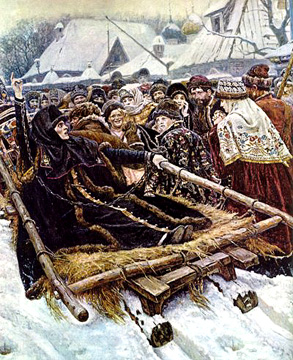
<>1674:England | Death of great poet John Milton.
His writings included _A_Brief History of Moscovia… (1682) [DK70.M55c3]
<>1675ja:1676au; [USA] New
World, Southern territories of "New England" | King Philip's War raged for 14 months between
Native American Wampanoag tribe, led by tribal leader "King Philip", and the Plymouth Colony
settlers
- Some call this war "The Puritan Conquest" and others "Metacom's
Rebellion" (using "Philip's" authentic Algonquian name)
- Measured in percentage terms of population, this was the bloodiest war ever in USA history
- Thousands of natives and colonists died
- More than half of the English settlements were destroyed and
colonial occupation of these territories was pushed back temporarily to the coastline
- The Native Americans, however, took the greatest losses, not only in disease and death at war but,
afterwards, when thousands were sold into slavery in the West Indies
- Even the neutral or pro-Plymouth Christian settlements of the Native Americans (called "praying towns")
were devastated as their populations were removed and resettled in barren islands where many perished of
cold and hunger
- Wampanoag peoples were destroyed and scattered in one of the
first modern instances of population
removal and concentration
- More on Native Americans
\\
*1998ap09:NYR:41-4| Gordon S. Wood
<>1675fa:Lower drainage of the Dnepr
River [map] | Zaporozhian Cossack
leader Ivan Sirko wrote letter to Ottoman Turkish sultan Mehmet IV [modern Turkish = Mehmed;
classical Arabic = Muhammad], whose full set of titles continued = Calif, Amir al-Mu'minin,
and Custodian of Mecca and Medina
Il'ya Repin historical portrait of the Cossack letter to Sultan
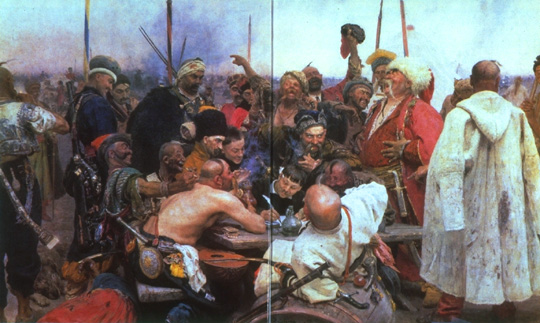
(View this painting in
[1] Wikipedia
or [2] Olga's Gallery)
The letter reads, "Zaporozhian Cossacks, to the sultan of Turkey: You Turkish Satan, brother and comrade of the
accursed Devil, and Secretary to Lucifer himself, what the hell kind of noble knight are you? The Devil craps
[??vikidae] and your army eats it up [pozhirae]. You will never be fit to rule over Christian sons.
We do not fear your army. On land or sea, we will fight you. You scullion of Babylon, you wheelwright of Macedonia,
you beer-brewer of Jerusalem, you goat-flayer of Alexandria, you swineherd of Egypt, both the Greater and the Lesser,
you sow of Armenia, you goat of Tatary, you depredator of Kamenets, you evildoer of Podoliansk, you grandson
of Beelzebub himself, you great silly oaf of all the world and of the netherworld and, before our God, a blockhead,
a swine's snout, a mare's a-s [sic!], a butcher's cur, an unbaptized brow, May the Devil take you! That is what
the Cossacks have to say to you, you slimy rascal! You are unfit to rule over true Christians! We do not know the
date, because we don't have a calendar. The moon is in the sky, the year is in the book, the day is the
same for us here as for you over there, and you can kiss us right back there! [signed] Koshevoi Hetman Ivan Sirko
with the whole Zaporozhian assembly [Translated from D. I. Yavornits'kii, Istoriia zaporaz'kikh kozakiv,2
(1990):392, with a nod of appreciation for the help found in GPR:616]
<>1676:1682ap27; tsar Fedor II [VSB,1=236-8]
<>1676:USA VA | Bacon's Rebellion, an early
example of labor unrest in the New World
- Nathaniel Bacon led a "giddy multitude" in rebellion against English colonial Governor William
Berkeley. Bacon was himself an English aristocrat by birth, and a relative of the famous philosopher and
visionary Francis Bacon, yet he became a champion of the yeoman laborer in the New World
- Kolchin:33 and 37 comparesBacon's Rebellion
with the Bolotnikov Rebellion in Russia 70 years earlier, especially
in view of how Bacon managed to unify a diverse but powerful force composed of
slaves, indentured servants, debtors, ex-servants, frontiersmen chafing under Berkeley's
restrained Indian policy, and political enemies of the governor. That such an alliance was
possible and that the governor's supporters did not make an issue of the participation of
blacks on the side of the rebels indicate how little slavery had yet shaped class attitudes.
The rebels were not only unified against Berkeley, but also with respect to the need to make more room for Euro-Americans
by pushing Native Americans out of colonial territories
- The rebellion chased governor Berkeley out of his Jamestown headquarters more than once, but when Bacon died,
the rebellion withered. Nonethless, Berkeley was dismissed from his post
- Still, the New World institution
of slavery expanded while the Russian institution
of serfdom grew stronger
<>1680c:Russian
secular tale of ribald misbehavior and
mischief, "Frol Skobeev, the Rogue" [ZMR2:474-86| ZMR1:397-409]
Return to top
Next SAC
|
|
|
|
|
|
|
|
|
|
|
|
|
|
|
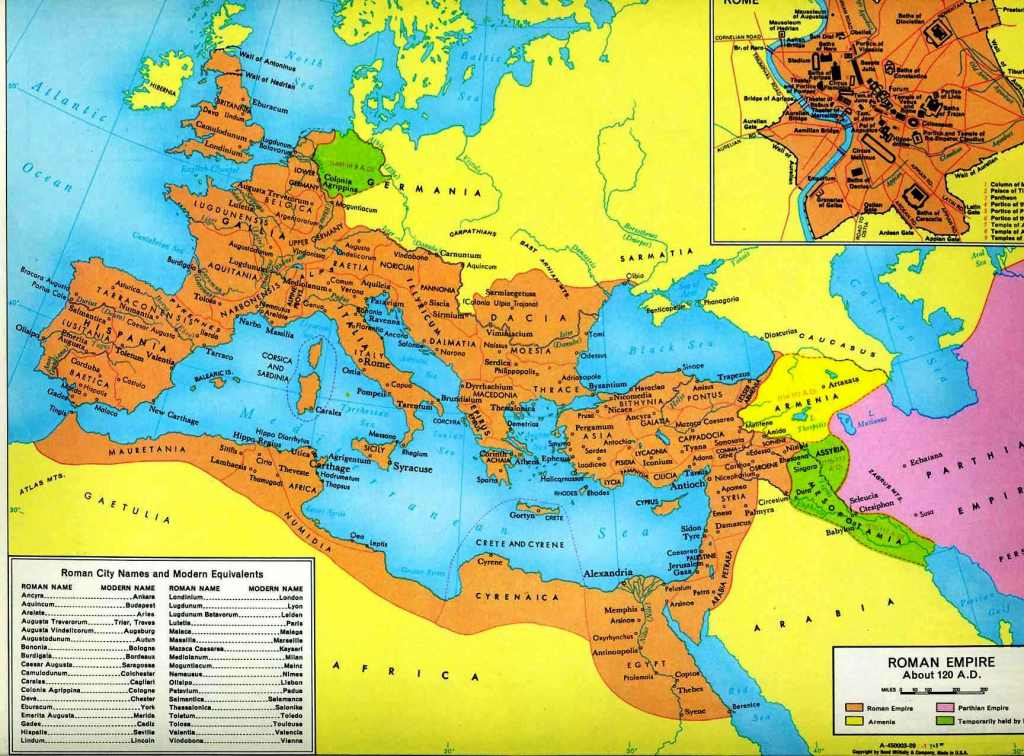
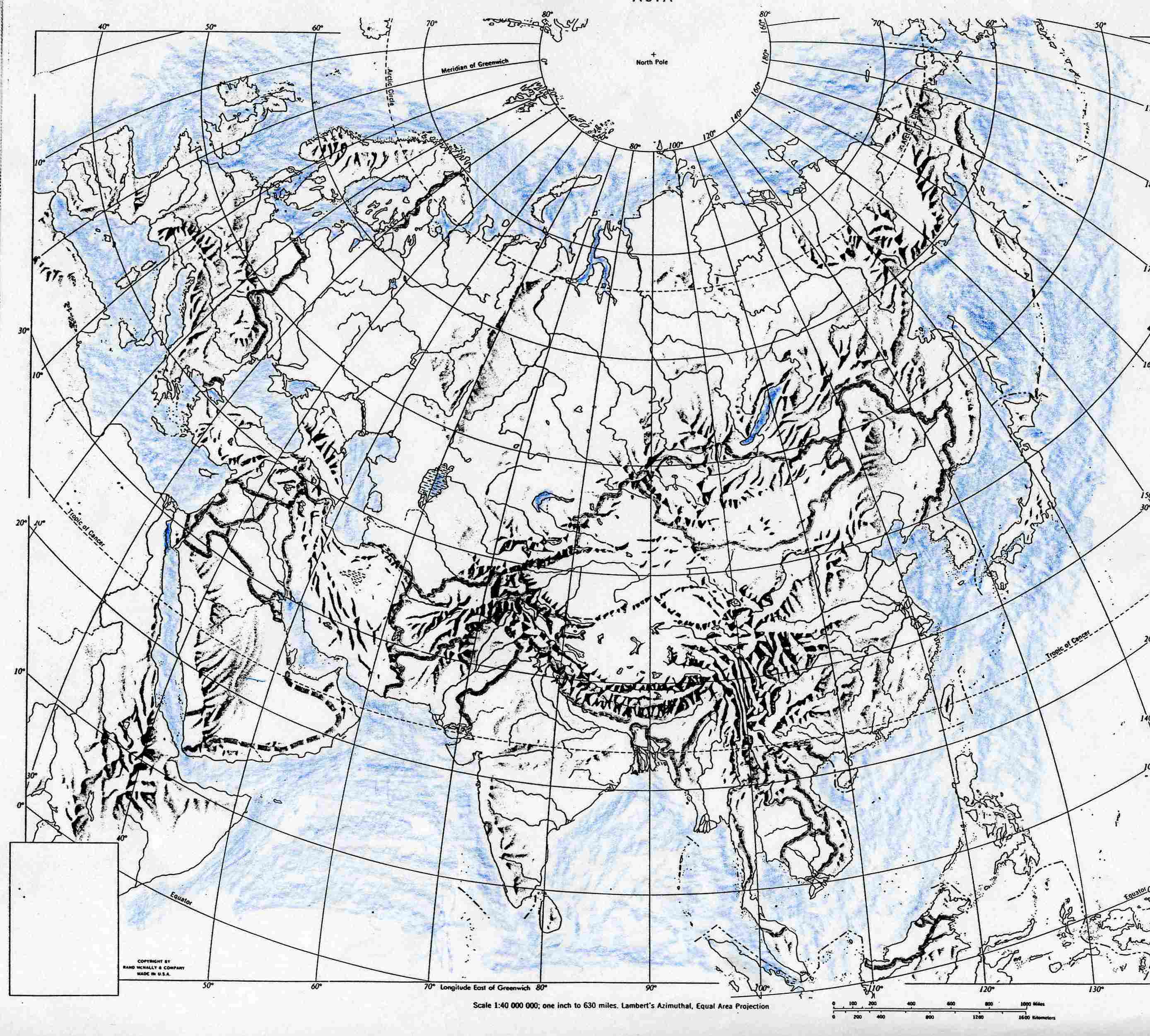
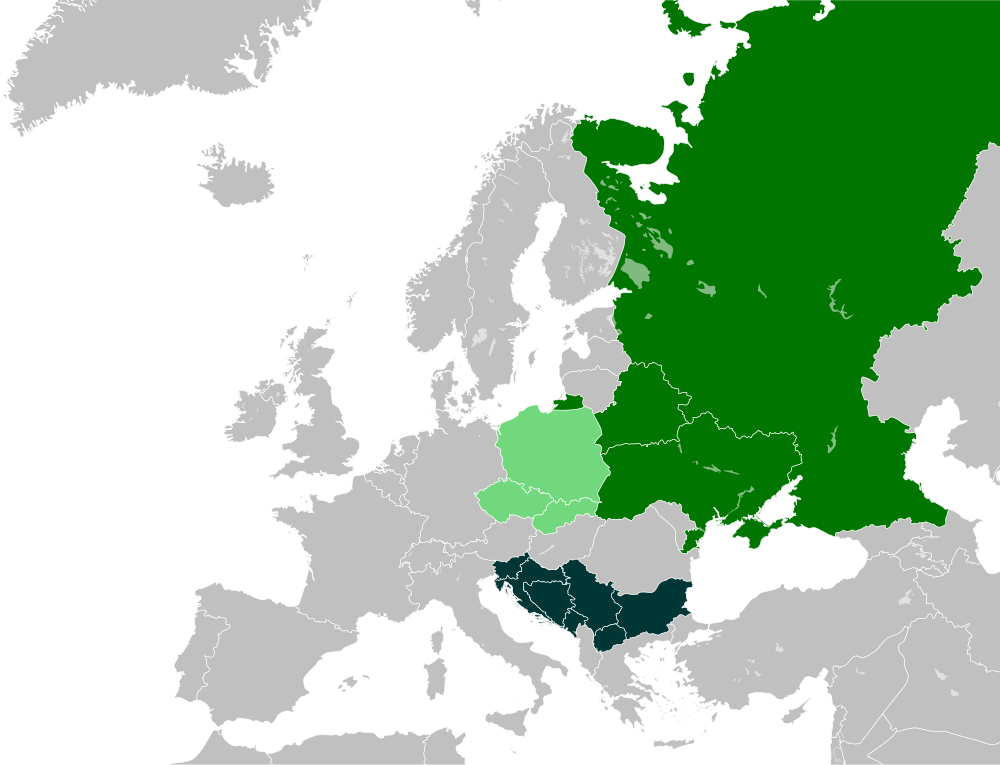
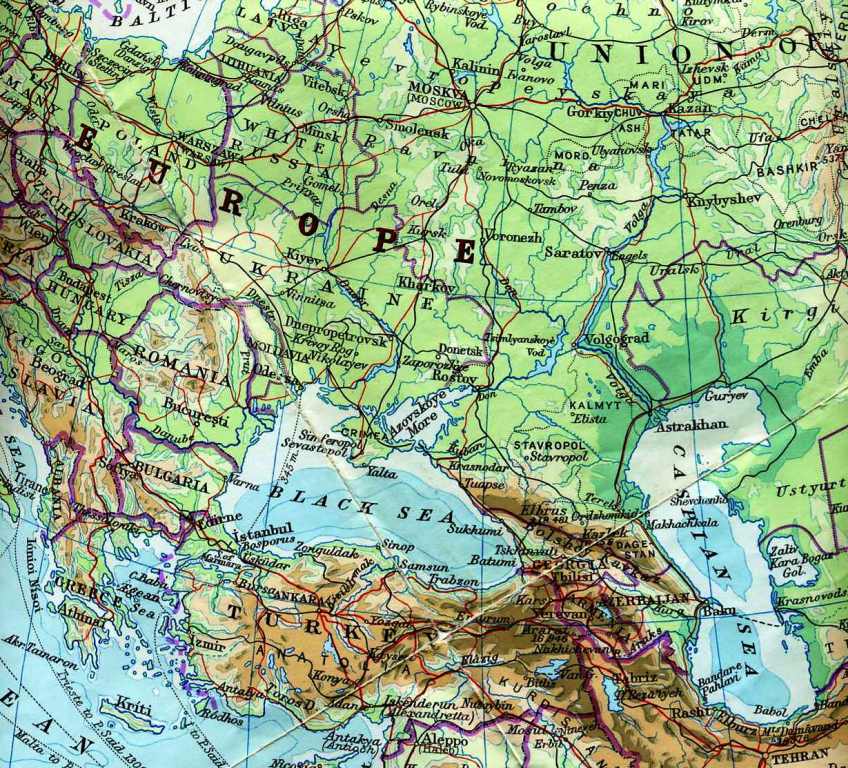

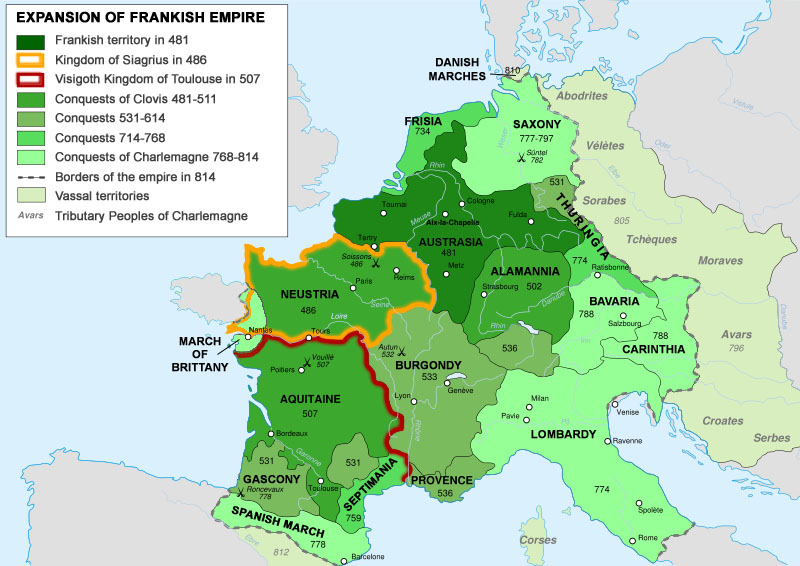

![[pix]](images/viking.ship.jpg)

![[pix]](images/2003mr21.10pm.Baghdad.jpg)
![[pix]](images/2003ap02.Baghdad.NASA.jpg)
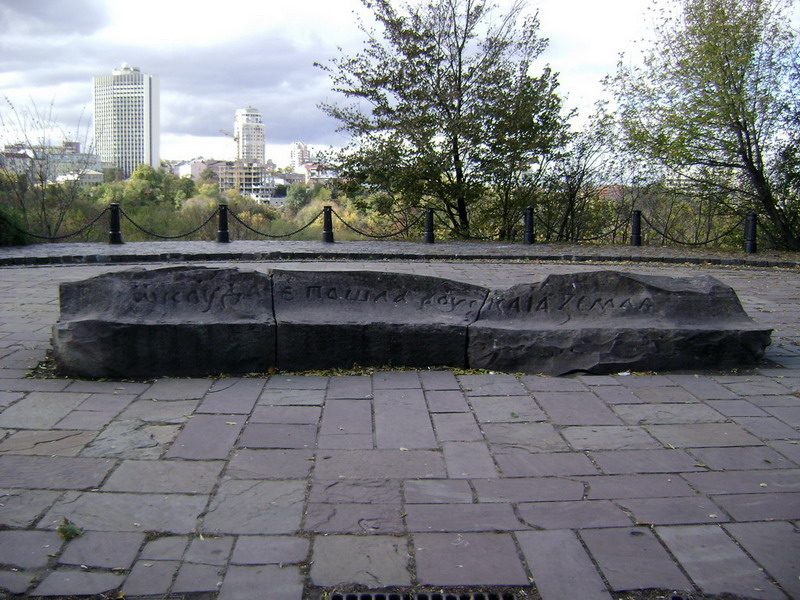
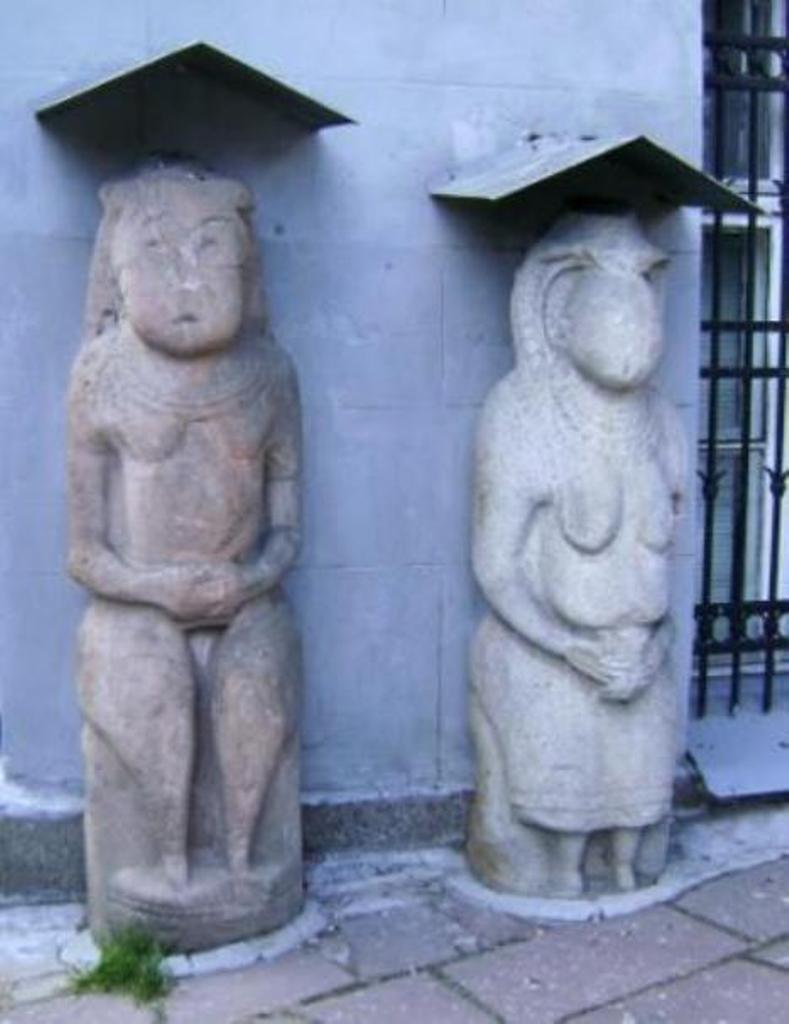
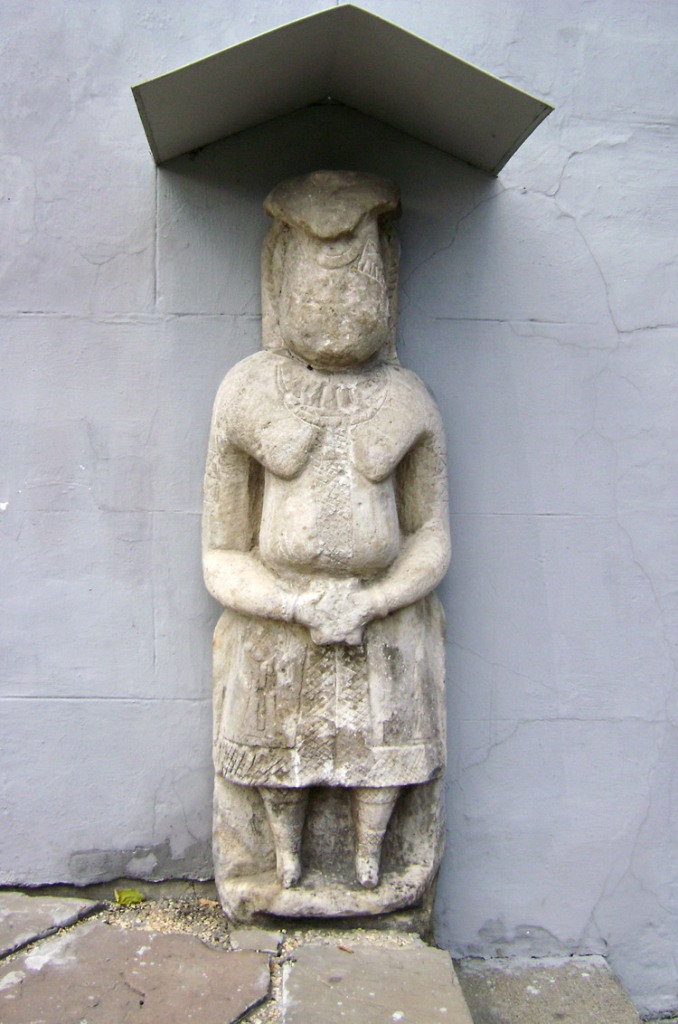
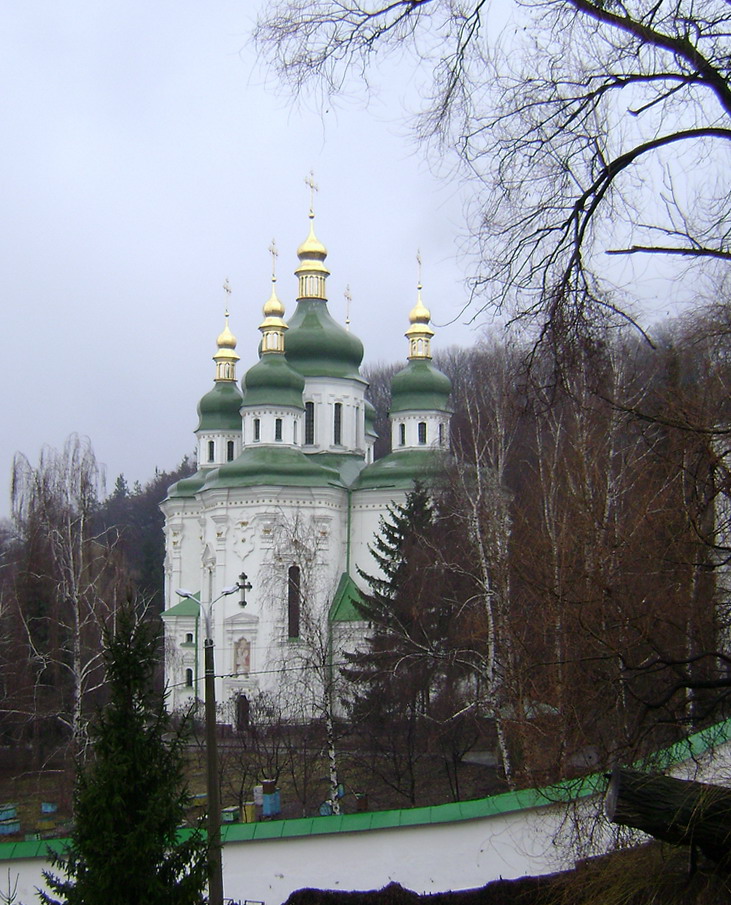
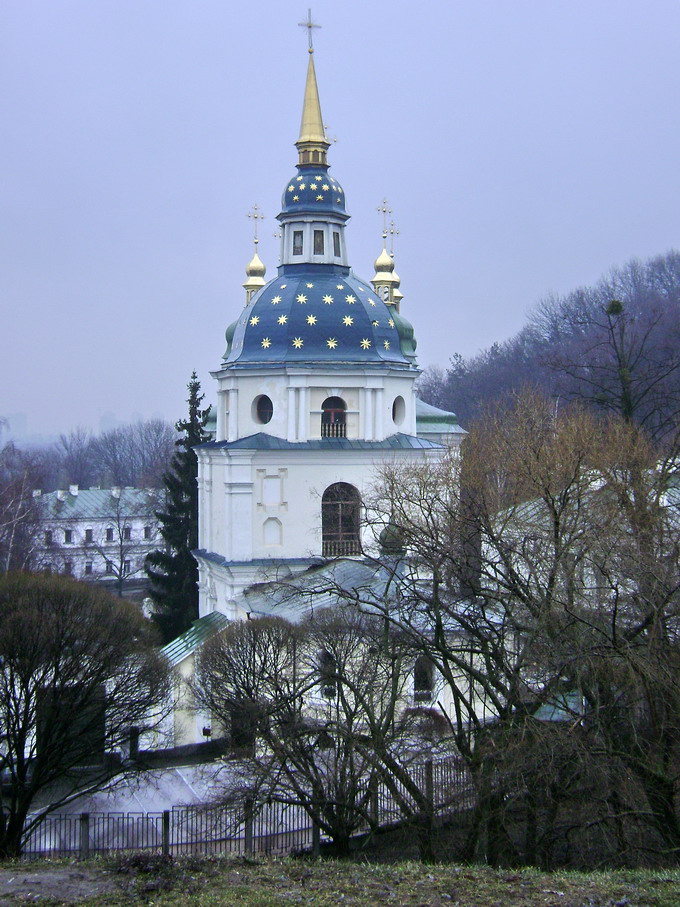
![[MAP]](images/frn.MPR.1054%20KIV.RUS%20Hmnd.jpg)
![[MAP]](images/1095-1140.EUR.crusades-CWA.152.jpg)
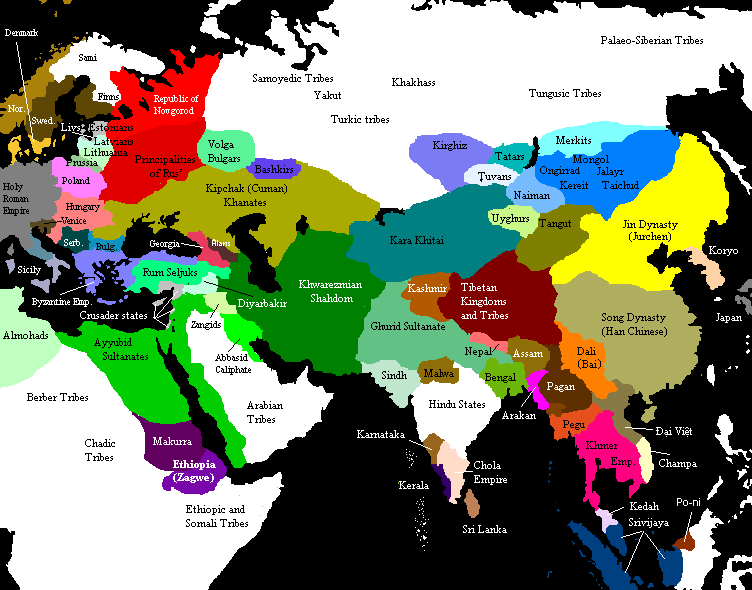


![[MAP]](images/1294.ASA-CWA153.jpg)
![[MAP]](images/frn.MPR.1237%20TTR.jpg)
![[MAP]](images/frn.MPR.1300-1533.jpg)
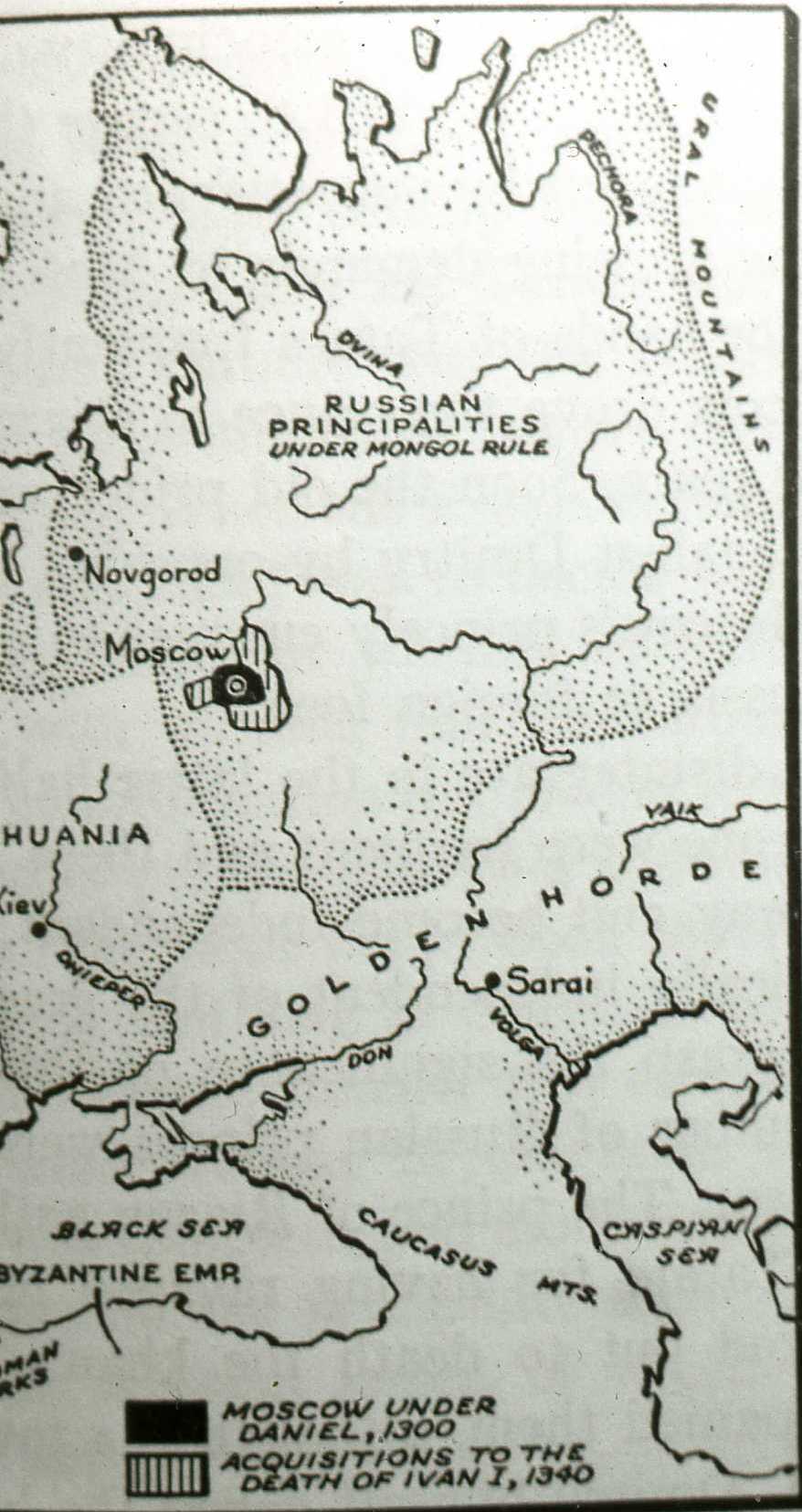
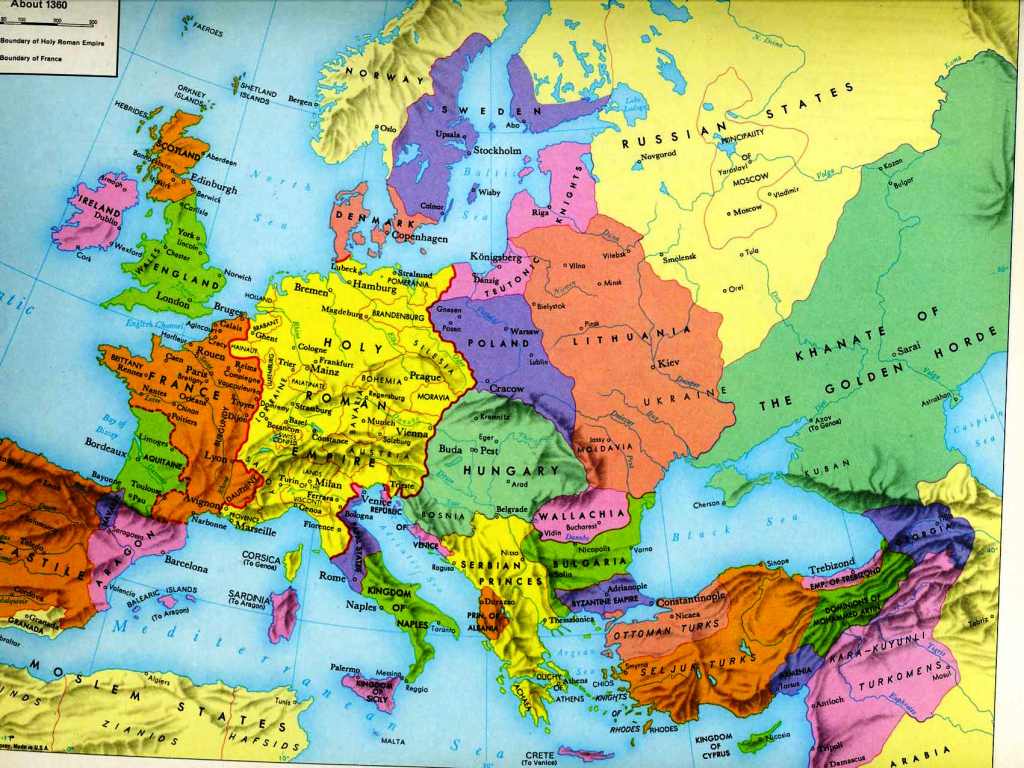
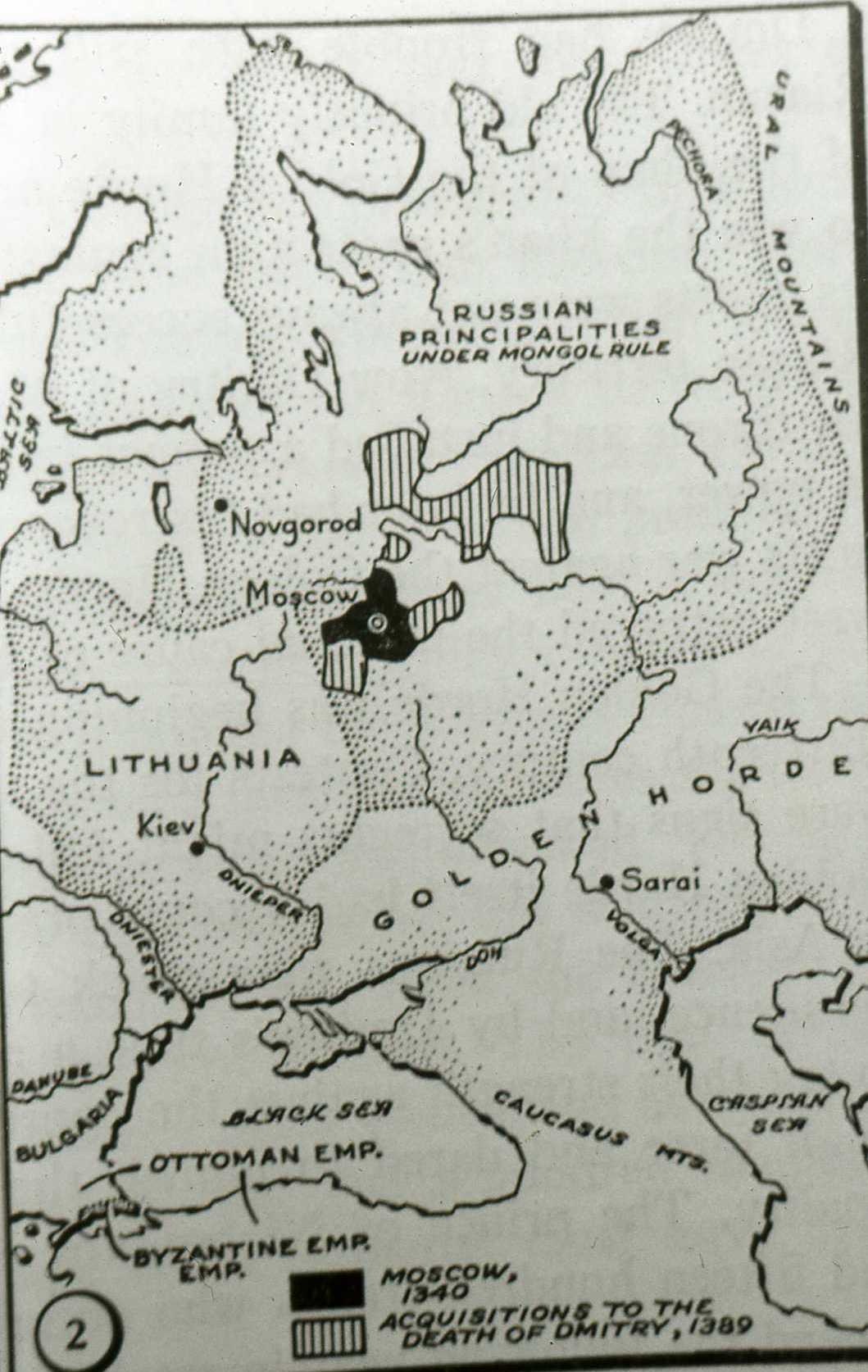
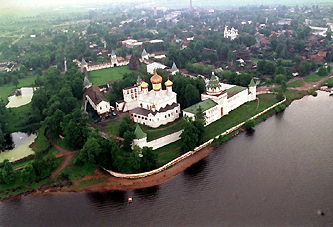
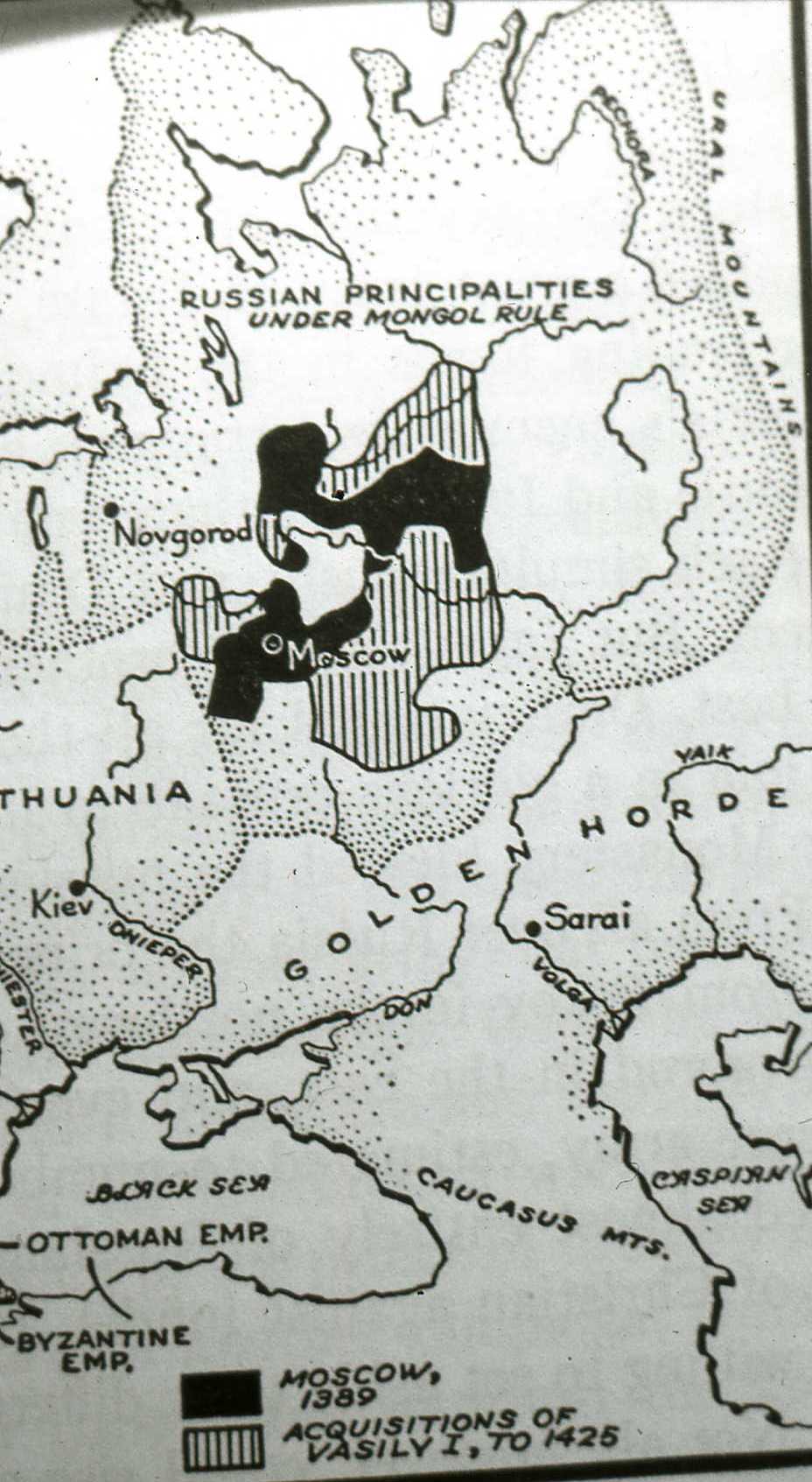

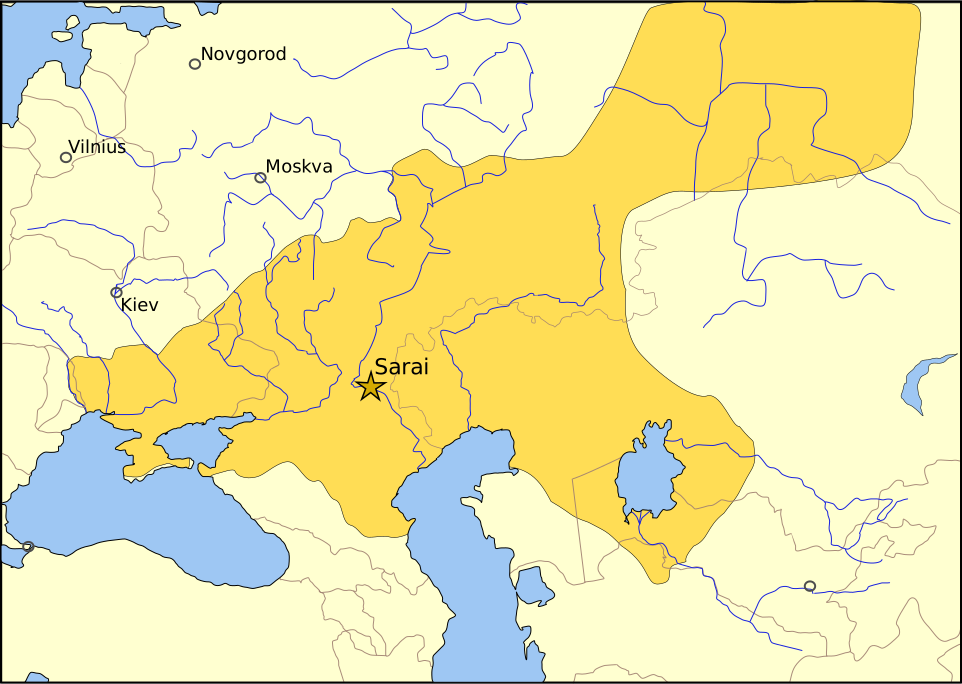

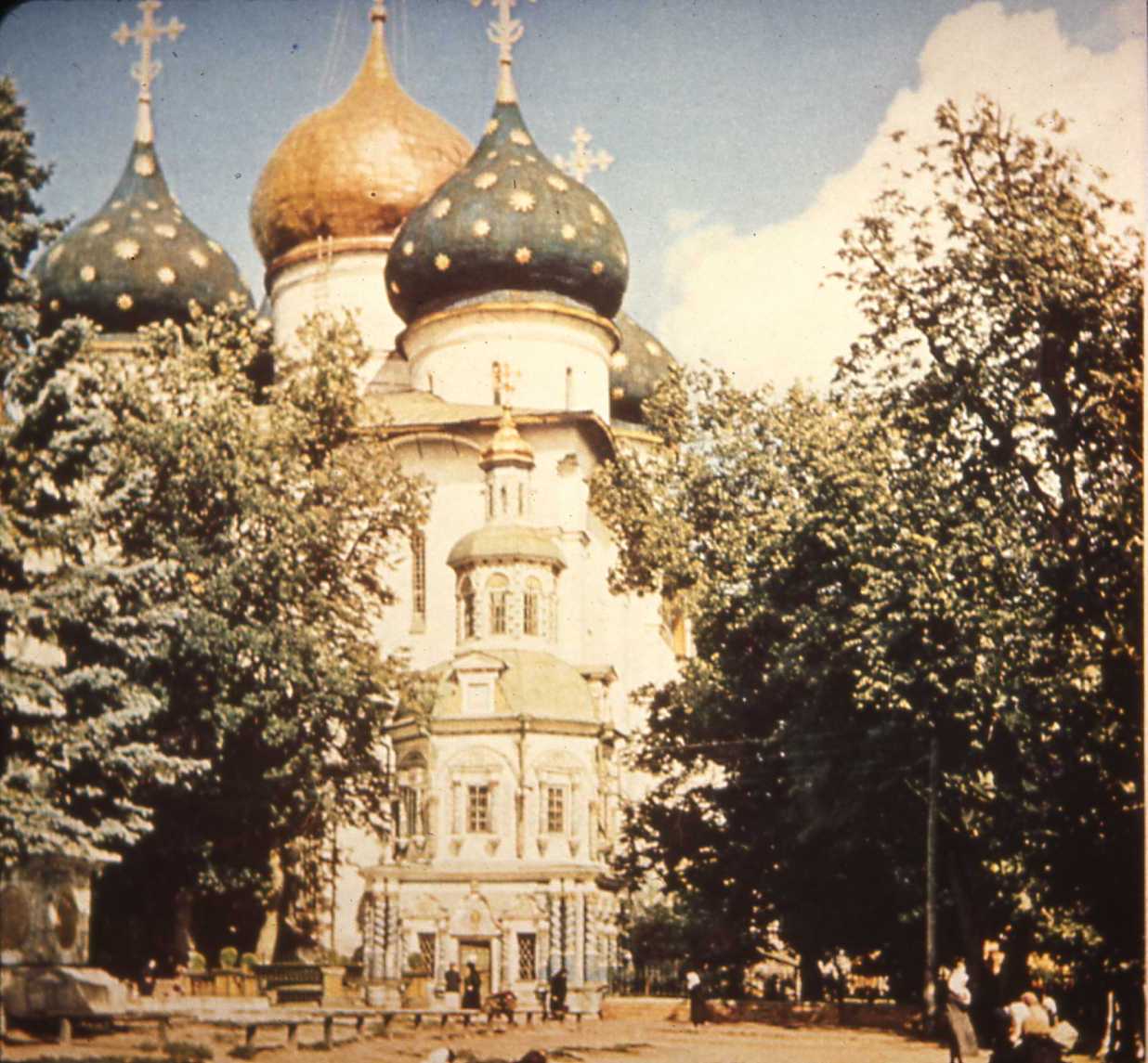
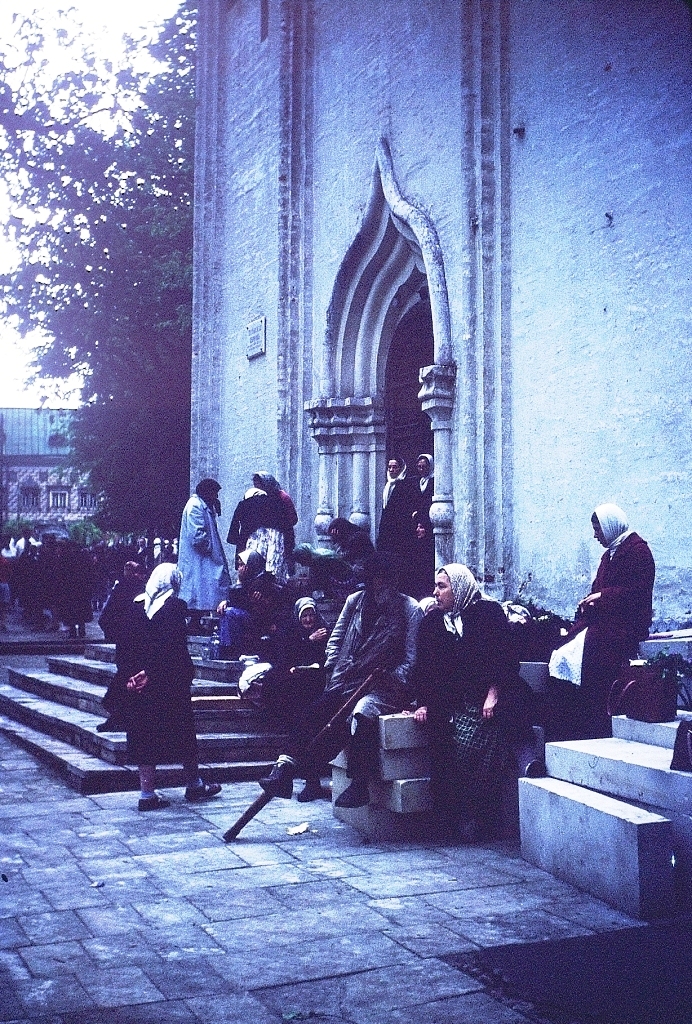
![[pix]](images/Lubok.T-S.mnk.tUt.no73.jpg)
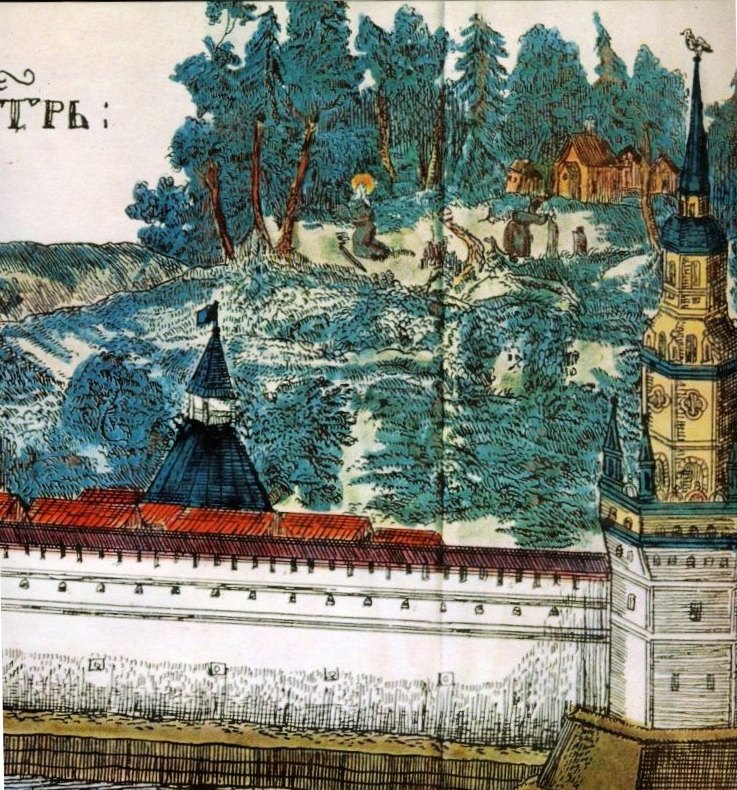
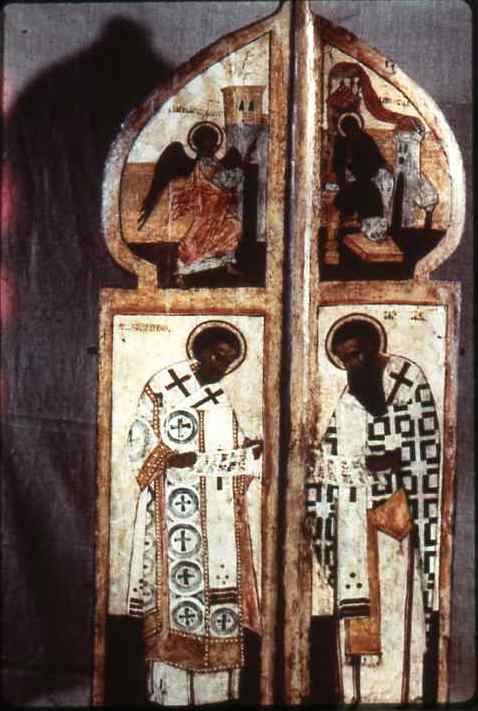
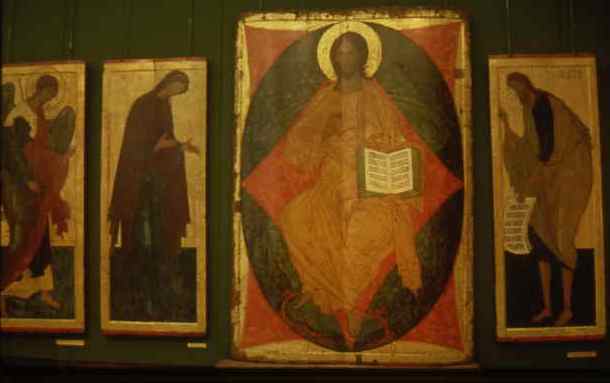
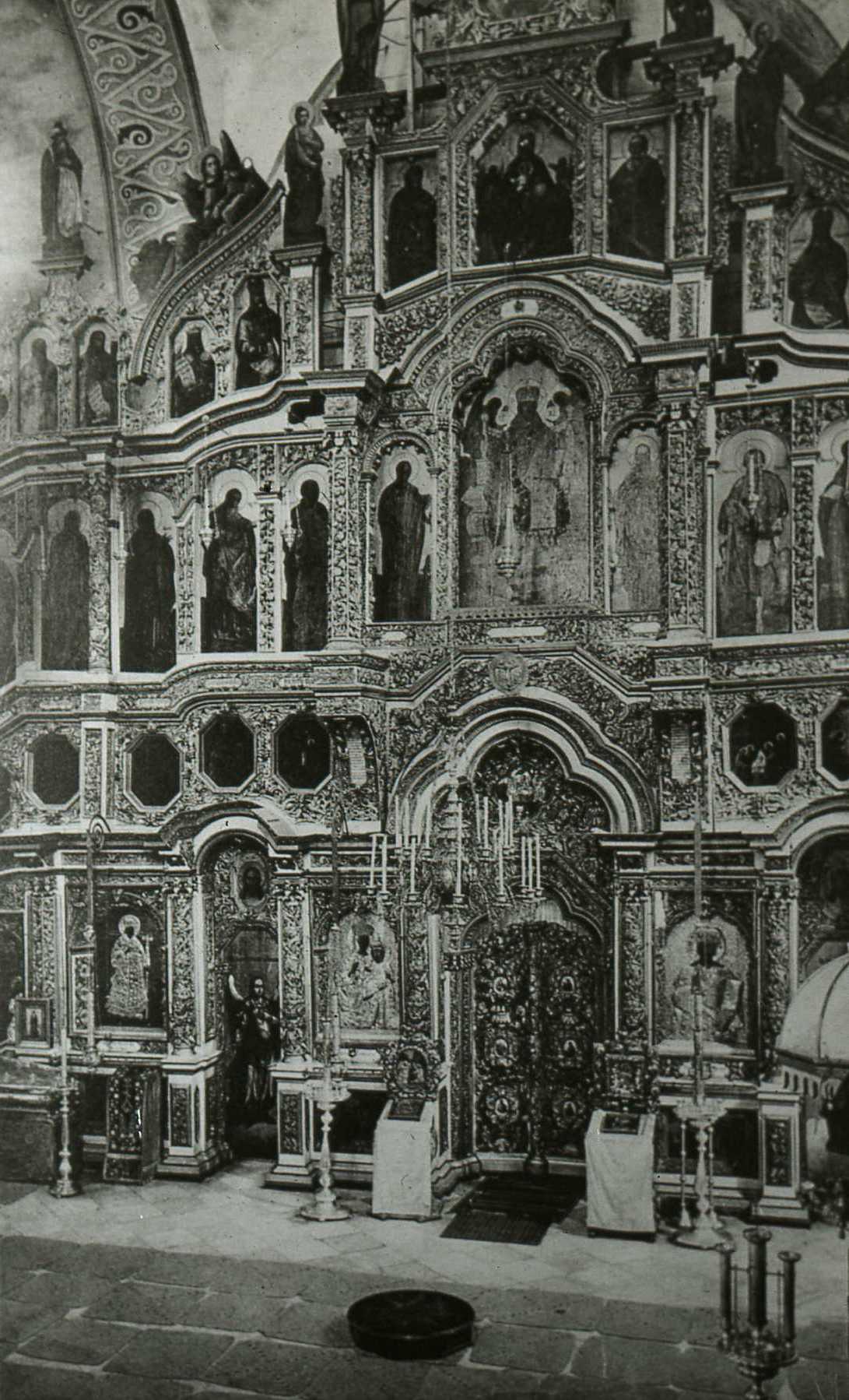
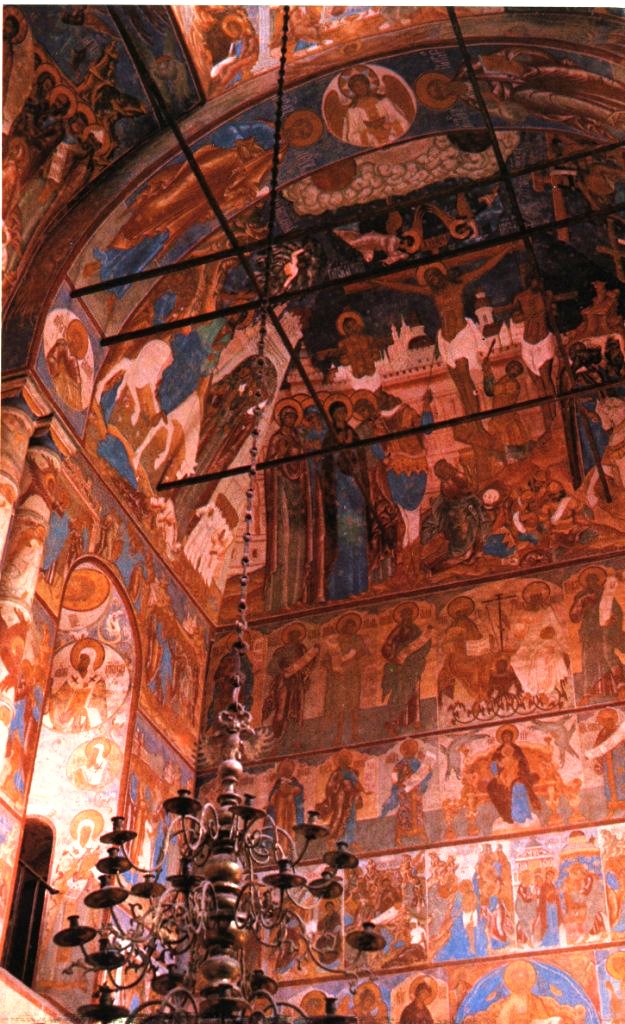
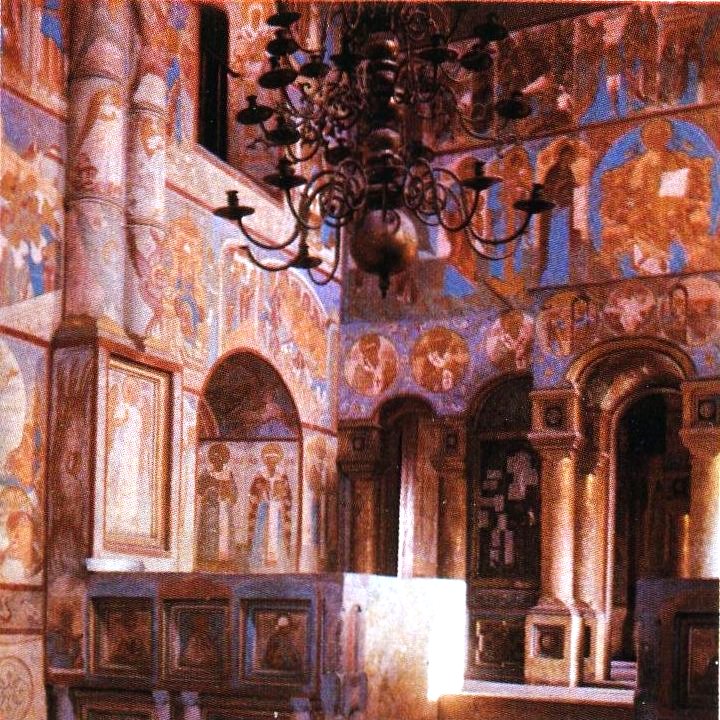
![[MAP]](images/frn.mpr04.Vxi-2.CIV573.jpg)
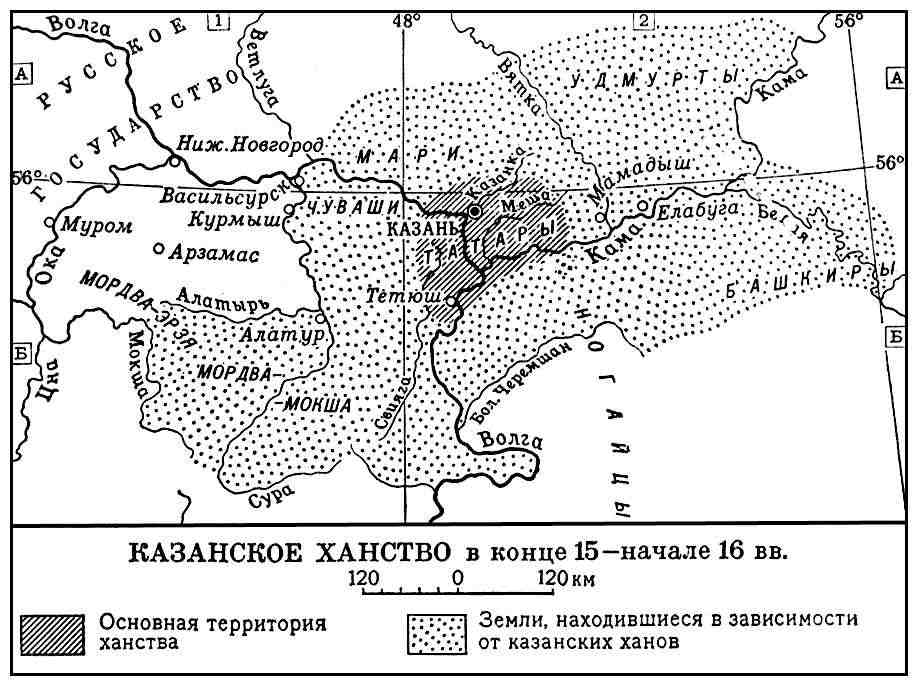
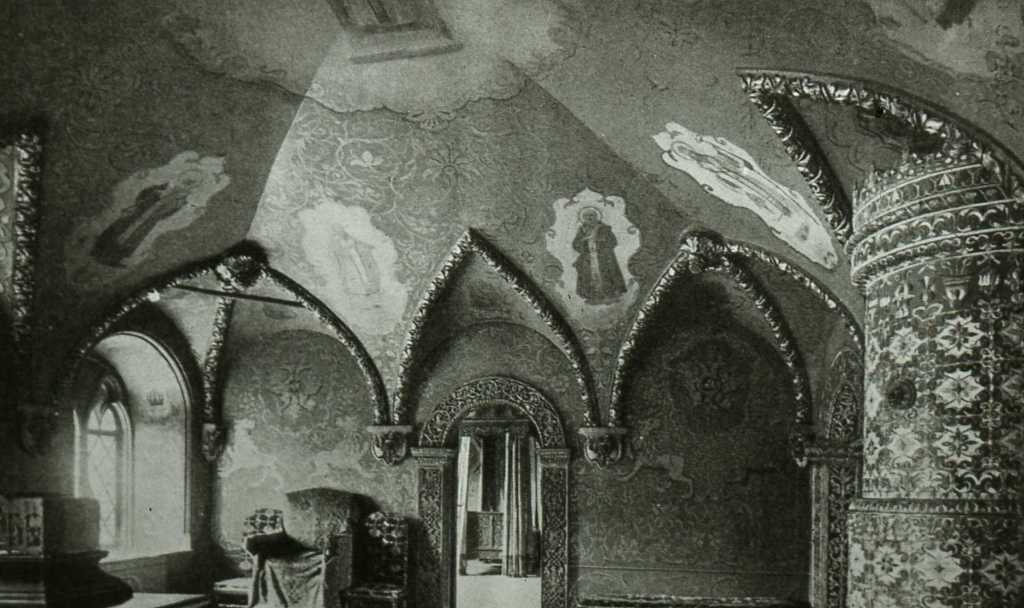
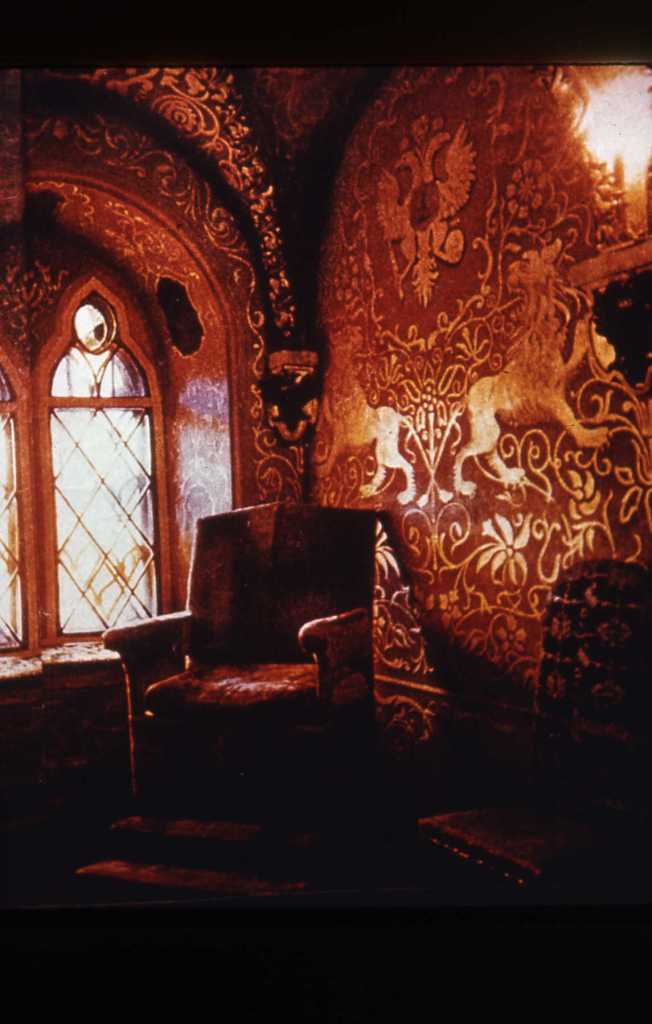
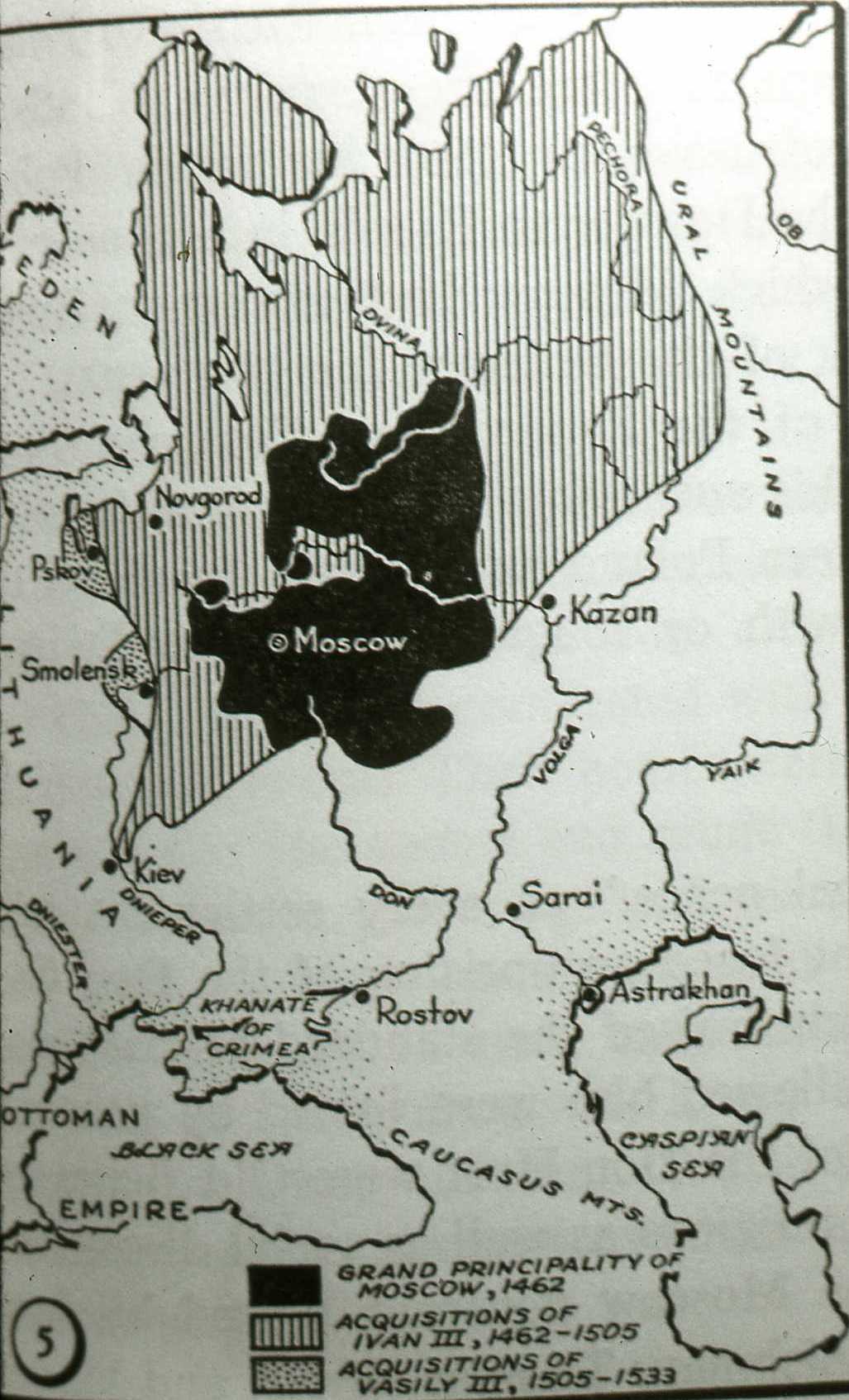
![[pix]](images/MVA.uspenskii.sobor.jpg)
![[MAP]](images/1492.discovery-CWA156.jpg)
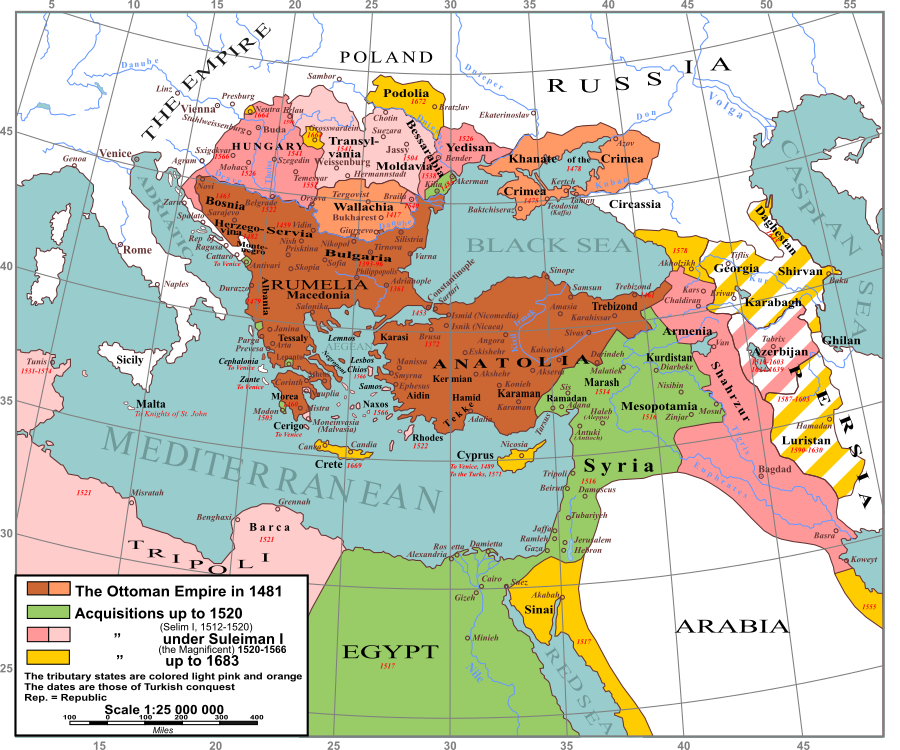
![[MAP]](images/frn.MPR.1533-1598.jpg)

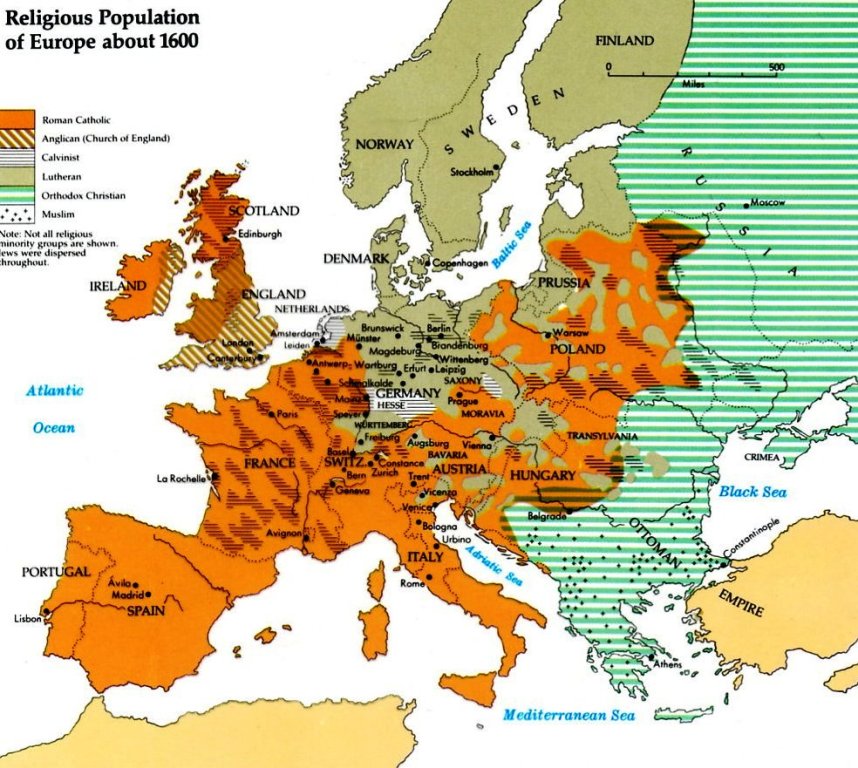
![[MAP]](images/frn.MPR.1598-1800.SBR-Palmer28.jpg)
![[MAP]](images/frn.MPR.1598-1725.jpg)
![[MAP]](images/frn.mpr07.Mxl.CIV576.jpg)


![[pix]](images/frn.MPR.1596.Novaia.Zemlia.NED.whalers.jpg)
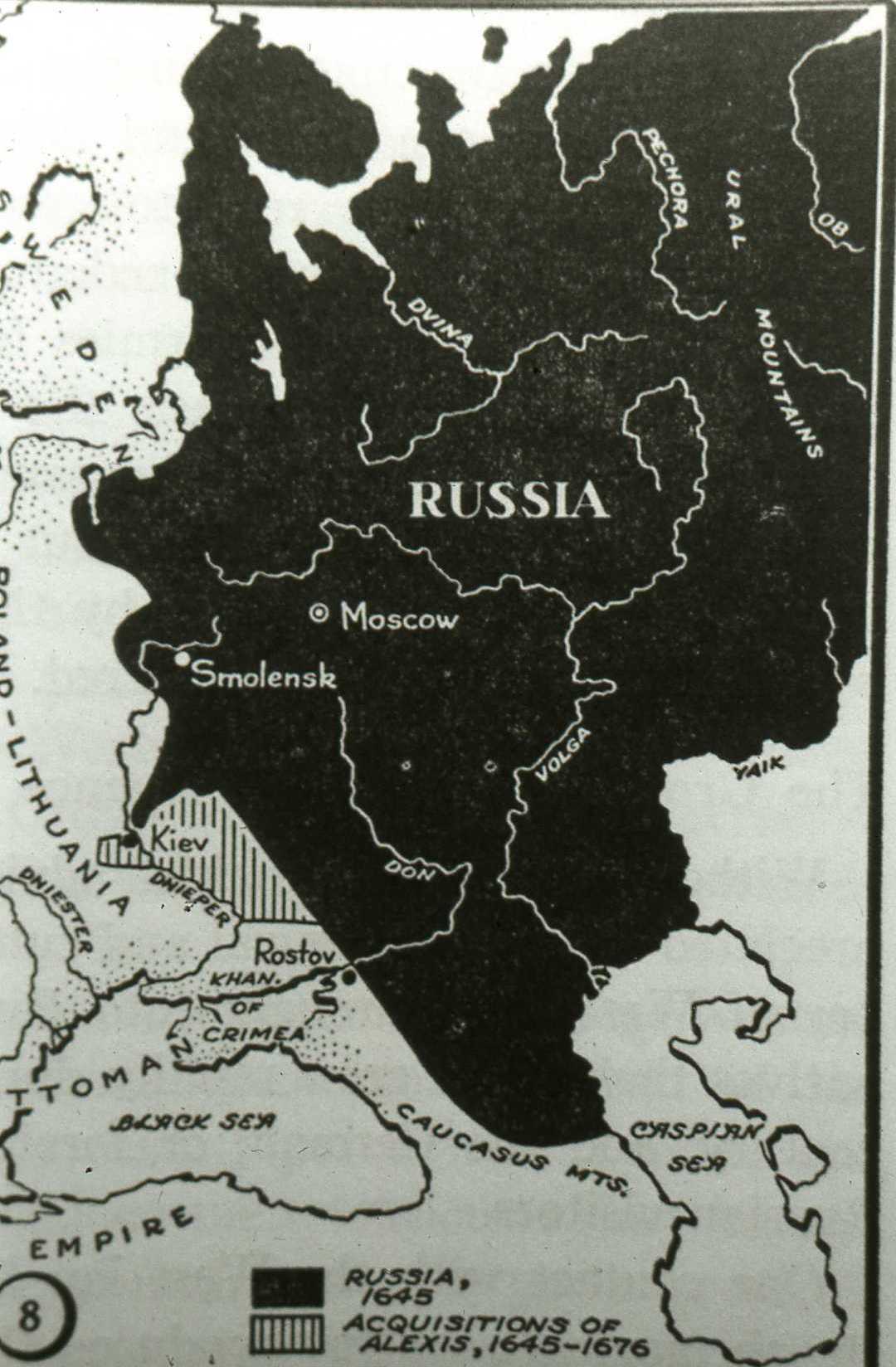
![[pix]](images/kiji.transfiguration.jpg)
