THREE PHASES of European and World Revolution
With particular attention to war and revolution [wrx&REV]
© 2010-2015 KIMBALL FILES
Table of Contents =
(0) Definitions = Revolution | modern total war
(1) Phase One = The Liberal Revolution [EREV#1]
(2) Phase Two = The Rise of Social Democracy [EREV#2]
(3) Phase Three = The Statist/Managerial Revolution [EREV#3]
(4) Bibliography = A D J O T W | ALWAYS cross-check BYD
(5) ETC
(6) Illustrations
A 4-part definition of "revolution" =
(1) Revolution is a conscious assault on an existing structure of ruling or governmental institutions
An assault simply to change who is in power is, by itself, not revolution. We call that "coup d'état". Therefore =
(2) Revolution seeks to put another set of ruling or governmental institutions in the place of the old
So far, this definition of revolution is a lot like the definition of war, especially wars of conquest. In fact, revolutions have historically been associated with wars -- before, during and/or after revolution. A research group once concluded that revolution ought to be called "internal war" [ID]. Thus a third component is necessary to distinguish revolution from inter-state or international war (between two existing governmental systems) =
(3) Revolution originates from within the targeted governmental authority, and
participants from within that authority are at the center of the action
To be a revolution, events must be largely "home grown", not
introduced from beyond the limits of the institutional system under revolutionary assault.
Thus modern revolution is understood within a widely accepted world view that
includes "sovereignty" [ID]
There is more than a casual relationship between modern revolution and modern war. Consult this
SAC narrative extension devoted to "total War" [TXT]
The most famous revolutions involved great masses of
participants and a degree of violence, though the numbers involved and the
levels of violence are not essential to the definition. Certainly the effects of
authentic revolution will always involve great masses of people, whether they
actively participate or not. That is so because sovereign governmental
institutions are always intertwined with the life of all within the systems' jurisdiction.
Let's add a final component to our definition, at least for consideration =
(4) Revolution is a distinctly modern experience
Not all epochs experienced revolution. For one thing, revolutions are unlikely
in times or places where there does not exist the idea of "progress" or "restoration" and the
belief in the possibility -- maybe we should say "the democratic imperative" -- of popular political
mobilization toward fulfillment of progressive or restorative goals. Only in the modern historical
epoch has revolution become one of the standard (if ultra extreme) forms of domestic political
behavior. Three early modern European "thinkers" captured these modern ideas or sentiments and left
a legacy that has proved controversial but enduring and globally influential =
John Locke [ID],
Jean Jacques Rousseau [ID],
Jeremy Bentham [ID]. Into the 19th century, four further
figures gave wide credence to related but different visions of history as progress =
Charles Fourier [ID],
Saint-Simon [ID],
Auguste Comte[ID], and
Karl Marx [LOOP]
PHASE ONE =
THE LIBERAL REVOLUTION
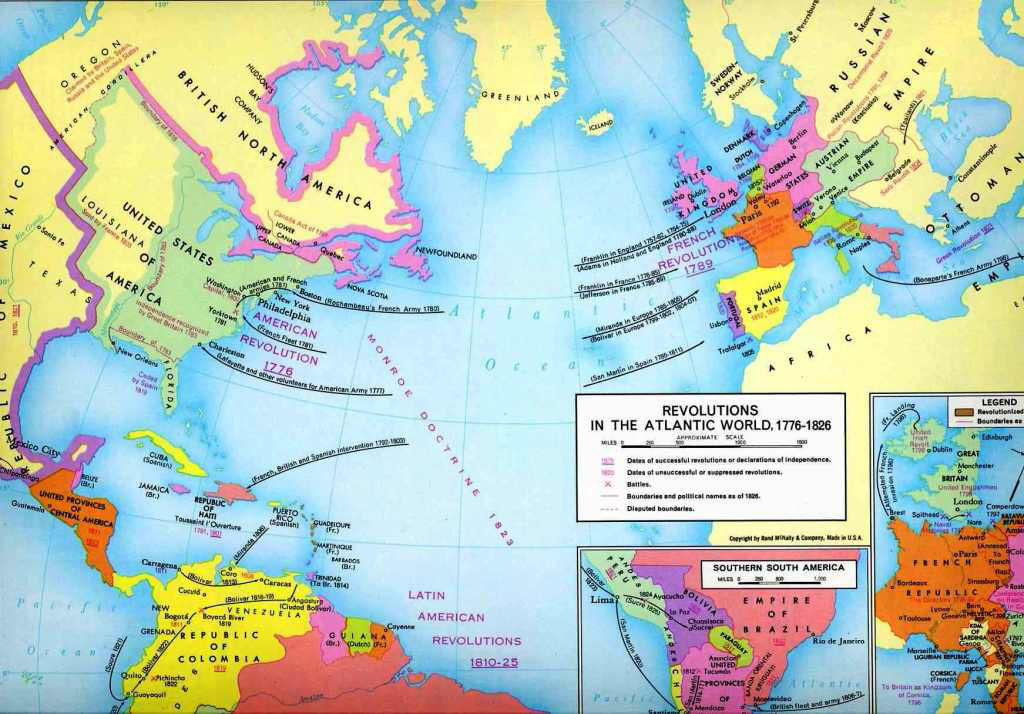
The era of European liberal revolution began with what some call the "Atlantic Revolution"
Ideas and ideals were only part of the equation. Great changes caused by revolutionary transition from pre-modern ways ("feudal" in Europe) to modern ways have everywhere forced a rebalancing of traditional relationships. The modern world has posed a profound challenge to traditional cultures, in "The West" and everywhere else. The first phase of European Revolutions could be called "The Westernization of the West" =
"The Left" and "The Right"
Out of the French Revolution came the now universal symbolism for the spectrum of political opinion that arose in response to this
transformation of public life = "left", "center", "right". These cardinal points in the European political
universe might not be best arrayed in a straight line, left to right, but around a near-circular Greek letter "omega" =
liberal conservative
radical Ω
reactionary
Around these points on the political spectrum that great swarm of 19th-century "-isms" hived themselves.
Liberals strove for independence from institutional authority and maximum individual freedom
Social ties were understood less in a traditional "communitarian" way, more in terms of what came to be widely
designated as "the social contract", such as espoused by John Locke [EG].
[LOOP on "liberal" from 1780s to 1880s]
Conservatives strove to preserve traditions and sustain historically proven ways of life
Social ties were understood to be hierarchical and stable in a traditional "community",
such as espoused by Edmund Burke [EG]
Radicals strove for a better future, such as had not yet been experienced, only conceptualized
Social ties might be thought of in rigorous and confining communitarian terms [EG],
or in an opposite direction, utterly spontaneous and anarchistic [EG]
Reactionaries strove to restore a past perfection, also
not yet experienced, only conceptualized
Society was generally subordinate to authoritarian regulatory agencies, such
as church, state, censors, police and military,
as urged by Joseph de Maistre [EG] or
Metternich [EG]
The omega form presented above reminds us that liberals and
conservatives do group together around the upper curve
While radicals and reactionaries are at the extremes, they seem almost to make contact with one another at
low center
These distinctions are far from absolute. Consider how, in USA, the popular and nostalgic children's novels by Laura Ingalls Wilder titled Little House on the Prairie can be said to have contributed to the rise of radical reactionary "neo-con" or "neo-lib" conservatism in late-20th-c "liberal" USA [POLITICO Magazine E-TXT]. The study of political culture is a marvelous enterprise. Recent decline in public respect for "politics" is a sorrowful and dangerous trend. This trend can easily be associated with SAC's third phase of the European and world revolution [ID]

Post-French-Revolutionary Chronology
Historical Contradictions within Liberalism
At the heart of the "Atlantic" or "liberal" revolution two sets of contradictions festered =
Striking different compromises along the ridge of these contradictions, European nations shaped their various domestic political, social and economic futures [more on relationship of political/institutional and economic changes in this era]
"Crunch Time" =
PHASE TWO,
THE RISE OF SOCIAL DEMOCRACY
The central feature of the second phase of European Revolution =
Interests of workers clashed with the interests of owners
If the first phase can be called "liberal", the second can be called
"social-democratic"
Big SAC LOOP on "wage-labor", from 1860s up to WW1
The era of social-democratic reform and revolution evolved out of the European liberal revolution and came into
conflict with it.
Liberalism had long struggled against opponents to the "right", and that struggle continued. But
now opposition arose on the "left", and it arose from the midst of liberal movements
themselves. A "left-wing liberal" trend, increasingly designated as "social-democracy" or "socialism", sought
to resolve the contradictions between freedom and equality in new and more radically egalitarian ways -- though
not necessarily more democratic ways.
The social-democratic phase, like the liberal phase before it, revealed an eventually tragic set of
contradictions. The old liberal contradiction still could not be transcended,
IE=The contradiction between freedom and equality. But a new set of
contradictions were soon visible in the growth of aggressive military-statism and imperialistic internationalism, along
with intense self-centered, often racist and chauvinistic nationalism.
Two remarkable developments, one in France and other in the northern German-speaking territories of middle Europe,
signaled growing crisis in the hitherto ascendant liberal revolution =
1) The two decades (1850-1870) of Louis Napoleon (Napoleon III) in France [5-hop
LOOP] were clear warning that the French Revolution could go sour, not just in the relationship of capitalists with labor but also in
the relationship of the nation state to civil freedoms (including the so-called "free market")
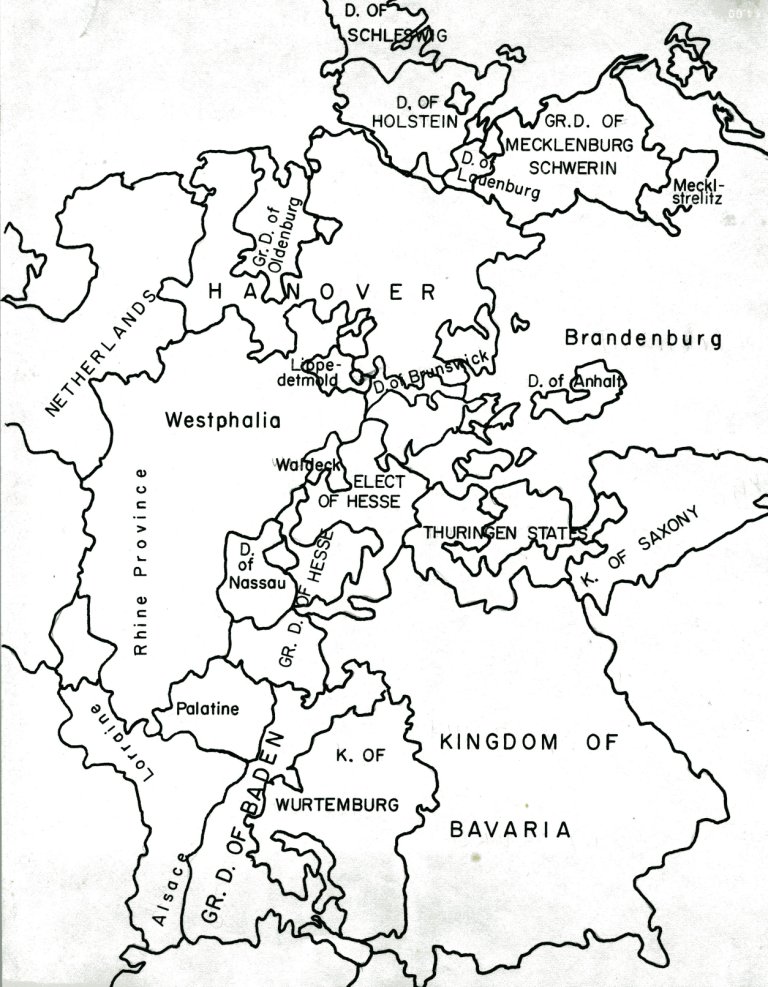
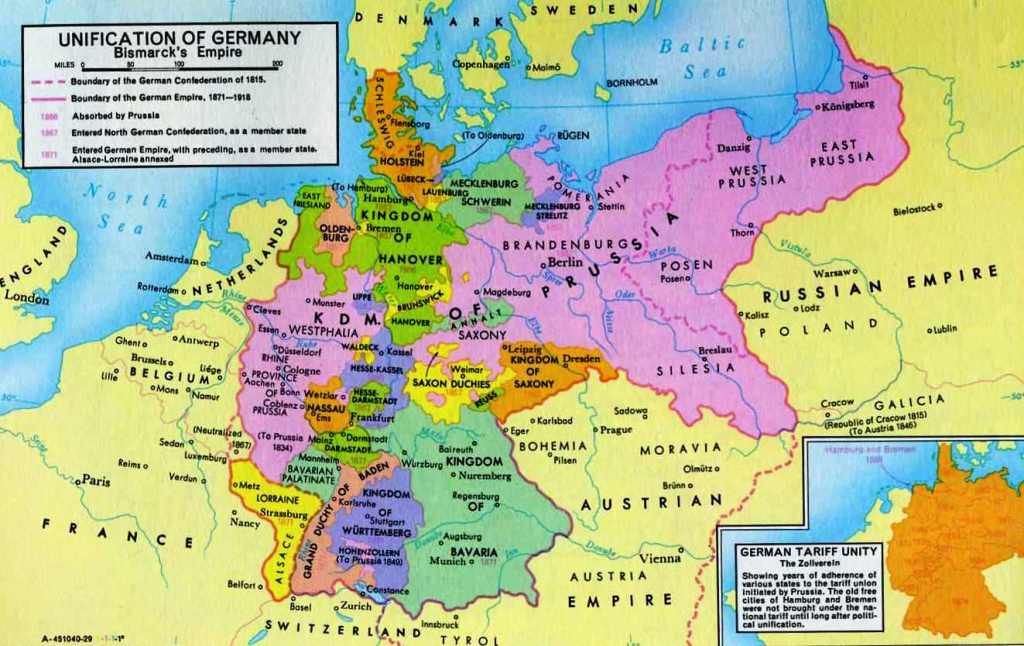
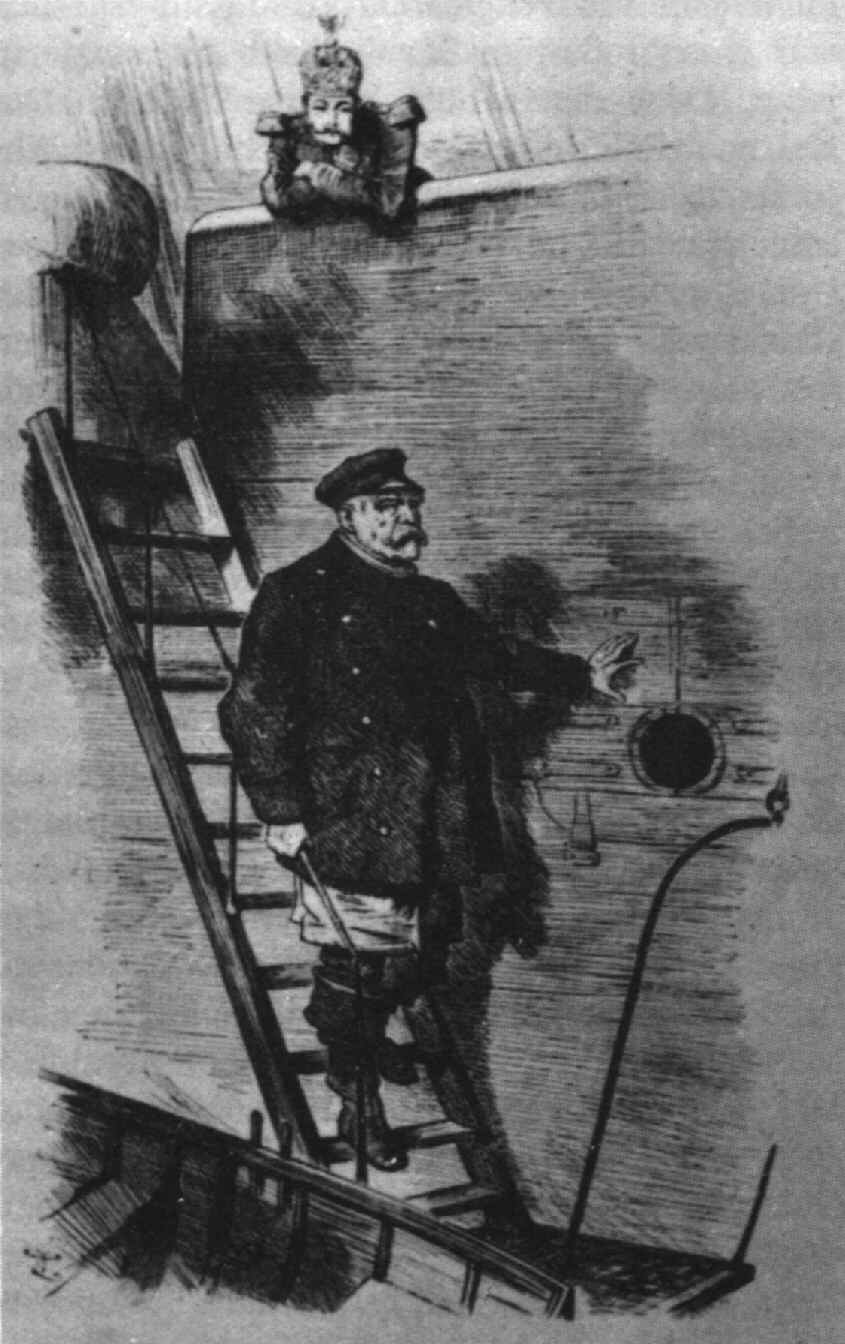
2) Otto von Bismarck [6-hop LOOP] was
born a Prussian but engineered creation of a new European nation-state, an imperial nation-state, the German
Empire [MAP#1] [MAP#2]
*1906: Gaston DaCosta was a representative of the second phase of the European and world revolution. He was a survivor of "The Paris Commune" [above], a shocking urban uprising in a major European metropol. He penned an angry, somewhat eccentric but brilliant and insightful interpretation of events 35 years after the events themselves [E-TXT] =
The third phase of European Revolution was inevitable once the habits, presumptions and practices of European Imperialism came home to roost
It is, perhaps, hardly necessary to say that this doctrine [liberty] is meant to apply only to human beings in the maturity of their faculties. We are not speaking of children, or of young persons below the age which the law may fix as that of manhood or womanhood. Those who are still in a state to require being taken care of by others, must be protected against their own actions as well as against external injury. For the same reason, we may leave out of consideration those backward states of society in which the race itself may be considered as in its nonage. The early difficulties in the way of spontaneous progress are so great, that there is seldom any choice of means for overcoming them; and a ruler [NB! "ruler" rather than "government"] full of the spirit of improvement is warranted in the use of any expedients that will attain an end, perhaps otherwise unattainable. Despotism is a legitimate mode of government in dealing with barbarians, provided the end be their improvement, and the means justified by actually effecting that end. Liberty, as a principle, has no application to any state of things anterior to the time when mankind have become capable of being improved by free and equal discussion. Until then, there is nothing for them but implicit obedience to an Akbar or a Charlemagne, if they are so fortunate as to find one. But as soon as mankind have attained the capacity of being guided to their own improvement by conviction or persuasion (a period long since reached in all nations with whom we need here concern ourselves), compulsion, either in the direct form or in that of pains and penalties for non-compliance, is no longer admissible as a means to their own good, and justifiable only for the security of others.How do you explain the relationship of the preceding paragraph to the whole set of arguments embeded in liberal political culture and put forward by Mill? More broadly, what happened to liberal Europe in the emerging age of aggressive Imperialism? Was there a way in which we might be tempted to say that the financial elites of Europe treated their own wage-labor populations as if they were "in a backward state of society"?
The violence and disorder of the Paris Commune came at the tail-end of a disturbing war between France and Prussia. This clusteration of events was evidence of transition from the grand 19th-century liberal phase toward the troubling third phase, the 20th-century phase of the European revolution.
PHASE THREE =
THE EUROPEAN AND THEN GLOBAL MILITARIST, MANAGERIAL/STATIST REVOLUTION
Important reverberations of the previous two phases ran through the 20th and into
the 21st centuries. The legacy of the previous two phases was far from extinguished. But however frequently we meet it, the traditional
European political spectrum of "left" and "right" [ID] gives little authentic guidance
to those who would try to understand this third phase of the European revolution
But we can point to three salient features of what SAC calls
the third phase, managerial statism. Each of these salient features arose in the late 19th century
and are often captured in the terminology of that century's greatest "isms" =
French historian and political theorist Elie Halévy's widely influential lectures and writings, gathered in The Era of Tyrannies, anchored themselves in point two above, "Militarism", possibly exaggerating the role of socialist militarism [ID]. Halévy devoted little attention to points one and three
How do the three 20th-c Russian revolutions fit in?
#1= 1905 [ID]
#2= 1917fe [ID]
#3= 1917oc [ID]
At first, the Russian revolutions, particularly #1 and #2, seemed to harbinger a new era
of social-democratic victory, a resolution of contradictions and a realization of ideals characteristic of
the first [ID] and the second [ID] phases of European revolution
Europeans widely assumed that the first phase made the second phase possible. Some thought it made it inevitable.
The strengths of what we are calling the first two phases of European and world Revolution complimented one another.
The second phase fulfilled the first. Some greeted this fulfillment with enthusiasm. With equal enthusiasm, those
whose interests were promoted in the first liberal phase dreaded the second social-democratic phase.
"Unnamed Revolution" =
There seemed some uncertainty about the nature of these two
1917 Russian revolutions,
swiftly one after the other. Uncertainty was reflected in the fact that the second of the two
1917 Russian revolutions bore so many different names = "Russian Revolution", "Communist Revolution",
"Soviet Revolution", and "Bolshevik Revolution"
Calendar reform in 1918 further blurred the picture. The new Russian
secular calendar put the anniversary of the "October Revolution" (IE= the Soviet
Revolution) in November [ID].
Nonetheless, official Soviet designation was "Great October". (SAC prefers "Soviet Revolution")
Sociologist Harold Lasswell identified the Soviet Revolution as "The Unnamed
Revolution" [Lasswell.UNNAMED], and he set about to define this
novel third phase of the European and world revolution which swept out of eastern Europe and across the global
landscape in the 20th century
The revolutionary Soviet state, the Union of Soviet Socialist Republics (1922-1991), was the first and, so far, most long-lived and massive expression of the third phase of the European revolution =
The politics of Joseph Stalin (Stalinism as a global "ism") were explained in two of Stalin's
writings =
A theoretical article, "Socialism in one country" [ID], and an urgent
speech, "You must abolish backwardness" [ID]
Stalinism in practice can be summarized in four categories of state policy [ID]
Stalinism arose in a time of expanding Italian Fascist and German Nazi "statism", IE=Central European expressions
of the new third phase of the European and world revolution
A new form of "government" appeared on the historical stage in this third phase of the European and, now, world revolution, and it
came to be called "totalitarianism", "state socialism", radical statism or reactionary statism [ID]
By the 1930s, it was clear that this third phase of European and world Revolution found expression in several
regions [EG]
By the 1940s, it was clear that this third phase found expression around the world [EG]
Economic globalization was followed now by political/institutional globalization
-- Bibliography --
Secondary works =
Academic and Other Theories of Political Culture,
with special reference to War and Revolution
GO bbl.BYD for primary documents and primary anthologies
<>Ackerman,Bruce| a{}
*1980:N.CN:YUP|>Social Justice in the Liberal State| ((plt.trx not same as Mds & Fedor|This is A’s "
dialogue as
it might be"
but then he turned to "
dialogue as it is"
SO,GO "
Neo-federalism"
:"
entire approach to
political legitimacy centers on the possiblility of successful dialogue"
["
Neo-federalism"
:156] ))
*1988:EC&D:153-93| "
Neo-federalism?"
| ((fdr idl=rvs legitimacy,not an oxymoron
but as final essential moment in rvs process; thus of global significance (vs.Arendt
idl of local sig of AREV)|Fedor=3rd way of legitimacy (combining #1=permanent
rvs & #2="
rvsy amnesia"
) by positing "
dualistic conception of political life"
:
(1) common good, ratified [rzr] by mobilized mass, expressing assent through
extraordinary tUt forms [cf=mainly #49] [highest cncept,but shd dominate only
rarely] & (2) normal politics| Normal plt is "
representational"
|Not "
mimetic"
but
"
semiotic"
(symbol is not the thing represented, and obviously so, explicitly a
stand-in) [169!] Dahl is most wrong to say Mds sought rxp w/o virtue, i.e., as
solution of problem posed by Mandeville’s Fable of the Bees [173] idl is to
"
economize on virtue"
;presume neither that it will prevail nor that it will
cease to be needed [173,quotes #57] Mds thought highest virtue in pbl life, but
recognized duality embraced in common phrase: PRIVATE CITIZEN [174-5] cst="
creative
synthesis"
of two great zpd traditions of pbl virtue [cvc.virtu] and private salvation))
*1993ap02:MNe#14:3| "
Boris Yeltsin and George Washington"
| ((R&A2.cst YlcB |W
also tore up cst= 1781:Art.of Confdr calling for unanimous assent of 13 colonies
to any amendment |rvs act now forgotten: cst.Convention said 9 wld do| "
By
lending his immense prestige to the Convention’s revolutionary break with
legality, Washington made it possible to make the new cst more than a piece of
paper| By seeking ratification [rzr] by the People, and not merely their standing
governments, Washington began the long and complex process of making the
Constitution into a specially compelling symbol of dmkic legitimacy"
|YALE
Sterling prf of lwx & plt.scs|W & YlcB "
It is easy to mock the comparison"
|A
contrasts promise of strong YlcB w/ Havel CZC loss of unity & POL decline| Many
mistakenly put ekn rfm ahead of plt, but that is mistake| As a man, Yeltsin does
not have the qualities of either Havel or Walesa| "
But his dmkic instincts are
sounder"
))
<>Adams,Brooks| a{}n{}o{ ID
}r{
*1913:NYC|_Theory of Social Revolutions| ((REV.trx| Mainly looks at the French Revolution))
}s{}t{}8{}
<>Adelman,Jonathan R|>Adelman.wrx&REV|
a{}n{~~hst trx
)r(
*1980:Boulder CO|_Revolutionary Armies: The Historical Development of the
Soviet and Chinese People's Liberation Armies ((UO))
*1985:Boulder CO|_Revolutions, Armies, and War: A Political History| (())
}s{}t{}8{}
<>Aksakal,Mustafa|_The_Ottoman
Road to War in 1914...|>Aksakal.OTM| ((UO| WW1a S.fr
OTM.TRK| See ch3:57-92 "The Ottoman Empire within the international order"| stt.ndp
and MPR=Intro:1-18 re- "pursuing sovereignty in the age of imperialism"| No ARM in
ndx| Why did the Ottoman Empire enter the First World War, late October 1914?
The war's devastations were by then perfectly clear| One leading TRK svt said
TRK leaders were "simple-minded" and "below-average". Compared with, say, OST
leaders the first contention does not distinguish TRK leaders. It is doubtful
that comparison with many other wartime leaders would distinguish TRK leaders.
Many emphasize that War Minister Enver Pasha, the key TRK leader, was in thrall
to the Germans and to his own expansionist dreams. Aksakal challenges these
common views. He holds that responsibility went far beyond Enver, that the road
to war was paved by the demands of a wider politically interested public, and
that the Ottoman leadership sought the German alliance as the only way out of a
web of international threats and domestic insecurities. The catastrophic
consequences of TRK entering WW1 had seismic impact on the Empire but far beyond
that on the Middle East [AfroAsia] as a whole, and that impact is felt even
today))
<>Albertini,Luigi|
a{1871}e{1941}n{}o{
}r{
*1952-1957:LND,OxUP|_The_Origin of the War of 1914| 3vv| ((UO| WW1a| ToC
=
v1= European relations from the Congress of Berlin to the eve of the Sarajevo
murder
v2= The crisis of July 1914. From the Sarajevo outrage to the Austro-Hungarian
general mobilization
v3= The epilogue of the crisis of July 1914. The declarations of war and of
neutrality))
}s{}t{}8{}
<>Amann,Peter H| a{}
*1962mr:PSQ#77,1:36-53| "
Revolution: a Redefinition"
| ((8x11 REV.trx
stt.mpy (dms stt.ndp)|48:REV="
when the state’s mpy of power is
effectively challenged & persists until a mpy of power is re-established"
| Weakness? fdr rpz gvt etc has
no plt.mpy, yet rvs challenge possible| Better say mpy of physical violence cf=BBL/Castoriadis))
|>Revolution and Mass Democracy: The Paris Club Movement in 1848|P.NJ:1975| ((obx REV48))
<>Arendt,Hanna| a{
}r{
*1963:NYC|On Revolution| ((REV.trx noWbr USA| “The sad truth of the matter is that the French Revolution, which ended in
disaster, has made world history, while the American Revolution, so triumphantly
successful, has remained an event of little more than local importance” [55-6 (as in Ackerman,“Neo”:158)]))
*1993:MNC,Piper|_Hannah Arendt,Was ist Politik? Fragmente aus dem Nachlass|EBy
Ursula Ludz| ((235p| trx plt.clt
*1993fa:Telos#97:172-7 Margaret Canovan rvw| plt=freedom, miraculous power to start afresh| Practical GRK & Roman achievements, ways
in which ctz~ acting together gave standards to themselves| C repeats the formula w/emphasis:“acting
together created binding standards for themselves. Humans can stand against destruction & create civilization &
frdom because they are plural” [C:175]. Socrates superior to Plato for this reason| Freedom of Athenian ctz~ consisted of their ability
to talk and think together, and to initiate something new together [dialogue & labor] Cf.analogy of oasis and desert [C:177]))
}s{
Canovan,Margaret
Disch,L
Honig,Bonnie
APL/Kettell
Villa,Dana
Hinchman,Sandra
}t{
}8{}
<>Arslanian,Artin| "Britain and the Transcaucasian Nationalities During the Russian
Civil War" [F/>Arslanian.BRITAIN/] ((8x11| Gwrx WW1c CAU wrx&REV nrg.p))
<>Artz,F. B|
*1934:|_Reaction and Revolution,1814-1832|Langer series| ((rxn rvsREV#1 CIV))
<>Aston,Nigel|_The_French Revolution, 1789-1804: Authority, Liberty, and the Search for Stability|>Aston.FREV| ((UO| 8x11:149-67 on wrx&REV| FREV | ToC=
pt1= The unfolding of the revolution, 1789-1804
The end of the monarchy, 1789-1792
The Convention, 1792-1795
An attempt at moderation: the Directory and the Consulate, 1795-1804
pt2= The creation of a new political culture
The language and signs of revolution and counter-revolution
The transformation of institutions
Changing partners of political participation
pt3= The revolution and its social impact
The militarisation of France: The nation in arms
Violence, vandalism and coercion
The economy and society
pt4= The revolution and the wider world
The impact on Europe
The French diaspora and the wider world))
<>Bacevich,Andrew J|_New American Militarism|>Bacevich.MLTism| ((wrx&REV|
USA mltism))
<>Baechler,Jean|_Les_phénomènes révolutionnaires.
PRS: 1970
<>Barker,A.J|_The_Neglected War: Mesopotamia 1914-1918|
*1967:LND,Faber|>Barker.NEGLECTED| ((noUO| 8x11:ch#7:162-74
"Persian Interlude" [IRN] WW1b| AfroAsia S.fr IRQ))
<>Bartlett,Th|_Military
History of Ireland|>Bartlett.IRELAND| ((ndr.sbk wrx&REV ch~ by *:|>Ohlmeyer,Jane
(re. 1603-1660):160-187 and Fitzpatrick,David (re. 1900-1922);379-406
))
<>Bartrop,Paul| “The Relationship Between War and Genocide in the Twentieth Century:
A Consideration”|>wrx&gnc| Journal of Genocide Research,4(4):519-532 [
E-TXT]
<>Bauer,Arthur. Essai sur les révolutions. PRS: 1908
<>Bayly,Christopher Alan|The
Birth of the e4Modern World|>Bayly.BIRTH
((8x11:ff wrx&REV|
CF=Osterhammel.TRANSFORMATION))
<>Bell,John| a{}n{BUL krx}o{}
*:|>Bell.BULGARIA|_Peasants in Power: Alexander Stamboliski
[Aleksandar Stamboliyski] and the Bulgarian Agrarian National Union, 1899-1923|
((UO| WW1a S.fr WW1c| Wki CF=Marx
Against the Peasantry))
<>Benda,Harry J| a{}n{Twrl ntg}
*1960no:Austrailian Journal of Politics and History#6,2:205-18| “Non-Western
Intelligentsias as Political Elites”| Reprint in KtsJH.PC:235-51
<>Bendix,Reinhard| a{}n{}o{
}r{
*:|_State and Society [Excerpted
E-TXT]
*:B.CA,UCP|>Bendix.KINGS|_Kings or People: Power and the Mandate to Rule | [Excerpted
E-TXT] 8x11:582-603 [QREV:582-88 | Arab ntnism:588-94 | SUMMARY &
conclusion:595-603]
}s{}t{}8{}
<>Beqiraj,Mehmet|
|_Peasantry in Revolution|:| ((HN13.B4| krx REV.trx))
<>Berghahn,Volker|
a{}n{hst.gph WW1a W.fr WW1c}o{GRM & EUR hstian mltism
}m{
Coliumbia University
homepage
}r{
*1966:|_Der_Stahlhelm. Bund der Frontsoldaten 1918-1935|>Berghahn.STAHLHELM|
((UO))
*1973:|_Germany and the Approach of War in 1914| ((UO))
*1982:|_Militarism : the history of an international debate, 1861-1979|>Berghahn.MILITARISM|
((UO))
*1987:|_Modern Germany : Society, economy, and politics in the twentieth
century|>Berghahn.MODERN| ((UO 8x11:ch#2:51-9, rxn, rfm and rvs| ))
*1994:|_Imperial Germany, 1871-1914 : Economy, society, culture, and politics|>Berghahn.IMPERIAL|
((UO))
*2006:|_Europe in the era of two World Wars : From militarism and genocide to
civil society, 1900-1950|>Berghahn.cvc.pbl| ((UO| wrx.total| gnc wrx&REV
mfgR| ntnism| Intro:1-6 | ch#1 "Europe
before World War I, 1895-1914":7-32 | Industrial Economy and Civil Society:7-15
| The Curse of Ethno-nationalism and Colonialism:15-25 | Premonitions of Total
War:26-32 || ch#2 "Violence Unleashed, 1914-1923":33-57 | Mobilization,
1914:33-9 | The Totalization of Warfare:39-47 | The Wars after the Great
War:47-57 ))
<>Bertrand,Charles ??, ed| a{}
*1977:Montreal,Proceedings of the Interuniversity Centre for European Studies 2nd International
Colloquium||>Revolutionary Situations in Europe,1917-1922: Germany, Italy, Austria-Hungary|
((sbr trx RSR.trx rvs.sit.trx GRM ITL OST EREV#3))
<>Bessel,Richard|_Germany After the First
World War|>Bessel.GRM| *1993| ((wrx&REV | 8x11:WW1c
W.fr| UO|
Defeat and demobilization had enormous economic, social, and psychological
consequences for the German Weimar Republic| Postwar transition was viewed as a
moral crusade by Germans desperately concerned about challenges to traditional
authority| Experiences and memories of the War affected politics| Dislocation,
both personal and national| A damaging legacy for German democracy| ToC=
1. German Society During the First World War
2. Wartime Planning for Post-war Demobilization
3. The Return of the Soldiers
4. The Demobilization of the Economy
5. Demobilization and Labour
6. Demobilization and Housing
7. Demobilization in the Countryside
8. The Post-war Transition and the Moral Order
9. The Legacy of the First World War and Weimar Politics))
<>Blackey,Robert,ed|_Revolutions and Revolutionists: A Comprehensive
Guide to the Literature| ((REF Z7164.R54.B55| rvs REV))
<>Blair,Dennis, Admiral|_Military Engagement: Influencing Armed Forces Worldwide
to Support Democratic Transitions| *2013:WDC,Brookings Institution Press|
2vv| ((wrx&REV
mlt&dmk| The response of an autocratic
nation's armed forces is crucial to the outcome of democratization movements throughout the world. But how
can military officers and defense officials in democratic nations persuade their counterparts in autocratic
regimes to favor democratic transitions? Here, Admiral Dennis Blair confronts this hard-edged challenge with
a primer on the factors that affect military behavior during democratic transitions. makes the strong case
for why the armed forces of any country should favor democracy and why, contrary to conventional wisdom,
many military leaders have supported democratic transitions in different regions of the world. Further,
it explains why military support, active or tacit, is essential to the success of any democratic
transition. Blair provides incisive commentary on civil-military relations and outlines the foundational
elements of armed forces in a democratic country. He presents sound advice to defense officials and
military leaders in established democracies that can be put into practice when interacting with
colleagues in both autocratic regimes and those that have made the break with dictatorship.
[Blair] analyzes democratic transitions in five major regions and surveys the internal power dynamics
in countries such as Iran and North Korea, dictatorships that are hostile toward and fearful of
democratic influences. Blair juxtaposes the roles, values, and objectives of military leaders in
autocratic nations with those in democracies. In turn, highlights how cross-networking with international
military delegations can put external pressure on autocratic countries and persuade them that democracies
are best not only for the country itself, but also for the armed forces. Volume one of this two-volume
project provides the educational foundation necessary so that military officers from established
democracies can raise their game in achieving effective dialogue on democratic development))
<>Blakely,Allison| "American Influences on Russian Reformist Thought in the Era of the French Revolution"|
*1993oc:RRe#52,4:451-471|>Blakely.R&A
[E-TXT]
Ponder Alan Wildman's editorial intro to this issue of RRe| ((AREV FREV C-2))
<>Blanchard,William H| a{}
*1984:Santa Barbara,Clio|_Revolutionary Morality: A Psychosexual Analysis of Twelve Revolutionists| ((bxo~
psx.trx masochism rvs.mrl lbv| Lawrence,TE RssJJ TolL KrpP Gandhi MrxK Sun Yat-sen TrtL Guevara,Che Castro,Fidel LnnV Mao))
<>Blickle,Peter|_The_Revolution of 1525:
The German Peasants' War from a new perspective|>Blickle.REV| Translated
by >Brady,Thomas A., Jr., and H.C. Erik Midelfort|
((GO/SAC/1521 | wrx&REV GRM krx.wrx krx.REV rlgP.rfm))
*:| "The 'Peasant War' as the Revolution of the Common Man -- Theses"| In Scribner,Bob, et al|_The_German Peasant War of 1525 --
New Viewpoints| ((ndr.sbk| 8x11:19-22, stapled with Hoyer,Siegfried, on mlt.orx of krx rbx
<>Blom,Philipp|_The_Vertigo Years: Europe,
1900-1914|>Blom.VERTIGO| *2008:NYC,Basic Books|
((UO WW1a 8x11 wrx&clt W.fr(mainly) gnr.txt| pbr.blurb= 20th.c not born in the
trenches of the Somme but rather in the fifteen years preceding. A new world
order emerged in ultimately tragic contradiction to the old. The major topics of
the day = terrorism, globalization, immigration, consumerism, the collapse of
moral values, and the rivalry of superpowers. [mfgR prl wmn grd~ dmk edc scs]
ToC= -- 1900: the dynamo and the virgin
-- 1901: the changing of the guard
-- 1902: Oedipus Rex
-- 1903: a strange luminescence
-- 1904: His Majesty and Mister Morel
-- 1905: in all fury
-- 1906: dreadnought and anxiety
-- 1907: dreams and visions
-- 1908: ladies with rocks
-- 1909: the cult of the fast machine
-- 1910: human nature changed
-- 1911: people's palaces
-- 1912: questions of breeding
-- 1913: Wagner's crime
-- 1914: murder most foul
))
<>Bobbitt,Philip|_Terror and Consent: The Wars for the Twenty-First Century|
((8x11:Intro&Conclude| wrx&REV EREV#3))
<>Bluntschli,Johann Kaspar| a{808}e{881}n{}o{prf plt.trx stt.ndp inx.lwx tntn.lwx
}m{
*1861+:Heidelberg.unv prf
}p{
Took position on post-USA cvl.wrx irx,lwx issue USA.v.ENG, the Alabama Claims
[ID]
}r{
*1864:|_Denkwürdiges aus meinem Leben| ((slf.bxo))
*1895:O.ENG,Clarendon:|_Theory of the State| ((stt.trx))
}s{
Wki
}t{}8{}
<>Bonine,Richard| on MlkP and Defensism| ((8x11))
<>Brinkley,George A|_The_Volunteer
Army and Allied intervention in South Russia, 1917-1921; A study in the politics
and diplomacy of the Russian Civil War| *1966:NotreDame.IN,UNDP| ((UO|
wrx&REV WW1b/WW1c Gwrx|
pt1= Russia and the World War:
The disintegration of Russia
The impact of German occupation
pt2= Allied intervention in South Russia:
The post-war [?but is this best thought of as "post"-WW1?] intervention
The French and the volunteers in Odessa
Britain as a buffer
pt3= The rise and fall of the volunteer army:
Denikin's military and political strategies
Retreat and the end of Allied aid
STUDENT REVIEW =
[This] is a study of the relations between allied powers and the Volunteer army.
This book focuses on the central questions of why the allies decided to
intervene in south Russia, and why they failed to defeat the Bolsheviks.
Initially the allies sought intervention in south Russia in order to reopen the
eastern front against Germany; they believed victory over Germany required a
Russian effort. Then after Germany was out of the picture, reasoning for
intervention became muddled. According to public propaganda, intervention was a
continuation of the anti-German war, and struggle against the Bolsheviks who had
broken the Entente. Brinkley aggressively denies another thesis; the idea that
allied intervention was a “coordinated conspiracy on the part of western
imperialism” (Brinkley, 277). This is clearly false in his mind because of the
disarray of allied orders and goals. The allied governments hesitated on
numerous occasions, there was disagreement between Britain and France, and
military morale from allied troops was egregiously low. Politics in London and
Paris caused confusion throughout the intervention as ambivalent policies forced
generals to walk a thin line and make decisions for themselves.
Brinkley goes on to point out the conflicting views and ideologies of
well-regarded statesmen from France and England. In summary, French and British
forces tried to act as buffers and mediators for the numerous factions fighting
in South Russia against the Bolsheviks. However, intervention seemed to have a
very different ideology than practice. For example, France did demand economic
commitments in South Russia in exchange for military supplies, for example grain
supply. Why did the intervention and the Volunteer army fail? Brinkley concludes
that intervention failed because Allied aid was severely insufficient, there was
massive disunity between political anti-Bolsheviks groups, and General Denikin
was unable to gain popular support and compromise. Furthermore, the Volunteer
Army developed a “class character” which hindered its wider support. Allied
forces and the Volunteer Army were unquestionably superior to the Red Army, but
infighting and the lack of whole-hearted support from Allies led to Bolshevik
victory. In fact, French policy was not to spill any French blood in Russia, but
rather to supervise and coordinate. Due to their policies of victory at the
least cost, the allies abandoned the responsibility which they had assumed by
intervening in south Russia.
Brinkley concludes by analyzing the greater impact of the intervention on
Soviet-Western relations. Bolshevik antagonism towards Western governments was
not founded on allied intervention in the Russian Civil War. Rather it was an
ideological difference beginning with the Revolution, pre-dating intervention.
He also spends a great deal of time on the responsibility of the Volunteer Army
leader Denikin in the failings of the Volunteer army. Clearly, as its leader,
fault is due, but Brinkley dives into his political failings much more so than
those of his military action. These failings include idealism, and an inability
to compromise [his independence in relation to cooperation with] the allies.
Though both sides of the anti-Bolshevik forces were at fault, Denikin had the
most to lose, and therefore should have compromised on his firm ideals in order
to benefit from more Allied military support. Brinkley’s analysis of Denikin
incites some opposition in the scholarly world. Yet, Brinkley’s study is highly
regarded by the academia, especially for its scholarship and footnotes. His
analysis of conflicting political policy in the intervention as well as
political factions in south Russia is particularly noteworthy. The writing is
elegant and thoughtful, and provides pages of invaluable footnotes which may be
used for further research.
))
<>Brinkman,Carl|_Soziologische Theorie der Revolution| Göttingen: 1948|
((REV.trx))
<>Brinton,Crane| a{}n{}o{}
*1938:|>Brinton.ANATOMY|_Anatomy of Revolution| ((JC491.b7 1965))
<>Broadberry.ECON| ((8x11 WW1 ekn ndr.sbk))
<>Brock.PACIFISM| ((8x11 BBL on pcx mvt since 1914))
<>Brovkin,Vladimir
N| a{}n{ndr & prm SDs(m) NEP vqt }o{}
*1994:PNJ,PUP|_Behind the Front Lines of the Civil War: Political Parties and
Social Movements in Russia, 1918-1922| ((UO| Gwrx wrx&REV
STUDENT REVIEW = This book outlines the
effects and reactions of peasants towards the varying factions that fought for
control of Russia during the civil war. The Red Army, White Russians (the
political faction, not the drink) and the Greens all vied for the control of the
peasantry. What ended up happening was that the peasantry revolted as well. The
Greens and other village strong factions all doubted the power, and suffered
under the power of the White and Red Russian forces.
Spanning the time of the revolution (1918-1921) the book overviews the many
geographically isolated events and western Russian events that occurred during
the civil war when it came to the peasants getting themselves downtrodden all
over. However, they did not let the rival factions completely eradicate them.
While they (the peasants) were ultimately expendable when it came to war or
sacrifice, they were also invaluable to the Russian economy. The agrarian
policies of both the Reds and the Whites devastated the peasantry and rewarded
it as well. Some factions levied heavy taxes on grain production centers and
when they didn’t get exactly what they asked for, then they got the end of a gun
pointed at them. Intimidation was the rule when it came to dealing with the
uneducated masses. Both the Imperialistic views towards peasants of the Whites,
and the distrust the Reds had for the Kulaks made it so the everyman couldn’t
get what he wanted with any side. This peasant distrust of both sides led to the
myriad of peasant uprisings and the “Greens” becoming a pressing force on the
soon to be victorious Soviet government.
The book argues that during the civil war, what truly became the driving force
behind a united Russia and a united peasantry was for the factions to compromise
with each other in some way. Most people agreed that the old Czarist imperial
Russia had to go, but what continued the fighting were the disagreements others
had within to the political climate of Russia, that spurred the fighting
further. In the end the politics was settled with the war of the Reds vs- the
Whites. The book puts it as two equally incompetent fighting forces. But one of
which had a better center of production (the Soviets). That was the political
war. The domestic unification war was the Whites vs- the Greens, and the Greens
vs- the Reds. This ended with the NEP allowing the farmers to continue their
work, while the growing soviet powers began to consolidate the economy and
industry to new heights.
))
<>Brown.EMBRACE| ((8x11 wrx&REV mnt.hst of
WW1a EUR ))
<>Burke,William A| *1961se:Military Review::|
“Guerrillas Without Morale-- The White Russian Partisans”| ((mlt.hst.gph WW1c
Gwrx wrx&REV))
<>Burns,Cecil D. The Principles of Revolution: A Study in Ideals. LND:
1920. “Popular” account, but last three chapters suggestive
<>Bushnell,John| a{}
|_Mutiny Amid Repression: Russian Soldiers in the Revolution of 1905-1906|
((RREV1 wrx&REV sld mlt|no WBR))
<>Butenko.wrx&REV| ((8x11 SSR MRXist trx))
<>Calvert,Peter. A Study of Revolution. Oxford: 1970
<>Carley,Michael J|_Revolution
and Intervention: The French Government and the Russian Civil War,1917-1919|
*1983:Kingston.CAN,McGill-Queen's UP| ((wrx&REV WW1c E.fr S.fr Gwrx FRN irx))
<>Carr,Edward Hallett| G/Carr.REV
<>CCR| ((ndr.sbk ToC
(wrx&REV in boldface) =
I. Introduction
Revolution and its Historians: the Critical Companion in Context / Edward Acton
Interpreting Revolutionary Russia / William G. Rosenberg
II. Revolution as Event
Russia, Europe and World War I / Dominic Lieven
February Revolution / Tsuyoshi Hasegawa
April Crisis / Ziva Galili
Breakdown of the Imperial Army in 1917 / Allan Wildman [wrx&REV]
October Revolution / Alexander Rabinowitch
Civil War: The Military Campaigns / Evan Mawdsley
Foreign Intervention / David S. Foglesong [Gwrx, S.fr]
Tenth Congress of the Communist Party and the Transition to NEP / Sergei V. Iarov
III. Actors and the Question of Agency
Chernov / Michael Melancon
Kerensky / Boris I. Kolonitskii
Lenin / Robert Service
Martov / Israel Getzler
Miliukov / Raymond Pearson
Nicholas II / Dominic Lieven
Spiridonova / Alexander Rabinowitch
Trotsky / Vladimir Iu. Cherniaev
Tsereteli / Ziva Galili and Albert P. Nenarokov
White Generals / Vladimir Iu. Cherniaev
IV. Parties, Movements, Ideologies
Anarchists / Vladimir Iu. Cherniaev
Bolshevik Party / Robert Service
Communist Opposition: From Brest-Litovsk to the Tenth Party Congress / Robert V. Daniels
Constitutional Democratic Party (Kadets) / William G. Rosenberg
Mensheviks in 1917: From Democrats to Statists / Ziva Galili and Albert P. Nenarokov
Socialist-Revolutionary Party (SRs), 1917-1920 / Michael Melancon
Left Socialist Revolutionaries, 1917-1918 / Michael Melancon
V. Institutions and Institutional Cultures
Soviet State / Robert Service
Cheka / Alter L. Litvin
Constituent Assembly / Nikolai N. Smirnov
Education, Schools and Student Life / Aleksei R. Markov
Factory Committees / Steve Smith
Family, Marriage and Relations Between the Sexes / Elizabeth Waters
Peasant Armies / Orlando Figes
Press and the Revolution / Boris I. Kolonitskii
Provisional Government / Howard White
Red Army / Francesco Benvenuti
Russian Orthodox Church / Mikhail V. Shkarovskii
Soviets / Nikolai N. Smirnov
Town and City Government / Nikolai N. Smirnov
Trade Unions / Diane P. Koenker
Village Commune and Rural Government / Orlando Figes
White Armies / Evan Mawdsley
VI. Social Groups, Identities, Cultures and the Question of Consciousness
Aristocracy and Gentry / Dominic Lieven
Bolshevik Cultural Policy / Christopher Read
Cossacks / Shane O'Rourke
Emigration / Robert C. Williams
Intelligentsia / Jane Burbank
Lower Middle Strata in 1917 / Daniel Orlovsky
Officers / Peter Kenez
Peasantry / Orlando Figes
Refugees in the Russian Empire, 1914-1917: Population Displacement and Social Identity / Peter Gatrell
Role of Ritual and Symbols / Richard Stites
Russian Industrialists and Revolution / Peter Gatrell
Soldiers and Sailors / Evan Mawdsley
Women and the Gender Question / Barbara Evans Clements
Workers / Sergei V. Iarov
VII. Economic Issues and Problems of Everyday Life
Grain Monopoly and Agricultural Transformation: Ideals and Necessities / Lars T. Lih
Problems of Social Welfare and Everyday Life / William G. Rosenberg
War Communism / Silvana Malle
VIII. Nationality and Regional Questions
Nationality Policies / Ronald G. Suny
Revolution in the Baltics: Estonia and Latvia / Olavi Arens and Andrew Ezergailis
Revolution in Central Asia / Martha Brill Olcott [AfroAsia]
Jews / John D. Klier
Revolution and Civil War in Siberia / Alan Wood [SBR]
Revolution in Transcaucasia / Ronald G. Suny
Ukraine / Mark von Hagen [UKR]
))
<>Cecil,Hugh P. and >Liddle,Peter eds|
*1966:LND,Cooper:|_Facing Armageddon : the First World War experienced|>CFA|
((UO| WW1b vqt ndr.sbk|
pt1= A world at war =
The substance of the war / John Terraine
The civilian dimension of the war / Imanuel Geiss
pt2= Command : responsibility and stress =
Winston Churchill and the strain of office, 1914-1915 / Martin Gilbert
Kitchener at the War Office / George Cassar
Ludendorff and Germany's defeat / Martin Kitchen
Haig and Pershing / Frank Vandiver
The French High Command and the mutinies of Spring 1917 / Leonard Smith [wrx&REV]
British decision-making 1917 : Lloyd George, the generals and Passchendaele / Trevor Wilson, Robin Prior
War experience and armistice conditions : generals and politicians / Bullitt Lowry
pt3= The naval and air war =
The German naval war 1914-18 : strategy and experience / Werner Rahn
The British experience of enforcing the blockade : the armed merchant cruisers in 1915 / Chris Page
The Britich merchant seaman at war / Tony Lane
Brothers in arms : the British Army and Navy at the Dardanelles / Geoffrey Till [S.fr]
Italy and the war in the Adriatic / Renato Sicurezza
The war in the air : the men and their machines / Jack Bruce
A German airman and his war : Oscar Bechtle / Peter Kilduff
pt4= Soldiers : national and unit identity--general [sld~ sld.vqt]
The French soldier in the trenches / Stephane Audoin-Rouzeau [FRN.sld =]
Little Mehmet in the desert : the Ottoman soldier's experience / Erik Zürcher [S.fr TRK.sld]
The American soldier in France 1917-1919 / James Cooke [USA.sld]
The reactions of Irish officers in the British Army to the Easter Rising of 1916 / Jane Leonard
Ernst Jünger : German stormtrooper chronicler / Thomas Nevin
The last hurrah : cavalry on the Western Front, August-September 1914 / Richard Holmes
pt5= Soldiers : national and unit identity--British [GBR.sld] =
The war experience of a typical Kitchener division--the 18th Division / Peter Simkins
The Scottish soldier at war / Edward Spiers
The British working man in arms / John Bourne [wage-labor]
The experience of the British Special Brigade in gas warfare / Donald Richter
The forgotten army of women : Queen Mary's Army Auxilliary Corps / Diana Shaw [wmn.sld.vqt]
pt6= Soldier morale =
The morale of the German Army 1917-18 / Hew Strachan [GRM.sld]
Morale in the Austro-Hungarian Army: the evidence of Habsburg Army campaign reports and Allied intelligence officers [OST-MGR.sld] / Geoffrey Wawro
Officer-man relations, discipline and morale in the British Army of the Great War / Gary Sheffield [GBR.sld cnp GBR.ofr]
The Russian soldier's morale from the evidence of tsarist military censorship / Irina Davidian [E.fr RUS.sld.vqt]
Morale & discipline in the Italian Army, 1915-18 / John Gooch [ITL.sld]
pt7= Medicine and experience [mdx hlt] =
Health systems in khaki : the British and American medical experience / Nick Bosanquet
Not a doctor's work? : the role of the British Regimental Medical Officer in the field / Ian Whitehead
The fight against disease in the Mesopotamian campaign / Mark Harrison [S.fr]
Facial surgery : the patient's experience / Andrew Bamji
Dr. James Dunn and shell-shock / Keith Sampson
pt8= Peoples at war [wrx.vqt D.fr]=
British loyalties : the evidence of an archive / Peter Liddle
A nation at war : the Russian experience / Vladimir Buldakov, Sergei Kudryashev, Genadii Bordiugov [E.fr]
Germany, the Home Front [GRM.D.fr]:
(1) The physical and psychological consequences of Home Front hardship / Peter Lowenberg| D.fr
(2) blockade, government and revolution / Alyson Jackson [wrx&REV]
The Home Front in Italy [ITL.D.fr] / Luigi Tomassini
Peoples of the underdeveloped world / Bernard Waites [Twrl,D.fr]
pt9= Resisters : rebels and dissenters=
The flames of Louvain : the war experience of an academic community / Mark Derez
Life in an occupied zone : Lille, Roubaix, Tourcoing / Annette Becker
The Arab experience of the war / Rashid Khalidi [S.fr ARB.D.fr]
The experience of Yugoslav agitation in Austria-Hungary, 1917-18 / Mark Cornwall [E.fr]
Opposition to the war in France : the case of Clovis Andrieu [FRN.pcx.mvt] / Jean-Jacques Becker
The British experience of conscientious objection [GBR.pcx.mvt] / Keith Robbins
pt10= The war experience projected : propagandists and their audiences [wrx&clt wrx.prp]=
German teachers at war / Eberhard Demm
War correspondents and conducting officers on the Western Front from 1915 [W.fr wrx.jrn] / Keith Grieves
Tommy's sisters : the representation of working women's experience [prl.vqt wmn] / Sharon Ouditt
The experience of war in American patriotic literature [blt] / Patrick Quinn
French children as target for propaganda / Stephane Audoin-Rouzeau
Through the eye of the camera : contemporary cinema audiences and their experience of war in the film [FLM], "Battle for the Somme" / Nicholas Reeves
pt11= Interpreting war experience : the arts and post-war reflection [wrx&clt]=
British war novelists / Hugh Cecil
British "anti-war" writers and their critics / Brian Bond
The French war novel : the case of Louis-Fedinand Céline / Frank Field
The experience of British artists in the Great War / Paul Gough
Painting armageddon / Jay Winter
Sir Ian Hamilton after the war : a liberal general reflects / John Lee
STUDENT REVIEW =
The book is a collection of over sixty different scholars from all over the World, edited by Hugh Cecil and Peter H Liddle. It focuses on the subject of the experience of men and women in a world war, both the leaders and those that they led. Through this it attempts to encompass many different aspects of the First World War. It sets out to analyze the kind of war that it was, demonstrate the technology in the war, the context that soldiers, sailors and airmen fought in as well as explain the hardships faced by women, children and non-combatants. It does all of this and more by being broken into 11 different parts, each covering a different aspect.
Part I of the book, A World At War, focuses on what the war was really about and serves to provide an introduction and overview of exactly what the First World War was. Part II, Command: Responsibility and Stress, then takes a look at the extreme stress placed on the leaders of the major belligerent countries and focuses on the burden of executive-office and it’s impact on the office holder during the war. Part III, The Naval and Air War, examines the experience of the German, Italian and British Navies as well as the Air Forces of various countries. Furthermore, it serves to highlight the major advances made in the machines of war. Part IV, Soldiers: National and Unit Identity – General, puts the spotlight on the soldiers of the First World War, starting with the French Soldiers’ experience in the trenches. Part V, Soldiers: National and Unit Identity – British, is much the same as Part IV, however, it only studies the experiences of the different peoples of Great Britain encompassing the experience of the Scottish Soldier all the way to that of the women of Queen Mary’s Army Auxiliary Corps. Part VI, Soldier Morale, studies just that, the morale of the soldiers of the various armies that fought in World War One. Additionally, it scrutinizes the relationship between officers and enlisted men in the British Army. Part VII, Medicine and Experience, surveys the struggles of the men and women who attempted to provide care for the massive amount of casualties experienced by belligerents on all sides. Part VIII, Peoples at War, shines the spotlight on the people serving not on the front lines but back in the home fronts and the major hardships that they endured. Part IX, Resisters: Rebels and Dissenters, demonstrates the experience of the people who either refused to serve, deserted or kept the fight alive while living in an occupied zone. Part X, The War Experience Projected: Propagandists and Their Audiences, provides insight into the experience of the people who attempted to keep the home fronts’ as well as the soldiers’ hearts and minds in the fight. Finally, Part XI, Interpreting War Experience: The Arts and Post-War Reflections, takes a look at the ensuing arts and subsequent contemplations of the War.
In conclusion, this book does a wonderful job of providing one with very in-depth yet concise accounts into the experiences of many different facets of the First World War. It does, however, tend to focus more on the experience of the British and is slightly lacking in the area of the Russian Experience, which is clearly a major theme in this course.
))
<>Cederman,Lars-erik|>Camber,Warren|>Didier,Sornette|
"Testing Clausewitz: Nationalism, Mass Mobilization, and the Severity of War" |
*2011:International Organization#65(4):605-638| ((wrx&REV| Drawing on
Clausewitz's classic theory, [the authors]
argue that the emergence of mass nationalism following the French Revolution profoundly altered the nature
of [international relations among European states], thereby transforming the conduct of interstate warfare.
To validate these assertions -- and thus to test Clausewitz -- [the authors] rely on quantitative evidence
at the macro level, with a particular focus on the global distribution of interstate war sizes, measured
in terms of battle deaths, over the past five centuries [CF:Sorokin].
Drawing on extreme value theory [W-ID],
[the authors] demonstrate that temporal discontinuities in the shapes of the tails of such distributions
can be used to draw inferences about the nature of the mechanisms underlying the bloodiest events in world
history [An unfortunate sentence]. This approach allows us to show that the interstate system experienced
a fundamental shift in the mechanisms underlying the production of [?that determined] war sizes:
a shift that can be dated to the years 1770–1810, and that resulted in a systematic increase in war severity.
These same tools also allow us to rule out a number of alternative explanations for this shift (including
changes in population sizes and changes in weapons technology), while providing evidence for a specific
account of war severity rooted in the mobilizational capacities of states))
<>Chapnik,Richard Herzl| 1979:Colorado
University PhD dissertation| “Toward a General Theory of Political Revolution:
An Historical Analysis of the Preconditions of the Russian Revolution of 1917”|
((DK265.C46 3v| REV.trx RREV2 RREV3))
<>Chickering,Roger| a{}n{}o{
}r{
*1998:C.ENG,CUP|_Imperial Germany and the Great War, 1914-1918|>Chickering.GREAT|
((UO ! 8x11:WW1b W.fr| GRM
*--The war begins. The "spirit of 1914" ; The plan ; Tannenberg and the Marne
*--The war continues. Bureaucratic foundations ; Mobilizing industrial resources
[35-40] ; Feeding soldiers and civilians [40-6] ; The mobilization of morale
[46-50]; The campaigns of 1915 ; Falkenhayn and Bethmann Hollweg [60-4 re.
wrx.aims(8x11)]
*--The war grows total. The land campaigns of 1916 ; Hindenburg and Ludendorff ;
The Hindenburg Program ; Occupied Europe ; The war at sea
*--The war embraces all. Warriors ; Homefront and battlefront [D.fr] ; Paying
for war ; War and social class ; Gender ; Generations young and old ; Confession
*--The war breeds discord. The war and "culture" ; Cold and hungry ; Criminality
and war ; Early opposition ; Industrial unrest: the labor movement splits ; War
aims and constitutional change
*--The war ends. "Peace feelers" [168-72 pcx] ; The enduring face of warfare ;
The Ludendorff Offensive ; The end ; The "stab in the back"
*--Epilogue: a great war))
Much more at UO, EG=
*2000:WDC|_Great War, total war: Combat and mobilization on the Western
Front, 1914-1918| Edited with Stig Förster|>CGW| ((UO|
WW1b wrx.total D.fr =
From cabinet war to total war / Hew Strachan
World War I and the theory of total war / Roger Chickering
World War I and the revolution in logistics / Martin Van QREVeld
Mass warfare and the impact of technology / Dennis E. Showalter
Total was as a result of new weapons? / Rolf-Dieter Müller
Planning total war / Holger Afflerbach
Most extensive experiment that the imagination can conceive / Wolfgang U. Eckart
War between soldiers and enemy civilians, 1914-1915 [D.fr] / John Horne and Alan Kramer
Blockade of Germany and the strategy of starvation, 1914-1918 / Avner Offer
Total rhetoric, limited war / Holger H. Herwig
First air war against noncombatants / Christian Geinitz
Bullying the neutrals / Marc Frey
Poincaré, Clemenceau, and the quest for total victory / John F.V. Keiger
Strategy and unlimited warfare in Germany / Wilhelm Deist
Strategy of unlimited warfare / David French
French strategy on the western front, 1914-1918 / David Stevenson
Strategy and total war in the United States [USA] / Russell F. Weigley
War aims, state intervention, and business leadership in Germany [wrx&ekn] / Gerald D. Feldman
Lloyd George and the management of the British war economy / Keith Grieves
Better late than never / Elisabeth Glaser
How (not) to pay for the war / Niall Ferguson
Mobilizing German society for war / Richard Bessel
Women's wartime services under the cross [wrx&wmn] / Jean H. Quataert
Pandora's box / Jörg Nagler
Painting and music during and after the great war [wrx&clt] / Arthur Marwick | wrx&clt wrx&xdj
))
<>Chorley,Katherine|_Armies and the
Art of Revolution| *1943:LND| ((UO| wrx&REV))
<>Cobb,Richard| a{1917}e{1996}n{}o{}
}r{
*1987:New Haven.CT,YUP|>Cobb.ARMIES|_The_people's armies : the armées révolutionnaires, instrument
of the terror in the departments, April 1793 to floreal year II| ((UO| wrx&REV|
W#1 |
CF:Pipes.RR:288-9))
}s{
W#2
}t{}8{}
<>Cohn,Norman| a{}n{}o{}
*1957:NYC|_The Pursuit of the Millennium: Revolutionary Messianism in Medieval and
Reformation Europe and its Bearing on Modern Totalitarian Movements|
((mdv ChxP rlg&REV Protestant Reformation and mdn sttism EREV#3))
<
>Colton,Ethan T|_Four Patterns of Revolution: Communist USSR, Fascist Italy, Nazi Germany, New Deal
America| *1964:NYC| ((REV.trx CMN FSCm FSCh FDR.plt))
<>Comaroff,John L. and >Stern,Paul
C|_Perspectives on Nationalism and War| *1995:|>C&S.NTNism|
((UO| ndr.sbk ntn.sttism wrx&REV
Self-interest, group identity / Russell Hardin
Social-psychological aspects of nationalism / Daniel Druckman
Why do people sacrifice for their nations? / Paul C. Stern
Rational nationalism: the passionate nationalism of rational choice / Fernando Coronil
Nationalism, the mass army, and military power / Barry R. Posen| WW1
States and nationalism in Europe, 1492-1992 / Charles Tilly| WW1
Nationalism and modernity: a methodological appraisal / Edward A. Tiryakian |
Comments / Vincente Raphael| mdn
Ethnicity, nationalism and the politics of difference in an age of revolution
/ John L. Comaroff| wrx&REV))
<>Croxton,Derek|_Westphalia: The Last Christian Peace|>Croxton.WESTPHALIA| *2013:NYC,Macmillan|
((wrx&REV ntn.ndp stt&pbl| In Handout NB! 358-9; in addition to
Handout, NB! 341-52))
<>Crozier,Brian Rossiter| a{1918}e{2012}n{CWX
wrx&REV EREV#3}o{jrn
W-ID
spy
}r{
*1958no:The Twentieth Century| “The Anatomy of Rebellion”
*1960:The Rebels: A Study of Postwar Insurrections
*2005:|>Crozier.VICTORY|_Political_Victory: The Elusive Prize Of Military Wars|
((Excerpted E-TXT|
crn=1870-2005
*--Contents (Excerpted E-TXT) =
*----3 The First Two Franco/German Wars, 1870-1914 [SAC ID#1 |
ID#2]
*---13 Postwar Disasters
*---21 The Third War, 1939-1945 [SAC ID]
*---31 MacArthur's Japanese Legacy
*---39 Post-Colonial Conflicts
*---41 France's Defeat in Vietnam, 1945-1954 [SAC
ID]
*---49 The Algerian Disaster, 1945-1962 [SAC
LOOP]
*---63 Britain's Malayan Emergency, 1948-1960
*---69 America's Defeat in Vietnam, 1961-1975 [SAC
ID]
*---77 The India-Pakistan Antagonism
*---85 Moscow's Afghan Obsession
*---87 The Tempting Country
*---91 The Fatal War, 1980-1989 [SAC
ID]
*---97 Soviet Methods
*--101 The Rise of the Taliban, 1995-1996
*--113 Collapse of the Soviet Empire, 1989-1990 [SAC
LOOP]
*--123 Three Minimal Wars
*--125 The Suez Fiasco, 1956
*--133 Before and After the Six-Day War, 1967
*--143 The Falklands Case, 1982
*--151 Tyrant Wars
*--153 Saddam Hussein's First War, 1980
*--161 Lessons of the Second War, 1990
*--171 Lessons of Kosovo, 1998 [SAC ID]
*--179 Looming Threats
*--181 The Chinese Threat, Part I
*--189 The Chinese Threat, Part II
*--199 Is Peace Possible?
*--209 Notes
*--217 Index
))
}s{
}t{}8{}
<>Cunha,Euclides da| a{866}e{909}
|_Rebellion in the Backlands|| ((trx krx.rvs “The” classic study of primitive
social rebellion sd Hobsbawm.PRIMITIVE))
<>Dadrian,Vahakn and >Akçam,Taner|_Judgment
at Istanbul: The Armenian Genocide Trials|>D&A|
((ndr & prm| 1920 prs of O.TRK officials ~~ARM.gnc KmlM| ToC =
<>Dahrendorf,Rolf. “Über einige Probleme der soziologischen Theorie der Revolution”. Archives Europeenes
de Sociologie v2 #1 (1961)
<>Dangerfield,George| a{}b{}c{}d{}e{}n{WW1
wrx&plt}o{
}r{
*1935:NYC,Smith & Haas|_The_Strange Death of Liberal England|>Dangerfield.STRANGE|
((UO WW1a| lbx plt.clt|
ToC = Their lordships die in the dark, May, 1910-August, 1911| Hubris, 1911-1913| The crisis, January-August, 1914| Epilogue
The lofty shade|
Winter,Jay explores turbulence [NOpcx clt.violence] of pre-wrx ENG pbl; violence or its threat omnipresent = Home Rule in IRE, wmn suffrage & wage-labor demands))
}s{}t{}8{}
<>Davies,James C| a{}n{}o{}
*1962fe:American Sociological Review#27,1:5-19| “Towards a Theory of Revolution”|
((E-TXT| A social scientific
restatement of the Tocqueville [Tcq] trx that REV~ follow from general “progressive” period
of improvement in life which is interrupted by more or less sudden reversals, rather than from period of steady decline
or mounting discontent. Expectations continue to rise while fulfillment falls. Concludes with some
curious remarks on predicting revolutions))
*1971:LND|Davies,James C.,ed|_When Men Revolt and Why: A Reader in Political Violence
and Revolution
<>Downing,Brian M? a{}
*1992:P.NJ,PUP|Downing.MILITARY|
_The_Military revolution and political
change: Origins of democracy and autocracy in early modern Europe | (())
<>Drucker,Peter F|
*1993sp:WiQ#17,2:52-73| "The Rise of the Knowledge Society"| ((svt ntg ))
<>Dulffer,Jost| a()n()o()
*:|_Planned Memory: The History Boom Surrounding the First World War| ((UO| WW1 hst.gph
General overviews such as Christopher Clark's 'Sleepwalkers' or Herfried Munkler's 'Der Grosse Krieg'
[The great war] have achieved enormous print runs. Oliver Janz's '14' wins over readers with its concise
analysis, while Jorn Leonhard's 'Buchse der Pandora' [Pandora's box] surprises with its innovation und
synthetic power. 'The Cambridge History of the First World War' is trailblazing))
<>Dunn,John|_Modern Revolutions: An Introduction to the Analysis of a Political Phenomenon| Cambridge, England: 1972| ((mdn))
<>Eckstein,Harry|
*1965:H&T#4,2:133-63| “On the Etiology of
Internal War”| ((wrx&REV trx| E-TXT))
<>Eckstein,Harry,ed.
*1964:Glencoe IL|_Internal War: Basic Problems and Approaches| ((wrx&REV
trx))
<>Edwards,Lyford P. The Natural History of Revolution. Chicago: 1927
<>Ekman,Diana Russell. “A Comparative Study of the Relation Between the
loyalty of Armed Forces and the Outcome of Mass Rebellion in the Twentieth
Century”. PhD dissertation, Harvard University,1970| (( 86wi: bbt.rqt| wrx&REV))
<>Elliott-Bateman,Michael,ed. Revolt to Revolution: Studies in the 19th
and 20th Century European Experience (1974)
<>Ellwood,Charles A. “A Psychological Theory of
Revolutions”. American Journal of Sociology 11 (July 1905): 49-59. “Revolutions are disturbances in the social
order due to the sudden breakdown of social habits under conditions which make
difficult the reconstruction of those habits, IE=the formation of a new
order. In other words, revolutions arise through certain interferences or
disturbances in the normal process of the readjustment of social habits.”
<>Elwood,R. C.,ed. Reconsiderations on the Russian Revolution.
Cambridge MA: 1976
<>Esler,Anthony,ed| a{}o{}
*--"Youth in Revolt"|In txt Mod EUR Social Hst ??| ((REV rvs std ~~ CIV re.830s:FRN generation REV30 REV48))
*1974:Lexington.MA,Heath|_The_youth revolution : the conflict of generations in modern history| ((prm.sbk ndr.sbk|
*--Conflict of opinion
*--What is a generation?
Ortega y Gasset,J. The importance of generationhood
Mannheim K. What is a social generation?
Rintala, M. Generations in politics
*--Generations in conflict
Treitschke, H. von. Focus on the movement, the German student unions
King, B. Focus on the youth leader, young Italy
Lutz,R.R. The generation as a social myth, the Viennese Academic Legion
Brower, D.R.A sociological analysis, fathers and sons in tsarist Russia
Loewenberg, P.A psychological approach, the Nazi generation
Samson, M. and Beke, L. Street people speak, the Hungarian revolt
Ehrenreich, B. and J.A radical analysis, the May days in Paris
*--Generational revolt, a force in history:
Feuer, L.S. Generational upheaval as a pathological factor in history
Moller, H. Rebellious youth as a force for change
Esler, A. After the youth revolution, what?))
<>Feierabend,Ivo K.,and L. Rosalind. “Aggressive Behavior within
Polities,1948-1962: A Cross-national Study”| *1966:Journal of Conflict Resolution
v10: 249 ff| (())
<>Feldman,Gerald| a{}n{}o{GRM.hstian
*1972:|_German Imperialism| G/Feldman.MPR
*1975:JMH#47(1):1-47| "Economic and Social Problems
of the German Demobilization, 1918-19"|>Feldman.DEMOB|
((WW1c wrx&REV))
<>Ferguson,Niall| a{}n{fnc bnk wrx.gnr| 8x11:WW1 ?wrx&REV?
crt of F's emphasis on dms plt in his account of wrx&plt wrx&irx}o{gnr.hst
}r{
*1995:|_Paper and iron : Hamburg business and German politics in the era of
inflation, 1897-1927| ((UO WW1c GRM bzn fnc))
*1998:|_The_House of Rothschild| ((fnc bnk))
*2001:NYC|_The_Cash Nexus: Money and power in the modern world, 1700-2000| ((UO| fnc))
*2006:LND,Allen Lane|_The_War of the world: History's age of hatred|>Ferguson.WAR|
((UO| WW1+ to CWX|
The world at the beginning of the 20th century seemed for most of its inhabitants stable and relatively benign| Globalizing, booming economies married to technological breakthroughs seemed to promise a better world for most people| Instead, the 20th century proved to be overwhelmingly the most violent, frightening and brutalized in history with fanatical, often genocidal warfare engulfing most societies
ch#1= Empires and races
ch#2= Orient express [S.fr]
ch#3= Fault lines
ch#4= The contagion of war
ch#5= Graves of nations
ch#6= The plan
ch#7= Strange folk
ch#8= An incidental empire
ch#9= Defending the indefensible
ch#10= The pity of peace
ch#11= Blitzkrieg
ch#12= Through the looking glass
ch#13= Killers and collaborators
ch#14= The gates of hell
ch#15= The osmosis of war
ch#16= Kaputt
Epilogue : the descent of the West
pdx#1= The war of the world in historical perspective
))
*2011:|_Civilization: The West and the rest| ((UO| rise of "The West"
))
}s{}t{}8{}
<>Ferro,Marc| a{
}r{
*1971se:SlR#30:484-97,500-511| "The Russian Soldier in 1917: Undisciplined,
Patriotic and Revolutionary"|>Ferro.SOLDIER|
[E-TXT |
Also in Brower.RR:] wrx&REV
*1972|_The_Russian Revolution of February,1917: The Fall of Tsarism and the
Origins of Bolshevik Power|
*1980|_October 1917: A Social History of the Russian Revolution|
*1985:Methuen|_The_Bolshevik Revolution: A Social History of the Russian Revolution| ((NoUO))
*--|_Aspirations of Russian society [Pipes.RR]
*1971:SlR| More aspirations
*1991:|_Nicholas II: The Last of the Tsars| ((N-1))
}s{}t{}8{}
<>Figes,Orlando| a{}n{krx
Gwrx gbx RREV.gnr}o{
}r{
*1989::O.ENG|_Peasant Russia, Civil War: The Volga Countryside in Revolution, 1917-1921|
*1996:L.ENG Cape|_A_People's Tragedy: The Russian Revolution, 1891-1924| ((DK260.F54+1996b|
gnr |NB! 33y-long RREV=bfr and after N-1| WW1 Grwx| esp. pp246-307))
STUDENT REVIEW =
As the title of this book says, this book is about the story of the Russian
revolution. The major questions the book answers are: why did the revolution
take place?, how did it affect the people’s lives?, what did people demand and
how the government and political leaders reacted to them?. The author’s basic
evaluation on the Russian revolution was disappointment because Imperial Russia
was merely replaced by the new autocratic Soviet and its people remained under
permanent repression by the new ruler. Given the fact that most of the political
leaders wanted to establish the democratic state and ordinary people yearned for
economical and political freedom from the political and economic restraints, the
results were devastating for people. The author’s analysis of the 1905 and 1917
2, 10 revolutions helped us understand the essence of the revolutions.
As the author pointed out, the 1905 revolution took place unexpectedly without
the help and initiative of the political parties. The humiliating defeat against
Japan and the widespread famine directly triggered the revolution. But, people
were not well organized and their demands focused more on their everyday life.
The political leaders had a very naive idea to limit a Tsar’s power only by
introducing a parliamentary system. As a result, the revolution failed to create
the new political system based on democratic principles. The reasons of the
failure were, as the author mentioned, attributed to the low political
consciousness of the ordinary people and the absence of the political leadership
who were in exile or abroad at that time. However, although the revolution did
not lead to real reforms, several meaningful advancements appeared in the
overall society. First of all, the revolutionary potential continued to grow;
the emergency of the third element, diversification of the class, increase of
urban labor population could provide a ground for political leaders to unite
people’s revolutionary potential. Secondly, the suspension of the land reforms
deepened the peasant’s mistrust for government, finally, made them challenge the
Tsar’s authority. It had a lot of implications because the peasant had fear of
the Tsar based on old and religious traditions and these attitudes played as
barriers to take further action against Tsar. As a result, the above mentioned
elements made the 1917 February revolution more organized and politicized
movement, compare to the 1905 revolution.
As the author maintained, the 1917 February revolution took place due to almost
same reasons as did the 1905 revolution; the serious food shortage, the
catastrophic economic situation and the outbreak of the First World War. The
devastated economy evoked people’s uprisings, and thanks to the lessons of the
1905 revolution people succeeded to expel the Tsar government. However, the
opposition political party leaders including socialist revolutionaries and
socialist democrats were hesitant to take over the power despite the peoples’
demands. According to the analysis of the author, they believed that Russia was
not ripe for the proletarian revolution, and therefore without bourgeois
revolution advancing, the proletarian revolution could not succeed. Furthermore,
they were concerned that if proletariat class would have seized the power, the
state would have fallen into the anarchistic conditions. Ironically, their
hesitation led the nation into chaos, in particular, in the country side. As a
result, this provided the reason for the Bolsheviks to take power. Even though
Lenin was a great leader of the Bolshevik party, Lenin was always a minority, in
all political parties and within the Bolshevik. When he declared “April These”
to urge militant struggles and achieve the proletarian revolution, majority of
the political leaders refused Lenin’s idea and reprimanded him for betraying
Marxism. However, only Lenin exactly caught people’s demands and succeeded to
create the Bolshevik party dictatorship by using militant methods and destroying
all the system opposed to the new Soviet. The author regarded the 1917 October
revolution as the political coup because well armed and organized Bolsheviks
took power with less participation of the masses.
Finally, as the author asserted, the failure of the revolution was, in part,
attributed to the despotic and autocratic political tradition of old Russia.
However, the discontinuation of the reforms carried out by the Tsar government
seemed to be more critical in that the government lost not only trust from
people but also last opportunities to keep Tsarism just by adding some
democratic elements to the political and administration system. Another point
that the author criticized was that majority of the political leaders strictly
excessively adhered to Marxism and rejected the people’s demand to take power.
As a result, this situation caused a vacuum of the power and it resulted in
anarchistic crisis all over the country, which ironically brought about another
type of an absolute regime called Bolshevik party dictatorship.
}s{}t{}8{}
<>Fischer,Fritz|
a{1908}e{1999}n{WW1b}o{GRM hstian}
*1967:NYC,Wiley&Sons|_Germany's Aims in the First World War| Tlng of
Griff nach der Weltmacht|>Fischer.AIMS| ((WW1b
GRM| rvw G/Jenkins,J| Whole issue of
JCH#48(2) devoted to Fischer.AIMS |
Feldman.MPR
ToC =
German imperialism: From great power policy to world power policy [WW1a]
Germany and the outbreak of war: The miscalculation on British neutrality
1: 1914-1916
In expectation of a Blitz victory: from Bethmann Hollweg in class
The promotion of revolution: means and ends
Popular pressures: publicists, societies, parties and princes
The war aims policy of the Reich's leaders, 1915: From depression to the claim for hegemony
The war aims policy of the Reich's leaders, 1916: Feelers for a separate peace in west and east
The objectives of war aims policy, I: Vassal states, a Germanic north-east and economic integration
Germany and the United States: submarine warfare and the Belgian question
War aims programmes: Germany and her allies, November, 1916 to March, 1917
2: 1917
A Hindenburg peace or a Scheidemann peace? War aims and internal policy
Maintenance of Germany's war aims programme: Parrying Austria's desire for peace
Germany and the new Russia: the promotion of revolution and attempts to make a separate peace [RREV wrx&REV E.fr]
War aims in the July crisis of 1917: change and continuity
Michaelis and Kuhlmann: renunciation in the west?
The re-shaping of war aims policy: maintenance of eastern aims [E.fr]
The objectives of war aims policy, II: between annexation and self-determination
3: 1918
The peace of Brest-Litovsk: the first realization of German war aims [E.fr]
The elaboration of Mitteleuropa: the peace treaties with Finland and Rumania-Poland and Mitteleuropia
The elaboration of the Ostraum: the Ukraine, the Crimea, the Don Transcaucasia [wrx&REV E.fr RREV]
Germany between whites and reds: policy towards rump Russia
The vision of world power: objectives of war aims policy, III
The expectation of final victory: climax of power and reverse, and the continuity of war aims
))
<>Fitzpatrick,David|_Politics and Irish life, 1913-1921:
Provincial experience of war and revolution| ((UO IRE IREV wrx&REV))
<>Florinsky,Michael T| a{1894}e{1981}n{}o{}
*1931:NH.CN,YUP|_The_end of the Russian empire|>Florinsky.END|
((272pp !WW1b wrx&REV G/Shotwell | kng issued also
without editor's preface as thesis (PH.D.) Columbia University))
*1953:NYC|_Russia:A History and an Interpretation| 2 vols|N.NY: ((G/GLOS|
rfr gnr.txt| noWbr))
<>Fogleson,David S|_America's Secret War Against Bolshevism: U.S.
Intervention in the Russian Civil War, 1917-1920| a{UO}o{Gwrx R&A F/Fogleson/
in this bbl}
<>Forster,Robert| a{}
*1970:|_Preconditions of Revolution in Early Modern Europe| With >Greene,Jack P., eds|
((PREV.trx rvs.sit))
*1980:In Pelenski.EREV:| "The French Revolution and the 'New' Elite,1800-50"|
((FREV ntg rvs EREV#1 [ID] ))
<>Friedrich,Carl J.,ed| *1966:NYC|_Revolution| (())
<>Fülöp-Miller,René|>FMiR|
a{}b{}c{}d{}e{}n{}o{
}r{
*1928:NYC,Knopf|>FMi.MIND|_Mind and Face of Bolshevism: An examination of cultural life
in soviet Russia| ((UO| REV&clt))
*1935:NYC|>FMi.LEADERS|_Leaders, Dreamers, and Rebels: An Account of the Great Mass
Movements of History and of the Wish-Dreams that Inspired Them| ((A bit rhapsodic, but always interesting))
}s{
*--[ID]
}t{}8{}
<>Gatrell,Peter|
*1986:NYC|_The_Tsarist Economy, 1850-1917| ((ekn.hst WW1a))
*1999:B.IN,IUP|_A_whole empire walking : refugees in Russia during World War
I|>Gatrell.WALKING| ((WW1b E.fr rfg vqt 317pp
bbl ndx
Origins of involuntary displacement
The politics of refugeedom
Resettlement and relief of refugees
Consolidating refugeedom
Refugees and gender
Refugees and the labor market
Refugees and the construction of "national" identity
Revolution and refugeedom
Conclusion: the meanings of refugeedom))
*2005:Harlow,Pearson|>Gatrell.WW1|_Russia's First World War: A Social and Economic History|
((noUO OWN| WW1 E.fr))
<>Geifman,Anna| a{}
*:|_Thou Shalt Kill: Revolutionary Terrorism in Russia, 1894-1917| ((trr
STUDENT REVIEW =
As the title suggests, the book [...] discusses the issue of terrorism during the
revolutionary period in Russia. Though the subtitle places the book between the years
1894 and 1917, Geifman is primarily concerned with the periods of the First Russian
Revolution, from 1905 to 1906, and its immediate aftermath, from 1907 to 1909. [The book]
is an overview of the evolution of the use of terror as a political statement and a
tactic with three main objectives. Geifman explains that these main objectives
of terror were to destabilize the Russian government, to protect the
revolutionary movement, and to punish the revolutionaries’ oppressors and enemies.
Geifman traces this evolution of terrorism within the main revolutionary parties
from their inception to World War I. These parties include the Party of
Socialists-Revolutionaries, the Russian Social Democratic Workers Party, and the
Constitutional Democrats, or the Kadets as they were also called. Geifman also
discusses the use of terror among various anarchist groups and various other
fringe groups, as well as individuals who used terror but were not necessarily
affiliated with one of these parties. Of these parties, the
Socialists-Revolutionaries, or the SRs used terror the most frequently, even
going so far as to create a separate unit within the party. This was the Combat
Organization whose sole role was the planning and implementation of terrorist
activities. Throughout the chapters devoted to each of these groups, Geifman
seeks to explain how the use terror became a part of their political doctrines,
the differences in how each party implemented terror, and the differences in how
each viewed and treated the terrorists.
One important fact that is worth noting about Thou Shalt Kill is that
Geifman does not define in depth the political and ideological differences
between the aforementioned parties, except concerning her focus on terrorism. If
that is what the reader is looking for, perhaps another book would be more
suited to this interest. It is not a failing on Geifman’s part per se; her focus
is merely on a different aspect of these parties’ doctrines. That said, at least
a basic understanding of each of these parties is valuable when reading
Geifman’s Thou Shalt Kill.
Throughout the book, Geifman describes several of the different groups who
became targets of terrorism during the revolutionary period. Government
employees, police officers, military officers, and guards were all targets
during this time period. According to Geifman, these people were symbols of the
authority and the oppression of the government. Other targets of terrorism were
factory owners, land owners, managers, bankers, and even workers who refused to
strike. These people, Geifman explains, were symbols of capitalism and the
oppression of the market. It is important to note that targets of terrorism were
not limited to people because many terrorists also plotted and carried out
attacks on structures and materials as well, such as oil rigs. Another aspect of
terrorism is what Geifman refers to as “expropriation.” Expropriation included
acts of robbery and extortion to fund both the political and terrorist wings of
the movement.
An interesting aspect of this book is that she takes the time to explain
terrorist activities within the rest of the Russian Empire as well. These areas
include Armenia, Georgia, Poland, Latvia, Lithuania, Estonia and the Duchy of
Finland. She does not go entirely in depth into these regions and gives only an
overview of the use of terror within them. However, this overview is very useful
in understanding terrorism in a broad context. In addition, an interested reader
is able to consult Geifman’s bibliography for additional sources.
A final feature of Thou Shalt Kill that is worth noting is this
bibliography. Geifman neatly arranges her sources into categories for easy
perusal. These categories include archives, periodicals and other public
documents, memoirs, and secondary sources. The bibliography is a valuable
resource should the reader desire to follow up with any of the parties, topics,
events or terrorists discussed in Geifman’s book.
))
>Geifman,Anna, ed| a{}
|_Russia under the last tsar : Opposition and subversion, 1894-1917| ((>O&S|
plt.pty~ SDm SDb Jwx SRs anx ntn Dmx lbx KDs SoO rxn plc GoS OChx dxv
>Liebich,Andre| Mensheviks
>Williams,Robert C| Bolsheviks
>Lokshin,Aleksandr| Bund in the Russian-Jewish historical
landscape>Geifman,Anna| Anarchists and the “Obscure extremists”
>Weeks,Theodore R| National minorities in the Russian empire, 1897-1917
>Morison,John| State Duma : a political experiment
>Stockdale,Melissa| Liberalism and democracy: the Constitutional Democratic
Party
>Pavlov,Dmitrii B| Union of October 17
>Bokhanov,Aleksandr| Hopeless symbiosis: power and right-wing radicalism ...
>Daly,Jonathan| Security police in late Imperial Russia [G/Daly]
>Korros,Alexandra S| Legislative chamber history overlooked: the state council
..., 1906-1917
>Freeze,Gregory L| Church and politics in late Imperial Russia: crisis and
radicalization of the clergy
))
<>Gelven,James L|_The Arab Uprising: What Everyone Needs
to Know|>Gelven.ARAB| *2015=ed#2 = [Hardcopy | *2012:ENG,OUP=ed#1 =
[E-TXT| UO
E-TXT#1 | UO
E=TXT#2] ((AfroAsia SaA ISL.REV wrx&REV |
*2010de:2011;Middle East -- NB! EGP TUN YEM and LYB = "Middle East" here, though 3of4 are in N.AFR and thus
SAC term "AfroAsia" also applies| Revolt ("uprisings") swept the region, shocking the world and ushering in
a period of unprecedented unrest. Protestors took to the streets to demand greater freedom, democracy,
human rights, social justice, and regime change. What caused these uprisings? What is their significance?
And what are their likely consequences?
Part#1 = A Revolutionary Wave?;
What is the Arab world?;
How homogeneous is the Arab world?;
Why do Arabs identify with one another?;
What was political life in the Arab world like on the eve of the uprisings?;
Why have authoritarian governments been so common in the Arab world?;
What was the state of the economy in the Arab world on the eve of the uprisings?;
What benefits did Arab regimes originally promise their populations?;
Why and how did Arab regimes renege on the promises they had made to their populations?
How did the demography of the Arab states make them vulnerable to uprisings?
How did a food crisis make Arab states vulnerable to uprisings?;
Why did populations wanting change in the Arab world have to take to the streets?;
Can we pinpoint the factors that caused the uprisings?;
What was the spark that ignited the Arab uprisings?;
Where did the demands for democracy and human rights come from?;
How appropriate is the word wave to describe the spread of protests throughout the Arab world?
Where did the phrase "Arab Spring" come from, and how appropriate is it to describe events in the Arab world?
Part#2 = The Beginning: Tunisia and Egypt;
What characteristics do Tunisia and Egypt hold in common?;
How entrenched were the autocracies ruling Tunisia and Egypt?;
Were there political parties in Tunisia and Egypt?;
How did the regimes in Tunisia and Egypt attempt to control their populations?;
How widespread was corruption in Tunisia and Egypt?;
How did the Tunisian uprising play out?; Was the uprising in Egypt like that of Tunisia?
What did protest leaders in Egypt learn from earlier protests there?
Why was one of the groups that organized the January 25 protests called "We are all Khaled Said"?;
What was the role of social media in the Tunisian and Egyptian uprisings?;
Who led the Egyptian uprising in Cairo?;
Why did the Tahrir Square protesters and others adopt the tactic of nonviolent resistance?;
[wage-labor = ] What was the role of labor in the two uprisings?;
What was the role of Islamic groups in the two uprisings?;
Why did the armies in Tunisia and Egypt refuse to put down the uprisings?
What changes did the uprising in Tunisia bring about?
What changes did the uprising in Egypt bring about?;
What are the ten greatest myths about the Egyptian uprising?;
Part#3 = Uprisings in Weak States: Yemen and Libya;
What did the political systems of Yemen and Libya have in common before the uprisings?;
What was political life in Yemen like before the uprising there?;
What was political life in Libya like before the uprising there?;
Why do political scientists consider Yemen and Libya "weak states"?
Why is the fact that Yemen and Libya are weak states important for understanding the uprisings there?
2015:ed#2 | Description: A revolutionary wave? -- The beginning: Tunisia and Egypt
Uprisings in weak states: Yemen and Libya --
"Coup-proofed": Bahrain and Syria -- The regional and global meanings of the Arab uprisings
"The Arab Uprisings: What Everyone Needs to Know answers readers' questions about the history and current state of the Arab
world and addresses all aspects of the uprisings of 2010 to 2011, including their causes, the role of social media,
the diverse paths they have taken, the role of the United States and the uprisings' impact on the United States,
and possible outcomes"
))
<>Gentile,Emilio|_Politics as Religion| *:P.NJ,PUP| ((plt.rlg|
SUMMARY of INTRO w/SAC editorial intrusions better to fit the text to our course
=
Over the past two centuries politics have often taken on the features of religion,
[those "features" being] defining the fundamental purpose
and meaning of human life. Secular political entities such as the nation, state, class, and party became the focus of
myths, rituals, and commandments, becoming objects of faith, loyalty, and reverence.
Civil and political religions
belong to a more general phenomenon, secular religion. This term is used to describe a more or less developed system of
beliefs, myths, rituals, and symbols that create an aura of sacredness around an entity belonging to this world and turn
it into a cult and an object of worship and devotion.
Abraham Lincoln defined reverence for the laws handed down by the Constitution and the Declaration of Independence as
the “political religion of the nation.” Luigi Settembrini called the Giovine Italia (Young Italy
[ID] ), a nationalist movement of Risorgimento, a “new political religion.”
Fascism explicitly used the term since the twenties to define its own totalitarian view of politics
[ID]. In 1935, the Austrian historian Karl Polanyi
[ID]
studied the “tendency for National-Socialism to produce a political religion,” while the American theologian Reinhold Niebuhr
[ID]
applied this term to Marxism and communism.
In The Ruling Class, Mosca discussed churches, religious sects, and political
parties in the same chapter, and put founders of religions and founders of sociopolitical schools within the same category.
He observed that the latter “ultimately are quasi-religions stripped of the divine element.” According to him, religious
sects and political parties operate in the same way, and “as long as their followers are loyal to the flag, they cover
for and excuse their worst villainies.”
According to Gustav LeBon [aka Le
Bon], the concept of religion does not necessarily presuppose the existence of a transcendent divinity.
The gods are figments of our imaginations [Is that and what follows standard religious assertions?!]: “It was undoubtedly
man who created the gods, but he then became subjugated to them immediately after their creation. They are not the products
of fear, as Lucretius claims, but of hope, and therefore their influence springs eternal. Of course, the gods are not
immortal, but the spirit of religion is eternal.”
LeBon considered religion in whatever form it manifested itself to
be the expression of an irrepressible human sentiment. Religion originates in the most peremptory of human instincts,
namely “the need to submit oneself to a divine, political, or social faith, whatever the circumstances.”
This sentiment has very simple characteristics, such as worship of a being supposed superior, fear of the power with which the being is
credited, blind submission to its commandments, inability to discuss its dogmas, the desire to spread them, and a tendency
to consider as enemies all by whom they are not accepted.
Whether such a sentiment applies to an invisible God, to a wooden
or stone idol, to a hero or to a political conception, its essence always remains religious. A person is not religious solely
when he worships a divinity, but when he puts all the resources of his mind, the complete submission of his will, and the
whole-souled ardor of fanaticism at the service of a cause or an individual who becomes the goal and guide of his thoughts
and actions.
Henri De Man, a scholar and socialist activist, considered the affirmation of socialism as a new collective
religion to be based on faith, which was a “psychological need” of the [?drooling"] masses. It originated and continually
drew sustenance and vigor from an “eschatological instinct” that transformed class solidarity from a purely economic
motivation into a “cause for ardor.”
Emile Durkheim
[ID] believed that religion “is a unified system of beliefs and practices
relative to sacred things [NB!], that is to say, things set apart and surrounded by prohibitions–beliefs and practices
that unite its adherents in a single moral community called a church.”
Its function is to elevate people beyond themselves
and have them live a superior life in the collectivity to which they belong. Religion is the condition in
which the individual, in a psychological state of “effervescence,” that is of elation and enthusiasm, transcends himself or
herself through deep involvement in the collectivity to which he or she belongs as a result of shared beliefs. In this sense,
religious experience “is above all warmth, life, enthusiasm, the exaltation of all mental activities, the transport of the
individual beyond himself [?or herself, as above?].”
For Durkheim, religion does not require the presence of a supernatural being,
because it is nothing more than the expression of the totality of collective life. The divine is the society itself, and
society venerates itself. “Religious representations are collective representations that express collective realities;
rituals are ways of acting that are generated only within assembled groups and are meant to stimulate and sustain or
recreate certain mental states in these groups.”
The individuals who constitute a community feel unified and maintain
that unity for as long as they share a set of beliefs and practice the rituals required by those beliefs. “Religious force
is the feeling the collectivity inspires in its members, but projected outside and objectified by the minds that feel it. It
becomes objectified by being anchored in an object which then becomes sacred [?which then is asserted to have become?], but
any object can play this role.”
Religious beliefs express [?wc?] the unity and identity of a collectivity, while
rituals are forms of actions [?wc?] that serve to evoke, maintain, and renew the unity and identity of a social group
through their reference to [?presumably?] sacred entities, which can be objects, animals, persons, or ideas.
Shared beliefs relating to [?wc?] sacred objects, such as the flag, the motherland, a form of political organization, a hero, or a
historical event are [?can be?] mandatory beliefs in that the community will not tolerate [can be persuaded not
to tolerate] their rejection or desecration. “For us [late 19th-c Germans] the fatherland, the French Revolution and Joan of Arc are sacred
entities and will not allow anyone to offend them.”
During the early years of the [?French?] Revolution, under the influence
of widespread enthusiasm, there was public support for a new religion with its own dogmas, symbols, altars, and festivities,
which spontaneously made sacred such entities as the Motherland, Freedom, and Reason, which originally had been purely secular
[?Catholic scholastic theologians?]. The Revolution attempted to gratify officially these “spontaneous aspirations” by establishing
the cult of Reason and the Supreme Being.
Durkheim claimed that the studies into revolutionary cults by the historian Albert Mathiez
[W-ID] confirmed his own considerations
on the French Revolution, and these studies had in turn used Durkheim’s concept of religion. In opposition to Aulard
[ID], Mathiez considered revolutionary cults
to be spontaneous manifestations of a new religion that originated from the political experience of Revolution.
He defined it as a “true religion,” albeit an ephemeral one, because it contained
all the fundamental elements common to all religions: faith, i.e., a set of obligatory beliefs that are asserted as indisputable
dogmas, and worship, i.e., a set of symbols and rituals through which the beliefs are manifested. The political essence of this
religion was patriotism and the messianic expectation of regeneration; its dogmas were the Law, the Constitution, Equality, Liberty,
and the Sovereignty of the People.
The existence of a civil or political religion appears plausible, if we refer to the concept
of the sacred developed by the German theologian Rudolf Otto in 1917. According to his theory, the sacred, which he considers to be
“a category of interpretation and valuation peculiar to the sphere of religion,” is an inexpressible spiritual experience that
cannot be understood rationally and occurs in the presence of the numinous
[ID].
This term, which was coined by Otto, refers
to the manifestation of an immense, mysterious, and majestic power that, through its enthralling and awe-inspiring nature, invokes a
feeling of absolute dependency in whoever experiences it, but at the same time it produces an irrational energy that “engages man’s
sentiments, drives him to ‘industrious fervor’ and fills him with a boundless dynamic tension both in terms of asceticism and
zealousness against the world and the flesh, and in terms of heroic behavior by which the inner excitement erupts into the external
world.” Religions originate from the numinous experience of the sacred.
Throughout history, political power has always been invested with a sacred nature [IE=not just the past 200 years as stated
at the beginning], even when not directly identified with a divinity. According to
religious anthropology, absolute
power is an essential attribute of the sacred, while political anthropology explains that an aura of sacredness always emanates
from those who hold power.
In the modern age, the state, having freed itself from the sanctification conferred on it by traditional religion, can appear as a numinous reality and an enthralling and awe-inspiring power that invokes a feeling of absolute dependency. Even modern warfare can be perceived as a violent experience of the sacred and therefore facilitate the formation of new religious beliefs directed toward secular entities, such as the nation, the people, or the race.
At the beginning of the Great War [WW1], following the decline of nineteenth-century secular religions [?which specifically?], the “numinous sentiment,” wrote the Italian philosopher Adriano Tilgher in 1938,wandered in a state of freedom and purity in search of new objects and terms on which to discharge itself, just as a lightning charge wanders in search of a place in which to discharge itself. Just after the war, it discharged itself on new objects: the State, the Fatherland, the Nation, the Race, the Class, which were entities which had to be defended against mortal dangers or one of which everything was expected.The period after the [First World] War witnessed one of the most startling outbreaks of pure numinousness ever recalled in the history of the world. [This is surely an outsized assertion.] We witnessed the birth of new deities [numines] with our own eyes. You would need to be blind and deaf to all current realities if you were unable to realize that for very many of our contemporaries State, Fatherland, Nation, Race, and Class are objects not just of enthusiastic veneration but also of mystical adoration.
Modern politics has thus become, according to the religious sociologist Jean-Pierre Sirroneau, “the preferred terrain for the creation and expansion of the sacred in secular societies.”
It is a fact that our contemporaries have tended to direct part of their religious aspirations and passions toward politics, transform political ideologies into myths, and look on many political leaders or dictators as divine and heroic figures. Modern politics is full of “sacred” persons.
These figures are both terrifying (tremendum) because they possess all the (technical, military and psychological) power of the modern state and have enormous capacity to impose their will and reek destruction, and reassuring (fascinans) because they represent a providential force capable of providing protection and safety to modern man who has been uprooted and ground down by the great industrial and urban complexes.
Politics have produced the idols of our time [this
contemporary world]. Politics reveal more easily the traditional expressions of religions, namely myth,
ritual, communion and faith. Politics have taken on the role of legitimizing the social order,
a role earlier performed by religion.
Civil and political religions belong to a more general phenomenon, secular religion. This term describes a more or less
developed system of beliefs, myths, rituals, and symbols that create an aura of sacredness around an entity belonging to this
world and turn it into a cult and an object of worship and devotion. The experience of totalitarian religions authorizes us to
argue that politics was the battlefield where the new gods fought for supremacy over men during the twentieth century [SAC exploration
of historical experience of "totalitarianism"]. Those who witnessed the advent of totalitarian religions were certainly convinced of
this, and they considered such religions to be a deadly danger to humanity.
))
<>Gerwarth,Robert and >Horne,John|
a{}n{}o{wrx&REV WW1b WW1c mltism wrx&pcx}
*2010:Contemporary European History#19,3:267-273| "The Great War and Paramilitarism in Europe, 1917–23"|
[UO E-TXT]
((
Influential hst.gph trends in study of political and paramilitary violence, with
particular reference to the relationship between wartime and post-war
violence. The heuristic value of the ‘aftershocks’ metaphor is considered,
as are the advantages (and potential pitfalls) of the contributors’
transnational approach. Finally, the authors suggest an agenda for future
research on paramilitary violence, which looks at the phenomenon in a global
perspective
))
*2012:Ox.ENG,OUP|Gerwarth.PARAMILITARY|_War
in Peace: Paramilitarism in Europe after the Great War: an introduction| ((UO wrx&REV mltism
|>Rosenberg,William G| "The syndrome of violence in Russia's civil wars, 1918-1920" | Gwrx E.fr
|>Gerwarth,R and John Horne| "Bolshevism as fantasy: Fear of revolution and counter-revolutionary violence, 1917-23"|
|>Gerwarth,R| "Fighting the red beast: counterrevolutionary violence in the defeated states of central Europe"|
|>Pertti Haapala and Marko Tikka| "Revolution, civil war, and terror in Finland in 1918"| ((wrx&REV))
|>Gentile,Emilio| Paramilitary violence in Italy: the rationale of fascism and the origins of totalitarianism
[wrx&REV FSCm total.sttism]
|>Yekelchyk,Serhy| "Bands of nation builders? Insurgency and ideology in the Ukrainian civil war"| mltism UKR
|>Balkelis,Tomas| "Turning citizens into soldiers: Baltic paramilitary movements after the Great War"|
|>Newman,John Paul| "The origins, attributes and legacies of paramilitary violence in the Balkans"|
|>Ungör,Uğur Ümit| "Paramilitary violence in the collapsing Ottoman Empire"| S.fr
OTM.TRK
|>Eichenberg,Julia| "Soldiers to civilians, civilians to soldiers: Poland and Ireland after the
first world war"| cvl.mlt ~~ hst~~ | POL IRE wrx&REV
|>Dolan,Anne| "The British culture of paramilitary violence in the Irish War of
Independence"| 8x11 wrx&REV IRE
|>Horne,John| "Defending victory: paramilitary politics in France, 1918-26. A
counter-example"| FRN mltism
))
<>Geyer,Dietrich| a{}
*1958:IntRevSocHis#3,2/3:| ((re. RREV1 & GRM SDs))
*1987:Leamington Spa|_Russian Revolution.| ((163pp RREV))
<>Gilbert,Martin| a{1936}n{}o{
}r{
*:|_Soviet Historical Atlas| ((G211.S1g53 rfr SSR lxt ggr))
*1994:|_The_First World War: A Complete History|>Gilbert.WW1|
((UO| gnr.txt WW1| Craig.NO = rvw| 31 maps [gnr n=4|
S.fr n=14 -- IE=half the non-gnr maps] Gilbert IDs 14 fronts on map#9 (SAC
designates as many as 11 as [S.fr] or [?S.fr] ), moving counterclockwise from NW
to NE =
*:|_Atlas of World War I||>Atlas.G.WW1 ((UO REF| ggr| G1037.G5 1994|
Origins of the war, the quarrels of the great European powers and the
mobilization of 1914, plus the major battles and all the individual campaigns --
including the war at sea and in the air --putting them in the wider context of
strategy
Beyond its thorough and precise military coverage, the atlas also explores the
diplomatic, economic, and social aspects of the conflict, and many of the maps
-- such as a map of German food riots in 1916, a state-by-state map of opposition to the war
in the United States in April, 1917, or a map analyzing India's manpower
contribution to war -- have put together normally scattered and diverse
information with exceptional clarity. A final section of maps explores the
political, economic, and human aftermath of the war. This fully revised Second
Edition of The Atlas of World War I features new maps, including maps that
detail the creation of Yugoslavia, and the Leipzig War Crimes Trials, and a map
analyzing the manpower contribution of American soldiers, state-by-state))
<>Goldstone,Jack A|
a{}n{}o{}
*1991:B.CA,UCP|>Goldstone.REV&rbx|_Revolution and Rebellion in the Early Modern World| ((UO|
8x11))
*1994:Orlando FL,Harcourt Brace|>Goldstone.REVS1|>Goldstone.REVS2|_Revolutions: Theoretical, Comparative and Historical Studies|
ed#2 [1986:ed#1]
((
REVS1 ToC=
*--Theories of revolution =
1. Classical approaches
2. The debate on modernization
3. A structural approach to revolutions
*--Comparative and historical studies of revolutions
4. The origins of revolutions
5. Peasants and revolution
6. The outcomes of revolutions
Conclusion: revolutions in world history
REVS2 (UO) 8x11:ToC-62
))
*2014:NYC,OUP|>Goldstone.INTRO|_Revolutions:
A very short introduction | (())
<>Gottschalk,L. “Causes of Revolution”. American Journal of Sociology
50,no. 1 (July 1944): 1-8. Revs the result of “multiple causation”. Must link
with historical specifics
<>Gould,Mark|_Revolution in the Development of Capitalism: the Coming
of the English Revolution| Berkeley CA: 1987| ((HN398.E5G68| ENG.REV#1
Cptism ekn&REV EREV#1))
<>Gouldner,Alvin W|_The_Future
Intellectuals and the Rise of the New Class: A Frame of Reference, Theses,
Conjectures, Arguments, and an Historical Perspective on the Role of
Intellectuals and Intelligentsia in the International Class Contest of the
Modern Era| Series: “The Dark Side of the Dialectic,” vol. 2. NYC:
1979;reprint,NYC: 1982. HM213.G68
<>Grainger,John D|_The_Battle for Syria, 1918-1920|>Grainger.BATTLE| ((
WW1b WW1c AfroAsia SYR|
<>Griewank,Karl|
*1955:Weimar|Der neuzeitliche Revolutionsbegriff: Entstehung und
Entwicklung| ((SMT| *1956oc01:AHR#62,1:97-98|>Brinton,Crane rvw
E-TXT | ENG summary in Lubasz.REV:55-61| “Emergence of the Concept of Revolution”| xrx))
<>Griffin,Patrick et. al. eds|>BS&A|_Between Sovereignty and Anarchy:
The Politics of Violence
in the American Revolutionary Era| ((UO
ndr.sbk wrx&REV | ToC =
*--Introduction / Patrick Griffin
*--"The constant snare of the fear of man": authority and violence in the eighteenth-century British Atlantic / Andrew Cayton
*--Destroying and reforming Canaan: making America British / Patrick Griffin
*--"Not by force or violence": religious violence, anti-Catholicism, and the rights of conscience in the early national United States / Chris Beneke
*--Government without arms; arms without government: the case of Pennsylvania / Jessica Choppin Roney
*--Stamps and popes: rethinking the role of violence in the coming of the American Revolution / Peter C. Messer
*--Social death and slavery : the logic of political association and the logic of chattel slavery in revolutionary America / Peter Thompson
*--Violence and the limits of the political community in revolutionary Pennsylvania / Kenneth Owen
*--Whiskey chaser: democracy and violence in the debate over the democratic-republican societies and the Whiskey Rebellion / Jeffrey L. Pasley
*--Escaping insecurity: the American founding and the control of violence / David C. Hendrickson
*--American Hercules: militant sovereignty and violence in the democratic-republican imagination, 1793-1795 / Matthew Rainbow Hale
*--The Battle of Fallen Timbers: an assertion of U.S. sovereignty in the Atlantic world along the banks of the Maumee River / John C. Kotruch
*--Epilogue / Peter Onuf
<>Gurr,Ted Robert| a{}n{REV.cause}o{}
*1968de:PSR#61:1104-1129| “A Causal Model of Civil Strife:
A Comparative Analysis Using New Indices”|
*1970:P.NJ,PUP|_Why Men Revolt|
<>Halévy,Élie|>Halevy,Elie| a{1870}e{1937}n{wrx&REV}o{
}r{
*1913:|_A_History of the English People in the Nineteenth Century|
[v1: "England in 1815" E-TXT]
*1929:Ox.ENG, Rhodes Memorial Lecture|>Halévy.WW1|>Halevy.WW1| "The World Crisis of 1914-1918:
An Interpretation"| 3 parts= "I. Towards Revolution, II. Towards War, III. War and Revolution" | Pub'd 1930:Ox.UP
[E-TXT]
| Reprint=Halévy.ERA:209-47 blw, with Fritz Stern interpretive essay on Halevy.WW1
[In Halévy.ERA:317-24]
*1938:PRS|_L'Ére des tyrannies: Études sur le socialisme et la guerre|>Halévy.Ére| ((OWN| tlng=
Halévy.ERA))
*1941:Economica#8,29:77–93|>Halévy.AGE| "The Age of Tyrannies"
[E-TXT]
*1965:NYC,Anchor|_The_Era of Tyrannies: Essays on Socialism and War|>Halévy.ERA|>Halevy.ERA|
IBy Fritz Stern:317-24 with essay on Halevy.WW1 | TBy R. K. Webb, with his preface:vii-xvii| ((ToC (gathered
here are several previous publications, listed here in their original crn order)
*1902mr22:Sorel,George [ID], a deliberation on his thesis, pdx#1 of Halevy.ERA:287-9
*1907:|>StSC's|Saint-Simon's ekn doctrine:21-60
*1908:StS's... #2:60-99 [GO 1924 blw]
*1919je04:ENG Whitley Councils [W-ID]:105-57
*1921:Problem of Worker Control:159-81
*1922jy02:Social Question in ENG:183-207
*1924:Conclusion to StS's... [1907+:abv]:99-104
*1929:World Crisis [reprt from Halevy.WW1 above]
*1933:Sismondi:1-20
*1934:Socialism and dmkic Parliamentarism:249-64
*1936:composition of Halévy.Ére abv, reprt in ERA:265-85
*1936no28:Further thoughts, pdx#2 of ERA:291-316
Halévy reaches back to the era of the Enlightenment in his search for the roots of 20th-c. tyranny, but for him
the immediate take-off point was the outbreak of WW1 in August, 1914, when the belligerent nations first adopted forms of social organization
appropriate to the demands of modern total war, characterized by two salient features =
(1) Nationalization of all means of production (tools, factories, raw materials), distribution (transportation and markets)
and exchange (money, finances), plus state co-optation of labor leaders and their unions in support of nationalization.
This may be called "State Socialism". It combines elements of syndicalism
[ID] and "corporatism" [EG]
(2) "Nationalization of ideas" in the public sphere [cnp] which takes two distinct forms
=
(2a) One form can be called negative because it suppresses all expression of opinion that the
state considers a threat to national interests and security
(2b) The other form can be called positive. Halévy described this
second form (nationalization of ideas) as "the organization of enthusiasm"
*--After WW1, national trends continued to follow points (1) and (2). Halévy labels them all, whether revolutionary socialist
or reactionary capitalist, with one "ism", namely, Socialism, more
specifically, "state socialism". These dominant 20th-c trends were "derived from this
war-time organization far more than from Marxism". These trends were simply "the continuation of war-time organization
in time of peace." These trends showed the ubiquitous 20th-c contradiction
between nationalist military and industrial liberation and managerial
military and industrial organization. In the 1924 Conclusion to StS's... [1907 and 1908 abv]:99-104 =
Now that the 'liberals' are no more than an intermediate or 'center' party [ID], the conflict is between a Caesarist étatisme and a democratic étatisme, between a corporatism [ID] with capitalistic and Christian tendencies and a syndicalism [ID] with emancipationist tendencies [103-4].))
}s{
*--SAC LOOP
*--Wki
}t{
}8{}
<>Hall,John A., ed|_States in History|*2986:O.ENG,Blackwell|>HSH| ((UO| sbk.ndr stt ntnism
|>Gellner,Ernest| "Soviets against Wittfogel: or, the Anthropological Preconditions of Mature Marxism":78-108| Mrx SSR.MRXism WttKA
|>Strange,Susan| "Supranationals and the State":289-305|tntn stt.ndp))
<>Halpern,Manfred|a{}
*1969:Journal of International Affairs#23,1:54-75| "
A Redefinition of the Revolutionary Situation"| ((8x11-rvs.sit))
<>Hart,Peter| "On the Necessity of Violence in the Irish Revolution"| In ndr.sbr,
Farquharson,Danine, and Farrell,Sean eds|_Shadows of the Gunmen: Violence and Culture in Modern Ireland:14-37| ((UO| IRE IREV
ntnism))
<>Hatto,Arthur| “ 'Revolution': An Inquiry into the Usefulness of an Historical Term”|
*1949:Mind#63:495-517| ((wrd.hst| E-TXT|
*1950ja:Mind#59(233):144 brief detailed
corrections))
<>Hobsbawm,Eric J|
a{1917}e{2012}n{mrxism}o{hstian
}r{
*1965:|_Primitive Rebels...| ((UO|))
*1973:|_Revolutionaries| ((REV.trx))
*1975au22+:SF.CA,Proceedings of XIV International Congress of Historical
Sciences|_Revolution|
*1990:C.ENG,CUP|_Nations and nationalism since 1780 : Programme, myth, reality|>Hobsbawm.NTNism|
((UO| ntn.sttism ToC =
The nation as novelty: from revolution to liberalism
Popular proto-nationalism
The government perspective
[*1870-1918:] The transformation of nationalism 1870-1918
[*1918-1950:] The apogee of nationalism 1918-1950
[*1950+:] Nationalism in the late twentieth century
*1994:|_The_Age of Extremes: A History of the World, 1914-1991| ((UO|
wrl.hst
The age of total war
The world revolution
Into the economic abyss
The fall of liberalism
Against the common enemy
The arts 1914-1945
End of empires
Cold War
The golden years
The social revolution 1945-1990
Cultural revolution
The third world
R̀eal socialism'
The crisis decades
Third world and revolution
End of socialism
The avant-garde dies - the arts after 1950
Sorcerers and apprentices - the natural sciences
Towards the millennium
New light on our understanding of the twentieth century, with incisive
assessments of events that have marked this turbulent period
Both personal and scholarly perspectives [on] such events as the great economic
depression of the 1930s, the Cold War, the rise of military regimes,
revolutionary changes in the arts, and technological advances in the sciences
Three parts -- The Age of Catastrophe, 1914-1950; The Golden Age, 1950-1973; and
The Landslide, 1973-1991 -- look at the legacy of the two world wars, the end of
colonialism and the growing importance of the Third World, as well as the
collapse of the Soviet Union
The third quarter of the twentieth century [...] brought about the "most
profound revolution in society since the Stone Age."
In conclusion, Hobsbawm looks to the next millennium, pointing up the dilemmas
posed by a burgeoning population, destruction of the environment, and the
growing economic disparity between rich and poor
Writes Hobsbawm, "Our world risks both explosion and implosion. It must change."
An astonishing command of historical details and data))
}s{}t{}8{}
<>Heenan,Louise Erwin| a{}n{}o{}
*1983:University of Texas PhD Dissertation| “Russia's Fatal Blunder: The Summer
Offensive of 1917: Diplomatic,Military,Political and Social Aspects”|
*1987:NYC,Praeger|_Russian Democracy's Fatal Blunder: The Summer Offensive of
1917|>Heenan.FATAL| ((UO 8x11:WW1b E.fr S.fr
wrx&REV))
<>Hewitson,Mark| "Princes’ Wars, Wars of the People, or Total War?
Mass Armies and the Question of a Military Revolution in Germany, 1792–1815"| *2013:War in History#20(4):452-490
[E-TXT]|
((wrx&REV GRM Nap1 mltism| In German lands during the revolutionary Napoleonic periods,
did a military revolution take place with the potential to transform
institutions and to alter contemporaries’ attitudes not merely about war, but
also about politics
and diplomacy? The scholarly debate about a metamorphosis of warfare during FREV and Nap1 periods
involves three connected controversies: (1) the meaning and timing of any ‘revolution’ in the conduct of war,
(2) the existence
of a ‘total war’ in or after 1792, and (3) the continuation of ‘cabinet
warfare’ by the majority of the German states [IE=war largely limited to
commanders and soldiers on defined and limited fields of battle]. Recently,
historians have argued that in southern and western Germany the geographical and
political diversity of the German states, in conjunction with popular criticism
of the burdens and sacrifices of warfare, militated against a broad military
revolution. This study contends that such popular criticism was itself
indicative of a transformation away from "cabinet warfare" and toward
conscription of more mobile and destructive mass armies in a seemingly unending series of wars,
a transformation which ensured that
military conflicts impinged more fully on civilian life))
<>Hoffer,Eric. The True Believer
<>Hopper,Rex D| “The Revolutionary Process: A Frame
of Reference for the Study of Revolutionary Movements”| *1950mr:Social Forces#28,3:270-279|
((xrx))
<>Hovannisian,Richard G| a{}n{ARM WW1b WW1c Grwx
ntn CAS}o{}
}r{
*1971-1996:B.CA,UCP|_The_Republic of Armenia|>Hovannisian.ARM|
4vv =
v1= Hovannisian.ARM,1 "The first year, 1918-1919"
[E-TXT]
*--E.TXT chapter
9
"Armenia at the Peace Conference":250-291
*--E-TXT chapter
10
"Caucasian Diplomacy and the White Armies":341-384
*--E-TXT chapter
11
"On Bolshevik Horizons":385-415]
v2=
Hovannisian.ARM,2 "From Versailles to London, 1919-1920"
v3=
Hovannisian.ARM,3 "From London to Sèvres,
February-August, 1920"
v4=
Hovannisian.ARM,4 "Between crescent and sickle--partition and Sovietization"
}s{}t{}8{}
<>Howard,Michael|_The_Lessons of History| *1991:NH.CN,PUP| a{UO}o{wrx&REV
trx hstgph}s{"War and Social Change":166-76 | F/Howard,Michael/ elsewhere in
this bbl}
<>Hunczak,Taras,ed|_The_Ukraine,1917-1921:
A Study in Revolution|>Hunczak.UKR| *1977:C.MA,HUP| ((UO| RREV3 wrx&REV Gwrx WW1b WW1c))
<>Janos,Andrew C| a{}n{plt.clt 1pty fxn}
*1970| “The One-Party State and Social Mobilization”, also re.grp pltics in CMN cvc.pbl|
In _Authoritarian politics in modern society; the dynamics of established one-party systems,
edited by Samuel P. Huntington and Clement H. Moore| ((ndr| 1pty fxn plt.clt))
*1976:|_Authoritarian politics in Communist Europe: uniformity and diversity in one-party states|
Contributors, Zygmunt Bauman ... [et al.]| ((JN96.A3 1976 .A97))
<>Jenkins,Jennifer|
*2013:JCH#48(2):397-417| "Fritz Fischer's 'Programme
for Revolution': Implications for a Global History of Germany in the First World
War"| ((WW1 GRM & wrl.hst G/Fischer.AIM))
<>Johnson,Chalmers.
Revolution and the Social System. Stanford: 1964. A model of
social-scientism gone to extremes
--|Revolutionary Change. Boston: 1966
<>Jones,James W| a{}n{trr wrx&REV wrx&rlg}o{
}l{
PsyD, PhD., ThD
}m{
Rutgers University Professor of Religion and Adjunct Professor of Clinical Psychology
John Jay College of Criminal Justice, Center on Terrorism, Senior Research Fellow
Licensed clinical psychologist
}r{
*2012:O.ENG,OUP|_Blood That Cries Out From the Earth: The Psychology of Religious Terrorism|
*2015:Distributed in excerpt by website "Library of Social Science"|>Jones.VIOLENT| "Why Does Religion Turn Violent?" (Part I)
((A factor that is virtually always cited by social psychologists and political scientists writing about religiously driven terrorism is the experience of shame and humiliation. For years, forensic psychology has emphasized the connections between shame, humiliation, and violence.))
Forensic psychologists cite numerous studies correlating conditions of shame and humiliation with increases in violence and crime, especially for males. For example, [7] a psychiatrist working in prisons reports on a study that suggests that every act of violence in the prison was preceded by some humiliating event in the life of the prisoner (Gilligan, 1996)
Statistics show that in the United States, at least, increases in crime follow exactly increases in the number of unemployed men. Feelings of humiliation on the part of Arab populations have been one of the most frequently cited "root causes" of the turn to fundamentalist Islam. One Palestinian trainer of the bombers has said, "Much of the work is already done by the suffering these people have been subject to. Only 10 percent comes from me. The suffering and living in exile away from their land has given the person 90 percent of what he needs to become a martyr".
A Palestinian psychiatrist reports that "humiliation is an important factor motivating young suicide bombers". By one estimate, over 90 percent of the recruits to militant Palestinian groups come from the villages and camps suffering the most from the Israeli presence, where the humiliation is greatest and the struggle is most intense. Hassan reports: "Over and over I heard them [militants] say, 'The Israelis humiliate us. They occupy our land, and deny our history' ".
While often rooted in social and political circumstances, shame and humiliation are profoundly psychological, and often spiritual, conditions. By holding out an absolute and perfect ideal—whether it is a divine being or a perfect guru or master or sacred text—against which all mortals inevitably fall short and by insisting on the "infinite qualitative difference" (in the words of Soren Kierkegaard) between human beings and the ideal, religions can easily exacerbate and play upon any natural human tendency toward feelings of shame and humiliation.
I would suggest the more a religion exalts its ideal, or portrays the divine as an overpowering presence and emphasizes the gulf between finite human beings and that ideal so that we must feel like "worms, not human" (in the words of the Psalms), the more it contributes to and reinforces experiences of shame and humiliation.
One common belief, which many commentators mention, of fanatically violent religious movements is their apocalyptic vision of a cosmic struggle of the forces of the all-good against the forces of the all-evil. Virtually all religious terrorists agree that they are locked in an apocalyptic battle with demonic forces, usually, that is, with the forces of secularism. The late Rabbi Meir Kahane, whose Jewish Defense League was responsible for numerous attacks on Muslims in the United States and Israel, said bluntly, "Secular government is the enemy".
Kahane's arch enemy, the founder of Hamas, Sheik Ahmed n Yassin, told a reporter, "There's a war going on" not just against Israeli occupation but against all secular governments including the Palestinian authority because there "is no such thing as a secular state in Islam" [8] (Juergensmeyer, 2000/2003). Asahara, the founder of the Aum Shinrikyo cult [ID] is reported to have shouted again and again at his followers, "Don't you realize that this is war" and to have insisted that his group existed "on a war footing".
The Reverend Peter Hill, who shot and killed a physician in front of a family planning clinic in the United States, justified his actions to an interviewer as being part of a "great crusade conducted by the Christian subculture in America that considers itself at war with the larger society, and to some extent victimized by it".
Juergensmeyer (2000) concludes his investigation of religiously sponsored terrorism around the globe, Terror in the Mind of God, with the comment that "what is strikingly similar about the cultures of which they [religious terrorists] are a part is their view of the contemporary world at war". Klein, Fairbairn, and others have written about the obvious psychoanalytic antecedents to this splitting of the world into all-bad, all-good camps. [This article might have missed a chance to link these trends with 20th-c militarism, the rise of "total war" (ID) ]
Violently apocalyptic movements not only split the world into irreconcilable opposites of good and evil, they also look forward to the climatic end of history, when evil will be violently eradicated. Apocalyptic religion is not only about dividing the world, it is also about purifying the world. In the apocalyptic mind-set, purification is almost always bloody.
Rather than envisioning a spiritual process through which the unholy is transformed into something holy, apocalyptic religions are full of fantasies and images of violence, warfare, and bloodshed in which the unholy is destroyed in the most gruesome fashion imaginable. Here purification becomes linked with violent death. We must explore the psychological dynamics involved in this linkage of purification and violent death.
The theme of purification is often linked to themes of death and rebirth, appears central in virtually every major religious tradition. Some, like Durkheim [ Elementary Forms of Religious Life (1965) | ID-Durkheim], have argued that the split between the pure and the impure, the sacred and the profane, is the defining characteristic of the religious consciousness. Certainly this seems especially true of fanatical religions at war with the impure and unrighteous world around them.
The traditional sectarian response has been to withdraw from the sinful world and create islands of purity separate from it (for example, the Amish people [or the Russian "Old Ritualists" who withdrew but were often victims of violence (SAC LOOP)]). Religious terrorists are not content to simply withdraw and protect their purity; they seek to actively transform and purify the surrounding world. Asahara is described as developing a "vision of an apocalyptic event or series of events that would destroy the world in the service of renewal".
In many religions the theme of purification is linked with the theme of sacrifice. The Latin root "sacri-ficium" means to "make holy." Sacrifice is a way of making something holy, of purifying it. Sacrifices are offerings to the divine and to the community. But they are a special kind of offering in that what is given is destroyed. But something is not only destroyed, it (or something related to it, like the religious community) is also transformed. Something is offered; something is made holy.
The practice of sacrifice may go back to the very foundations of religion. The early Vedas in India center around various sacrificial rituals, and much of the Hebrew Torah is taken up with instructions for conducting sacrifices. Of course, Hinduism later gave rise to the Upanishads with their elaborate metaphysical discussions as well as to a wide range of yogic, meditational, and devotional practices. Furthermore, the Hebrew prophets and later writings came to ridicule the idea that God requires bloody sacrifices, insisting instead on a "broken and contrite heart" (Isaiah) and "justice, mercy, and humility" (Micah).
But the theme of sacrifice did not die out entirely. It was taken up by some strands of Christianity that continued to insist, with the author of the Letter to the Hebrews (apparently a conservative first-century Jewish convert to Christianity), that "without the shedding of blood, there is no forgiveness of sins." One of the burdens of this paper will be to attempt to unpack the psychology behind this connection between purification or redemption and the shedding of blood, since that theme appears so central to so much religiously motivated violence.
References:
1. SOURCE
2. Other essays
3. Citation
4. Scholarly Info
5. Citation
6. Citation
7. Gilligan.VIOLENCE
8. Citation
<>Katkov,George| a{}n{}o{}
*1967:LND|_Russia,1917: The February Revolution|
*1980:LND|_The_Kornilov Affair: Kerensky and the Break-up of the Russian Army|
((RREV3 mlt wrx&REV))
<>Kautsky,John H|>KtsJH|
a{}n{wrl ntg}
*1962:|_Political Change in Underdeveloped Countries: Nationalism and Communism|
EBy KtsJH|>KtsJH.PC
*1982:|_The_Politics of Aristocratic Empires|
<>Kenez,Peter| n{WW1c S.fr Gwrx
wrx&REV| FLM clt.hst}o{
}r{
*1971:B.CA,UCP|_Civil War in South Russia, 1918: The First Year of the Volunteer Army|
}s{}t{}8{}
<>Kennedy,Paul M|
a{}n{}o{
}r{
*1980:Allen and Unwin|_The_Rise of the Anglo-German antagonism, 1860-1914|
((UO| WW1a))
*1985:Boston,Allen.Unwin|>Kennedy.wrx.plans|_The_War plans
of the great powers, 1880-1914| ndr.sbk| ((UO| WW1a ndr.sbk|
Diplomacy and war plans in the United States, 1890-1917 / J.A.S. Grenville*1987:NYC,Random|_Rise of Fall of the Great Powers : economic change and military conflict from 1500 to 2000|>Kennedy.R&F| ((UO| WW1+ irx MPR Σwrx&REV|
Naval operations plans between Germany and the USA, 1893-1913... / H.H. Herwig and D.F. Trask
Imperial cable communications and strategy, 1870-1914 / Kennedy,PM
The revolution in British military thinking from the Boer war to the Moroccan crisis / J. McDermott
The Royal Navy and war planning in the Fisher era / P. Haggie
Joffre reshapes French strategy, 1911-1913 / S.R. Williamson
A German plan for the invasion of Holland and Belgium, 1897 / J. Steinberg
The development of German naval operations plans against England, 1896-1914 / Kennedy,PM
The significance of the Schlieffen plan / L.C.F. Turner,LCF
Moltke and Conrad : relations between the Austro-Hungarian and German general staffs, 1909-1914 / Stone,N [E.fr S.fr]
The Russian mobilisation in 1914 / Turner,LCF [E.fr]
Includes ndx))
The rise of the western world [The West]
-- The Habsburg bid for mastery, 1519-1659
-- Finance, geography, and the winning of wars, 1660-1815 [fnc&ggr ?territory or ekn?]
-- Industrialization and the shifting global balances, 1815-1885 mfgR ??pp.194-275 re-mobilization
-- The coming of a bipolar world and the crisis of the "middle powers" : part one, 1885-1918 [?Define "bipolar world"]
-- The coming of a bipolar world and the crisis of the "middle powers" : part two, 1919-1942
-- Stability and change in a bipolar world, 1943-1980
-- [?DITTO] To the twenty-first century))
*2006:NYC,Random House|_The_Parliament of Man: The Past, Present and Future of the United Nations|>Kennedy.UNO| ((UO| tntn.gvt wrl.gvt
Makes sense of UNO commissions and committees, and how the six main operating bodies operate and interact| How five permanent members of the Security Council overcome political antagonisms, EG=To spearhead military supervision of aid in humanitarian crises, and how lack of cooperation among the great powers has hamstrung such initiatives, EG=ecx control of greenhouse gas emissions and exacerbated effects of globalization on developing nations' economies As a body, the UN emerges here for what it is: fallible but indispensable}s{}t{}8{}
pt1= Origins -- The troubled advance to a New World Order, 1815-1945
pt2= The evolution of the many UNs since 1954
The conundrum of the Security Council
Peacekeeping and warmaking
Economic agendas, north and south
The softer face of the UN's mission
Advancing international human rights
"We the peoples": democracy, governments, and nongovernmental actors [NGO~]
pt3= The present and the future
The promise and the peril of the twenty-first century
Appendix: Charter of the United Nations))
<>Kettle,Michael|_Russia and the Allies,1917-1920| *1981:Min.MN,UMP|
UO has vv.1-3, v1= The allies and the Russian collapse, March 1917-March 1918| v2= The road to intervention, March-November 1918|
v3= Churchill and the archangel [Arkhangel'sk] fiasco, November 1918-July 1919| Projected as a five volume study, including
(according to the 1981 "Author's Note" to v1) v4 and v5, "taking the story down to Denikin's forced evacuation of Novorossisk
in early spring 1920, [...] are in final draft" [11], but appear never to have been printed|
((wrx&REV WW1b WW1c S.fr E.fr Gwrx| Much prm, largely ENG RXV~))
<>Kharkhordin,Oleg|>XrxO|
a{1964}n{cvc.pbl}o{plt.trx
}l{UCBerkeley PoliSci PhD
}m{
SPB European University plt.trx
}r{
*1998se:Europe-Asia Studies#50,6:| “Civil Society and Orthodox
Christianity”| ((E-TXT|
OChx rlg| G/.MAIN blw))
*2001my:History and Theory#40,2:| “What Is the State?: The Russian
Concept of Gosudarstvo in the European Context”| ((E-TXT|
cvc.pbl trx| G/.MAIN blw))
*2001no:European Journal of Social Theory#4,4:| “Nation, Nature and
Natality: New Dimensions of Political Action”| ((E-TXT|
G/.MAIN blw))
*2005:MA Cambridge, MIT|_Making Things Public: Atmospheres of Democracy|
“Things as Res Publica: Making Things Public” (pp. 280-9)| ((UO| rpx|
G/.MAIN blw| Search UO catalog for gnr bbl re. "Making Things Public"))
*2005:|_Main Concepts of Russian Politics|>Kharkhordin.MAIN|
((SMT| Draws together previous four titles))
}s{}t{}8{}
<>Kimball,Alan| a{}n{}o{}
*1976de:SlR#35,4:715-23|>Kimball.MINTS| “I. I. Mints and the Representation of Reality in History”|
[2015:Full MS TXT revised] ((wrx&REV))
*1991su:Telos#8:187-95|Kimball, Alan, and Gary Ulmen| "Weber on Russia"| ((H1
.T44))
<>Kirchheimer,Otto. “Confining Conditions and Revolutionary
Breakthroughs”. American Political Science Review 59 (1965): 964-974
<>Knapp,Newton Ben. The Psychology of Ecstatic Crowds: A Paper Read Before the Contemporary Club,Davenport,Iowa,May 1,1919. Davenport,Iowa: 1919
<>Knirck,Jason K|_Imagining Ireland's Independence: The Debates Over the Anglo-Irish Treaty of 1921|>Knirck.IMAGINING| ((UO| IREV IRE ntnism irx| ch#2 "Irish Nationalism and the Irish Revolution, 1912-1921":11-74))
<>Kolonitskii,BI| a{}n{mlt & plt.clt
wrx&REV}o{
}r{
*2001:|_Simvoli vlasti i bor'ba za
vlast': K izucheniiu politicheskoi kul'tury....
}s{}t{}8{}
< >Konrad,Gyorgy [George here], and >Szeleny,Ivan| The Intellectuals on the Road to Class Power. Translation by Andrew Arato and Richard E. Allen of “Az Ertelmiseg utja osztalyhatalomhoz” NYC: 1979. HM213.K6813
<>Kornhauser,William. Revolutions. Comparative/International Series,Institute of International Studies,University of California,reprint no. 386. Berkeley: [n.d.]
<>Koselleck,Reinhart|
*1969:Studium Generale| |“Der neuzeitliche Revolutionsbegriff als
geschichtliche Kategorie”| ((REV.trx))
*1985:C.MA.HUP|_Futures
Past: On the Semantics of Historical Time| tlng of *1979:FaM|Vergangene Zukunft: Zur Semantik geschichtlicher Zeiten|
TBy Keith Tribe|. ((REV.trx= “Historical Criteria of the Modern Concept of
Revolution” (39-54) ))
<>Kuhn,Thomas|_The_Structure of Scientific Revolutions| CHI:1967
<>Labor Research Study Group,Scott Nearing,leader. The Law of Social Revolution. NYC: 1926
<>Larson,Reidar. Theories of Revolution,from Marx to the First Russian Revolution. Stockholm: 1970
<>Lasswell,Harold D|>Lasswell.UNNAMED| “The Unnamed Revolution (The Permanent Revolution
of Modernizing Intellectuals)”. In _World Revolutionary Elites: Studies in Coercive Ideological
Movements| *1965:C.MA| ((mdn
Introduction: The study of political elites, by H.D. Lasswell
The world revolution of our time: A framework for basic policy research, by H.D. Lasswell
The Politburo, by G.K. Schueller
The Fascists: the changing elite, by H.D. Lasswell with R. Sereno
The Nazi elite, by D. Lerner with I. de S. Pool, and G.K. Schueller
Kuomintang and Chinese Communists elites, by R.C. North with I. de S. Pool
The coercive ideologists in perspective, by D. Lerner|
With the exception of chapters 1 and 7 and much of chapter 2, the text is reproduced from
Hoover Institute studies, 1951-52, and from the American Political Science Review, v31))
<>Lasswell,Harold D.,and Abraham Kaplan|_Power and Society: A Framework for Political Inquiry| Chapter 10: “Process,” pp. 240-285| *1950:NH.CN
<>LeBon,G.
The Psychology of Revolution. NYC: 1913. See esp. book II of part one,“The Forms of Mentality Prevalent During Revolution,” pp. 75-122
<>Leiden,Carl,and Karl M. Schmitt|_The_Politics of Violence: Revolution
in the Modern World| NYC: 1968| ((wrx&REV))
<>Lenk,Kurt|*1973:|_Theorien der Revolution
<>Leonhard,Jörn| a{}n{}o{}
*2004:Redescriptions: Political Thought, Conceptual History and Feminist Theory,#8(-1):17-51| "The Semantics of
Liberalism in European Comparison"| ((lbx wrd.hst ~~hst))
<>Liber,George O| a{}n{UKR wrx&REV}o{}
*2016:Toronto,UTP|_Total Wars and the Making of Modern Ukraine, 1914-1954|>Liber.TOTAL| ((ntn.stt.ndp WW1 STL WW2))
<>Lijphart,Arend|
a{936au17}b{Netherlands}n{fxn}o{plt.scs
}m{UCal,S.Diego
}r{
*1997:Democracy
in Plural Societies| ((Introduced notion of ‘co-social or
consociational democracy’, made up of FOUR ELEMENTS =
(1) Authority constituted by a large coalition of political leaders of all
significant segments of a multi-component society
(2) Mutual veto or the role of ‘coinciding majority’, which are an additional
guarantee of minority segments’ vital institutions
(3) Proportionality = main principle of political representation, distribution
of positions in the state machinery and state budget according to each segments' proportion
(4) High quality of autonomy of each
segment in managing its
own internal affairs))
}s{}t{}8{}
<>Lincoln,W.Bruce| a{}n{}o{}
*1986:NYC,Simon and Schuster|>Lincoln.ARMAGEDDON|_Passage
through Armageddon: The Russians in war and revolution, 1914-1918| ((UO| gnr
WW1b E.fr wrx&REV RREV2 RREV3 637pp ndx
STUDENT REVIEW =
Throughout Lincoln’s diverse research of Russian society during the period
between 1914-1918, time and time again the book revolves around two major themes
that paint a picture of Russia’s experience within World War I and the
inevitable revolutions. First, the tsar Nicolas II and his Romanov imperial
family had almost completely disenfranchised the people of the empire, and
instead had chosen an inner circle of friends and “holy men” that further led
them astray from ruling in the interest of the common citizen. Then secondly,
once Russia had entered the Great War, there was a complete disregard in
planning for lack of resources, armaments, ammunition and transportation. These
problems were then proliferated by a outmoded utilization of 19th century
tactics in a 20th century battlefield which then forced public organizations
like Zemstvo to realize that they must produce incredible results for the war
effort where the Russian government had failed. Lincoln’s writing highlights the
various ways in which the mismanagement of nearly every aspect of government led
to a socio-economic implosion, civic disorder and an evaporation of legitimate,
Russian imperial sovereignty.
In regards to the first problem of Nicholas II’s incompetence in finding
affinity with his own people, there are several roots to the issue. Beginning
with the fact that Nicholas came into the royal throne with an obvious lack of
experience in government and foreign affairs, to make matters worse his wife
Aleksandra manipulated him on several occasions to disregard the advice of
experienced statesmen and military leaders. Instead, Lincoln explains the
Romanov family found solace in the company of “holy healers” like the French
Charlemagne Dr. Phillipe and the Serbian cult leader, Rasputin who served by
comforting their ailing hemophiliac son while the prayers of the starving
proletariat class went unanswered. The tsar’s malleability continued blind his
judgment on tours of the frontline defensive strongholds (which were made
insufficient due to mobile military tactics) and military hospitals where he was
allowed only the optimistic glimpses of his army’s performance by nervous
officers. Until it was too late he truly believed that his soldiers were well
equipped and holding strong on the front lines while the reality of the conflict
was exponentially grimmer. Lincoln does a fantastic job covering the war from
all angles and has many thought provoking facts that give detailed insight into
the spectrum of lives touched by war: from the struggling war ministers,
struggling to keep order with insufficient supplies, to the peasant soldier
trying to make it home alive from impossible odds. For this analysis of wartime
decisions and complications that were encountered by Russian forces in World War
I, Passage Through Armageddon may very well be an appropriate source for
research pertaining to the relationships between Russian officers and their
mutinous forces.
In the case of roots to revolt and the overthrowing of the Royal Family, this is
where Lincoln excels in his connection of public organizations to the war
effort, which we can conclude became the spark of the revolution preceding the
end of the Great War. Due to the ridiculous stress that last minute
militarization burdened working class citizens of Russia, women and children
quickly filled positions formerly held in factories, mines and mills by their
husbands and fathers. With the dangerous amalgamation of long hours and unsafe
working conditions, compiled by skyrocket market prices, the likely survival
rate of the common proletariat family plummeted, resulting in unionization and
mass riots. On the front lines soldiers had lost their nationalistic pride and
decided that fighting for the Motherland had become a lost cause; so in many
cases the peasant soldier returned with their rifle (if they were even issued
one) and joined their families in the streets of urban centers to protest. All
in all, the future social discontent that would shake the nation in coming years
after 1915 is displayed concisely by Lincoln’s research and his vast records
give a detailed, “behind-the-scenes” account of an empire in turmoil. Much can
be taken away from [this book], but at the heart of the issue is the
relationship between the devastation of the Great War and the socio-economic
complications that fueled revolutionaries to take action against a tyrant who
had traded the responsibility of his starving country for a bourgeoisie
lifestyle far away from the front lines.
))
*1990:DeKalb.IL,NIUP|_The_Great reforms: Autocracy, Bureaucracy, and the
Politics of Change in Imperial Russia| ((grt.rfm EGR))
*1994:NYC|_The_Conquest of a Continent: Siberia and the Russians| ((SBR
frn MPR))
<>Loewenhardt,John,ed|_Political Parties in Post-Communist Russia|
*1998:Routledge| ((E-TXT| ))
<>Lounsbery,Anne|*2007:C.MA,HUP|
_Thin Culture, High Art: Gogol, Hawthorne, and
Authorship in Nineteenth-Century Russia and America| ((R&A rdg blt clt|
Marvelous, but no apparent ref. to Weidle))
<>Lovell,David W. From Marx to Lenin: An Evaluation of Marx's
Responsibility for Soviet Authoritarianism. Cambridge ENG: 1984
<>Lubasz,Heinz,ed|>Lubasz.REV|
_Revolutions in Modern European History| Series:
“Main Themes in European History”| NYC: 1966| ((OWN wrx&REV|>Porshnev,BF
"Plebian Uprisings in France Preceding the Fronde, 1623-1648" |>Zagorin,Perez
"The English Revolution, 1640-1660" |>Hill,Christopher PREV & "Brotherhood of
Man" |>Griewank [GO] |>Palmer,RR "The World Revolution of the West, 1763-1801"
|>Lefebvre,Georges, "The French Revolution in the Context of World History" |>Brunschwig,Henri
"The Revolution of 1848" |>Berlin,Isaiah "Russia and 1848" |>Carr,EH "The
Background of the Russian Revolution" |>Schapiro,Leonard "The Bolsheviks and
Their Rivals" |>Daniels,Robert "The Russian Revolution Runs Its Course"))
<>Macfie,Alexander Lyon|_The_End of the
Ottoman Empire, 1908-1923| *1998:LND,Longman|>Macfie.END|
((UO| WW1a WW1b WW1c S.fr re.Orientalism, AfroAsia, Eastern Question, hst.gph|
Intro:1-19 sets OTM.TRK in wrl.MPR system and expanding cptism| Young
Turks:20-55| Balkan Wars (and rise of ntn.sttism and ntnism):71-94| [PRS.pcx=]
Peace of Paris & aftermath, ch10,11,12 & conclusion:182-239| EUR MPR and
OTM.TRK))
<>MacMillan,Margaret| a{}n{}o{
}r{
*2002:NYC,Random|>MacMillan.PARIS|_Paris 1919: Six Months that Changed the World|
((UO| WW1c PRS.pcx| G/1919ja18
pt#1 Getting Ready for Peace*:|_The_War that ended peace: The Road to 1914|>MacMillan.ROAD| Variant subtitle = How Europe abandoned peace for the First World War| ((UO 8x11:WW1a| pzn! ?pop.hst.gph?
1. Woodrow Wilson comes to Europe
2. First impressions
3. Paris
4. Lloyd George & British Empire delegation
pt#2 A New World Order
5. We are the league of the people
[6. Russia| 7. The League of Nations| 8. Mandates]:63-109
pt#3 The Balkans Again [S.fr:109-54]
9. Yugoslavia
10. Rumania
11. Bulgaria:136-42
12. Midwinter break
pt#4 The German Issue
13. Punishment and prevention
14. Keeping Germany down
15. Footing the bill
16. Deadlock over the German terms
pt#5 Between East and West [E.fr:207+]
17. Poland reborn
18. Czechs and Slovaks
[19. Austria| 20. Hungary]:243+
pt#6 A Troubled Spring
21. The Council of Four
22. Italy leaves
23. Japan and racial equality:306+
24. A dagger pointed at ... China
pt#7 Setting the Middle East Alight [S.fr AfroAsia wrx&REV:347-455]
25. Greatest Greek statesman since Pericles [Venizelos]
26. end of the Ottomans
27. Arab independence
28. Palestine
29. Atatürk and the Breaking of Sèvres
pt#8 Finishing Up
30. Hall of mirrors
pdx= Woodrow Wilson's Fourteen Points [?appearing late in txt]
))
ToC = War or peace?*2013no15:TLS:3 rvw of MacMillan.ROAD by Philpott,William =
Europe in 1900
Great Britain and splendid isolation
"Woe to the country that has a child for king!" : Wilhelm II and Germany
Weltpolitik : Germany's place on the world stage
Dreadnought : the Anglo-German naval rivalry
Unlikely friends : the Entente Cordiale between France and Britain
The bear and the whale : Russia and Great Britain
The loyalty of the Nibelungs : the dual alliance of Austria-Hungary and Germany
What were they thinking? : hopes, fears, ideas, and unspoken assumptions
Dreaming of peace
Thinking about war
Making the plans
The crises start : Germany, France, and Morocco [S.fr]
The Bosnian crisis : confrontation between Russia and Austria-Hungary in the Balkans [S.fr]
1911: the year of discords : Morocco again
The first Balkan Wars
Preparing for war or peace : Europe's last months of peace
Assassination at Sarajevo
The end of the Concert of Europe : Austria-Hungary declares war on Serbia [S.fr]
Turning out the lights : Europe's last week of peace
The War
It is a slow-motion disaster unfolding: the metaphorical driverless freight train [what of celebrities listed above?] packed with explosives accelerating past the various halts on the line before the eventual crash. In a world in which old values of war and antediluvian systems of government rattle over social aspirations [and that sounds pretty serious], the popular will for reconciliation expressed in a growing peace movement is powerless to derail it. [...] The volume is so dense in its detail in places, however, that those who do not enjoy the cut and thrust of diplomacy may find it hard going. Macmilllan's thesis [is credible =] that the statesmen of Europe confined themselves into an increasingly narrow channel [though they are here said not to be driving the freight train] that would eventually bring them to blows [...]. Whether Lord Salisbury's eccentric dining habits and the fact that he was bullied at school had any bearing on that, howeverr, is harder to discern}s{}t{}8{}
))
<>Malefakis,Edward E| a{}n{ wrx&REV 1936-1939:SPN.cvl.wrx
[SAC] }o{}
*1970:|_Agrarian Reform and Peasant Revolution in Spain: Origins of the Civil War| ((skz srf.rfm rvs CIV))
*2006:Madrid,Taurus|>Malefakis.GUERRA|_La_Guerra Civil española| ed#2 of La
guerra de España, 1936-1939|
<>Malia,Martin| a{}n{}o{}
*2006:NH.CN,YUP|>Malia.LOCOMOTIVES|_History's Locomotives: Revolutions and
the Making of the Modern World| ((wrx&REV trx))
<>Manzano Baena,Laura| "NEGOTIATING SOVEREIGNTY: THE PEACE TREATY OF
MÜNSTER, 1648"|>Manzano.SOVEREIGNTY| *2007:HPT#28,4:617-641
[E-TXT]
<>Marwick,Arthur and >Emsley,Clive et al. eds|
a{1936}e{2006}n{wrx&pbl wrx&pcx vqt WW1}o{
}r{
*1968:B.MA,Little,Brown|_Britain in the century of total war; war, peace, and
social change, 1900-1967| ((Samuel J. Hurwitz,Samuel J. rvw
E-TXT))
*1989:|>Marwick.WAR&PEACE|_War,
Peace and Social Change in Twentieth-Century Europe| Editors Emsley and Marwick joined here by >Simpson,Wendy|
((UO| ndr.sbk| wrx&pcx wrx&REV
ToC=
Total war / Ian F.W. Beckett
The persistence of the old regime / Arno J. Mayer [wrx&REV]
The birth of the modern : 1885-1914 / G.D. Josipovici [mdn]
Domestic conflict and the origins of the First World War : the British and the German cases / Michael R. Gordon [wrx&REV]
Italian peasant women and the First World War / Anna Bravo [krx wmn]
Epilogue to Army, industry and labor in Germany, 1914-1918 / Gerald D. Feldman
Recasting bourgeois Europe / Charles Maier
Conquest, foreign and domestic, in fascist Italy and Nazi Germany / MacGregor Knox [WW2]
Hitler's foreign policy / Norman Rich
Hitler's war and the German economy : a reinterpretation / R.J. Overy
The effects of World War II on French society and politics / Stanley Hoffmann [wrx&REV]
The 'levelling of class' / Penny Summerfield
The impact of World War II on Leningrad / Edward Bubis and Blair A. Ruble [WW2]
World War II and social change in Germany / Mark Roseman [wrx&REV]
Accompanying material for an honours-level history course produced by Open University
))
*1990:Bristol.PA,Open University Press in association with the Open University|>W&P|
|_War, peace, and social change: Documents,
Europe 1900-1955| W&P,1= 1900-1929| W&P,2= 1925-1959| ((prm.sbk| WW1 WW2 CWX| wrx&REV pcx))
*1990:Open University Series: War, Peace and Social Change: Europe 1900-1955
*1990:Bristol.PA,Buckingham|>Marwick.WAR&CHANGE|_War and change in twentieth-century Europe| ((UO| ndr.sbk WW1 WW2
ToC =
Nature and causes of war / Bernard Waites and Clive Emsley
The processes of change / Arthur Marwick, John Golby and Bernard Waites
The impact of total war / Clive Emsley, John Golby and Arthur Marwick [wrx.total]
Main issues relating to war, peace and social change in 20th-century Europe
Nature and causes of war
Debates over effects of two world wars on both geopolitical and social developments in the 20th century
))
<>Mawdsley,Evan| a{}e{}n{wrx&REV WW1b Gwrx
RREV3}o{}
*1978:NYC,B&N:|_The_Russian Revolution and the Baltic Fleet: War and
Politics, February 1917-April 1918| ((mlt nvy))
*1987:B.MA|_The_Russian_Civil War| ((Gwrx))
<>Mayer,Arno|
a{1926}b{Luxembourg}n{WW1c}o{
}m{
Princeton unv hst prf(emeritus)
}r{
*1959:NH.CN,YUP|_Wilson vs. Lenin|>Mayer.WvL|
Original title =
The_Origins of the New Diplomacy| ((TXT
excerpts))
*1967:NYC,Knopf|_Politics and Diplomacy of Peacemaking: Containment and Counterrevolution
at Versailles, 1918-1919|>Mayer.P&D| ((UO| rvw#1 by
Craig,Gordon [E-TXT] |
rvw#2 |
rvw#3 |
((ToC [NB! chapters on S.fr, but how does S.fr influence Mayer's general conclusions? !No OTM.TRK and no Sèvres in ndx, TRK only 8 listings!]=
*--Prologue:3-30 Excellent general summary| Mayer's words [with SAC editor pedagogical augmentation in brackets] =In order to appreciate the world historical importance of the Paris Peace Conference, it is necessary to view it against the background of the extreme complexity of the international and domestic politics of 1918-19. This complexity was due toPART ONE= TOWARD THE ARMISTICE
[1] the convergence of the end of the Great War with the start of the Bolshevik Revolution in Russia,
[2] the collapse of political authority in Eastern and Central Europe,
[3] the threat of revolution throughout defeated Europe, and
[4] the right-wing upsurge inside the victorious nations [dms.plt].
These unanticipated and unintended consequences of the war produced conditions of national and international [?imperialist] disequilibrium that rendered this peacemaking task more extensive and more intricate than any previously on record. Moreover, the interplay of national and international politics reached unequaled intensity. As a result, more than ever before, peacemakers had to be [transnational] politicians in addition to being diplomatists [representing their own nation-state]. Also, the opportunities, purposes, and instruments for [international] intervention in the affairs of other states assumed unparalleled proportions. [Mayer.P&D:29-30]
1. The Allied Left in Retreat:33
2. The Victors and the Armistice:53
3. The Vanquished and the Armistice:90-116
PART TWO= POLITICAL CONSEQUENCES OF VICTORY
4. United States: Congressional Elections:119-132
5. Britain: Khaki Election:133-166 [Britain:133-66, 604-46]
6. Wilson's Grand Tour:167-193
7. Italy: Sonnino's Triumph:194-226
PART THREE= CONTAINMENT [wrx&REV Mayer.P&D:229-337 E.fr| G/1919ja18]
8. German Revolution: Between Washington and Moscow:229
9. The Allies and the German Revolution:253
10. The Allies and the Russian Revolution:284-343
PART FOUR= MARKING TIME
11. Location, Delegations, Agenda, Intelligence:347
12. The Stillborn Berne Conference:373
13. Russia: The Buckler Mission and Prinkipo Summons:410
14. Russia: The Bullitt Mission:450
15. Storm Signals:488
16. The Rise of Bela Kun [Mayer,P&D:521-56, 559-603, 716-50, 827-51, 139pp in all] G/1919mr21
PART FIVE= THE PEACE CONFERENCE SHAKEN [E.fr]
17. The Hungarian Jolt:559-603
18. Intrusion of Politics: Britain:604-46
19. Intrusion of Politics: France:647-72
20. Wilson's Fiume Appeal:673
21. Bela Kun in Power:716-750
PART SIX= THE WAGES OF VICTORY
22. The Versailles Treaty:753
23. Recognition of Kolchak:813
24. Overthrow of Bela Kun:827-851
25. Abortive General Strike:853-73
[26] Epilogue= Disillusioned Intelligentsia:875-93 [??Add quotes]
Bibliography:895
))
}s{
*--Wki
}t{}8{}
<>Mayzel,Matitiyahu| a{}n{wrx&REV}o{}
*1979:Osnabruck: Biblio-Verlag|>Mayzel.GENERALS|_Generals
and Revolutionaries: The Russian General Staff during the Revolution; A Study in
the Transformation of a Military Elite| ((GWt mlt.ofr~ WW1b S.fr
RREV2 RREV3|
STUDENT REVIEW =
Having read many historical studies, I feel confident saying that [this] is a
great read. First and foremost it is written more like a story than a historical
writing. It drew me in as I flipped page to page, feeling as if I was in the
story and not just an observer; something I rarely find in books of this nature.
Using many primary sources, Mayzel educates the reader on the workings of the
Russian army and its impact on World War 1 and revolutions between the late 19th
century till the end of the Bolshevik revolutions.
The [book] sets up the way the Russian military was run and how officers gained
their posts. The many different academies that officers went through and the
process required. Through this, the reader gains knowledge on many of the pre
war and revolution conditions of the military; primarily the stark differences
between soldiers, officers, and generals. Each group considers themselves apart
from the other and it is these divisions that will have an impact on the way war
and revolutions end up. Mayzel spends most of his time explaining the workings
of the General Staff, referred to as the
Genshtabisty, and its effect on Russia. The Genshtabisty tend to
be conservative generals who do not fraternize with the rest of the military,
believing themselves to be expert war theoreticians. They are very apolitical
and distance themselves from politics, focusing rather on the military and war.
As the war with Germany got worse, many up and coming young officers from the
academies began to see a need for a change within the military, as well as
politics. This group of officers was nicknamed “Young Turks”
[ID]. Shortly after
the abdication of the Tsar [ID],
there was a shuffling of war ministers within the new government. Many of these
“Young Turks” saw this as an opportunity to better their station and began getting
involved into politics, something the old army had never thought of. Mayzel uses many
letters between officers to show the radicalization of the officers. As the military
began to be more political, there was a harsh distinction between the new and the old
officers. As the situation came to a head, many conservative generals deemed it
necessary to involve themselves in politics, because the way things were going
within Russia was weakening their efforts in the war against the Germans, who
were advancing on Petrograd and Moscow. This lead to the Kornilov Affair
[ID], where the general Kornilov
attempted a coup of the provisional government set up after the absence of Tsar
Nicholas II. The coup ended poorly and soured the conservative Genshtabisty
desire to get involved in politics.
Many officers and some Genshtabisty still involved themselves with the
socialists, Mensheviks and Bolsheviks. However, those generals gave up who
believed the changing of governments would deliver Russia into German hands.
They began to sit aside and take orders from their “new masters”. Mayzel speaks
on the complexity of the situation within the leadership of the military and how
this led to their reaction to the events within Russia, as well as the war. He
focuses on the more political sides of the Genshtabisty and rarely touches
on the officers who are actually on the front fighting the war.
))
<>Mazlish,Bruce. The Revolutionary Ascetic: Evolution of a Political
Type. NYC: 1976
<>Mazour,Anatole|
a{}n{DKB}o{}
*1937:|_The_First Russian Revolution,1825: The Decembrist Movement; Its
Origins, Development, and Significance| ((
STUDENT REVIEW =
As a relative beginner in 19th century Russian history, I very much appreciated
the well-rounded approach Anatole Mazour takes in telling the tale of the
Decembrist movement. He relates to us the political and economic background in
Russia and contemporary Europe, the foreign and nationalistic influences of the
founders, the marked division in their ideals and strategy as well as their
geography, the events within the actual acts of revolt, the reasons for their
failure, the details of their trial and punishment, the experiences of the
Siberian exiles, as well as their social and political legacy in the coming
struggles for reform in Imperial Russia (and Siberian development). All of this
he completes with an abundance of primary and closely witnessed secondary
sources that come from both within the movement and also from the state, an
autocratic bureaucracy in which many of them operated while simultaneously
plotting its demise. Although the choice of title directly connects the
Decembrists to the 20th century revolutions, I believe Mazour has given us this
history without bias towards later political ideologies in Russia. He paints
each character with both their qualities and their seeming inadequacies,
stripping the heroes of protection from glorified legacy while still noting
their patriotic intentions. Altogether he leaves us with the impression that
this was an important step towards modernizing a country still clinging to
feudalism in an industrial Europe, but that its failure was due to the
exclusivity of its membership and their fear of the peasant masses.
[mdn=] In the development of the movement, he makes sure that we are aware of
the conservative atmosphere in which the movement was born. Some of the original
Decembrists had returned to a harshly ruled Russia with experiences from an
increasingly liberal Western Europe. As the secret project of young military
officers of the high noble rank, the original members sought, quite
patriotically, to modernize the State so as to accomplish the kind of economic
modernization and class mobilization developing in the rest of Europe. They
simply did not want their beloved Russia to be left behind in the competitive
imperial world; for many of the Decembrists of a higher caste, the desire for
democratic values such as the emancipation of the serfs came only with the
concept that they could be better put to use in a factory. Because of their fear
of an uprising of the illiterate masses, inspired by the bloody French
Revolution as well as the Pugachev rebellion of the previous century, this
secret society maintained elite ties throughout the military and bureaucracy and
were never able to truly utilize the desperation of peasants and soldiers even
in the days of their actual revolt. There was plenty of logic in their stance to
revolutionize the State in a country where the economy lagged severely and
justice was a matter of wealth, but the divisions within the movement and the
personal failures and betrayals of members who were raised to fear and admire
the monarchy led to the downfall of the revolt and harsh reaction by the
prevailing autocracy.
Surely, there are plenty of the Decembrists who Mazour reveres as honest men who
followed through on a mission that they believed was imperative for their
beloved country. His portrayal of their subsequent punishment and the various
manners in which they received it demonstrates the author’s deep analysis of
each figure in this movement and the veracity of their dedication. He holds up
as heroes the members who stuck to their vision of helping Russia come out of
the dark, some by continuing to press for reform and others by putting their
elite education and organizational skills to work for the Siberian population
around them. Writing in 1937, he would have known how their legacy had already
been strong with later reform and constitutionalist movements and I’m sure
Anatole would not be surprised by the continued co-optation of the Decembrist
ideal by political movements in an ever-changing Russia. For any student who
wishes to understand any aspect of the Decembrist movement, this book is a great
base.
))
<>Mazower,Mark| a{}n{ irx.plt plt.clt Nap1 wrx&REV tntn.plt tntn.gvt wrl.gvt wrl.fdr wrl.plt ntn.stt LoN UNO }o{
}m{
Mazower's professional webpage [E-TXT]
Personal webpage [E-TXT]
}r{
*2012:|>Mazower.GOVERNING|_Governing the World: The History of
an Idea: 1815 to the Present| ((UO|
Era of internationalism. The concert of Europe, 1815-1914
Under the sign of the international Brotherhood
The empire of law
Science the unifier
The League of Nations
The battle of ideologies Governing the world the American way. "The League is dead. Long live the United Nations"
Cold War realities, 1945-49
The second world, and the third
Development as world-making, 1949-73
The United States in opposition
The real new international economic order
Humanity's law
What remains : the crisis in Europe and after
World government, from the first post-Napoleonic visions of the brotherhood of
man to the current crisis of global finance
Publisher's blurb [with bold-face, hypertext links, and some reformatting
inserted by SAC editor] =
The story of global cooperation between nations and peoples is a tale of dreamers goading us to find common cause in remedying humanity’s worst problems. But international institutions have also provided a tool for the powers that be to advance their own interests and stamp their imprint on the world. [This book] tells the epic story of that inevitable and irresolvable tension—the unstable and often surprising alchemy between ideas and power. From the beginning, the willingness of national leaders to cooperate [with one another] has been spurred by crisis:
EG=The book opens in 1815 [ID], amid the rubble of the Napoleonic Empire
The Concert of Europe [ID and EG] was [devised] with an avowed [two part] mission =But if the Concert was a response to Napoleon, internationalism was a response to the Concert
- to prevent any single power from dominating the continent and
- to stamp out revolutionary agitation before it could lead to [further] war
[This is Mazower's most difficult idea, and the publisher's blurb expands on it =]}s{[Monarchical] courts [the sphere of insider aristocratic power] and monarchs disintegrated [EG#1 | EG#2 | EG#3 | EG#4 | EG#5 | EG#6 | ] Medieval monarchies were replaced by revolutionaries and bureaucrats 19th century internationalists included bomb-throwing anarchists and the secret policemen who fought them Marxist revolutionaries [EG] and respectable free marketeers [were equally internationalist] [EG] But they all embraced nationalism, the age’s most powerful transformative political creed [And they all] assumed that nationalism and internationalism would go hand in hand [WW1c=] The wars of the twentieth century saw the birth of institutions that enshrined many of those [internationalist] ideals in durable structures of authority| Most notably the League of Nations in [?after?] World War I [LOOP] and the United Nations [LOOP on UNO] after World War II [enshried those ideals]
Throughout this history, we see that international institutions are only as strong as the great powers [IE=great sovereign nation-states] allow them to be
The League was intended to prop up the British empire
With Washington taking over world leadership from [the English Foreign Office at] Whitehall, the UNO became a useful extension of American power
[However,] two things followed from the late 1960s on [according to Mazower],[fnc=] From the 1990s to 2007, [...] a new regime of global coordination built upon economic rule-making by central bankers and finance ministers [...]
- America lost control over the dialogue
- The rise of the independent Third World [ID] saw a marked shift away from the United Nations and toward more pliable tools such as =
The World Bank and the International Monetary Fund [LOOPS]
[It is] a regime in which the interests of citizens and workers are trumped by the iron logic of markets
Now, the era of Western dominance of international life is fast coming to an end
A new multi-centered global balance of forces is emerging
We are living in a time of extreme confusion about the purpose and durability of our international institutions
History is not prophecy, but [...] the current dialectic between ideals and power politics in the international arena is just another stage in an epic two-hundred-year story
))
Wki bxo
}t{}8{}
<>McLauchlin,Theodore| "Loyalty Strategies and Military Defection in Rebellion"|*2010ap01:Comparative Politics#42(3):333-350| ((AfroAsia SYR JRD IRN wrx&REV| The trxical points made in this article are illustrated through comparison of rebellions in Syria, Jordan, and Iran. Two common strategies for maintaining military loyalty -- individual incentives and ethnic preference -- produce very different outcomes for defection of government troops when a rebellion arises outside the military. Since a strategy of individual incentives rests on a continuous judgment of regime strength, a rebellion can provoke a self-fulfilling prophecy that the regime will collapse. An ethnic preference policy identifies soldiers as loyal or disloyal based on group identity and gives those soldiers strong incentives to act accordingly. A rebellion by the out-group might generate out-group defection, but not in-group defection))
<>Mearsheimer,John J|_The_Tragedy of Great Power Politics|
((E-TXT
|>Mearsheimer.TRAGEDY| wrx&REV RREV3 sct on "Soviet Union (1917-91)" emphasizes
"realism" of RUS and then SSR irx. Less promotion of REV than protection of INX| Mearsheimer's approach
is termed “offensive neorealism” [ID]
<>Mearsheimer,John J., and Walt,Stephen M|_Israel Lobby
and U.S. Foreign Policy| ((irx ISR|GO/SAC))
<>Mensel,Alfred. “Revolution and Counter-revolution”. Encyclopedia of
the Social Sciences 13 (first edition): 367-376
<>Mitrany,David|
a{}n{plt.trx macro-ekn.trx irx krx.plt EEUR FSC mrxism.v.krx}o{[ID]
}r{
*1951|_Marx against the Peasant: A Study in Social Dogmatism| ((>MvP| mdn mfgR grd~
lbx.ekn.mnt doomed krx vlg.skz ekn & clt| See Don Treadgold rvw [E-TXT]
In years after WW1c E.fr EEUR, krx or vlg-based, plt.clt~ came to the forefront,
but were defeated by radical nationalist governments (of a distinctly fascistic
sort). Many of these rural political cultures gained life again in the years
after WW2, only to be defeated now by Soviet-style communist regimes ))
}s{
}t{}8{}
<>Moore,Barrington,Jr| a{}n{SSR.stt idl pbl|
trx plt.scs| RREV R&A| lbx G.rfm Prs Grb}o{
}r{
*1950:C.MA|Soviet Politics: The Dilemma of Power; The Role of Ideas in Social Change| ((ch11:“The Organization
of Authority”:247-76| Comparison of fxn plt tUt in USA & ENG parliament [262-3] But fxn cannot simply be 1 pzn:264 plt give & take
does not occur in open tUt setting in SSR| BUT ch goes on to expose how incredible the presumption of single-person decision-making must be|
Totalitarian model dominant here,but Moore too smart to be fully drawn into it| Compare w/M’s Liberal Politics))
*1958:C.MA|_Political Power and Social Theory: Six Studies| ((xrx 8x11 Wbr))
*1966:B.MA|_Social Origins of Dictatorship and
Democracy: Lord and Peasant in the Making of the Modern World| (([525] contains Wbr,Entwicklungstendenzen|
NB! great AREV ch. “The American Civil War: The Last Capitalist Revolution”:111-155| While book promises RUS,it shys away
from that topic,so central to the larger theme))
*1978:White Plains NY| Injustice: The Social Bases
of Obedience and Revolt| ((xrx REV rdg))
*1989no15:NYC:Harriman Institute |Liberal Prospects under Soviet Socialism: A Comparative Historical Perspective|
First Annual W. Averell Harriman Lecture| ((30p OWN| ~~w/M’s Sov.Politics))
}s{
}t{}8{}
<>Nadel,George| “The Logic of the 'Anatomy of
Revolution', with Reference to the Netherlands Revolt”| *1960jy:CSinSH#2,4: 473-484|
((REV.trx| NDR.rbx| Lively,intelligent inquiry into the problems of defining REV and applying
the definition to actual historical events))
<>North,Douglass |>Wallis,John |>Weingast,Barry|>NW&W|_Violence
and Social Orders: A Conceptual Framework for Interpreting Recorded Human History| ((UO| wrx&REV|
wrl.hst trx))
<>Nureev,Rustem M| a{}n{AMP}o{plt.eknist
}m{
National Research University - Higher School of Economics (НИУ-ВШЭ)
Институциональная экономика, общественный выбор, микроэкономика
}r{
*--Website bbl
*1990de01:Problems in Economics#33,8:53-73|"The Asiatic Mode of Production and Socialism"| ((The
analogy between socialism and the Asiatic mode of production has been drawn more
and more frequently in foreign literature since the end of the 1950s. In 1957, Wittfogel.WOD generated
numerous responses in bourgeois literature (M.Belov,M | Niemeyer,G | Friedrich,C |
Schapiro,L ETC). 1967:The Chinese Problem (Garaudy,R) | Wallerstein.WORLD#1 |
1980s: works by R. Bahro,R | Mlynař,Z | Stojanović,S ETC))
*2009:Kaliningrad|>Нуреев,Р.М. and Ю. В. Латов [>Latov,Yu.V]|
_Россия и Европа: эффект колеи (опыт институционального анализа истории экономического
развития)|_Russia and Europe: The Effect of Turning Points ["paths", 'forks
in the road"] (An Essay in the Institutional Analysis of Economic Development History)|
((
ekn&tUt [ekn&plt plt&ekn] mdn RUS&zpd R&A | txt blw is a poor www ENG tlng from the
RUS.lng, but SAC editor has lightly touched up the tlng, introduced boldface for
emphasis, and entered hypertext links to SAC so that the main ideas might better
poke through =
<>Ober,Josiah|_Democracy and Knowledge: Innovation and Learning in Classical Athens| ((TLS 8x11|
plt.trx dmk plt.clt))
<>Omer,Bartov and >Weitz,Eric D|
*2013:B.IN,IUP|>Omer.SHATTERZONE_Shatterzone of Empires: Coexistence and Violence
in the German, Habsburg, Russian, and Ottoman Borderlands| UO
E-TXT | WW1a wrx&REV ntnism in MPR peripheries of GRM OST-MGR OTM.TRK))
<>Osterhammel,Jürgen|
a{1952}n{wrl.hst tgf pxd rrd ntn.stt WW1a WbrM }o{
}r{
PRIMO lists large bbl! Base=CHN.hst, but he has super-novaed into wrl.hst
*1997:|_Colonialism: A Short History| ((UO))
*2001:Geschichte und Gesellschaft,27(3):464-479| "Transnationale
Gesellschaftsgeschichte: Erweiterung oder Alternative?"| ((E-TXT via PRIMO|
tntn.gvt))
*2005:P.NJ,PUP|_Globalization: A Short History| ((UO))
*2006:LND,German Historical Institute|_Europe, the "West" and the civilizing
mission| ((UO| zpd and MPR))
*2014:P.NJ,PUP|_The_Transformation of the World: A Global History of the Nineteenth Century
|>Osterhammel.TRANSFORMATION| TBy Patrick Camiller|
((UO=850909580| wrl.hst WW1a Σwrx&REV| ch10:514-71 "Revolution: From Philadelphia via Nanjing to Saint Petersburg"
Osterhammel has been called the “Braudel of the nineteenth century”. He “moves beyond conventional Eurocentric and chronological accounts with breathtaking global scope and towering erudition”. He examines the “long nineteenth century”, taking readers from New York to New Delhi, from the Latin American revolutions to the Taiping Rebellion, from the perils and promise of Europe’s transatlantic labor markets to the hardships endured by nomadic, tribal peoples across the planet. Osterhammel describes a world increasingly networked by the telegraph, the steamship, and the railways. He explores the changing relationship between human beings and nature, looks at the importance of cities, explains the role slavery and its abolition played in the emergence of new nations, challenges the widely held belief that the nineteenth century witnessed the triumph of the nation-state, etc
*2014je01:Library Journal| rvw by David Keymer, Modesto CA = Even if the 19th century was not yet wholly modern, it was the gateway to the modern age, setting patterns (inklings of a global economy, the gradual triumph of liberal institutions [lbx tUt], the start of a worldwide communication system) that would dominate the century to come. With its emphasis on the analysis of systems and networks, this grand synthesis is as much social science as history but [?but] is infused with the sensitivity to difference (variance, exception) that the best historians bring to their work. Osterhammel's principal area of study is Chinese history: that focus is a virtue for this book because it brings a perspective that sees a broader civilization than just an imperial Western world with a tail. This superb study gives form to a global history that lasts from the late 18th well into the 20th century and it does so without oversimplifying. It is exhilarating to find a system builder with such a feeling for nuance and difference. The only study comparable is Bayly.BIRTH
))
}s{
*--Wki.bxo
}t{}8{}
<>Paice,Edward|_World War I: The African Front|
*2008:NYC,Pegasus|>Paice.AFR| ((OWN| ))
<>Palmer,RR|_The_Age of Democratic Revolution: A Political History of Europe and America,
1760-1800|>Palmer.AGE,1 "THE CHALLENGE"|>Palmer.AGE,2
"THE STRUGGLE" ((wrx&REV EREV#1
| Search UO catalog with "Age of Democratic Revolution" to get a
half-century-worth of titles related to the Palmer thesis|
In EUR & future USA, 1760 to 1800 was the
great revolutionary era. The outlines of the modern
democratic state came into being. Palmer argues that the North
American [LOOP], French [LOOP],
and Polish [ID] revolutions -- and
the movements for political change in Britain
[EG], Ireland
[EG], Holland, and elsewhere --
were manifestations of similar political ideas, needs, and conflicts. An
older form of society, defined by legalized and enforced social rank and
hereditary or self-perpetuating elites, and a new form of society that placed
greater value on social mobility and legal equality clashed| NB! "Democratic" in
title and "equality" in summary statement of topic))
<>Paret,Peter, et al., eds|
_Makers of modern strategy: From Machiavelli to
the nuclear age| *1986:P.NJ,PUP|>MMS| ((ndr.sbk wrx mltism| ToC =
The origins of modern war
Gilbert,Felix| Machiavelli : the renaissance of the art of war
Rothernberg,Gunther| Maurice of Nassau, Adolphus, Raimondo Montecuccoli, and the "military revolution" of the 17th century
Guerlac,Henry| Vauban : the impact of science on war
Palmer,RR| [ntn.sttism] Frederick the Great, Guibert, Bülow : From dynastic to national war
The expansion of war
|>Paret,Peter| [wrx&REV] Napoleon and the revolution in war
Shy,John| Jomini
Paret,Peter| Clausewitz
[wrx&mfgR] From the Industrial Revolution to the First World War
Earle,Edward Mead| [wrx&ekn] Adam Smith, Alexander Hamilton, Friedrich List: Economic foundations of military power
|>Neumann,Sigmund and von Hagen,Mark| [wrx&REV] Engels and Marx on revolution, war, and the army in society
Holborn,Hajo| [GRM.mltism] The Prusso-German school : Moltke and the rise of the general staff
Rothenberg,Genther E| Moltke, Schieffen, and the doctrine of strategic envelopment
Craig,Gordon| Delbrück: the military historian
Pinter,Walter| [RUS.mltism] Russian military thought : the Western model and the shadow of Suvorov
Porch,Doublas| [wrx&MPR] Bugeaud, Galliéni, Lyautey : the development of French colonial warfare
Weigley,Russell| [USA] American strategy from its beginnings through the First World War
Crowl,Philip| Alfred Thayer Mahan : The naval historian
From the First to the Second World War [WW1 to WW2]
Craig,Gordon| The political leader as strategist
Howard,Michael| Men against fire : The doctrine of the offensive in 1914
Geyer,Michael| [wrx&mfgR] German strategy in the age of machine warfare, 1914-1945
Bond,Brian and Alexander,Martin| Liddell Hart and De Gaulle : The doctrines of limited liability and mobile defense
MacIsaac,David| Voices from the central blue : The air power theorists
[SSR.mltism] The making of Soviet strategy / Condoleezza Rice
Matloff,Maurice| Allied strategy in Europe, 1939-1945
James,D.Clayton| [USA JPN] American and Japanese strategies in the Pacific War
Since 1945 [CWX]
Freedman,Lawrence| The first two generations of nuclear strategists
Carver,Michael| Conventional warfare in the nuclear age
|>Shy,John and >Collier,Thomas W| [wrx&REV Twrl] "Revolutionary war"
Craig,Gordon and >Gilbert,Felix| Reflections on strategy in the present and future))
<>Pelenski,Jaroslaw,ed|>Pelenski.EREV|*1980:Iowa City,|_The_American and European
Revolutions,1776-1848: Sociopolitical and Ideological Aspects| ((ndr.sbk AREV FREV REV30 REV48 [SAC] ))
<>Peregudov,Sergei| a{}
*1993my01:Sociological research#32,3:6-| “Civil Society As a Political
Phenomenon”| ((UNCOVER NWO cvc.pbl plt))
<>Perrie,Maureen| a{}n{krx.mvt| RREV1 plt.pty
SRs skz}o{}
*1972:P&P#57:134f| “The Russian
Peasant Movement of 1905-1907: Its Social Composition and Revolutionary
Significance”|
*1976:C.ENG, CUP|_The_Agrarian Policy of the Russian Socialist-Revolutionary Party from its Origins through
the Revolution of 1905-1907|
<>Pethybridge,Roger|_The_Spread
of the Russian Revolution: Essays on 1917| *1972:LND| ((RREV|
CF= 1975:Cautionary rvw by Allan K. Wildman [E-TXT]
))
<>Pettee,G. S|_The_Process of Revolution| ((REV.trx))
<>Pipes,Richard, ed|>Pipes.RR|
a{}n{ ndr.sbk WW1b wrx&REV RREV2 RREV3}
*1968:|_Revolutionary Russia| ((ToC:
Erickson,John, "The Origins of the Red Army" Pipes.RR:286-325 (pb edition pages)
Meijer,Jan, "Town and Country in the Civil War" Pipes.RR:259-82
))
<>Pocock,J.G.A.| a{}b{}c{}d{}e[}n{rvs.trx}o{
}r{
*1975:P.NJ,PUP|>Pocock.MACHIAVELLIAN|Machiavellian Moment: Florentine Political Thought and the Atlantic Republican Tradition|
((UO E-TXT))
*1980:P.NJ,PUP|>Pocock,ed.THREE|Three British Revolutions: 1641, 1688, 1776| ((UO| ndr.sbk| REV#1("Puritan")
REV#2("Glorious") #3=AREV))
<>Porter,Roy, and Mikulas Teich,eds|_Revolution in History. Cambridge ENG: 1986|(())
<>Price,D. C|Russia and the Roots of the Chinese Revolution,1896-1911| *1974:C.MA|
((QREV & RUS))
<>Ramadan,Tariq| *2012:O.ENG,OUP|_Islam and the Arab Awakening|>Ramadan.ISLAM
[E-TXT]
2hr YouTube lecture|
<>Rejai,Mostafa, and Kay Phillips| a{}
*1983:New Brunswick.NJ|_World Revolutionary Leaders| ((USA3.rvs REV.trx rvs))
<>Remington,Thomas F| a{}n{RREV3 Gwrx NEP
RPR=G/1999 blw}o{}
*1984:Pittsburgh PA: UPP|_Building Socialism in Bolshevik Russia:
Ideology and Industrial Organization,1917-1921| ((mfg bzn.apx))
*1985fa:SlR#??|
“Politics and Professionalism in Soviet Journalism”|
*1986:MA.B,Little,Brown|_Politics in the USSR| With Frederick C. Barghoorn|
((CWX take on earliest stirring of Grb's Prs))
*1999+|_Politics in Russia|>RPR =
<>Reshetar,J. S.,Jr|_The_Ukrainian
Revolution,1917-1920: A Study in Nationalism|>Reshetar.UKR|
*1952:Princeton| ((ntn UKR RREV3
Gwrx))
<>Reynolds,Michael A| a{968}n{OTM.TRK & RUS MPR}o{
*2011:C.ENG and NYC,CUP|>Reynolds.SHATTER|_Shattering empires:
The clash and collapse of the Ottoman and Russian
empires, 1908-1918| ((UO| WW1a WW1b WW1c
S.fr wrx&REV MPR&REV| 303pp lxt MAPS bbl ndx
ToC = The high politics of anarchy and competition
Troubles in Anatolia: imperial insecurities and the transformation of borderland politics
Visions of vulnerability: the politics of Muslims, revolutionaries, and defectors
Out of the pan, into the fire: empires at war [Sample E-TXT]
[MPR ntn.stt=] Re-mastering Anatolia: rending nations, rending empires
[CAU.Mts=] Brest-Litovsk and the opening of the Caucasus
Forced to be free: the geopolitics of independence in the Trans-Caucasus:191-218
Racing against time|
pbr blurb= "... unraveling of these empires [?wrx&REV as D.fr MPR&REV] was both cause and consequence of World War I .... It irrevocably changed the landscape of the Middle East and Eurasia and reverberates to this day in conflicts throughout the CAU and AfroAsia| kng draws on extensive research in the Ottoman and Russian RXV~ .... vs-accounts that portray their clash as one of conflicting nationalisms [not ntn~ in conflct], ... argues that geopolitical competition and the emergence of a new global interstate order = key to understanding ... history in the Ottoman-Russian borderlands [metropols compete in contested peripheries, ?but only 2 metropols| No ENG or FRN?] in the twentieth century"))
<>Retish,Aaron B|
*2008:_Russia's Peasants in Revolution and Civil War| ((wrx&REV))
STUDENT REVIEW =
The author [...] covers the beginning of WWI, or Great War in 1914. [He]
ends with the Russian military victory which was the prelude to the ensuing
famine after the war, as well as the New Economic Policy in 1921. The
author, Aaron Retish, focuses on the Viatka Provinces as he saw that the
peasants were fundamental in the Great War, Revolution, and the Civil War.
He does refer back to the Russian population at large, but he mainly stays
within Viatka Province.
The war was a huge change in the established status quo of peasant life,
millions of young men were being sent up to the front and thus created a
huge burden for those still at home. “Wartime drained the village of its
most basic items. Conscription and the astounding number of casualties stole
and, often, multiple male members from households, disrupting peasant
traditions and the family cycle” (Retish, pg 54). Rural families would
donate what they could to the war effort but for them they were always
straddling a thin line between starvation and making it to the next harvest.
Often families would petition the government to try to receive pardons for
sons going off into war because if they were killed then there would no one
to carry on the name, or to help in the fields to bring in the harvest.
Retish sides with the idea that the wartime mobilization, as well of the
destruction of the tsarist system, fostered an environment that allowed the
rural population to break away from the traditional norms. In the eight
subsequent chapters, Retish catalogues and explains, in chronological order,
the eight years from the Great War to the Revolution. In chapter one, Retish
focuses mainly on the call to arms and the mobilization of the peasant class
on July 18, 1914. The war brought villages closer and turned the population
into a front for the war. He explains the life altering effect the
mobilization had on peasants. In chapter two and three, Retish looks into
the peasant participation in the 1917 Revolution. Chapter four re-examines
when land was sanctioned following the Bolshevik Decree on Land. The
peasants saw that under the Soviet ideology that land ownership was a
fundamental right of citizens and this was a huge incentive for the peasants
to idealize and adopt a Pro-Soviet standing. Chapters five through eight
look at how peasants coped with the violent changes of the Civil War from
1918-1922. Chapter five gives a more in-depth look at Viatka’s grain
politics and military conflicts. The peasants saw the ruling class both
unorganized and greedy which then turned to angering the peasants because
they did not always have enough food to spare for the war effort; even after
the New Economic Policy of 1921 was introduced that reduced the amount
peasants would have to put out. Chapter six talks about how the Soviet
State, as well as the Communist party, was able to permeate the village.
Chapter seven shows that both the peasant’s language, as well as identity
was becoming more Soviet following party and propaganda campaigns. Chapter
eight focuses on “The Citizens’ Hunger” and explains the devastation on the
Civil War which led to millions of deaths.
This book argues that the peasants did not dream of complete autonomy,
rather, Retish would argue they wanted both to be able to redistribute the
land amongst themselves as well as achieve a sense of freedom for
landowners. This gives an insight on how the peasants viewed themselves
compared to the state as well as what the peasants would eventually want out
of the revolution.
Villages and communes acted as one to take advantage of the overthrow of the
tsarist order and claim land and forests that they had coveted. Seizures of
merchant and landlord estate land in the southern districts received the
most press and space in the official documents as it was what educated
society feared the most (Retish, pg 96).
The story of peasants in revolution is one of violence and
terror as much as it is of freedom, emancipation, and negotiation. Peasants
were able to help create a participatory political system that was aimed at
helping them through their lives.
<>Richards,Michael D| a{}
*2004:NYC,Routledge|>Richards.REV|_Revolutions in World History|
((noUO ndx 8x11:xrp| wrx&REV:15 & 90
ToC=
gnr.trx:1-9 [8x11]
EREV:11-21
MXO.REV:23-36
RREV(2 parts, 1917 & STL):37-53
VNM.REV:55-71
IRN.REV:76:83
Summary on REV~ in wrl.hst:86-98 [8x11]
NB! noFREV noAREV| Implication= EREV is root of AREV and FREV and set model for wrl, so REV bcm non.zpd hst))
<>Schapiro,Leonard,and Peter Reddaway, eds|Lenin:
The Man,the Theorist,the Leader|
<>Ritter,Gerhard|
a{1888}e{1967}n{}o{"right-wing" GRM hstian
}m{
WW1 experience and subsequent scholarly and political career
[W-ID]
}r{
*1958:NYC,Praeger|_The_Schlieffen plan: Critique of a myth| ((UO| WW1a
W.fr ~~S.fr| Schlieffen, Alfred,Graf von, 1833-1913
Development of Schlieffen's operational ideas
The political implications of the Schlieffen Plan
Texts =
[*1905de:] Schlieffen's great memorandum of December 1905
[*1906fe:] Schlieffen's additional memorandum of February 1906
General observations on the Schlieffen Plan by H. von Moltke
[*1912de28:] Schlieffen's memorandum of December 28th, 1912
Notes by Major von Hahnke on Graf Schlieffen's memorandum of December 28th, 1912
[*1911:] Schlieffen's operational plan for "Red" (France) of 1911))
*--Fuller bibliography of Ritter works [Wki]
}s{
*--Wki.bxo
}t{}8{}
<>Rogan,Eugene|
a{}n{wrx&REV WW1 OTT.TRK}o{}
*2015:NYC,Basic Books|>Rogan.FALL|_The_Fall of the Ottomans: The Great War in the Middle
East| ((jpeg 8x11:TiP-28; 49-52 (ch1="A Revolution and Three Wars,
1908-1913":1-28), Conclude))
<>Roosa,Ruth. “Russian Industrialists,Politics,and Labor Reform in
1905”. *1975:RHi#2,2: 124-148
<>Rosenberg,William
G| a{}n{lbx RREV2 RREV3 KDs plt.pty}
--|_A.I._Denikin and the Anti-Bolshevik Movement in South Russia| ((Gwrx))
--|_Liberals in the Russian Revolution| ((JN6598.K95R67
STUDENT REVIEW =
[This book] provides an account of the
non-soviet liberal movement following the Tsar’s resignation. Specifically, it
provides a detailed analysis of the Kadet’s political actions and their positive
and negative impacts on both their own party and the revolution as a whole. The
Constitutional Democratic Party (Kadets), second only to the Soviets in
influence in 1917, laid much of the framework for the 1917 Provisional
Government. Despite being composed of the professional class, the Kadets
consistently claimed to represent the struggle of all Russian Peoples.
The party followed three basic principles: gosudarstvennost’,
nadpartiinost’, and rule of law. Gosudarstvennost’, “state
system,” represented the Kadets’ national philosophy that the individuals’ or
even city’s needs must be subordinate to those of the state. Furthermore, it
represented the belief that political changes must come before social changes.
Nadpartiinost’ represented the Kadets’ political beliefs at the party level.
The Kadets strongly believed that in order to create a strong state one must
abandon the party system and simply vote or act upon one’s own conscience.
The Kadets’ most important principle was its commitment to law. For this reason
the Kadets believed that the governmental system could only have power if it was
given to them by the constituent assembly. Without the constituent assembly, the
Kadets believed that no major political or social reform could be acted upon
(the constituent assembly was not elected till two months after the Provisional
Government’s collapse).
Over the eight months of the Provisional Government’s existence and the
following civil war, these three principles would continually distance the
Kadets from the revolutionary movement.
Rosenberg argues that because the Kadets’ staunch commitment to
Gosudarstvennost’and Nadpartiinost’ the Kadets were forced rightward in the political
spectrum, distancing themselves from the radical movements within both the
peasants and military. Rosenberg further explains that the major fault with the
three coalition governments (joint cabinets formed of both Socialists and
Kadets) was that the Kadets would not allow for any substantial social changes
that were being demanded for by the peasants and military without the formation
of a constituent assembly. This was viewed by the masses as further evidence of
the failure of the current government regime, and would aid the Bolshevik’s
recruitment. Special attention is directed towards Manuilov, the Kadet party
head throughout the book.
))
<>Rosenberg,William G., and Marilyn Young| a{}
*1982:O.ENG|_Transforming Russia and China: Revolutionary Struggle in the Twentieth Century|
((REV.trx RREV QREV cmp CHN&RUS CIV krx? Wbr?))
<>Rougle,Charles. “The Intelligentsia Debate in Russia,1917-1918”. In
Nilsson, Art: 54-105
<>Rowney,Don K| a{}n{stt
apx.tUt MID EREV#3}o{}
--|_Transition to Technocracy: The Structural Origins of the Soviet Administrative State|
<>Rudé,George| z{}
*1964:NYC| The Crowd in History,1730-1848: A Study of Popular Disturbances in France and England,1730-1848. NYC: 1964
--|Ideology and Popular Protest
<>Russia's Great War and Revolution| 3vv [Website
and E-TXT of this vast sbk.ndr]
((wrx&REV WW1b RREV2 RREV3))
<>_Russian [through 1992:SSH#30= “Soviet”] Studies in History:
A Journal of Translations|>RSH|>SSH| ((UO has hard copy from 1962
thru 2008:RSH#46| More recently, Sharpe digitized TXT
<>Rutherford,Ward| a{}n{WW1b E.fr}o{}
*1992:C.ENG,I.Faulkner|_The_Tsar's war, 1914-1917 : The story of the Imperial
Russian army in the First World War| Revision of *1975:LND,Cremonesi|_The_Russian
Army in World War I| ((UO| Shotwell Series 321pp bbl
ndx))
<>Ryder,AJ| a{}
*1959:LND,Routledge&Paul|>Ryder.GREV|_The_German Revolution,
1918-1919| ((UO| wrx&REV G/1918no09| bbt search on "German Revolution, 1918-1919" gives many
kng~ & rtl~ EG=White))
<>Sakwa,Richard| a{}
*1988:St.Martin's|_Soviet Communists in Power: A Study of Moscow during the
Civil War,1918-21| ((UO order| Gwrx MVA))
<>Saul,Norman| a{}
*1978:L.KS,KUP|_Sailors in Revolt: The Russian Baltic Fleet in 1917|
((wrx&REV mlt nvy RREV2 RREV3
STUDENT REVIEW =
Perspective and Causality: Norman Saul’s Examination of the Pre-Revolutionary
Russian Baltic Fleet
According to Norman Saul, sailors of the Russian Baltic fleet were among the
more radical elements at the time of the October Revolution, as demonstrated by
numerous violent acts and open opposition to the Provisional Government in
Petrograd. In his book, Sailors in Revolt, he attempted to explain why they
became the way they were by telling the story of the fleet from its inception
until the events of 1917. Using the first eight chapters to tell his story, he
concluded his book with personal observations and an analysis of the
contributing factors.
In the first chapter, “The Baltic Fleet Before 1914,” Saul breaks the topic into
different aspects: the history of the fleet from the time of its creation by
Peter I through its trials in the Crimean War, its rebuilding process, and an
examination of the sailors during that time frame. When looking at the
rebuilding process, he focused on events starting in 1870 that saw the fleet
ignored, later built up, destroyed in the 1905 Battle of Tsushima, and then
built up again in time for the Great War with Germany. Of note was how the Great
Reforms limited funding from 1870 – 1894 because most of the budget was geared
towards revitalizing the Black Sea fleet, which was devastated in the Crimean
War, and building up the new Pacific fleet in Vladivostok. French pressure to
strengthen the alliance against Germany finally forced Russia to shift its
budget to building new ships for the Baltic fleet, which were then lost—along
with most of the 3500 crewmembers—in the Battle of Tsushima. Saul’s attention to
this point raised due questions about the impact of the Great Reforms on the
fleet, implying by the start date of the policies that they may have served as
the genesis for subsequent events leading to the October Revolution. In the end,
Saul didn’t paint a very rosy picture of the condition of the fleet,
equipment-wise, inasmuch that they were seemingly in a constant state of repair
and replacement.
[wrx&REV=] When looking at the fleet personnel, Saul used a few statistics to
illustrate how some ideological historians had wrongly given the impression that
the Baltic sailors were united in a revolutionary mindset because of their
working-class background. Through his research of Soviet Naval Archives, he
found that wartime recruits (1914-1916) indicated “only 25.4 percent were
actually workers; the others were ‘semiproletarian’ (26 percent) and peasant and
petty bourgeois (48.6 percent).” Additionally, their literacy rate was
relatively high (75.5 percent), which meant that, because the sailors spent
three-quarters of their time ashore, they had both access to revolutionary
materials and the ability to read it. When looking at the combined statistics
against the backdrop of Saul’s lengthy examination of how most of the sailors
simply weren’t interested in political discourse or causes, one gets a clearer
picture of a fleet that wanted prompt and meaningful redress of terrible
conditions and treatment, but not necessarily a fleet bent on overthrowing the
tsar himself.
In subsequent chapters, Saul continued to examine conditions within the fleet as
Russia progressed through World War One, highlighting a cascade of problems
ranging from the shipbuilders, to an ineffective leadership from the top down,
to the promulgation of radical elements within the ranks of the fleet. He
pointed out that many Russian shipyards had been corrupt and incompetent due to
shady business practices and lazy, unskilled workers. Poor decisions and
non-responsive dictatorial leadership from the Ministry on down into the ranks
of the naval fleet officers further fomented the sailors’ dismal morale into
acts of rebellion and revolt. As for the revolutionary elements that made their
way into the rank and file of the enlisted corps, Saul had found that only about
one percent of the sailors were actually affiliated with a revolutionary party,
but that small number was extremely effective in stirring up discontent to such
as degree that by 1915, naval crews were rebelling over almost anything from a
mistrust of foreign commanding officers to not getting their ration of meat.
After events led to the February Revolution and the abdication of Tsar Nicholas
II, Bolshevik elements convinced the Baltic military forces to form
organizations with which to address the various grievances and demands. What was
most interesting in this regard was that their initial list of demands
essentially consisted of three items: guaranteed pay of at least nine rubles per
month, freedom to roam around the town without having to ask permission first,
and freedom to drink as much as they wanted. This revelation truly solidified
Saul’s assertion that the sailors were not a united band of revolutionaries bent
on establishing a proletarian nation. Rather, it demonstrated that many of them
simply wanted an end to the harsh, draconian conditions in which they were
forced to live and work as members of the Russian navy.Saul summarized these
observations fairly well in his concluding chapter, giving due credit to all of
the various factors that brought the sailors of the Baltic fleet to rebellion
and revolution in 1917. He did not discount the socialist movement within the
ranks of the seamen, but did add perspective in that many revolted for their own
personal reasons or, simply, to go along with the mob. Saul gave a good analysis
of the events, backed by stacks of primary source materials, but did not address
any possible explanation as to why the fleet, on the whole, did not resort to
all-out rebellion prior to 1917. Investigating this question would have
strengthened his argument tremendously, but its absence should not detract from
the fact that Saul did an admirable job examining a topic that was politically
charged in many academic circles at the time. Because of the broad range of
contributing factors that led to the Baltic sailors rebelling, this book should
be a must-read for anyone examining pre-revolutionary Russian history.
))
<>Schapiro,Leonard, ed|>Schapiro.1pty| a{}n{sbk plt.clt fxn
R&A}
*1972:|_Political
Opposition in One-party States| ((G/Bauman“Second| Also,gnr discussion of Q:“Can the Party Alone Run a One-party State?” Many
interesting trx issues--when 2pty opposes 2 similar pty~,is that not in functional truth a 1pty? [32] But
heart of matter=all systems, including “totalitarian” are [I wld say] fxnized in
the very process of (1) recruiting leaders (ambitions clash), (2) mobilization
of initiatives (various opinions; but a natural ggr or spacial fdrization, & (3)
orx of dsn (someone will be offended) [31]))
<>Schoenbaum,David. Hitler's Social Revolution
<>Schorske,Carl E| a{}
*1955:C.MA|_German Social Democracy,1905-1917: The Development of the Great Schism|
((GRM SDs RREV1 WW1|ch2,esp:36-42,Vorwärts gave daily coverage frm Bloody Sunday on|
GRM nrg.c-grners zbx~ encouraged by RUS events|905se17:BblA chm of GRM SDs
address before Jena pty cng| As a product of this experience, Luxemburg
sharpened sense of (1) need for mass ddd guided by orx, rather than orx powered
by mass ddd; and (2) anti-apxic attitude| Her essay=“Mass Strike Party and Trade
Unions”| CF:Schurer & Stern))
<>Schwartz,David C| “A Theory of Revolutionary
Behavior”| In Davies.WHEN:109-132
<>Sedov,LA| a{}
*2007:Russian Social Science Review#48,6:47-63| "Traditional Features of R.
plt.clt in Their Current Perspective" | ((plt.clt.trx ))
<>Seton-Watson,Hugh| a{}n{wrx&REV}o{}
*1960:NYC|_Niether War Nor Peace: The Struggle for Power in the Post War World| ((ndr CWX))
*1965:NYC,Praeger|_The_East European Revolution| ((ndr CWX))
*1967:O.ENG,OUP| G/Seton-Watson/ in REF sct
*1977:|_Nations and States: An Enquiry into the Origins of Nations and the
Politics of Nationalism| ((prm ntn & ntn.stt ntnism CIV))
<>Shanin,Teodor| a{}n{trx
krx RREV1 RREV2 Gwrx}
*1972:O.ENG|_The_Awkward Class: Political Sociology of Peasantry in a Developing Society,
Russia, 1910-1925| ((OWN))
*:| Peasants [?? readings]|:| ((HT421.S368|sbk rdg krx|G/Danilov|
G/Chaianov|))
*1985:1986??; N.CN, YUP|_Roots of Otherness: Russia's Turn of Century| 2vv|
((OWN gnr hst.gph NTR RUS3
v1 subtitled “Russia as a ‘Developing Society.’”|
VOLUME ONE, STUDENT REVIEW =
Teodor Shanin, analyses the peasant condition in rural Russia prior to the
1905 Revolution. The book is the first volume in a two-part series titled,
“The Roots of Otherness,” and ends with an open ended discussion about
Russia’s ‘backwardness’ to which Shanin attributes a large portion of his
arguments. Although the 1905 revolution is not discussed in this first
volume, Shanin draws together a wide variety of themes, attitudes, and
events which led to its inception. His goal is clear, his argument in this
book is to analyze the ‘backwardness’ of Russia at the turn of the century,
and to bring to light ‘Rhythms’ which led to the 1905-07 era. As a warning
to readers, however, Shanin’s work tends to deviate from the main topic of
the book, and many of the arguments made are unsupported by sources. Shanin
argues his point, or points, effectively, and his writing flows well. The
book is organized efficiently and quite easy to navigate for quick
referencing.
Before embarking on his main topic, Shanin writes a brief history of the
overall condition of peasants since Kievan Rus, around the 11th Century of
the common era. Shanin explains how peasants were traditionally treated, and
depicts the evolution of peasants into serfs, citing most notably (and in
most detail) Saint George’s day, and the 1649 Ulozhenie. Following this is a
brief survey of how Serfs were treated, and the evolution of their treatment
under Catherine II and Peter the Great. Several notable figures who were
heavily involved in shaping the condition of the peasants, or serfs, failed
to make any appearance in Shanin’s work, most prominent of all being Ivan
IV. Understandably, Shanin asserted from the outset that his analysis would
take the perspective of someone looking up rather than someone looking
looking down, meaning his goal would not be to examine the Autocracy in
depth. However, the sub-header for the first portion of the book is ‘The
Evolution of Russian Autocratic Power.’ Likewise, the larger portion of the
text refers to either Catherine, Peter, or whichever Monarch suited the
period covered.
Once this beginning analysis is finished, the book immediately delves into
the issue of peasants and land distribution. The chapters under ‘Russian
Peasant Society’ point out the various socioeconomic issues the peasants
faced following their emancipation from Serfdom. Shanin argues that Russian
backwardness in rural areas kept agriculture from effectively evolving as it
had in Western Europe. For example, the Three-Field System, which worked
efficiently in Western Europe, gradually found its way into Russian rural
areas, but failed to provide similar results. Shanin attributes this failure
to the structure of peasant society which was effectively a ‘closed society’
(pg. 74), which did not take kindly to new innovations. Shanin points his
finger at the Volost, a local administrative governing unit implemented
after emancipation, as yet another source for failures, drawing continuously
on the idea of increasing localization (pg. 101).
Shanin’s socialist views come barreling through in the following section
when he argues that capitalism had, in effect, taken a firm foothold in
rural Russia, and that this shift in rural political culture led to the
revolutionary ideals sought in 1905. According to Shanin’s argument, the
rural areas were ‘working towards socialism’ in the way Marx had predicted
it would in all capitalist societies (pg. 143). He also argues that the
revolutionary situations in the early 20th century were socialist upheavals
which had come too early. This is argued through statistics: Capital
investment had not grown to large enough proportions, and wage-labor farming
only accounted for ten percent of the overall rural workforce. Therefore,
according to Shanin, rural Russia was capitalist, but needed more time to
become more so in order to ‘work towards socialism.’
Conclusively, Teodor Shanin’s work remains fascinating, yet somewhat
suspicious. Shanin often times shoots himself in the foot with his own
arguments by making the opposing argument stronger than his own position,
yet somehow stays firm in his own vindication (as with the example in which
he claims to survey the peasant situation from the bottom-up, yet his
subheading to the chapter and analysis pertain uniquely to the autocracy).
His views on capitalism and socialism are clear: Socialism was inevitable in
Russia, and made more affirmingly so in Rural Russia. Notwithstanding, if
one were to take into consideration the year of this work’s publication, one
could extrapolate a political agenda from this book. Overall, this book was
entertaining, educational, and interesting; but not without its faults.
v2 subtitled “Russia,1905-1907: Revolution as a Moment of Truth”|
VOLUME TWO, STUDENT REVIEW =
Imagine a peasant that has nothing going for his, or herself. These people
had been emancipated just 40 years earlier from a life of indentured
servitude. Now imagine, that though they have been emancipated, they have
very few opportunities, and the wages they are being paid, are becoming
insufficient to cover rent costs of land. This is the picture Mr. Shanin
paints in his book The Roots of Otherness Vol. 2. Summarizing the revolution
of 1905 and its results, not as a whole, but by breaking down the revolution
by class, party, and explaining just how these two are integrated into one
another.
Shanin explains that two different types of peasants are perceived during
this time, those who can help themselves, who are also literate, and those
who cannot help themselves, and are illiterate. He explains that those who
were literate were the ones reading the revolutionary text either given to
them, or found by them. Shanin also explains that in 1905 these peasants
were revolting for themselves, rather than for a change in government, and
also that some of the revolting was done by stripping the “shire’s”
(landlord) house of wood, to use for firewood. Shanin argues that the
peasants came away as the most benefiting of those involved in the
revolution, as they achieved higher wages, and succeeded in lowering the
cost of rent for land. Shanin also cites that a crucial component to the
revolutionary situation in Russia was “the crisis of agriculture, the branch
of production providing the livelihood for most of the population.” This
explains the why there was large amounts of demonstrations, and striking, as
much of the population was facing near famine. This was not the first time
that Russia had faced famine, as many regions of the state had been facing
poor crop yield for many years prior.
Shanin also gives light to the involvement of individuals from the
non-Russian peripheries. Georgia, Latvia, and Armenia in particular
demonstrated great revolutionary potential, as the strikes were more
considerable, and consistent than that of those in both St. Petersburg, and
Moscow. The strike progressed even to the point that in Latvia as an
example, a force of roughly 10,000 partially armed villagers, confronted the
army. This was not an isolated event and resulted in revolutionary regime
holdings in the countryside of many Baltic provinces.
Shanin explains the Stolypin Land Reforms, and how they were improving the
quality of life in the rural communities, specifically on peasant communes.
As there were two different classifications of peasants, as mentioned above,
Stolypin explained, “We decided to lay the wager on the sturdy and strong,
and not the drunken and weak.” This resulted in the privatization of peasant
communal lands.
Statistics that break down peasant attacks, and workers striking show not
relation between each other, however since the peasants and workers are
influenced by different political parties. The workers were influenced by
the Social Democrats, and the Social Revolutionaries influenced the
peasants, one can see that the differences can be based on a number of
different factors For example, it could be based on the involvement of the
political party on that particular, or even an increase in rent that the
peasants were facing.
This book painted a picture of a peasant that was strained thin on
resources, and was willing to do anything to change their situation, and how
the political parties they interacted with affected them. It also showed the
outcome of the revolution, and the relation, and relevance to the 1917
revolution.
))
<>Sheehan,James J| n{wrx&REV wrx&pcx}o{
}r{
*2008:Boston,Houghton Mifflin|>Sheehan.WHERE|_Where have all the soldiers gone?: The
transformation of modern Europe|
((UO WW1c WW2 pcx trx=cvl.stt|
Prologue : War and peace in the twentieth century}s{
pt1= Living in peace, preparing for war, 1900-1914:3-65 | "Without war, there would be no state":3-21| Pacifism and militarism:22-41| Europeans in a violent world:42-65
pt2= A world made by war, 1914-1945:69-144 | War and revolution [wrx&REV]:69-91 [G/1918no09]| The twenty-year truce| The last European war
pt3= States without war. The foundations of the postwar world| The rise of the civilian state| Why Europe will not become a superpower
Epilogue : The future of the civilian state
Radical shift in EUR history. For centuries, nations defined themselves by willingness and ability to wage war
But after WW2, EUR began to redefine statehood, rejecting ballooning defense budgets in favor of material well-being, social stability, & ekn growth [?!] ))
}t{}8{}
<>Shelokhaev,V. V| a{}
*1991:MVA|_Ideologiia i politicheskaia organizatsiia rossiiskoi liberal’noi
burzhuazii| ((lbx brz plt pty~ plt.clt USA RREV1))
<>Shils,Edward| a{}n{ntg Twrl}o{
}r{
*1960ap:WoP#12,3:329-68| “The Intellectuals in the Political Development of the
New States”| Reprint in KtsJH.PC:195-234
}s{
}t{}8{}
<>Shlapentokh,Dmitrii| a{}n{}o{
}m{
University of Indiana, South Bend, history
}r{
Various titles on FREV in RUS plt.clt, 1865-1905 | EUAism | Soviet ideologies
during Gorbachev
*:|_The_Proto-Totalitarian State, Soviet Cinematography, 1918-1991 (with
Vladimir Shlapentokh)
*:|_East Against West, The First Encounter: The Life of Themistocles
*:|_French Revolution and the Russian Anti-Democratic Tradition: A Case of
False Consciousness| ((cnx rxn vs-dmk plt.clt
Since 1991 Russian plt.clt has come full circle. Now democratic forces contend
with authoritarian nationalism, a rebirth of an antidemocratic tradition and
trends toward authoritarianism (?totalitarianism).
Positioned between Europe and Asia, Russian intellectuals have for centuries
been divided geographically, politically, and culturally into two distinct
groups
These two ideologies [Slavophilism and Westernism] cut across
the political spectrum of late nineteenth-century Russia and competed for
dominance in the country's intellectual life
Tension between these opposing groups seemed to harbinger violent upheaval
Some thought that Russia would follow the path of France; a French-style
revolution might be possible on Russian soil
In this book, Shlapentokh describes the role that the French democratic
revolution played in Russia's intellectual development by the end of the
nineteenth century.
Web blurb continues = The revolutionary upheaval in Russia at the beginning of
twentieth century and the continuous expansion of the West convinced most
Russian intellectuals that the French Revolution in its democratic reading was
indeed the pathway of history. Yet the rise of totalitarian regimes and their
expansion proved the validity of the sober vision of nineteenth-century Russian
intellectuals. Some conservative Russian intellectuals believed that not only
would Russia preserve its authoritarian regime but it would spread this regime
all over the world. In this context, Shlapentokh argues the French Revolution
with its democratic tradition was only a phenomenon of Western civilization and
hence transitory.
The flirtation with Western ideology, with its democratic polity and market
economy that followed in the wake of the collapse of the communist regime,
culminated in an increasing push for corporate authoritarianism and nationalism.
This work helps explain why Russia turned away from democratic to autocratic plt
even as it experimented with capitalism
))
<>Shlapentokh,Vladimir|
a{}n{}o{}
*2010:Journal of Communist Studies and Transition Politics#26(1):54-79|
"Is Putin's regime less vulnerable than Monarchist Russia in 1916 or the Soviet
Union in 1990?"| ((WW1 RREV2 GRB Prs PutV))
<>Siegelbaum,Lewis
H| a{}n{}o{}
*1983:NYC,St.Martin's|_The_Politics of Industrial Mobilization in
Russia,1914-1917: A Study of the War-Industries Committees| ((UO| WW1b E.fr
mdn| 312pp bbl ndx))
<>Sharpe,James|_A_Fiery and Furious People| ((ENG wrx&psx,
a legacy
of great violence and subsequent gradual pacification. Route from its bloody past to its
relatively peaceful present, with the state's growing capacity to create and enforce laws))
<>Short,James F.,Jr., and >Wolfgang,Marvin
E.,eds|_Collective Violence| *1972:Chicago| ((wrx&REV))
<>Shy,John GO MMS [wrx&REV]
<>Sil,Rudra, and >Katzenstein,Peter|_Beyond Paradigms:
Analytic Eclecticism in the Study of World Politics| ((UO| 8x11 wrl.hst trx ))
<>Skocpol,Theda| a{}n{FREV RREV QREV ~~hst|
wrx&REV}o{}
*1979:C.ENG,CUP|_States and Social Revolutions: A Comparative Analysis of France, Russia, and China|
((International aand World-historical Contexts:19=24| War, the Jacobins, and Napoleon:185-6))
*1985|_Bringing the State Back In|>Skocpol.Bringing|>Skocpol.BRING
|>Skocpol,Theda, Peter Evans and Dietrich Rueschemeyer,eds| ((ndr.sbk stt trx little direct ref. to Wbr, tho generous &
opaque acknowledgment of his influence: quotes Alfred Stepan's version of Weber's definition of the state because Stepan
“captures the biting edge of the Weberian perspective.” [7] Skocpol used “Weberian” ideas rather than the ideas of Weber))
<>Smith,Canfield|_Vladivostok under Red and White Rule: Revolution and Counter-revolution
in the Russian Far East,1920-1922| ((DK265.8| Gwrx SBR))
<>Smith,Leonard V|_The_Embattled Self: French
soldiers' testimony of the Great War| *1957:I.NY,CUP|>Smith.EMBATTLED|
((UO| WW1b WW1c W.fr FRN sld~ wrx&clt| CF=Fussell,Paul))
<>Snow,Edgar| a{}n{wrx&REV QREV}o{ jrnist
}r{
*1939:| ed#2=1944| ed#3=1968:Grove Press "reprint" w/ substantial revisions & annotations
|>Snow.RED|_Red Star Over China|
*--Author’s Preface; Part Four: Genesis of a Communist
*--Ch.1, “Childhood”
*--pt1, ch#1(6) through ch#4(9); pt2, ch#1(10) through ch#4(13) (VI-XIII:35-82)
*--ch#15 through ch#22 (XV-XXII:87-132)
*--ch#24 through ch#26 (XXIV-XXVI:150-164..., up to *1927au07:Party Conference)
Introduction by Dr John K Fairbank
Preface to the Revised Edition
125 Years of Chinese Revolution
A Note on Chinese Pronunciation
Part One = In Search of Red China
01.1. Some Unanswered Questions
01.2. Slow Train to Western Peace
01.3. Some Han Bronzes
01.4. Through Red Gates
Part Two = The Road to the Red Capital
02.1. Chased by White Bandits
02.2. The Insurrectionist
02.3. Something About Ho Lung
02.4. Red Companions
Part Three = In Defended Peace
03.1. Soviet Strong Man
03.2. Basic Communist Policies
03.3. On War with Japan
03.4. 2000000 in Heads
03.5. Red Theater
Part Four = Genesis of a Communist
04.1. Childhood
04.2. Days in Changsha
04.3. Prelude to Revolution
04.4. The Nationalist Period
04.5. The Soviet Movement
04.6. Growth of the Red Army
Part Five = The Long March
05.1. The Fifth Campaign
05.2. A Nation Emigrates
05.3. The Heroes of Tatu
05.4. Across the Great Grasslands
Part Six = Red Star in the Northwest
06.1. Beginnings
06.2. Death and Taxes
06.3. Soviet Society
06.4. Anatomy of Money
06.5. Life Begins at Fifty
Part Seven = En Route to the Front
07.1. Conversation with Red Peasants
07.2. Soviet Industries
07.3. They Sing Too Much
Part Eight = With the Red Army
08.1. The Real Red Army
08.2. Impression of Peng Tehhuai
08.3. Why Is a Red?
08.4. Tactics of Partisan Warfare
08.5. Life of the Red Warrior
08.6. Session in Politics
Part Nine = With the Red Army Continued
09.1. Hsu Haitung the Red Potter
09.2. Class War in China
09.3. Four Great Horses
09.4. Moslem and Marxist
Part Ten = War and Peace
10.1. More About Horses
10.2. Little Red Devils
10.3. United Front in Action
10.4. Concerning Chu Teh
Part Eleven = Back to Pao An
11.1. Casuals of the Road
11.2. Life in Pao An
11.3. The Russian Influence1
11.4. Chinese Communism and the Comintern
11.5. That Foreign Brain Trust
11.6. Farewell to Red China
Part Twelve = White World Again
12.1. Preface to Mutiny
12.2. The Generalissimo Is Arrested
12.3. Chiang Chang and the Reds
12.4. Point Counter Point
12.5. Auld Lang Syne?
12.6. Red Horizons
Epilogue = 1944
Notes to the 1968 Edition
Appendices
Abbreviations
Further Interviews with Mao Tsetung
Biographical Notes
Leadership in the Chinese Communist Party
Bibliography Index About the Author Copyright ((prm QREV Mao
This journalist's account should probably be filed with other primary sources, but it has become an old chestnut. Snow was not available to read proofs of the initial London and New York editions, but he revised the text of the 1939 and 1944 editions. The Publisher's Note in the 1939 edition explained that Snow added a "substantial new section" of six chapters bringing the narrative up to July 1938 as well as "many textual changes". Snow made the textual changes partly to polish, but he also responded to friends and reviewers. Some of them felt Snow's account of party history had been too critical of Soviet policy, and others felt that he had given too much credit to Mao for independent Chinese strategies. Snow toned down but did not remove the implicit criticisms of Stalin. The 1944 edition was allowed to go out of print in the 1950s))
}s{
*--W-ID
}t{}{8}
<>Sokol,Edward Dennis|>Sokol.REVOLT |_The_Revolt of 1916 in Russian Central Asia| *1954:B.MD| ((SMT| 8x11:WW1b S.fr CASA wrx&REV AfroAsia| map))
<>Sorel,Georges|_Reflections on Violence| 1908) ((wrx&REV| See especially the later eds with appendix “In Defense of Lenin” ))
<>Sorokin,Pitirim| a{}n{}o{
}r{
*1937:NYC|_Social and Cultural Dynamics|>Sorokin.wrx&REV = v3: “Fluctuation of Social Relationships, War and Revolution"| ((
v1 = Fluctuation of forms of art
Part one:
Forms and problems of cultural integration and methods of their study -- Ideational, sensate, idealistic, and mixed systems of culture -- Concrete illustrations of the chief types of culture mentality -- Sociocultural fluctuations: concept and forms of sociocultural process
Part two:
Fluctuations of ideational, idealistic, and sensate forms of art: Is there any uniform sequence in the flourishing of various arts in the history of any given cuture? Preliminary critical survey of theories of the subject -- Is the curve of art development uniformly similar in various sociieties and cultures? Preliminary critical survey of the subject (continued) -- Ideational, sensate (visual), and mixed (idealistic, cubistic, and other) styles in art: painting and sculpture -- Recurrence in social space and fluctuation in time of the ideational, visual, and mixed styles in painting and sculpture (qualitative outline) -- Recurrence in social space and fluctuation in time of the ideational, visual, and mixed styles in painting and sculpture (qualitative outline) (continued) -- Qualitative description of the fluctuations of the main styles and their satellites in the painting and sculpture of Western Europe --Fluctuation of ideational and visual forms of architecture -- Fluctuation of ideational, sensate, and mixed forms of music -- Fluctuation of ideational and mixed forms of literature and criticism
v2 = Fluctuation of systems of truth, ethics, and law
Part one:
Fluctuation of ideational, idealsitic, and sensate systems of truth and knowledge (Wissenssoziologie) : Fluctuation of ideational, idealistic, and sensate systems of truth and knowledge (Quantative)
Qualitative clarification of the fluctuation of the systems of truth and knowledge
Movements of scientific discoveries and technological inventions
Fluctuation of "First Principles" : I: Fluctuation of idealism and materialism
Fluctuation ... : II: Fluctuation of eternalistic temporalistic mentality
Fluctuation ... : III: Fluctuation of the influence of realism, conceptualism, and nominalism
Fluctuation ... : IV: Fluctuation of the influence of sociological universalism and singularism
Fluctuation ... : V: Fluctuation of realistic, nominalistic, and mixed conceptions of the juridiscal personality: corporations and institutions
Fluctuation ... : VI: Fluctuation of the influence of deterministic and indeterministic mentalities
Fluctuation ...: VII: Fluctuation of the linear, cyclical, and mixed conceptions of the cosmic, biological, and sociocultural processes
Fluctuation of the basic categories of human thought: causality, time, space, number
Fluctuation of general and special scientific theories
Part two:
Fluctuation of ideational and sensate forms of ethical and juridical culture mentality (dynamic of ethical values)
Fluctuation of ideational, sensate and mixed systems of ethics in the Greco-Roman and Western cultures
Fluctuation of absolutism of absolutism and relativism, optimism and pessimism, in ethicophilosophical thought -- Fluctuation of ethicojuridical mentality in criminal law
v3= Fluctuation of social relationships, war, and revolution [CF=Cederman] =
- Part one
- Types and fluctuation of the systems of social relationships
- Familistic, contractual, and compulsory relationships and systems of interaction (groups)
- Fluctuation of the familistic, contractual, and compulsory relationships in the life process of the main European social groups:
- From the Carolingian society to the Fourteenth Century [...]
- From the Fourteenth to the Twentieth Century
- General conclusions concerning the fluctuation of the forms of social relationships in Western society
- Fluctuation of theocratic (ideational) and secular (sensate) forms of government and leadership
- Fluctuation of ideational and sensate liberty
- Fluctuation of systems of social relationships in their quantitative aspects
- "Rarefaction"and "Condensation" of the network of organized social groups
- Their oscillations between totalitarianism and the Laissez Faire
- Expansion and contraction of government control and regulation
- Migration of social relationships
- Fluctuation of economic conditions
- Part two:
- Fluctuation of war in the intergroup relationships
- Fluctuation of war in the history of Greece, Rome, and Europe:
- Methodological
- Fluctuation of magnitude of war in the history of Greece, Rome, and Europe:
- Absolute figures
- Summary and main results
- Part three:
- Fluctuation of internal disturbances in intragroup relationships
- Fluctuation of internal disturbances in the history of Greece, Rome, and Europe
- Methodological
- Movement of internal disturbances by countries
- Summary of main results
- Part four:
- Culture, personality, and conduct: Relationship between types of culture and types of personality and behavior
- Postscript
v4= Basic problems, principles, and methods: Part one: The sociocultural system and its properties: Peculiar nature of the empirical sociocultural system versus pure causal and pure meaningful systems -- Empirical sociocultural systems: their structural and dynamic properties -- Composition and structure of the total culture of an area -- Part two: How culture changes: Does the total culture of an area chqnge in togetherness or independently in its varios parts? -- Genesis, multiplication, mobility, and diffusion of sociocultural phenomena in space -- The uniformities: synchronicity and temporal order in sociocultural change -- The uniformities: synchronicity and temporal order in socio-cultural change (continued) -- Uniformities of rhythm and phases in sociocultural change -- Problem of periodicity of sociocultural rhythms -- Criticism of the meta-empirical, cosmic, biological, and mixed theories of social rhythms and periodicities. Sociologistic theory of periodicity -- Tempo and tempo uniformities in sociocultural change -- Part three: Why and how of sociocultural change: Principle of immanent change of sociocultural systems and congeries --The principles of immanent change in the history of social thought and in contemporary research -- The "why" of sociocultural rhythms and swings. The principle of limit -- The problems of ever-linear, ever-new, and strictly circular sociocultural change -- The reason for the super-rhythm of ideational-idealistic-sensate phases in the Greco-Roman and Western super-systems of culture --The twilight of our sensate culture and beyond
))
}s{}t{}8{}
<>Special Operations Research Office [ID]|_Case Studies in Insurgency and Revolutionary Warfare|>CRW| ((wrx&REV| 4vv in series =
[1] Cuba, 1953-1959|>CRW:Cuba| Primary research responsibility: N.A. LaCharité (1963)
[2] Algeria, 1954-1962. Primary research responsibility: P.A. Jureidini (1963)
[3] Vietnam, 1941-1954. Primary research responsibility: B. Cooper, J. Killigrew, and N. LaCharité (1964)
[4] Guatemala, 1944-1954|>CRW:Guatemala| Primary research responsibility: N.A. LaCharité, R.O. Kennedy, and P.M. Thienel (1964)| a{UO} ))
<>Stevenson,David| a{1954}n{WW1a WW1b WW1c pcx & MIC Σwrx&REV}o{
}r{
*1988:O.ENG,OUP|>Stevenson.WW1&irx|_The_First World War and international politics| ((UO|ch#1 = The outbreak of the conflict, July-August 1914*1991:The Historical Journal#34(1):65-86| "The Failure of Peace by Negotiation in 1917" [E-TXT]
ch#1,sct#i:11-17 "The Balkan Precipitant"| Does not reach back to 1912
ch#2 = The expansion of the conflict, August 1914-April 1917
ch#3 = War aims, August 1914-April 1917
ch#4 = The failure to compromise, March-November 1917
ch#5 = Resolution by force, November 1917-November 1918
ch#6 = The fruits of victory, November 1918-November 1920| NB! extended crn!
))
*1996:O.ENG,OUP|>Stevenson.ARMS|_Armaments and the coming of war : Europe, 1904-1914| ((UO WW1a mltism MIC|1. Arms and the Men
2. Continental Equilibrium? 1904-1908
3. The Breakdown of Equilibrium in the East: From the Bosnian Crisis to the Balkan Wars, 1908-1912 [S.fr Bwrx]
4. The Breakdown of Equilibrium in the West, 1908-1912 [W.fr]
5. The Great Acceleration, 1912-1913
6. Vials of Wrath, 1913-1914
Based on original research in several countries, the first full analysis of the politics of armaments in pre-1914 Europe
Directs attention away from the Anglo-German naval race towards the competition on land between continental armies
Defence policies & the interaction between growth of military preparedness & diplomatic crises in Mediterranean & Balkans
Insights from political science and with a fresh conceptual framework for WW1a
Provides case-study of the broader relationships between armaments and international conflict))*1997:NYC,St.Martin's|>Stevenson.OUTBREAK|_The_Outbreak of the First World War: 1914 in perspective| ((UO| WW1a
1. Austria-Hungary and Serbia [S.fr]
2. Germany and the Blank Cheque
3. Russo-French Response
4. Towards World War
5. The Search for Understanding
Conclusion: The Vision of War))*2004:LND,Allen Lane|>Stevenson.1914|_1914-1918: The history of the First World War| ((UO WW1b))
*2004:NYC,Basic Books|>Stevenson.TRAGEDY|_Cataclysm: The First World War as political tragedy| ((UO| WW1b WW1c pcxpt1= Outbreak. The destruction of peace ; The failure of the war of movement, summer-winter 1914*2011:C.MA,HUP|>Stevenson.1918|_With our backs to the wall: Victory and defeat in 1918| ((UO WW1c mainly W.fr|
pt2= Escalation. Making a new world, spring 1915-spring 1917| The widening of the war| War aims and peace negotiations| The land war in Europe: Strategy| Technology, logistics, and tactics| Manpower and morale| Armaments and economics| Naval warfare and blockade| The politics of the home fronts [D.fr Σwrx&REV]
pt3= Outcome. The third phase, spring 1917-autumn 1918| The February Revolution and American intervention, spring 1917| Towards exhaustion, summer-autumn 1917| The Central Powers' last throw, autumn 1917-summer 1918| The turn of the tide, summer-autumn 1918| Ceasefire
pt4 Legacy. Peacemaking, 1919-1920| Rebuilding, 1920-1929| Demolition, 1929-1945
Conclusion: The war becomes history|
WW1 plt influence = politicians deliberately took risks that led to war in 1914; the war continued as a result of conscious choices including the acceptance of high casualtiesDeadlock, 1914-1917}s{}t{}8{}
On the defensive, March-July 1918
On the attack, July-November 1918
The new warfare: intelligence, technology, and logistics
The human factor: manpower and morale
Securing the seas: submarines and shipping
[MIC D.fr] The war economies: money, guns, and butter =The home fronts: gender, class, and nation
- USA:350-70
- GrB:370-87
- FRN:387+
- ITL:399-405
- BLG:405-87
- TRK:407-10
- OST-MGR:410-19
- GRM:419-37
Armistice and after
*--At the end of 1917 Britain and France faced a strategic nightmare. Their great offensives against Germany had been calamitous, leaving hundreds of thousands of young men dead and wounded for negligible territorial gains. Despite America's entry into the war the US army remained tiny, the Italian army had been routed, and Russia had dropped out of the conflict. [E.fr]The Central Powers now dominated Central and Eastern Europe, and Germany could move over forty divisions to the Western Front. Yet only one year later, on 11 November 1918, the fighting ended [on W.fr] -- an arrangement between two [?two?] weary opponents to suspend hostilities, granting the Allies victory))<>Stone,Lawrence| “Theories of Revolution”| *1966ja:WoP#18,2:159-176| ((E-TXT| xrx REV.trx))
<>Strachan,Hew| a{}n{WW1 mlt.hst}o{}
*1998:OxUP|>Strachan.WW1|_World War I: A History| ((UO gnr.hst))
*2001:OxUP|_The_First World War| v1= "To Arms"|>Strachan.ARMS| ((UO 8x11:WW1(Ferguson rvw)|
The origins of the war
Willingly to war
The Western Front in 1914 [W.fr]
The Eastern Front in 1914 [E.fr]
The war in northern waters, 1914-1915
War in the Pacific, 1914-1917
The dark continent: colonial conflict in sub-Saharan Africa [AFR S.fr=]
Turkey's entry [OTM.TRK]
Germany's global strategy
Financing the war [fnc]
Industrial mobilization [MIC]
Conclusion: the ideas of 1914
First generation of WW1 historians [hst.gph] focused on a limited range of sources and primarily on military events. Strachan combines a military and strategic narrative with cultural, diplomatic, economic, and social history. Avoids national preoccupations in order to be both global and comparative. This first of three volumes in this study examines not only the causes of the war and its opening clashes on land and sea, but also the ideas that underpinned it
From Dracobly = not to be confused with two other books by Strachan of the same name: the Oxford Illustrated History and The First World War, which is an excellent short one volume history that came out of a BBC series on the war), the first chapter of which seems to have been published separately as The Outbreak of the First World War))
<>Suny,Ronald Grigor| a{}n{AfroAsia S.CAU CAS ARM AZR GRZ RREV WW1b Gwrx}o{}
*1972:P.NJ,PUP|_The_Baku Commune,1917-1918: Class and Nationality in the Russian Revolution| ((GRZ ntn RREV3))
*1983fe:AHR#88,1:31-52| “Toward a Social History of the October Revolution” [E-TXT]
*1993:|_The_Revenge of the Past| ((ntn))
*1996:AA.MI,UMP|>Suny.TRANSCAUCASIA|_Transcaucasia, Nationalism, and Social Change: Essays in the History of Armenia, Azerbaijan, and Georgia| rvz-1983.ed| ((UO| ndr.sbk WW1b (1917-1921) ntnism|
ToC=
Iran and Caucasia / Nina G. Garsoïan
The origins of Caucasian civilization : the Christian component / R.W. Thomson
The Turkic peoples and Caucasia / Peter B. Golden
The ethnic composition and the socio-economic condition of Eastern Armenia in the first half of the 19th century / George A. Bournoutian
Viceroy Vorontsov's administration of the Caucasus / L.H. Rhinelander
The emergence of political society in Georgia / Ronald Grigor Suny
Nationalism and socialism in the Armenian Revolutionary Movement (1887-1912) / Anahide Ter Minassian
Revolution and liberation in the 1892 and 1907 programs of the Dashnaktsutiun / Gerard J. Libaridian
The Azerbaijani bourgeoisie and the cultural-enlightenment movement in Baku : first steps toward nationalism / Audrey Altstadt
National consciousness and political orientations in Azerbaijan, 1905-1920 / Tadeusz Swietochowski [wrx&REV]
Nationalism and social class in the Russian Revolution : the cases of Baku and Tiflis / Ronald Grigor Suny
Caucasian Armenia between Imperial and Soviet rule : the interlude of national independence / Richard G. Hovannisian [wrx&REV
Britain and the Transcaucasian nationalities during the Russian Civil War / G/Arslanian.BRITAIN
Bolshevik organizational development in early Soviet Transcaucasia : autonomy vs. centralization, 1918-1924 / Stephen Blank
Clientelism and the roots of post-Soviet disorder / Charles H. Fairbanks, Jr.
On the road to independence : cultural cohesion and ethnic revival in a multinational society / Ronald Grigor Suny
Beyond the nation-state : cultural and ethnic politics in Soviet Transcaucasia / Mark Saroyan
Nagorno-Karabakh and the politics of sovereignty / Nora Dudwick
Georgian-Armenian relations in 1918 to 1920 and 1991 to 1994 : a comparison / Stephen F. Jones
Transcaucasia since Stalin : the economic dimension / Gertrude E. Schroeder
Population redistribution and the ethnic balance in Transcaucasia / Barbara A. Anderson and Brian D. Silver))
*1997:CCR:719-27|>Suny.CAU.REV| "The Revolution in Transcaucasia"| ((wrx&REV))
<>Szamuely,Tibor| a{}
*1972su:Survey#18,8:56-90| “The Birth of Russian Marxism”| ((MRX))
*1974:|_The_Russian Tradition| ((DK61.S9 1974| trx))
<>Tackett,Timothy|_Becoming a Revolutionary| ((REV.trx REV))
<>Talmon,JL|_The_Origins of Totalitarian Democracy. NYC: 1960
*1967:|_Romanticism and Revolution in Europe,1815-1847|
*1980:|_The_Myth of the Nation and the Vision of Revolution: The Origins of Ideological Polarization in the Twentieth Century| ((ntn.stt&REV))
<>Tanter,Raymond,and Manus Midlarsky. “A Theory of Revolution”. Conflict Resolution 11,no. 3: 264-279
<>Thompson,John M| a{}n{}o{
*1966:P.NJ,PUP [?1967]|>Thompson.PRS.pcx|_Russia, Bolshevism, and the Versailles peace| ((UO| WW1c E.fr wrx&REV 429pp))
*--G/Mehlinger
<>Tilly,Charles L| a{}n{hst.gph wrx.trx ekn.trx}o{
}r{
*1973my:Center for Research on Social Organization, University of Michigan|>Greenstein and Nelson W. Polsby|_Handbook of Political Science| “Revolutions and Collective Violence”| ((Working Paper no. 83| 8x11”Rev Readings” OWN wrx&REV trx))
*1975:|_The Rebellious Century,1830-1930| Written with Tilly,R| ((REV prl CIV))
*1985: "War Making and State Making as Organized Crime"| In Skocpol.BRING| ((E-TXT| wrx))
*1990:C.MA,Blackwell|_Coercion, Capital and European States, AD 990-1990|>Tilly.COERCION| wrx&REV))
- ((Vast historical perspective on the question of the relationship between
ToC=
- Modern industrialized militarism
- The great economic "ism", Capitalism
Cities and States in World History
European Cities and States
How War Made States, and Vice Versa
States and their Citizens
Lineages of the National State
The European State System
Soldier and States in 1990
Tilly's main point was that two historical forces combined to create modern European nation-state political cultures and economies =
- Coercion (industrialized, state-controlled and state-funded police and military force)
- Investment capital ("capitalism" and industrial invigoration of human productive power)
- The combinations took three characteristic forms, based on three different ways of balancing coercion and market economics. Thus were produced three different sorts of European nation-states or political institutional systems of rule and/or governance =
- Coercion-intensive nation-states
- Capital-intensive nation-states
- Capitalized coercion nation-states
- Liberal politics [ID] and free-market economies flourished best in #2 above, but not all European states went the middle route
- Some nations favored freedom over equality, some leaned the other direction
- Some favored "security" and nation-statism over civil liberties, some leaned the other direction
*1995fa:Journal of Social History| Christopher H. Johnson reviewed Tilly's book | Excerpts =
))As he so often does, Charles Tilly has taken on an enormous problem in this book and has produced an intelligent and provocative analysis of it. In many ways, this study represents the capstone of his lifelong interest in state formation. It appeared, of course, at the very moment when the world system was profoundly shaken by the collapse of the Soviet empire. It is a sure sign of the plausibility of the main arguments of the book that they were not in the least undermined by this event.There is a rather different JSTOR review of Tilly by Wm. McNeill
[...] Tilly's work provides an elegant classification of patterns of state development in Europe since the tenth century (the appropriate starting point certainly) based upon the ways two fundamental systemic forces, military power and capital, intertwined. There was nothing inevitable about the "triumph of the nation-state" nor is its permanence likely. In the course of the Middle Ages, three forms of state power evolved, each based on contingent circumstances of history and geography: coercion-intensive, capital-intensive, and capitalized coercion. Although none of their leaders ignored Josiah Child's famous dictum that "power and profit ought jointly to be considered," the balance between the two elements gave particular character and particular historical potential to these three different types of European state. Each manifested a path of state formation that led to national states, but it was clearly the third that proved the most viable and paved the way toward Western world domination in the eighteenth and nineteenth centuries. France and Great Britain mobilized capital for war and used war to generate capital in an optimal fashion, while simultaneously within both nations the exponents of each struggled for political power, thus mobilizing larger and larger segments of their populations into the process of state development. This social and cultural dynamism gave these states an unprecedented vitality, and they proved to be the model for modem state development. But capital-dominant city-states, largely seagoing, such as Genoa, Venice, and the Dutch Republic [Netherlands], where capital holders dominated the military, also contributed to state formation, as did landlord-based territorial empires such as Prussia or Russia where coercion generated tribute from conquered areas as well as unrecompensed service and stipends from physically subjected internal populations. Some in each group evolved directly into nation-states, but those that did increasingly adopted (often quite consciously) many characteristics of the third, while those that did not were swallowed up (e.g. the two Italian city-states) or fell apart (e.g. Poland). [...]
In a profession where the vogue is currently shifting away from systems analysis to culture, discourse, and questions of human agency, Charles Tilly's work reminds us of the continuing power of large-scale problematizing. His conclusion, based securely in macro-social history, is convincing -- as far as it goes. The nation-state indeed became the twentieth-century model, principally because interstate competition in the West compelled it to be so. Although it brought a host of institutions beneficial to its populations and in the West itself created formal representative democracy, its main support remained military, as World War II gave way to the Cold War. As the model was exported to the Third World through the good offices of development funds and armies of social scientists to states often artificially shaped by colonial boundaries, institutions, and social structures, the key ingredient, not surprisingly, was military: Western or Soviet hardware, huge armed services, and political leadership in the hands of generals who used the very mechanisms of the state to oppress their internal enemies (especially ethnic rivals) and attack their neighbors. The Western model in fact was inappropriate, riding roughshod over indigenous political institutions and creating havoc in ordinary people's lives. Although Tilly does not discuss it, recent political change in Ghana has proved that stability with widespread popular approval can be achieved by abandoning aspects of the Western model and revitalizing "traditional" institutions, in this case king/queenship among the Ashanti. The larger point: the Western nation-state was time-and-place specific and overrode other types of state in the West itself, types in fact that may be on the rebound. Loose federations, reduced nation-state sovereignty, and greater regional autonomy (indeed statehood as in the former Soviet Union) seem to be the new formula. And this, of course, corresponds -- a point Tilly does not make with sufficient vigor -- with the emergence of a qualitatively new organization of capital, the emergence of a truly global economy under the aegis of multinationals that recognize no traditional state boundary. Socialist In These Times (6-27-94) calls it "The Death of Nations" and capitalist Wall Street Journal (6-20-94) speaks of a "global paradox: the closer that trade and technology bind nations together, the bolder the moves to break nations apart." While Tilly tends to think -- along with Habermas and many others -- of capital and coercion as equal players in the evolution of social systems, one must wonder whether there might still be a place in our conceptual tool bag for Eric Olin Wright's defense of "weak historical materialism."
*1992:O.ENG,OUP|_European Revolutions, 1492-1992| ((
- Conflict, revolt and revolution [the nature of revolution]
- Transformations of Europe
- Revolutions, rebellions and civil wars in the low countries and elsewhere [RevSit~ in Low Countries, Iberia and Balkans]
- The British Isles [esp. 17th-c]
- France and other Frances [1750+]
- Russia and its neighbours
- Revolutions yesterday, today and tomorrow [recent national revolutions in Central and Eastern Europe with the supranational movements in the European Community
- [Tilly] argues that, despite some indications to the contrary, a renascence of individual cultures is likely, to be accompanied by the decline of revolutionary nationalism
- In this book, Charles Tilly reinterprets the last five centuries of European history, a period characterized by war, revolt, and contention, by the rise and struggles of states and empires, and by urbanization, enrichment and industrialization. His focus is on revolutions, their origins in ambition and discontent, and the variability of their outcomes over time and according to place, politics and culture
- He seeks an understanding of revolutionary processes grounded in the contingencies of circumstance, and to show the place of the great revolutions in the long-term history of Europe and the world at large
}s{}t{}8{}
<>Tunstall,Graydon|_Blood on the Snow: The Carpathian Winter War of 1915|>Tunstall.BLOOD| ((noUO| WW1b OST S.fr| A gross failure of remote aristocratic mlt leadership in all phases, WW1a and WW1b, a central reason we say OST was "Second Sick Man of Europe"| CF=Sked.DECLINE for previous longue duréeThe real tragedy was the mental and physical trauma on the hundreds of thousands of troops on both sides of the lines. Blizzards, freezing temperatures, intermittent sleet, wind, and snow intermixed with thawing conditions created a nightmarish existence. Enormous casualties resulted from sickness, frostbite, and the ominous White Death. Snow buried the wounded who could no longer stand. Others succumbed during the wrenching cart rides down mountain slopes. Some exhausted soldiers who dared to step along the mouintain trails froze to death. Maintaining a steady flow of supplies was almost impossible, with thousands of horses dying in the mire during the melting conditions and more succumbing to the exertion of pulling heavy loads up the snow- and ice-covered paths without sufficient feed and cover [211].
))<>Ulrichsen,Kristian Coates|_The_First World War in the Middle East| *2014:Hurst|>Ulrichsen.MIDEAST| ((320p. bbl ndx| WW1 AfroAsia S.fr Ulrichsen (history, LND Sch. of Econ) reminds readers of the Middle East, balancing mlt, pbl and plt consequences. The interests and engagement of the five MPR powers [GBR FRN TRK OST-MGR RUS -- ?no GRM?] in the region and describes the costly military campaigns from the CAU mtn~ to NE AFR and Palestine to Mesopotamia [IRQ]. wrxing ntn~ and lcl nsx suffered heavy losses in men and resources from battles, famine, disease, and destruction of property. From WW1a to WW1c as incipient national movements struggled with revived FRN and GBR colonial ambitions and the newly formed states in the region strained to create viable governments and economies. Archival and monographic sources| Cotemporary relevance
))
<>Vagts,Alfred| a{}n{}o{
*1959:NYC,Free Press revised edition| *1937:NYC,Norton = 1st ed|>Vagts.MLTism|_A_History of Militarism: Civilian and Military| ((OWN| wrx&REV| mltism wrx.total ch#8:WW1:229-90 | "The Failure of the Aristocracy":245-9 | mlt & REV:92-128, plus pt3 = "The Military and Politics" [ch#9 ch#10 and ch#11]:293-403))
<>Venturi,Franco| a{}
*1952:Turino, J. Einaudi|_Il_populismo russo| 2vv| ((krx.mvt Mrx rvs ppx RS1 RS2 RUS3|FRN ed has long,updated intro| Badly served by title affixed to ENG tlng))
*1960:LND & NYC|_Roots of Revolution: A History of the Populist and Socialist Movements in Nineteenth Century Russia|TBy F. Haskell| ((|>VRR| Mrx rvs ppx RS1 RS2|many eds since ITL orig,1952|FRN ed has long,updated intro
STUDENT REVIEW =
One may believe that the Bolshevik Revolution of 1917 was simply the culmination of the violence in the Great War and the subsequent public outrage at a seemingly endless and futile war effort. From this revolution, it may seem as if the overthrow and execution of the tsar was a simultaneous assault on the autocratic regime. But in actuality, this regicide had been done before and the idea and action had its roots in the decades prior. In Roots of Revolution by Franco Venturi, he succinctly portrays a Russia decades and decades before this overthrow that was ripening towards revolution.
Over the 700 pages, Venturi is determined to objectively present the relation of the state with its people and the humanism on the side of both revolutionaries and reactionaries. This relation is important to understand for the same dynasty (the Romanovs) had been in charge for centuries, since before Peter the Great in the late 17th and early 18th century. By “humanism” I suggest that Venturi explains necessarily the rationale behind each side during the chaotic 19th century. What we get from this book is a pattern of revolutionary (though that term is misleading early on since most “revolutionaries” were more interested in constitutional monarchies rather than democracies) movements and reactionary legislation. For example, we have the Decembrist uprising in 1825 that is immediately subdued by the program of Official Nationality under the 30-year reign of Nicolas I. Also, we see the pattern where Alexander II was assassinated by terrorists which was followed by fierce reactionary legislation (led by Constantine Pobedonostsev) up until the forgotten revolution of 1905. The book essentially begins with the Decembrists and ends with the chaotic year of 1881. Both endpoints are a time in which power shifted from one tsar to another.
The first two chapters introduce two major characters in the origins of populism in Russia: Herzen and Bakunin. The book continues at a solid temporal pace thoroughly mixing in the philosophy and subsequent action of both sides. The reader truly notices how revolutionary ideas among the educated elite progressed and why the government reacted the way it did. It allows the reader, whether an academic or simply a curious intellectual, to notice that the terrorist acts of the 1870s and 1880s and the so-called revolutions of the early 20th century were not simultaneous acts but decades of pent up frustration along with the efforts of the intelligentsia in educating and mobilizing the masses. “The People” did not all of a sudden decide to act out on behalf of their disgust for such an oppressive regime. For decades, the educated revolutionaries were educating the peasants on necessary changes within the backward governmental system.
Venturi does a great job of mapping this revolutionary evolution out for the reader. It goes over the success and ultimate failures of each movement within the 19th century. But in those successes, we see how revolution was possible simply because the ideas remained for future generations (i.e. Kolokol, Great Reforms, student groups) even if their voices and actions failed at the time.
))
<>Verhoeven,Claudia| a{}n{mdn trr}o{}
*2009:Ithaca,Cornell U.Press|_The_Odd Man Karakozov: Imperial Russia, Modernity, and the Birth of Terrorism| (())
<>Voloboev,P et al., eds| *1995:MVA,AkN|>WW1&XXc||_WWI and the XX century: Acts of the international conference of historians, Moscow, 24-26 May, 1994| ((UO | 8x11:WW1 | 254pp| At head of title: Russian Association of the WWI History, Institute of Universal History, Russian Academy of Sciences, Commission of the History of International Relations| ToC=
|>Yakovlev,N, "Last War of Old Russia"
|>Carroll,F, "Great War and the Twentieth Century" [WW1c]
|>Grekov,B., "German Liberal Politician Dr. Walther Rathenau and His Policy Toward Russia, 1914-1922"
|>Grishina,R on Stockholm Conference
|>Aoselius,G on SWD mlt commanders exaggerated image of RUS threat:130-2
|>Tupolev,B on imperialism and WW1a:133-6 [MPRism]
|>Bondarevskii,G, "The Middle East: Its Role in the Origins of World War I":136-40 [AfroAsia and WW1a S.fr]
|>Pegushev,A "The Colonial World and the War":140-3 [MPRism]
|>Zivanov,S "Serbia: the Culprit or Victim of the War":147-50 [SRB S.fr]
|>Shkundin,G "Bulgaria's Place in Military and Political Plans of the Entente Powers During the World War I":165-8 [BLG S.fr]
|>Gibelli,A "Soldiers' Letters -- A Source for the History of the War Experience":182-4 [sld ltr~ vqt]
|>Hanigan,W "Shell Shock During the Great War":185-6 [wrx.hlt]
|>Foglesong,D "The New Diplomacy and Covert Intervention: American Intelligence Organizations and the Russian Revolutions":197-201 [RREV2 RREV3 Gwrx R&A USA irx.spy]
|>Shatsillo,K "The Roots of the Armament Crisis in the Russisn Army at the Start of World War I":206-10
|>Popovic,N "Differences Between the War Aims of the Entente and Serbia in the First World War":210-12 [S.fr SRB slow acceptance of YUG.ntn.stt idl]
|>Zhilin,A "Strategic Plans of the Entente on the Eastern Front in the Siummer of 1917":213-15 [E.fr subordinated to INX of W.fr]
|>Shishov,A "The Caucasian Front of World War I":229-31 [CAU S.fr]
|>Likharev,D "Naval Armaments and Militarism in Late 19th and Early 20th Centuries":236-8 [WW1a mltism mlt.nvy]
))
<>Wade,Rex| a{}n{WW1b E.fr wrx&REV mlt RREV2 RREV3}o{}
*1969:S.CA,SUP|>Wade.PEACE|_The_Russian Search for Peace: February-October 1917| ((UO| irx wrx&pcx))
*1984:S.CA,SUP|>Wade.RED|_Red Guards and Workers' Militias in the Russian Revolution| ((UO))
<>Waites,Bernard|_A_Class Society at War: England, 1914-1918 |>Waites.CLASS| ((WW1b W.fr ENG wrx&pbl ?clx.wrx?
[WW1a=] wrx&REV=Certain ENG contemporaries thought WW1 stifled growth of that class conflict that arose prior to 1914 [EG=Ernest Bevin]
*--TXT of Norman Stone rvw of Waites. A vital topic but a bland and dense little book))
<>Wallerstein,Immanuel| a{}b{}c{}d{}e{}n{AFR}o{plt.eknist
}r{
*1961: G/SAC/*1961:USA| Brief ID of "World System Theory", but best done in *2011: "summary of key concepts" blw =
*2011:B.CA,UCP|>Wallerstein.2011|_The_Modern World System I: Capitalist Agriculture and the Origin of the European World—Economics in the 16th Century, with a New Prologue| UO E-TXT] | UO E-TXT#2, summary of key concepts
*2011 [...] II: Mercantilism and the Consolidation of the European World-Economy, 1600-1750| [E-TXT]
*2011 [...] III: The Second Era of Great Expansion of the Capitalist World-Economy, 1730s-1840s| [E-TXT]
}s{
}t{}8{}
<>Walt,Stephen M| a{}n{CF=Mearsheimer}o{}
*1992ap:WoP#44,3:321-68| "Revolution and War"|
*1996:I.NY,CUP|>Walt.wrx&REV|_Revolutions and War| ((Excerpts E-TXT, browse intro and ch#1 | ~~hst trx esp. FREV RREV & IRN.REV, w/ less concentrated attention to AREV MXO.REV TRK.REV QREV | 7 case studies| 365pp))
<>Wawro,Geoffrey| n{}o{}
*2003:|_The_Franco–Prussian War: The German Conquest of France in 1870–1871
*2014:NYC,Basic Books|>Wawro.MAD|_A_Mad Catastrophe: The outbreak of World War I and the collapse of the Habsburg Empire| ((UO| WW1a WW1b S.fr (?E.fr) OST.MGR SRB wrx&mfgR | GO 1917mr02ToC =
The sick man of Europe [?OTM.TRK and/or OST.MGR]
Between blunder and stupidity
The Balkan Wars [Bwrx]
Murder in Sarajevo
The streamroller
Misfits
Krásnik
Komarów
Lemberg and Rawa-Ruska
Death on the Drina Warsaw
The thin gray line
Serbian jubilee
Snowmen ))
<>Weitz,Eric D|_A_Century of Genocide: Utopias of Race and Nation |>Weitz.GENOCIDE| gnc
<>Westad,Odd Arne|_Cold war and revolution: Soviet-American rivalry and the origins of the Chinese Civil War, 1944-1946| *1993:NYC,CUP| ((CREV CWX irx))
<>White,James D|>White.WW1c| "National Communism and World Revolution: The Political Consequences of German Military Withdrawal from the Baltic Area in 1918-19"| *1994ja01:Europe-Asia Studies#46,8:1349-1369 [E-TXT] ((WW1c BAL.S GRM wrx&REV))
<>Wildman,Allan K|
*1967:CHI|_The_Making of a Workers' Revolution: Russian Social Democracy,1891-1903| ((SDs))
*1980:1988:PUP|_The_End of the Russian Imperial Army|>Wildman.END| 2vv = “The Old Army and the Soldiers' Revolt (March-April 1917)” and “The Road to Soviet Power and Peace”| ((RREV2 RREV3 WW1b E.fr wrx&REV mlt
STUDENT REVIEW =
The Russian Revolution of 1917 was an event that left a deep mark on history. Allan Wildman brings into perspective the importance of World War I and its influence on the Revolution of 1917. The Revolution of 1917 was distinguished by the politicization and by Russia’s millions of peasants, workers, and other suppressed groups. Wildman [...] chooses to look at one major group that many researchers and historians have overlooked or excluded. The group that many have forgotten to see or chosen not to consider are the soldiers of the Russian Imperial Army. The Russian Imperial Army was made up of men who were peasants, workers, or may have been part of another suppressed group. These men experienced the atrocities of the World War I and may have played a significant role within the Russian Revolution.
Wildman discusses from the very beginning of Volume 1 in the Preface how Russia had been at war for 3 grueling years. He states, “Fifteen million of its people had been processed into the ranks, close to two million were never to return, several times that number returned crippled and scarred.” (XV) World War I was considered to be the Great War. World War I was a new era and changed the way the world would look at wars. Of those soldiers to return from the war were either crippled, scarred, or may have been lucky to be physically unharmed. But these men returned with deep wounds to their minds and souls. These wounds that would permanently remain in their lives, changed the way these men would think and feel. Maybe even change how they would view the world itself. But their wounds from the war would play a major role in their very own behavior throughout the Revolution.
By March of 1915, the Russian Artillery was so low on shells, that there were entire regiments and divisions completely destroyed. The men at the front had no way of protecting themselves from the full frontal attacks and the flanking maneuvers that came to them from the enemy. By October and November there were very few replacements that would arrive. The replacements that would arrive were mostly untrained and unarmed. The officers and commanders were expected to arm these new replacements with rifles from the field. Many of these rifles were damaged or so worn from continuous use. (Ch. 3, 84-89)
In Chapter 3, The Great Ordeal, Wildman shows how the peasant soldier “was experiencing the war in his own way and storing up vengeful thoughts against those who spoke so glibly of dying for Tsar and fatherland.” The common soldier, of whom were mostly peasants have portrayed this feeling of anger and a sense of betrayal. His is spoken to about how great it is to die for your tsar and for your fatherland, yet he is the one dying, not the man of whom has spoken to him. There is so much distrust at hand that by Fall of 1915 the Russian Army is barley holding together. There are cases of desertion, contempt for officers, and disobedience to orders were reaching large quantities. (Ch. 3, pg. 93). Wildman brings into perspective the nightmares that these men lived. The betrayal that they may have felt from their own government. Full regiments and divisions were destroyed due to the lack of ammunition supply and the lack of obedience by the commanding officer to distribute the ammunition sparingly. This ignorance cost the lives of thousands of soldiers.
))
<>Willer,David,and G. K. Zollschan. “Prolegomenon to a Theory of Revolutions”. In G. K. Zollschan and Hirsch,eds., Explorations in Social Change. Boston: 1964
<>Wilson,Edmund|_To the Finland Station: A Study in the Writing and Acting of History| *1940:LND|NYC: 1959:NYC;etc| ((HX36.W5 1972))
<>Winik,Jay|_The_Great Upheaval: America and the birth of the modern world, 1788-1800|>Winik.GREAT| ((GO/SAC/1776jy04))
<>Winter,Jay,ed|_America and the Armenian Genocide of 1915| ((UO| WW1b ARM.gnc))
<>Wittfogel,Karl August| a{896}b{}c{}d{}e{988}n{Mrx MRX Lnn REV.trx AMP RREV3}o{
}r{
*1957:NHC|_Oriental Despotism: A Comparative Study of Total Power| (NB! chapters 9 & 10)|>WOD| ((p429 & 488,re. Zur Lage,Wbr noticed “Asiatic” qualities of RUS| Is Russia a European state and culture?
2007:Penguin Custom Edition, devoted to “Interpretations of the Western World” opens with a section on “Early Empire, the State, and natural Resources: The Wittfogel Thesis”. The publisher described the section with these words: “Among the more influential theories concerning the origin of state power in early civilizations was the thesis developed by Karl Wittfogel: that early states developed totalitarian political and social structures in order to develop and control water resources for intensive agriculture, which in turn required the ability to command labor”. The essays presented in Wittfogel, “The Hydraulic Civilizations”, in _Man’s Role in Changing the Face of the Earth [general principles with limited relation to Russia]
))
*1960jy:WoP:487-508| “The Marxist View of Russian Society and Revolution”| ((E-TXT))
*:|SlR, reprinted in TDU:323-358 with full discussion| “Russia and the East: A Comparison and Contrast”| (())
}s{
Plekhanov
F/Gellner,Ernest/
*1973:Current Anthropology#14.5:|>Mitchell,William| “The Hydraulic Hypothesis: A Reappraisal” [E-TXT]| ((crt of WttKA critics))
}t{}8{}
<>Wolf,Eric| a{}n{}o{}
*1969:NYC|_Peasant Wars of the Twentieth Century|>Wolf.PEASANT| ((krx trx| wrx&REV|
*1971au:American Anthropologist#73,4(new series):869-87|>Jayawardena,Chandra| rvw of Wolf.PEASANT E-TXT))
<>Wolfe,Bertram| a{}n{}o{
}p{
*1920s:Wolfe was a USA member of the Comintern, but broke with it [ID] as Stalin tried to exert his dictatorship over the USA Communist Party
}r{
*1956su:Antioch Review#16,2:190-197| "'War Is the Womb of Revolution': Lenin 'Consults' Hegel"|>Wolfe.WAR| [E-TXT] ((wrx&REV Lnn RREV3))
}s{
Wki
}t{}8{}
<>Wolfenstein,E. Victor| *1971:P.NJ,PUP|>The Revolutionary Personality|psx trx
<>Wood,Gordon S| a{}n{USA AREV Cst rdx.plt dmk}o{}
*:|_The_Creation of the American Republic| ((USA2.REV|how rvs.idl developed after AREV))
*1987:In Beeman, Beyond:69-109| "Interests and Disinterestedness in the Making of the Constitution"| ((INX Mds cst| Federalists feared "good old American popular politics" (73) esp. states legislatures, IE: regional or provincial vitality; dmk not solution but problem(75) [Put this in terms that appear to conform to Telos glossary, Enlightened absolutist vs.populist axiology; cosmopolitans vs.gbx; court vs.country all this helps focus on the sttist!! quality of debate] Superior, distinterested pzn best suited to plt life [ntg?] (85,cf=Fed#35),but vs.fdrists knew better (89)| PS:mny of feds=interest on loans & lnd vs.feds (e.g.,William Findley [93-8])= freebooting entrepreneurial trd))
*1992:N.NY:Knopf|>The Radicalism of the American Revolution| ((447p|Edmund Morgan rvw in 8x11 AREV in human relations,frm pbl order to pbl anx,frm hierarchy to eqly,frm know your place to make your place|Not intention of "Fathers" but all REV~ leave leaders behind|pbl changes made AREV "most rdxal and most far-reaching event in American history" | Look years bfr 1776,Am bcm like ENG,pbl bcm mnxal,vertical hierarchy etc|eqly in pbl relations,though,also grew|Crude dmk of behaviour|787:cst tried to check headlong dmk,but too late|Pursuit of happiness won out over notion of disinterested virtue|Cash nexus replaced pbl.hierarchy| Not eqy just of opportunity,or rough fxx,etc| "Equality became so potent for Americans because it came to mean that everyone was really the same as everyone else, not just at birth, not in talent or fxx or wlt, not just in some transcendental rlgious sense of the equality of souls| Ordinary Americans came to believe that no one in a basic down-to-earth and day-in-and-day-out manner was really better than anyone else | That was equality as no other nation has ever quite had it"| wrk essential
))
<>Wright,Mary C| *1962ja:CSinSH| “Revolution from Without”| ((REV.trx| CF=Von Laue))
<>Yoder,Dale| “Current Definitions of Revolution”| *1926:AJS#32:433-441| ((E-TXT|Elementary,but clearly organized summary,as of 1926))
ETC
NOT YET INTEGRATED W/ABOVE<>Airapetov,OR|_Uchastie Rossiiskoi imperii v Pervoi mirovoi voine (1914-1917)| Участие Российской империи в Первой мировой войне (1914-1917) Tom 1: 1914 god--nachalo| Tom 2: 1915 god--apogei| *2014:Moskva: KDU (Knizhnyi dom Universitet)| ((WW1b| 335 & 315pp))
<>Astashov,AB|_Russkii front v 1914--nachale 1917 goda: voennyi opyt i sovremennost'| Русский фронт в 1914--начале 1917 года: военный опыт и современность| Moskva: Novyi khronograf, 2014. 736 p| ((WW1))
<>Belarus' v gody Pervoi mirovoi voiny (1914-1918) : sbornik dokumentov|>BPV| Sostaviteli: V.V. Vrublevskii, i dr| Minsk: Belarus' 2014| ((WW1 BRUS CF=Beliavina| 352pp))
<>Beliavina,VN|_Belarus' v gody Pervoi mirovoi voiny| Беларусь в годы Первой мировой войны| Minsk: Belarus', 2013| ((WW1 BRUS| CF=BPV| 396pp))
<>Coxwell,C.Fillingham (Charles Fillingham)| a{1856}|_Through Russia in war-time| New York : C. Scribner, [1917?] ((311ppDK27 .C6 1917))
<>Danilov,YuN|_Russkie otriady na frantsuzskom i makedonskom frontakh : 1916-1918 gg| Русские отряды на французском и македонском фронтах : 1916-1918 гг. Moskva: Kniga po Trebovaniiu, 2013. 288 p| ((WW1))
<>Englishman [pseudonym]|_The_Russian diary of an Englishman, Petrograd, 1915-1917| New York, McBride, 1919| ((228pp (maps) ))
<>_Letopis' Velikoi voiny : 1914| Летопись Великой войны : 1914| Moskva: Kniga po Trebovaniiu, 2013| ((WW1 crn 300pp))
<>Pavlovich,Mikhail|_Mirovaia voina 1914-1918 gg. i griadushchie voiny|
Мировая война 1914-1918 гг. и грядущие войны| Moskva: Librokom, 2013| ((WW1b WW1c 344 p))
<>Pierce,Ruth|_Trapped in "Black Russia". Letters, June-November, 1915| [Microform]. PUBLISHER Boston, New York, Houghton Mifflin Co., 1918. DESCRIPTION 149 p. NOTES Microfilm. Woodbridge, Conn., Research Publications, [1977] 1 reel (part), 35 mm. (History of women, reel 917, no. 7678) SERIES: History of women ; reel 917, no. 7678| UO MICROFILM HQ1111 .H5 ser.1 reel 917
<>Shambarov,Valerii|_Posledniaia bitva imperatorov : parallel'naia istoriia Pervoi mirovoi| Последняя битва императоров : параллельная история Первой мировой| *2013:Moskva,Algoritm| ((622pp| WW1))
<>Simpson,James Young| a{1873}e{1934}n{}o{}|_The_self-discovery of Russia| *1916:NYC,George H. Doran Co| ((227pp))
<>Smith,Clarence Jay|_The_Russian struggle for power, 1914-1917; a study of Russian foreign policy during the First World War| New York, Philosophical Library [1956] DESCRIPTION 553 p. 21 cm. NOTES Bibliography: p. 515-525
<>Wilton,Robert|Russia's agony| a{}n{}o{Correspondent of The Times at Petrograd| New York, Longmans, Green; London, E. Arnold, 1918. 356 p. front., maps
<>Zaliubovskii,AP|_Snabzhenie russkoi armii v Velikuiu voinu vintovkami, pulemetami, revol'verami i patronami k nim| Снабжение русской армии в Великую войну винтовками, пулеметами, револьверами и патронами к ним Moskva: Kniga po Trebovaniiu, 2013 reprint of original 1936 ed| ((WW1 MIC 138pp))<>| (())
<>| (())
<>| (())
<>| (())
<>| (())
<>| (())
<>| (())
<>| (())
<>| (())|
*1776:1826; The Atlantic Revolutionary epoch
Early 20th-century photo of grape vines at Harmony Community
*1831:Bristol, England| Riots put down violently by 3rd Dragoon Guards
*1846:Anti-Corn Law League
*1848:London Chartist meeting
Contemporary newspaper gravure depicted same scene
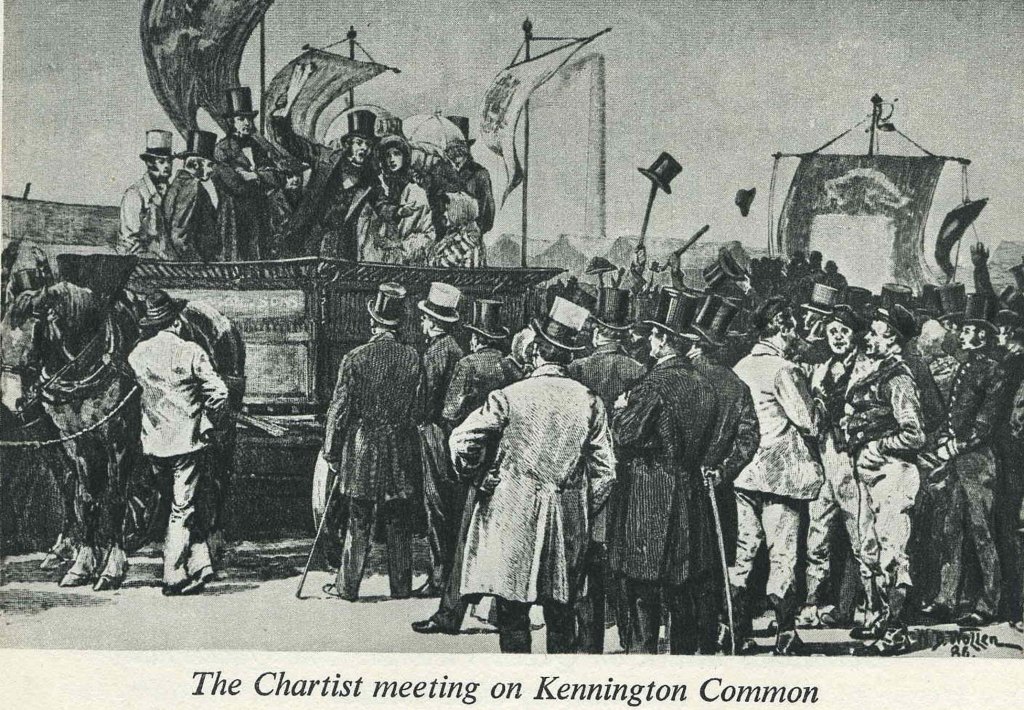
*1870c:Germany before unification
*1871:Germany unified
*1890:Punch cartoon depicted Kaiser Wilhelm "putting down the pilot" [Bismarck]
|
|
|
|
|
|
|
|
|
|
|